

Last Updated on May 12, 2026 by Alex
Hi there, Alex is on the line. If you are reading this text, it means you are considering Belgium not just as a country for tourism, but as a place for a serious career breakthrough.
The EU Blue Card is the “gold standard” for highly qualified specialists. The most important thing to know: in Belgium, the right to work and the right to reside are combined into a single document — the Single Permit. The process might seem complicated due to the country’s regional division, but if you put everything on the shelves, the algorithm becomes transparent.
Let’s continue. In this section, we ground the theory and move on to specific figures and articles of the law. For Google E-E-A-T, it is critically important that the data is confirmed by official sources.
Blue Card Requirements in Belgium 2026: Salary, Education, and Criteria
Many people confuse the standard Single Permit for highly qualified specialists with the Blue Card. The main difference lies in the level of mobility and the specific legal requirements. If you are aiming for a Blue Card, your indicators must meet the criteria enshrined in the Law of April 30, 1999, and current regional regulations.
To get a broader perspective on the legal framework, check out our comprehensive EU Blue Card in Belgium guide covering all 2026 updates.
Minimum Salary for a Blue Card in 2026
The salary threshold is the first thing an inspector looks at. In Belgium, these figures are indexed every year. From January 1, 2026, new requirements for annual income (gross, including the 13th-month salary and holiday payments) came into force.
Important: There is no single figure for the whole country in Belgium — the threshold depends on the region where your employer is registered.
| Region | Minimum Salary (EU Blue Card 2026) | Official Resource |
| Flanders | €63,586 per year | Vlaanderen.be |
| Brussels | €4,748 per month (~€56,976/year) | Economy-Employment Brussels |
| Wallonia | €68,815 per year | Wallonie.be / Le Forem |
Note: For young specialists (under 30 years old) or graduates of Belgian universities, reduced thresholds may apply in some regions, but for the classic Blue Card, the primary benchmark is the figures above.
Accurate financial planning is key, so make sure to review the latest EU Blue Card Belgium salary thresholds to ensure your contract meets regional requirements.
Education Requirements and Degree Recognition in Belgium
The Blue Card is issued only to those who have confirmed their “high qualification.” According to the directive EU Blue Card Recast (2021/1883), the requirements have become more flexible, but the core remains the same:
- Diploma: A Bachelor’s degree or higher is required (minimum 3 years of study).
- Compliance: Your specialty according to the diploma must correlate with the position in the employment contract.
- Recognition: For a Single Permit application, a translation and an apostille are often sufficient. However, if your profession is regulated (doctor, engineer, architect), full confirmation of qualifications through regional profile bodies will be required.
Is full degree recognition in Belgium necessary? Usually, an apostille and translation are enough. But if your profession is regulated (for example, a doctor or an architect), you cannot do without equivalence through NARIC.
Blue Card vs. Ordinary Single Permit: Why is it beneficial?
“Alex, why do I need a Blue Card if the salary threshold is higher?” — this is a frequent question. The answer lies in the rights you receive after 2 years:
- Free Access to the Labor Market: After 24 months of working in Belgium on a Blue Card, you can change your employer without the need to receive a new “approval” from the regional Ministry of Labor.
- Intra-European Mobility: Directive 2021/1883 allows you to move to another EU country (for example, Germany) under a simplified scheme after only 12 months of stay in Belgium.
- Simplified Family Reunification: Family members receive the right to work in Belgium automatically and without additional labor market tests.
The employment contract must be concluded for a period of at least 6 months. This is a key change of 2026 — previously, at least a year was required.
In the next section, we will analyze a step-by-step algorithm: how to submit documents through the Working in Belgium portal and how much time the wait actually takes.
Step-by-Step Algorithm: From Job Offer to Single Permit
The entire process is centered on the Working in Belgium platform. This is a “one-stop shop,” but behind the scenes, the application goes through two stages: regional (right to work) and federal (right to residence).
Step 1: Payment of the Administrative Fee (Contribution Fee)
Before the system accepts your file, the government fee must be paid. In 2026, the requirements have become more stringent.
- Cost: €377 (valid as of May 2026 for highly qualified specialists and Blue Card applicants).
- How to Pay: Bank transfer to the account of the Immigration Office (Office des Étrangers). The employer obtains the payment details here.
- Important: Without a payment receipt uploaded to the system, the application is considered invalid.
Step 2: Submission via the One-Stop Counter
The employer logs into the Working in Belgium portal and uploads the document package.
- Application Destination: The system automatically determines the region based on the company’s office address.
| Region | Responsible Authority | Physical Address |
| Flanders | Department of Work and Social Economy | Ellipse Building, Koning Albert II laan 35, 1030 Schaerbeek |
| Brussels | Brussels Economy and Employment | Place Saint-Lazare 2, 1035 Brussels |
| Wallonia | SPW Économie, Emploi, Recherche | Place de la Wallonie 1, 5100 Jambes (Namur) |
Step 3: Processing: Timelines and Monitoring
- Official Timeline: Up to 90 days.
- Practical Reality: Flanders currently processes Blue Card applications in 4–6 weeks, while Brussels takes 6–8 weeks.
- How to Check: The employer sees the status in their personal account on Working in Belgium. You can track the status of your specific part (residence) using your case number on the Office des Étrangers website.
Step 4: Receiving Annex 46 and Visa D
Once both authorities (Labor and Immigration) grant their approval, Annex 46 is generated. This is a PDF file featuring a QR code.
- What You Need to Do: Print Annex 46 and book an appointment at the Belgian consulate or visa center (VFS Global) in your country.
- Visa Type: National Category D Visa.
- Visa Cost: Approximately €180 (consular fee) + the visa center service fee.
Alex’s Advice:
If you are already in Belgium legally (for example, on a job search or student visa), you do not need to leave. You submit Annex 46 directly to your local municipality (Stadhuis / Maison Communale) to replace your current ID card with a Single Permit.
Useful Contact Information:
If your application is “stuck,” you can try to clarify the status by calling these numbers (strictly between 9:00 AM and 12:00 PM Brussels time):
- Brussels: +32 (0)2 204 13 99
- Flanders: +32 (0)2 553 43 00
- Wallonia: +32 (0)81 33 43 92
While the Single Permit application process in Belgium became almost entirely digital in 2026, the human factor in regional ministries remains. Next, we will discuss how to assemble a document package so that the inspector won’t even think about clicking the “Refused” button.
Required Document Package: Expert Checklist
The entire package is divided into two parts: what the company prepares and what falls on your shoulders. Remember that for a Single Permit, all documents for a Blue Card in Belgium must be either in English or in one of the official state languages (French, Dutch, or German).
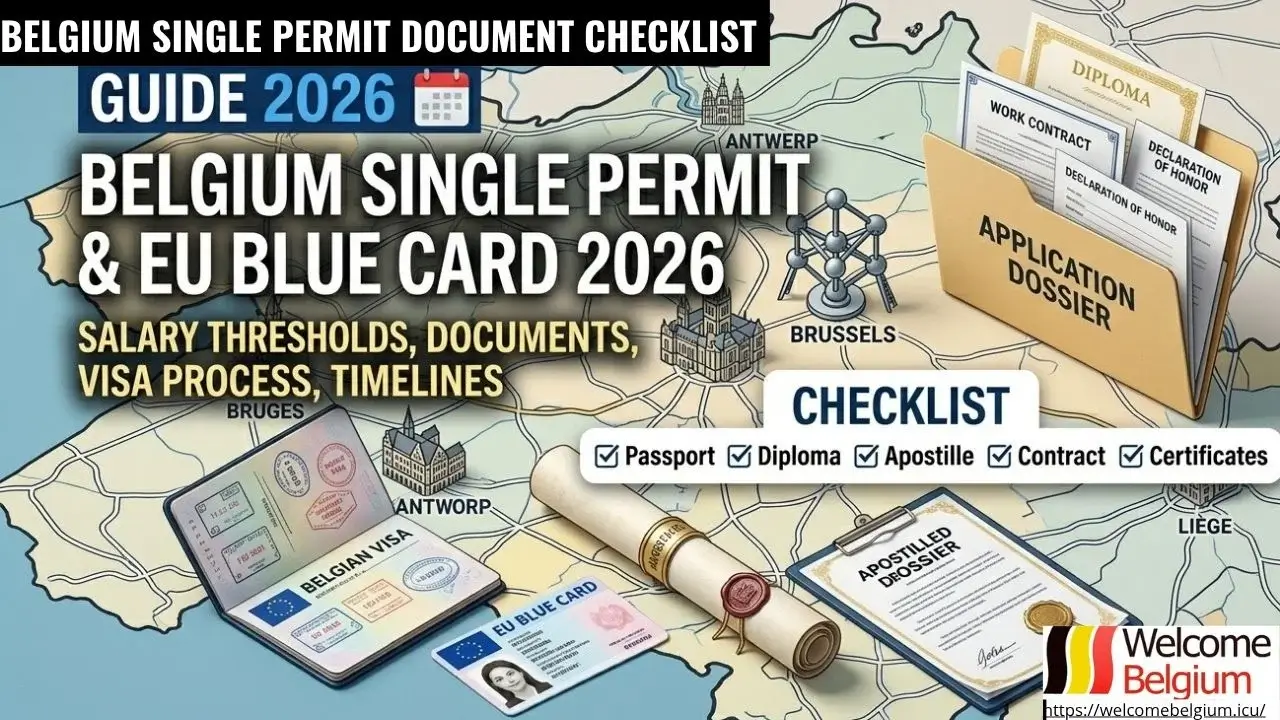
Documents from the Employee (Your Area of Responsibility)
- 1. International Passport. Copies of all pages (even blank ones). The passport must be valid for at least another 12 months.
- 2. Higher Education Diploma. Original + apostille + notarized certification and translation.
- Important. The apostille is placed in the country where the diploma was issued. Without it, the document is just paper to the Belgian authorities.
- 3. Police Clearance Certificate. Must be issued no more than 6 months prior to submission. An apostille and translation are also required.
- 4. Medical Certificate for a Belgian Visa. This is a specific form.
- Where to get it. From a doctor accredited by the Belgian Embassy in your country. If there are none in your country, any general practitioner will do, but the certificate will have to be legalized.
- 5. Proof of Fee Payment. That very receipt for €377 I mentioned above.
Documents from the Employer
- 1. Employment Contract. Signed by both parties, indicating a salary not lower than the regional Blue Card threshold.
- 2. Special Annex to the Contract. In Belgium, this is often called an “Annex” to the employment agreement, which details the working conditions specifically for a foreign specialist.
- 3. Proof of the Company’s Solvency. Tax certificates and statements proving that the firm can pay you the declared salary.
Alex’s Advice:
If you are translating documents, do it with a sworn translator (traducteur juré). Google and ordinary translation bureaus won’t work here — the Migration Service (Office des Étrangers) is extremely fastidious regarding terminology.
Emphasis on Legalization: Apostille and Translation
Translating documents for a Single Permit is not just about changing the language.
- Apostille First, Then Translation: This is the golden rule. If you translate a diploma and then get it apostilled, the translation will have to be redone because the apostille stamp must also be translated.
- Validity Period: A police clearance certificate “lives” for six months, while a medical certificate lasts only 3 months. Plan your time so that the documents are “fresh” by the time they are submitted through the portal.
What You Will Receive in the End:
If the package is assembled correctly, the finale of all this paperwork will be Annex 46 (an attachment to the contract), which will be sent to your employer’s personal account. This is your permit. With it, you request a Visa D, which is stamped into your passport in 3–5 business days.
Ready for the nuances? In the next section, we will break down how rules differ in various parts of Belgium and why Flanders might be more advantageous for an IT specialist than Wallonia.
Regional Characteristics: Flanders vs. Brussels vs. Wallonia
In 2026, Belgium took a big step toward digitalization by moving almost all processes to the Working in Belgium platform. However, the “back-end” (the people who actually check your documents) is different for each region.
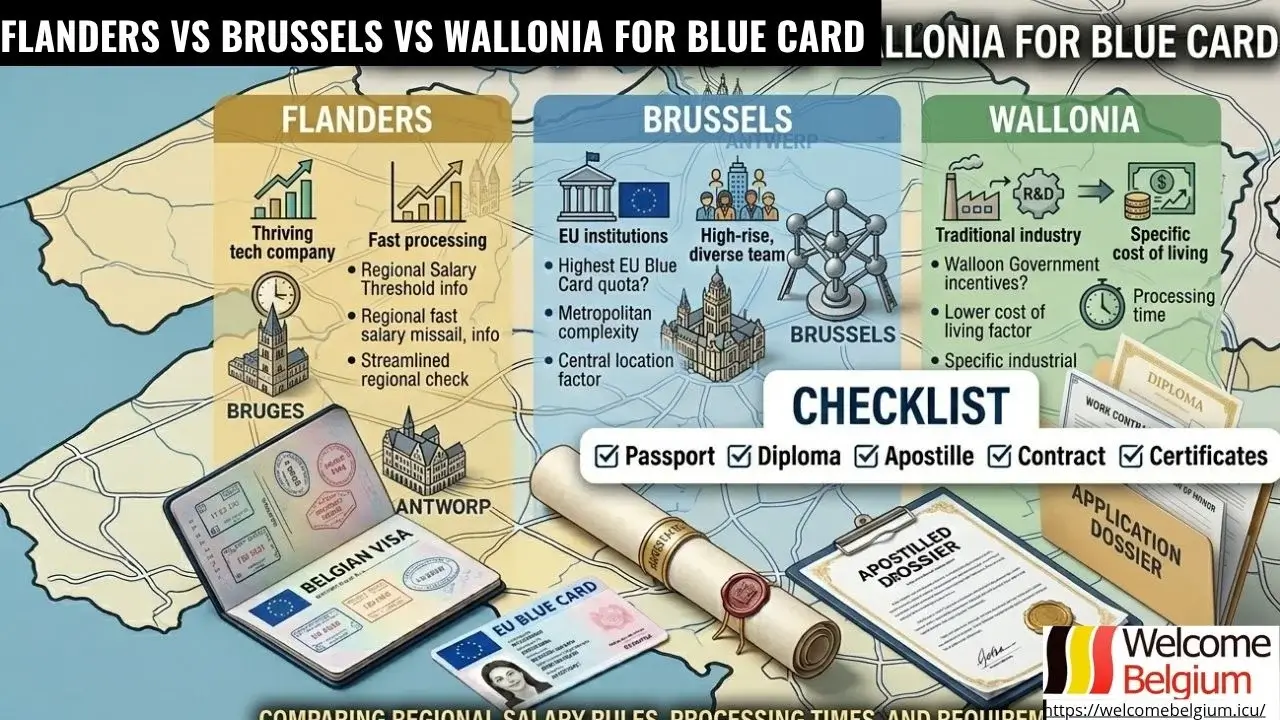
Blue Card Processing Times in Belgium: Where Are Applications Approved Faster?
If time is critical for you, the choice of region can be a decisive factor.
- Flanders. The undisputed leader in speed. Since January 4, 2026, an updated portal was launched here through Flanders Innovation & Entrepreneurship. Flanders has implemented a “fast-lane” system, thanks to which correctly submitted Blue Card Flanders applications are approved on average in 15–30 days. This is the best indicator in the country.
- Brussels. The capital remains the most congested. Despite reforms to the Brussels Economy and Employment portal, the real processing time here is 6–8 weeks. Brussels strictly monitors compliance with the monthly salary threshold, allowing not even the slightest deviations.
- Wallonia. Traditionally a calmer region. The SPW Économie, Emploi, Recherche portal works stably, with timelines around 4–6 weeks. But be careful: Wallonia has the highest salary requirements for the Blue Card in 2026.
Regional Single Permit Requirements: Why Company Registration Matters
Your Single Permit is tied to the region where your company conducts its economic activity. This affects not only the submission portal but also regional quotas and shortage occupation lists (although shortage lists aren’t critical for the Blue Card, they show the region’s general loyalty to migrants).
| Parameter | Flanders | Brussels | Wallonia |
| Submission System | Full Digital (WIB) | Transition Period (WIB) | Transition Period (WIB) |
| Speed (Blue Card) | High (from 15 days) | Medium (6-8 weeks) | Medium (4-6 weeks) |
| Salary Threshold 2026 | €63,586 (per year) | €4,748 (per month) | €68,815 (per year) |
Features of Immigration to Belgium by Region: Technical Nuances 2026
As of May 2026, all three regions have switched to mandatory digital submission. Previously, in Wallonia and Brussels, you could send documents by e-mail — forget about that. Now your employer must be registered in the Crossroads Bank for Enterprises (CBE); otherwise, they simply won’t get access to the system.
Alex’s Notes:
If your employer is an international company with an office in Brussels but you will be working at a site in Flanders, clarify through which department the submission will go. Sometimes a 2-week difference in waiting is worth double-checking the documents.
If you are an IT specialist and you have two equal offers from Antwerp (Flanders) and Brussels, know this: in Flanders, you will likely receive your ID card a month earlier.
Rights and Mobility: What Does the EU Blue Card Offer After 1–2 Years?
Obtaining a Single Permit is only the beginning. The true value of the Blue Card reveals itself after the move. Here are the three main bonuses that make this status more advantageous than a standard work visa:
- Changing Employers: During the first 12 months, you are tied to a specific employer. After 12 months, you can change companies (meeting Blue Card criteria), and after 24 months, you gain unrestricted access to the labor market.
- Intra-European Mobility: According to Directive 2021/1883, after 12 months of legal residence in Belgium, you have the right to move to another EU country for work under a simplified scheme.
- Family Reunification: Partners receive a residence permit with an automatic right to work. In 2026, simultaneous application for the specialist and family is standard via the portal.
Alex’s Note: The ultimate “prize” is the L-card (Permanent Residency). Years lived under a Blue Card in different EU countries are cumulative.
FAQ: Answers to Frequent Questions About the Single Permit
Can I apply while in Belgium on a different visa?
Yes. If you have a valid residence permit (e.g., student or search year), your employer submits a request via Working in Belgium. After approval, you exchange your card at the local municipality without leaving the country.
What should I do if the salary is slightly below the threshold?
Look for a compromise with your employer to increase the gross rate. Even a minimal deviation guarantees a Single Permit refusal.
Do I need a lawyer's help?
Immigration consultation is only necessary in complex cases, such as replacing a diploma with work experience or filing an appeal.
When should I start renewing the permit?
Start 3–4 months before your current permit expires. In 2026, permit renewal is done entirely online.
Understanding your gross salary is just the first step; you should also investigate expat taxes in Belgium to calculate your actual take-home pay.
Summary and Useful Links
To successfully obtain a Blue Card in 2026, you need a recognized diploma (3+ years), a contract of at least 6 months, and a salary above the regional threshold.
Official Belgian Websites:
- Working in Belgium — the main application portal.
- be — the portal for Flanders.
- Economy-employment.brussels — the portal for Brussels.
- be — the portal for Wallonia.
Final recommendations and detailed algorithms for all visa types: Guide to Immigration to Belgium.
Disclaimer
The information in this article is provided solely for informational purposes and does not constitute legal advice. We recommend checking current data on official government portals before submitting documents.


I am looking to relocate from UAE to Belgium. What is the best option I have 17 years strong in retail and logistics. I want to work in Belgium.
Hi! 17 years in retail and logistics is a massive asset, but relocating from the UAE to Belgium requires a clear understanding of European immigration rules and how the local job market is split.
Since you are applying from outside the EU, your main goal is to find an employer willing to sponsor your visa. Here are your three best options based on your background, along with a few reality checks:
1. The Logistics Track via Single Permit (Most Realistic)
Belgium (especially the Flanders region) is the logistics heart of Europe due to the Port of Antwerp and Brussels Airport. Roles like Logistics Manager, Supply Chain Analyst, or Warehouse Director frequently land on the regional “shortage occupations” lists (knelpuntberoepen).
The Benefit: If the role is on this list, the work permit approval process for non-EU citizens is fast-tracked. You can check out how this process works in our comprehensive guide: Single Permit in Belgium: Step-by-Step Application Process.
Note on Retail: General retail management (store manager, etc.) is rarely sponsored because there are enough local candidates. Focus your job search strictly on B2B logistics, e-commerce operations, or supply chain roles.
2. EU Blue Card (For Senior Management)
If your 17 years of experience put you at an executive or senior director level, look into the EU Blue Card.
The Criteria: You need a signed contract for at least 6 months, a relevant higher education degree, and a gross annual salary above the official Belgian threshold (which is indexed yearly, usually around €55,000–€60,000+ depending on the region).
3. Intra-Corporate Transfer (ICT Permit)
Since you are in the UAE, where major global players (DHL, FedEx, Amazon, Kuehne+Nagel, Majid Al Futtaim) have massive hubs, the safest route is to get hired by a multinational company in Dubai/Abu Dhabi and then request an internal transfer to their Belgian office. This bypasses the standard labor market testing.
⚠️ Reality Checks for UAE Expats:
Language: For logistics hubs, English is the corporate language. However, if you want pure retail operations, speaking French or Dutch is non-negotiable in 90% of cases. Stick to international supply chain vacancies.
The Tax Shock: In the UAE, you are used to tax-free salaries. In Belgium, income tax is progressive and among the highest in the world—expect around 45–50% of your gross salary to go to taxes and social security. Always use a Belgian “Gross to Net” salary calculator before signing an offer!
Next Steps:
Tailor your CV to the European format (remove photos and marital status), set your LinkedIn location to Belgium, and check local job portals like Indeed.be or VDAB (Flanders).
Once you secure an offer and arrive, the paperwork starts. To help you hit the ground running, we have prepared detailed, step-by-step guides for new expats right here on our website. Make sure to bookmark them:
First, you’ll need to register at your local town hall—here is how it works: City Hall Registration (Anmeldung) in Belgium.
Next, you must set up your mandatory health insurance: How to Choose and Register with a Mutuelle.
To get the most out of local healthcare and link up with a family doctor, read this: Opening Your Dossier Médical Global (DMG).
If you are moving with family or students, you might also need this: Annex 32: Everything About Visa Sponsorship.
Good luck with your relocation journey!
Alex