
Last Updated on May 17, 2026 by Alex
The Belgian healthcare system is widely recognized as one of the most efficient in the EU, yet its operation is strictly regulated. For any foreign national planning a long-term stay in the Kingdom, health insurance in Belgium is not just a formality—it is a mandatory requirement for legal residency. Without proper registration with a local health insurance fund (known as a mutuelle or ziekenfonds), a migrant carries full financial risk: the cost of medical services without state coverage here is critically high.
For expats, employees, and individuals applying for temporary protection status, integration into the Belgian healthcare system is standardized. Whether you are obtaining an EU Blue Card or arriving on a standard employment contract, compulsory health insurance in Belgium guarantees the reimbursement of most medical expenses. As an expert for this platform, I, Alex, will break down the system’s regulatory framework, the exact cost of services for 2026, and a step-by-step registration algorithm to optimize your expenses.
Health Insurance Law in Belgium: The Legal Framework
The foundation of local healthcare is the statutory health insurance law in Belgium. The primary regulatory act is the Law of July 14, 1994 on compulsory insurance for medical care and benefits (Loi relative à l’assurance obligatoire soins de santé et indemnités / Wet betreffende de verplichte verzekering voor geneeskundige verzorging en uitkeringen). This law establishes that compulsory health insurance in Belgium applies to all legal residents, including foreigners holding a residence permit (VNR/VNJ).
Official Sources and Belgian Legislation:
| Regulatory Act / Resource | Number and Official Title (FR / NL) | Link to Official Source |
| Primary Health Insurance Law | Law of July 14, 1994 / Loi relative à l’assurance obligatoire soins de santé et indemnités / Wet betreffende de verplichte verzekering voor geneeskundige verzorging en uitkeringen | Moniteur Belge (Official Gazette) |
| Official Portal of the Regulator | INAMI / RIZIV (Institut national d’assurance maladie-invalidité / Rijksinstituut voor ziekte- en invaliditeitsverzekering) | Official INAMI Website |
| Social Security Code (Statutes Database) | Code de la sécurité sociale / Code van de sociale zekerheid | Belgian Federal Portal (Social Security) |
State regulation and coordination are managed by INAMI / RIZIV (National Institute for Health and Disability Insurance). This body reports directly to the Ministry of Social Affairs and Public Health. The law requires every resident to personally register with one of the approved funds (mutuelles) to activate their healthcare rights.
Key Functions and Responsibilities of Belgian Supervisory Authorities:
- Budgetary Control: INAMI allocates state funds among the various insurance providers.
- Price Fixing: The authority approves a uniform price nomenclature for medical consultations, procedures, and pharmaceuticals.
- Accreditation: The regulator maintains the official registry of recognized mutual insurance funds (mutuelle / ziekenfonds).
Violating these regulatory requirements or ignoring registration deadlines deprives a foreigner of the right to state subsidies for medical treatment. Without official enrollment in the system, any medical assistance will be billed exclusively at full commercial rates.
Tip from Alex:
Having a signed employment contract automatically obligates you to pay social security contributions (ONSS). However, the law does not automatically enroll you in the medical system. To activate your coverage, you must personally submit your documents to your chosen mutuelle. Do this within your first week after receiving your Annexe or eID.
How Compulsory Health Insurance Works in Belgium: Mutuelle and Co-payments
The mechanics of compulsory health insurance in Belgium are based on a reimbursement system. When you visit a doctor or buy prescription medication, you do not receive the service entirely for free up front. The state system, via your chosen fund, covers the majority of the costs, but the patient always contributes a certain percentage out of pocket.
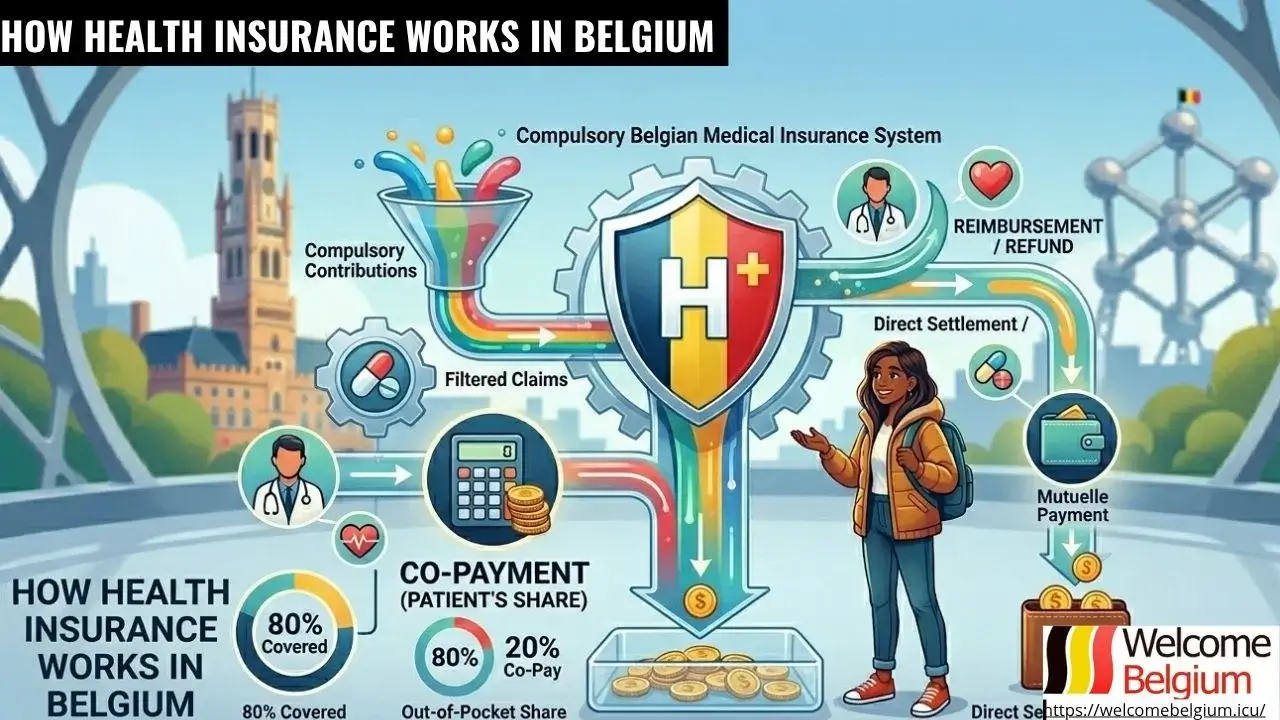
This fixed, non-refundable share of medical expenses is called the ticket modérateur (co-payment). Its exact amount is regulated by the state, and basic coverage typically ranges from 50% to 75% of the service cost. To easily track rates and calculate costs, I recommend using the official calculator on the Ma Santé / Mijn Gezondheid portal, where the official price for every procedure is logged.
To comply with the law, residents must choose the specific framework through which their reimbursements will be processed:
- Belgian Mutuelles (Mutuelle / Ziekenfonds): These are independent mutual insurance funds (e.g., Partenamut, CM, Helan). For a small monthly membership fee (around €10–€15), they offer not only the mandatory basic coverage but also additional perks: discounts on gym memberships, eyewear, dental care, or summer camps for children. If you prefer premium private coverage, providers like DKV Belgium also offer supplementary insurance policies.
- CAAMI / HZIV Funds: This is the public, state-run alternative to commercial funds. Enrollment and membership here are entirely free (there are no monthly fees), but this comes with a few strict administrative conditions and limitations:
- Limited Coverage: The fund covers only the statutory mandatory medical minimum. You will not receive any extra perks or subsidies (such as discounts on optics, dental implants, psychotherapy, or children’s camps).
- Processing Mechanics: Unlike large commercial mutuelles that offer advanced digital services, dealing with CAAMI can often take longer when it comes to processing documents and medical expense refunds.
- Who is it for?: This solution is optimal for those who want basic medical security without extra costs, strictly follow system guidelines, and do not require extended medical perks.
For vulnerable groups, additional social aid and healthcare guidance can be coordinated via local CPAS / OCMW offices.
Regardless of your choice of fund, the quality and speed of emergency medical care in hospitals remain identical, as basic medical services are regulated by the same overarching legislation. Your choice between a commercial mutuelle and the free CAAMI depends entirely on your need for additional health and wellness services. If you or your children require regular visits to specialists, new glasses, or sports club renewals, a classic fund membership quickly pays for itself.
Important:
For the majority of expats, a standard paid mutuelle is more financially viable. The reimbursement for a fitness club membership or an annual dental cleaning alone completely offsets the annual cost of the fees. However, if your budget is very tight, feel free to register with CAAMI—you will still receive the basic safety net in full.
Health Insurance for Employees and EU Blue Card Holders in Belgium
For salaried employees and highly qualified professionals, integration into the healthcare system is heavily automated, yet it still requires personal action at the final stage.
How Social Security Contributions Work
The moment you sign an employment contract, mandatory taxes and contributions are deducted from your gross salary.
- The Collecting Body: The National Social Security Office — ONSS (Office National de Sécurité Sociale), operating under the Law of June 27, 1969.
- What It Grants: These payroll deductions grant you the right to medical coverage, but they do not automatically register you with a specific clinic or health insurance fund.
The Employee’s Duty and the Blue Card
Statutory health insurance for employees in Belgium will not activate until you manually select a fund (mutuelle).
While you are navigating the EU Blue Card application process in Belgium and waiting for your official contract, you may need a temporary private policy (such as Feather or AXA Expat). However, as soon as your employment is confirmed, you are legally obligated to register with a mutuelle to activate your rights under the Law of July 14, 1994.
Maintaining valid EU Blue Card health insurance in Belgium is a strict requirement by immigration services to preserve and extend your residence permit status.
Extra Protection: Hospitalization Insurance
Beyond the basic public policy, commercial hospitalization insurance in Belgium (Assurance hospitalisation) is critical for expatriates. The state system covers hospital ward stays only partially.
Major Belgian corporations usually include this option as a standard benefit in their corporate social package. If your employer does not provide it, you should purchase a policy independently from specialized operators:
- AG Insurance
- DKV Belgium
- An extended package within your current mutuelle.
You can always verify the status of your social security contributions and review data submitted by your employer online via the official Social Security Belgium federal portal.
Tip from Alex:
When I signed my first contract in Brussels, I didn’t review the benefits package closely enough and missed the fact that my employer was already covering my Assurance hospitalisation. As a result, I unknowingly duplicated the service and paid for it twice—once via my company’s corporate package and again out of pocket to my mutuelle. Always demand a detailed breakdown of the medical risks covered in your benefits package from your HR department.
Which Mutuelle to Choose in Belgium: Rating of the Best Health Insurance Funds for Foreigners
To save you from manually translating the websites of dozens of providers, I have compiled an independent rating of the five largest and most popular health insurance funds in the Kingdom for 2026.
Summary Table: Comparison of Belgium’s Largest Mutuelles:
| Health Insurance Fund (Mutuelle) | Regional Coverage | Est. Monthly Contribution | Main Feature / Specialization | Ideal Match For |
| Partenamut | Brussels & Wallonia | ~ €14.75 | Best English mobile app & advanced digitization | Expats and IT professionals in French-speaking regions |
| Helan | Flanders & Brussels | ~ €13.25 | Strong focus on young families & sports benefits | Families with children and expats in Flanders |
| Christian Mutuality (CM) | Nationwide | ~ €10.00 | Largest network of physical branches in the country | Those prioritizing face-to-face visits and a low membership fee |
| Solidaris | Nationwide (Regionally split) | ~ €12.50 – €14.00 | High subsidies for eyewear & newborn birth grants | Locals and those needing specific regional assistance |
| CAAMI / HZIV | Nationwide | €0.00 | Absolutely free state-run basic mandatory minimum | Budget-conscious immigrants with no specialized requests |
1. Partenamut (Partena)
One of the most progressive and digitized funds, primarily serving Brussels and the French-speaking part of the country.
- Operational Profile: Nearly all administration is handled online. The fund is highly accommodating to expats and provides a wealth of information in clear English.
- Advantages (Pros):
- Excellent Mobile App: Medical receipts and hospital stamps can be scanned directly via a smartphone camera, with reimbursements processed within 2–3 days.
- High Sports Cashback: Up to €95 per year in rebates for gym memberships or sports club fees.
- Great Support: An efficient customer service team capable of managing queries from foreigners in English without issue.
- Disadvantages (Cons):
- One of the highest monthly membership fees in the market.
- Restricted native presence in Flanders (where they operate under the companion brand Helan).
- Contacts:
- Official Website: be
- Hotline: +32 2 444 41 11
- Head Office: Boulevard Louis Mettewie 74-76, 1080 Bruxelles.
2. Helan (Ziekenfonds)
The leading technological giant in the Flemish market, formed through the merger of PartenaZorg and OZ.
- Operational Profile: This is the sister fund to Partenamut, built specifically for the Dutch-speaking region and Brussels.
- Advantages (Pros):
- Substantial Birth Benefits: Massive premium payouts and support packages upon the birth of a child (including equipment rentals and home help).
- Great Optical & Mental Health Coverage: Up to €50 per year for glasses or contact lenses, alongside solid reimbursements for psychotherapy sessions.
- Paperless Workflow: A fully integrated personal online portal for all document processing.
- Disadvantages (Cons):
- Primary communications and interfaces default to Dutch (English assistance exists, but the depth of support is slightly lower than Partenamut).
- Contacts:
- Official Website: be
- Hotline: +32 2 218 22 22
- Head Office: Boomsesteenweg 5, 2610 Antwerpen.
3. Christian Mutuality (CM / Christelijke Mutualiteit)
The largest and most historically established mutual insurance fund in Belgium, covering millions of insured individuals.
- Operational Profile: A conservative, highly stable, and reliable framework backed by a massive federal budget.
- Advantages (Pros):
- Affordable Membership Fee: Low monthly cost hovering around ~ €10.00.
- Unrivaled Physical Footprint: Physical branches and dedicated vignette drop-boxes can be found in virtually every town and major village across Belgium.
- Extensive Network: Direct access to their own convalescent homes, rehabilitation centers, and youth care programs.
- Disadvantages (Cons):
- Slower digital transition. The mobile app lags behind modern competitors in user experience, and the manual verification of paper receipts can take up to 3 weeks.
- Contacts:
- Official Website: be
- Hotline: +32 2 246 41 11
- Head Office: Rue de la Loi 121, 1040 Bruxelles.
4. Solidaris
A large association of socialist health insurance funds divided into two autonomous regional wings: Solidaris Wallonie and Solidaris Vlaanderen.
- Operational Profile: Historically founded to support the working class, this fund maintains incredibly strong protections for patient rights and chronic illness support.
- Advantages (Pros):
- Pharmacy Discounts: Favorable reduced pricing structures when buying prescription medications within Solidaris’s own pharmacy networks.
- Specialized Care Schemes: Quality subsidized care programs for senior citizens and individuals with disabilities.
- Solid Baseline Cashbacks: Generous payouts for routine dental examinations and pediatric medicine.
- Disadvantages (Cons):
- Due to the rigid separation between regions (Wallonia vs. Flanders), moving your legal residence from Brussels to Antwerp forces you to re-register and re-file documents within the regional Solidaris structure.
- Contacts:
- Official Website: be
- Hotline (Brussels): +32 2 506 96 11
5. CAAMI / HZIV (Caisse Auxiliaire d’Assurance Maladie-Invalidité)
The only purely state-run public body in Belgium that carries out the functions of a health insurance fund without commercial add-ons.
- Operational Profile: This public fund provides strictly what is outlined by the federal INAMI law under the Law of July 14, 1994. No marketing, no advertising campaigns, and no lifestyle bonuses.
- Advantages (Pros):
- Zero Membership Cost: The monthly contribution is €0.00. You do not pay a single cent for basic enrollment.
- Budget Friendly: An excellent temporary solution for newcomers who have just arrived in the country and need to tightly control early relocation outlays.
- Disadvantages (Cons):
- No extra services. Forget about reimbursements for fitness clubs, summer camps, complimentary dental kits, or discounts on prescription glasses.
- The administrative workflow is heavily paper-based and considerably slower.
- Contacts:
- Official Website: caami-hziv.fgov.be
- Hotline: +32 2 229 35 00
- Head Office: Rue du Trône 30-32, 1000 Bruxelles.
Tip from Alex:
If you are relocating to Brussels or Wallonia alone on an employment contract and value your time, go ahead and choose Partenamut. If you are moving to Flanders with your family, sign up with Helan. You will easily recover the extra few euros a month with your very first reimbursements for a fitness club membership or prescription sunglasses. Storing stacks of paper files with the free CAAMI is only worth it if you are absolutely certain that you will never use commercial “perks” and lifestyle cashbacks.
Health Insurance in Belgium for Refugees and Beneficiaries of Temporary Protection
Belgian legislation guarantees baseline medical rights for vulnerable categories of migrants. This applies to asylum seekers (refugee status) as well as individuals arriving under humanitarian missions, including Ukrainians holding a valid A card (Carte A).
The Role of Social Services: CPAS / OCMW
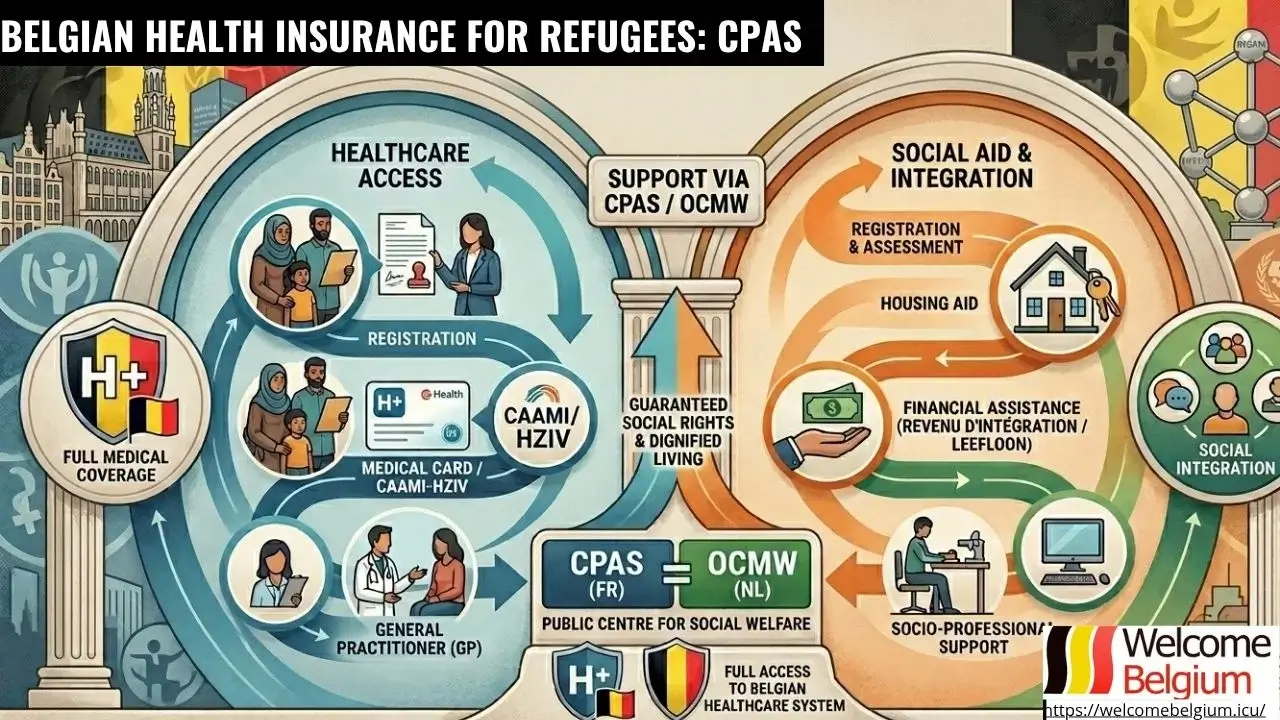
The primary bridge between a newcomer and the healthcare system during the initial integration phase is the Public Center for Social Action—known as CPAS in French or OCMW in Dutch. This institution operates strictly under the Organic Law of July 8, 1976 on Public Centers for Social Action.
This institution operates strictly under the Organic Law of July 8, 1976 on Public Centers for Social Action. To better understand how this support structure functions and handles newcomer integrations, you can review our comprehensive guide on the CPAS / OCMW social assistance system in Belgium.
The social service agency provides financial coverage for migrants across two main pathways:
- For Asylum Seekers: The agency issues a referral for Urgent Medical Assistance—Aide médicale urgente (AMU). This ensures that emergency medical costs are covered directly by social services, saving the patient from out-of-pocket expenses during acute or life-threatening conditions.
- For Persons Under Temporary Protection (A Card Holders): The CPAS helps legally set up a membership with a mutuelle. Subject to case review and approval, the social service may cover monthly membership fees and the mandatory co-payment (ticket modérateur), minimizing the migrant’s personal medical expenses.
How to Activate Your Medical Coverage
To activate health insurance for refugees in Belgium, you must first complete verification at the local commune of your actual residence. You can locate the address and contact details of your local branch, as well as review subsidy eligibility criteria, on the official federal portal SPP Intégration sociale.
Once a social worker approves your file, your data is automatically synchronized with the central eHealth database. At this stage, your health care integration under temporary protection in Belgium is complete: when visiting a doctor, simply present your A card or the official certificate issued by the CPAS to receive discounted rates.
If you require scheduled non-emergency treatments or complex surgeries, CPAS medical assistance in Belgium mandates a prior written approval (billing consent) from your assigned caseworker.
Critical Warning:
A common and costly mistake among newly arrived migrants is booking routine medical appointments immediately after receiving their A card, without waiting for the written decision from the CPAS. Social services do not cover medical expenses retroactively. You must first obtain an official consent form (réquisition) from your social worker before scheduling an appointment at a clinic.
2026 Changes in Belgian Health Insurance: Taxes and Digitization
The Belgian healthcare system undergoes regular optimizations. Keeping track of annual legislative amendments is highly recommended, as they directly impact your household budget. In 2026, key updates in Belgian healthcare focused on insurance premium taxation and deep digital service integration.
Increase in Insurance Premium Tax
The primary financial update of the year stems from the government’s deficit reduction package approved under the Federal Budget Framework for 2026–2029.
- Legal Mechanism: Amendments have been introduced to the Code of Taxes Assimilated to Income Taxes (Code des taxes assimilées aux impôts). The standard tax on insurance operations for health and property contracts has officially risen from 9.25% to 60%.
- Effective Date: This change took effect on April 1, 2026, and applies to all insurance premiums due on or after this date.
- The Impact: This adjustment has led to an automatic, minor increase in the monthly cost of a mutuelle in Belgium for 2026. The increase affects most supplementary commercial insurance contracts, including popular hospitalization policies (assurance hospitalisation) like those offered by DKV Belgium, as well as extended dental plans.
Official breakdowns of fiscal structures can be monitored via the SPF Finances federal portal. For a broader view of your financial setup, you can also explore our detailed walkthrough regarding expat tax status and fiscal rules in Belgium to maximize your potential cost savings.
If you pay your insurance on a monthly basis, the new tax rate is already reflected in your statements. For those who paid their annual premium upfront in January, the new rates will only apply upon your next scheduled policy renewal. Official breakdowns of fiscal structures can be monitored via the SPF Finances federal portal.
Full Digitization: eHealth and Itsme
Concurrently, 2026 marks the final transition of the medical sector to entirely paperless operations under the Plan d’action interfédéral eSanté.
- Digital Prescriptions (e-prescription): Medical prescriptions have completely migrated to the federal eHealth platform via the Recip-e system. The transition period has officially concluded, and paper prescription slips are a thing of the past. Pharmacists no longer require paper forms; they pull up your digital prescription directly from the chip of your eID card or by scanning a barcode on your smartphone screen.
- Mandatory Itsme Integration: Secure patient authentication within the healthcare ecosystem is now tightly bound to the state-backed Itsme application. Without this digital identity key, you cannot log into your personal mutuelle portal, access federal health dashboards, verify reimbursement statuses, or view your electronic health records.
Official tracking tools and digital healthcare access portals are available via these federal channels:
- Monitor your active prescriptions and manage health record access rights on the central Belgian health portal: Ma Santé / Mijn Gezondheid.
- Regulations for digital prescriptions and baseline statutory coverage are maintained in accordance with the Law of July 14, 1994 by the National Institute for Health and Disability Insurance: INAMI / RIZIV.
Tip from Alex:
If you have recently relocated to Belgium and have not yet configured your Itsme account, make this your absolute top priority. Without a verified Itsme profile in 2026, you will be virtually locked out of managing your medical data and tracking reimbursements. Download the app and activate it via your Belgian bank account or at the local commune immediately after receiving your physical residence card.
How Much Does Health Insurance Cost in Belgium: Case Studies of Costs and Reimbursements
To accurately understand the financial mechanics of local healthcare, it is essential to examine specific practical scenarios. The real cost of medical services in Belgium and the depth of your coverage depend primarily on two factors: whether you have opened a Global Medical File (DMG/GMD) and the accreditation status of your doctor.
The Main Cost-Saving Tool: The DMG File
The actual price of medical services in Belgium is not rigidly static. It is regulated by base tariffs established under national collective agreements (Accord médico-mutualiste), but variations occur based on region, a doctor’s seniority, and evening or weekend surcharges.
The table below outlines approximate calculations for a standard daytime consultation with an accredited General Practitioner (GP):
| Service / Clinical Case | Estimated Cost (Base INAMI Tariff) | Approx. Mutuelle Reimbursement | Final Out-of-Pocket Cost (Ticket modérateur) | What Determines the Final Amount? |
| GP Visit (with an active DMG file) | ~ €34.00 – €36.00 | Major portion of the tariff | From €4.00 | Conventionné status, absence of evening surcharges. |
| GP Visit (WITHOUT a DMG file) | ~ €34.00 – €36.00 | Restricted coverage | From €10.00 | Absence of a registered permanent GP link in eHealth. |
| Prescription Antibiotics | ~ €15.00 – €20.00 | Varies by drug category | ~ €4.00 – €6.00 | Therapeutic importance of the medicine (Standard Category B). |
| Annual Membership (e.g., CM fund) | ~ €120.00 / year (~ €10.00/mo) | Optional perks (basic optical/sports discounts) | Entire premium amount | Fixed administrative service cost of the specific fund. |
| Annual Membership (e.g., Partenamut fund) | ~ €177.00 / year (~ €14.75/mo) | Optional perks (extended sports cashback up to €95) | Entire premium amount | Inclusions of extra commercial services and lifestyle rewards. |
Note: Pharmacy cost calculations are modeled on standard Category B medications (therapeutically essential drugs), where the state subsidy covers the baseline portion of the price automatically at the counter.
A Crucial Distinction: Conventionné vs. Non-conventionné
When evaluating how much health insurance costs in Belgium, it is critically important to verify the medical professional’s legal billing status in the INAMI / RIZIV registry:
- Conventionné (Accredited): The doctor commits to respecting the official price caps set by the medical-mutuelle national agreement. A standard daytime visit will remain within the state-mandated range (around €34.00). Under these conditions, your personal co-payment is minimized.
- Non-conventionné (Non-accredited): The specialist retains the right to charge unregulated commercial fees (suppléments d’honoraires), which can scale up significantly depending on the region or clinic’s prestige. Mandatory state health insurance will reimburse you strictly based on the standard statutory tariff—leaving you fully responsible for the entire extra surcharge.
Important Action Step:
Always verify a physician’s accreditation status before booking an appointment using the search directories integrated into your mutuelle’s website. If you do not have corporate hospitalization insurance, a single consultation with a non-accredited specialist surgeon or gynecologist can result in a hefty out-of-pocket invoice that a standard policy will not cover. Maintain financial balance and utilize the state co-payment system wisely.
How to Get Health Insurance in Belgium for Foreigners: A Step-by-Step Checklist
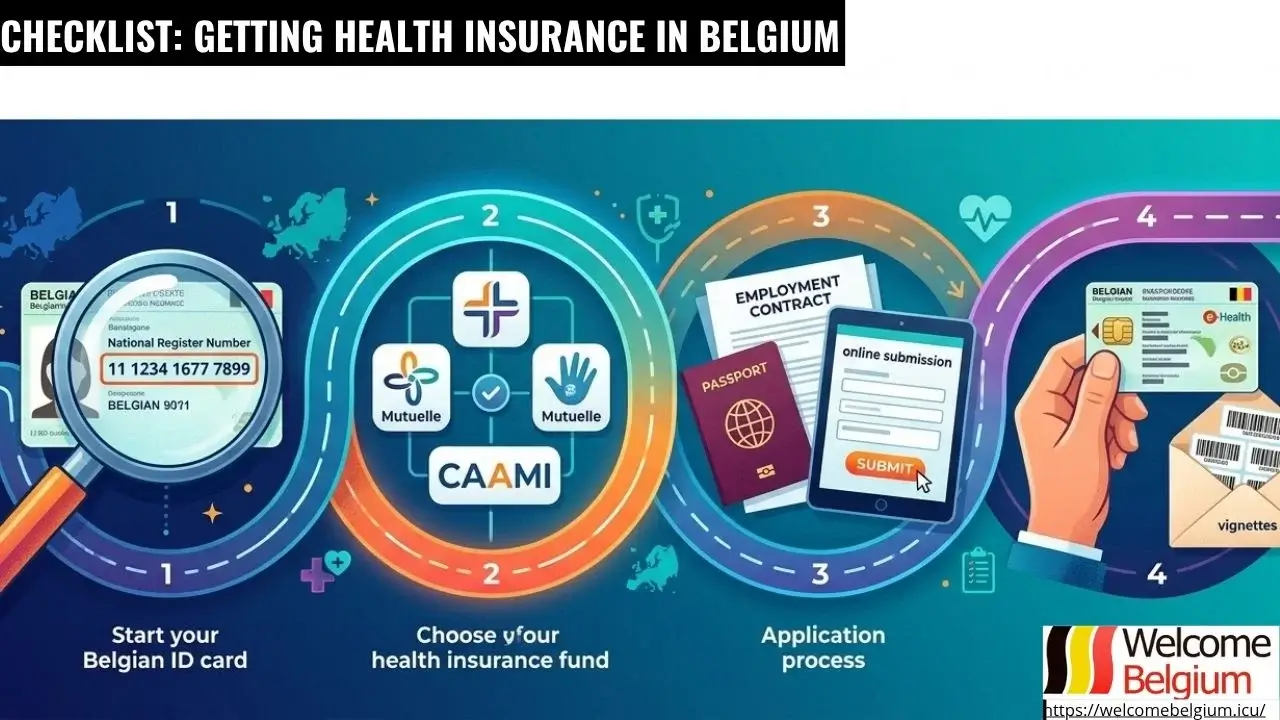
The process of integrating into the Belgian healthcare system consists of four consecutive stages. To help you set up your health insurance in Belgium as quickly as possible, I have put together a structured, actionable blueprint.
Checklist: 4 Steps to Activate Your Health Insurance
Step 1: Obtain Your National Register Number (Numéro national)
Following your initial registration at the local town hall (Commune) of your actual place of residence, you will be issued a temporary document (such as an Annexe 15 / Annexe 26) or a physical plastic electronic identity card (eID).
- What to Look For: On the back of the plastic card or within the text block of your paper document, locate a unique 11-digit tax and social security identifier known as the National Register Number (Numéro national / Rijksregisternummer).
- Why It Is Essential: Mandatory state health insurance in Belgium for foreigners cannot be activated without this identifier, as all centralized eHealth medical databases link your profile directly to this unique number.
Step 2: Choose a Health Insurance Fund (Mutuelle / Ziekenfonds)
You will need to choose from and compare the registration terms of the primary commercial insurance funds operating in Belgium:
- Christian Mutuality (CM)
- Solidaris
- Partenamut
- Helan
An alternative option is to register with the entirely free public state fund: CAAMI / HZIV.
Expert Tip from Alex:
When selecting a commercial fund, look beyond just the baseline membership fee. Verify if there are physical branch offices near your home and check the user rating of their mobile app. For Brussels and Wallonia, Partenamut is highly responsive; in Flanders, CM and Helan traditionally hold the strongest infrastructure networks.
Step 3: Prepare Your Documents and Apply
You can initiate the registration procedure online via the official website of your chosen mutuelle, or book an in-person appointment at a local office.
The base documents you will need to provide include:
- Your international passport or national ID card.
- Proof of legal residency status in Belgium (your Annexe document or a valid physical eID card).
- A copy of your employment contract (if you are an employee or an EU Blue Card holder).
- An official decision letter granting medical financial support from the social welfare services, CPAS / OCMW (if you are arriving under temporary protection or hold refugee status).
Step 4: Activate Your Profile and Receive Your Vignettes
If you select a traditional commercial fund, you must pay your first membership fee. As soon as the transaction is processed, your insurance profile and the chip on your eID card will be activated across the shared healthcare network.
Within a few business days, you will receive an envelope via regular mail containing sheeted adhesive paper labels known as vignettes. Despite total sector digitization, these stickers remain useful: you must attach them to paper medical invoices (attestation de soins donnés), independent laboratory referrals, and rare old-format prescriptions when submitting them manually to your fund’s physical drop-box for a bank refund.
Financial Parameters and Processing Times
To help you budget your finances and schedule your time effectively, I have summarized the core financial metrics and expected wait times into a quick reference table.
- Setup Costs and Monthly Fees:
- Initial Registration: Free across all insurance funds.
- Commercial Fund Fees: Ranges from ~ €9.99/month (e.g., at CM) up to ~ €14.75/month (at Partenamut) per adult. Dependent children and cohabiting relatives are covered under your account at no additional charge.
- Public CAAMI Registration: €0.00 (exempt from monthly administrative membership fees).
- Processing and Reimbursement Timelines:
- Application Processing & eHealth Sync: 3 to 7 business days from the moment a complete document packet is submitted.
- Mailing of Paper Vignettes: Up to 2 weeks for home delivery.
- Reimbursement Turnaround: Digital claims submitted via a smartphone app are processed in 2–4 business days; paper invoices dropped off with a vignette take up to 2–3 weeks.
Common Issues and How to Solve Them
Based on personal experience and feedback from other expats, I have highlighted three main obstacles foreigners face when setting up their coverage.
The Waiting Period Dilemma (Stage d’attente)
- The Issue: The insurance fund informs you that you must clear a 6-month “waiting period,” during which baseline medical reimbursements will not be paid out. This occurs if you were not previously covered by a state health insurance system within the EU prior to arriving in Belgium.
- The Solution: For EU Blue Card holders and regularly employed staff whose salaries are subject to mandatory social security deductions via the ONSS, this waiting period is waived in almost all cases. However, the mutuelle must first receive confirmation of your active tax and employment status. If you moved under a different residency track, request an S1 form from the health authority of your previous EU country to prove continuity of insurance history.
Suspended Reimbursements Due to eID Delays
- The Issue: Your temporary Annexe document expires, the commune is delayed in manufacturing your physical eID card, and your mutuelle temporarily freezes your medical payout claims.
- The Solution: Request a temporary extension certificate (Annexe 15) from your town hall. Upload a clear scan of this extension directly into your user portal on the mutuelle’s website or bring it to a local office. The fund is legally required to extend your active insurance coverage for the exact duration specified on the certificate.
Backdated Invoices Upon Retroactive Registration
- The Issue: You register with a health insurance fund three months after entering Belgium on an EU Blue Card, and the fund sends an unexpected retroactive bill covering those past three months.
- The Solution: Under Belgian law, health insurance coverage must remain continuous from the exact day of your official registration in the national register. You are legally obligated to clear these backdated monthly fees. To minimize out-of-pocket expenses, ensure your fund has the exact start date of your active employment contract; for any initial buffer weeks (e.g., house-hunting periods), you can request a rate adjustment if you can document an absence of Belgian income during that brief gap.
Tip from Alex:
The moment you receive your envelope containing your paper vignettes, peel off a few and tuck them directly into your wallet or passport cover. You might need them unexpectedly for an independent laboratory blood test or during an emergency room admission at a hospital (Urgences). Having a sticker ready on hand significantly speeds up the intake paperwork for clinical staff.
Frequently Asked Questions About Health Insurance in Belgium (FAQ)
This section provides answers to the most critical questions about the Belgian health insurance framework. The structure of this section is optimized to support Schema.org microdata implementation (FAQPage).
The Dossier Médical Global (DMG) is your centralized digital medical record maintained by your designated family doctor (GP). Opening a DMG automatically reduces your personal out-of-pocket co-payments (ticket modérateur) for GP consultations by approximately 30%. This administrative registration setup is completely free of charge for the patient.
Yes, it covers routine annual check-ups, standard cleaning, and basic fillings at approximately 70% to 80% of the official state tariff. However, complex dentistry—which includes implants, crowns, bridges, and orthodontic braces—requires a separate, optional commercial dental plan.
While the law requires registered residents to maintain coverage, the penalties for non-compliance are financial. Without registration, you forfeit your right to reimbursement. Any medical visit or hospital stay will be billed at 100% of the total cost, exposing you to severe medical debt.
Simply present your physical eID card at the counter when purchasing your medicine. The centralized eHealth network automatically calculates your applicable state subsidy in real time. You only pay your specific out-of-pocket co-payment share (ticket modérateur) at the register.
The basic compulsory insurance package reimburses a fixed, modest amount (typically ranging from €40 to €100 once every 1 or 2 years) for frames, lenses, or contact lenses prescribed by an ophthalmologist. To access higher coverage caps, you must opt into extended supplementary services.
You should contact the on-duty medical service (Médecin de garde) or head to the nearest hospital emergency room (Urgences). While statutory tariffs are higher during these off-peak hours, your basic compulsory insurance covers them under standard regulatory terms.
No, you do not need to change your insurance provider, as all major national operators manage infrastructure seamlessly across the entire country. You only need to register your new address at your incoming commune town hall; data will synchronize automatically.What is a DMG (Dossier Médical Global)?
Does basic health insurance cover dentistry in Belgium?
Can I live in Belgium without any health insurance?
How do I get a refund for prescription medications bought at a pharmacy?
Does a mutuelle cover eyeglasses and contact lenses?
What should I do if I fall ill during the weekend or at night?
Do I need to switch my mutuelle if I move to a different commune?
Maintain financial balance and utilize the state co-payment system wisely. Additionally, keep in mind that medical refunds represent just one branch of state support; make sure to check your eligibility criteria for other forms of financial aid via our overview of social welfare benefits in Belgium.
Health insurance in Belgium is a strictly regulated but highly transparent system that guarantees robust financial protection, provided you manage your documentation correctly. To completely avoid unnecessary out-of-pocket expenses, an expat simply needs to obtain an eID card in a timely manner, register with a suitable mutuelle, and establish a digital DMG record with an accredited family doctor. Leverage modern digital tools, double-check your physician’s accreditation status before booking appointments, and monitor your social welfare entitlements closely.
Official Sources of Information
- Central Belgian Digital Health Portal: Ma Santé / Mijn Gezondheid
- National Institute for Health and Disability Insurance: INAMI / RIZIV
- Federal Public Service Finances: SPF Finances
- Official Federal Guide to Social Services: be — CPAS / OCMW
Disclaimer
This material is provided for informational purposes only and does not constitute formal legal advice or official financial counseling. Legislative frameworks, insurance fund tariffs, and medical reimbursement structures in Belgium are subject to change. For up-to-date information tailored to your specific clinical or administrative scenario, always contact a representative of your chosen insurance fund (mutuelle) or a dedicated social worker at your local CPAS/OCMW office directly.