Last Updated on April 13, 2026 by Alex
When planning your relocation, it’s crucial to understand that securing a work visa for Belgium in 2026 requires strict adherence to new regulations following the recent migration reform. Since the beginning of the year, the application process has shifted entirely to a digital format, and minimum salary thresholds have undergone their latest indexation. In this guide, I, Alex, have compiled an up-to-date database of all permit types—from the standard Single Permit to the EU Blue Card—so you can accurately assess your chances of legalization.
The cornerstone of a successful application is no longer just having a contract, but ensuring it strictly meets the financial criteria of your specific region: Flanders, Wallonia, or Brussels. Drawing on data from the official state gazette, Moniteur Belge, and practical experience with migration services, I’ve mapped out the immigration process step-by-step: from initial employer coordination to commune registration and receiving your ID card.
Types of Work Permits in Belgium
To ensure a smooth move, you must identify the correct document type right away, as your qualification requirements and minimum salary level depend on it. In 2026, the Belgian work visa is processed through a unified procedure (Single Permit), but the selection criteria vary significantly based on your specialization.
Below is a comparative table of the primary permits currently in effect. It will help you quickly determine which pathway fits your profile.
Comparison of Main Work Permit Types (2026)
| Permit Type | Best For | Key Requirement (2026) | Validity |
| EU Blue Card | Highly qualified professionals (IT, Engineers, Executives) | Contract of €62,300+ (gross/year), Higher Education degree | Up to 4 years (renewable) |
| Single Permit (HQ) | Professionals with a university degree | Salary above regional thresholds (e.g., €50,450 in Flanders) | Usually 1 year (renewable annually) |
| Professional Card | Freelancers, Entrepreneurs, Business owners | Solid business plan, proven economic benefit to Belgium | 2 to 5 years |
| Intra-Corporate (ICT) | Employees transferred within a multinational company | Employed outside the EU for 3–12 months prior to transfer | Up to 3 years (for managers) |
Alex’s Pro-Tip:
If your qualifications allow you to apply for the EU Blue Card, prioritize this option. It offers a streamlined path to permanent residency and much greater mobility within the European Union compared to a standard Single Permit.
Single Permit (Unified Authorization)
This is the most common type of authorization, combining both work and residence rights into a single plastic ID card. In 2026, the Single Permit procedure has become fully digital: all interactions between the employer, the Immigration Office, and the regional Ministry of Labour take place via a dedicated online portal.
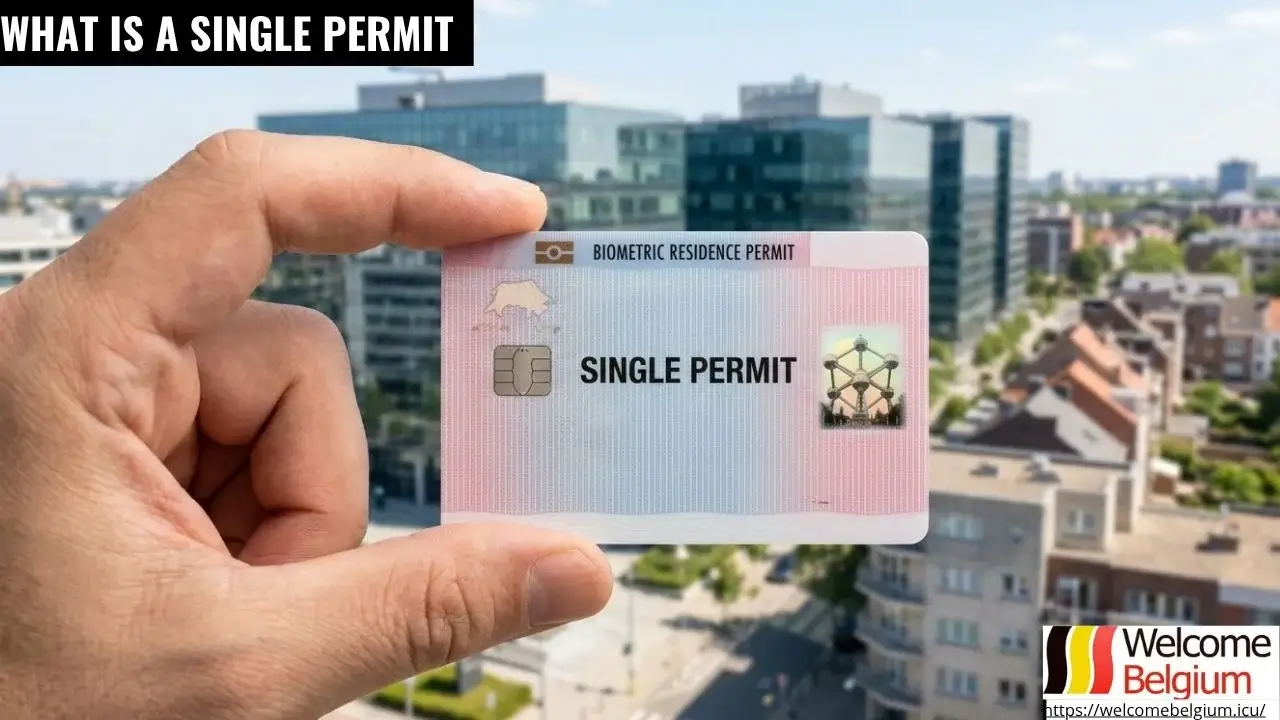
The defining feature of this permit is its regional dependency. Since salary requirements and shortage occupation lists in Belgium are decentralized, the conditions of your stay depend entirely on where your employer is registered.
Key Single Permit Categories:
- Highly Qualified Professionals: The most popular route for office employees and engineers. It requires a higher education degree (at least 3 years of study) and strict adherence to the salary threshold.
- Shortage Occupations: If your profession is on the official shortage list (e.g., nurses, certain construction specialists, or technicians), education requirements may be lowered. However, the employer must prove the lack of suitable candidates in the local EU labor market.
- Mid-level Specialists and Workers: Available only in exceptional cases or under specific regional quotas when a vacancy cannot be filled by EU citizens.
The issuance process is governed by the Federal Law of 15.12.1980 and the Royal Decree of 02.09.2018. Specific salary requirements are set annually by regional decrees in Flanders, Wallonia, and Brussels.
To verify current legal texts and financial thresholds in 2026, use the official state resources:
- Moniteur Belge — The official state gazette where all legislative changes are published.
- Working in Flanders, Brussels Economy, Emploi Wallonie — Regional labor portals with exact salary figures by category.
- Office des Étrangers — The Immigration Office portal for Visa D and residency matters.
Important:
Unlike the Blue Card, a standard Single Permit strictly ties you to a specific employer for its entire duration (usually 1 year). If you change companies, the application process must start over under the current 2026 thresholds.
EU Blue Card in Belgium
This permit type remains the “gold standard” for high-level experts. In 2026, the EU Blue Card in Belgium has become even more attractive due to simplified employer-change rules, though candidate requirements remain the most stringent.
Unlike the standard Single Permit, Blue Card conditions are uniform nationwide, as they are based on an EU Directive rather than just local laws.
Key Criteria for 2026:
- Salary Threshold: Your annual contract must provide a minimum of €62,300 (gross). This figure is the latest federal minimum, reflecting recent indexation.
- Education: A higher education degree (minimum 3 years) is mandatory. In some sectors (e.g., IT), 5 years of proven professional experience may be accepted as an equivalent in 2026, but a degree remains the strongest evidence.
- Contract Duration: The contract must be signed for at least 6 months (reduced from the previous 1-year requirement).
Blue Card standards are regulated by EU Directive 2021/1883, which has been implemented into Belgian law.
- EU Blue Card Network — Official resource for checking general program conditions.
- Moniteur Belge — Where I track the annual updates to the €62,300 threshold.
Alex’s Notes:
The biggest advantage of the Blue Card in 2026 is mobility. After one year of working in Belgium, you can move to another EU country under a simplified scheme. Additionally, your family members gain the right to work in Belgium automatically, without needing separate work permits.
Professional Card
If your path isn’t about working “for the man” but rather launching your own project or freelancing, a standard work visa for Belgium won’t cut it. In this case, you need to apply for a Professional Card (Beroepskaart).
In 2026, Belgium has sharpened its focus on innovation. Consequently, getting approval for a simple reselling business has become tougher, but the doors are wide open for IT consultants, engineers, and those in the creative industries.
Key Features of the Professional Card:
- Economic Benefit: This is the primary criterion. You must prove that your business will benefit Belgium—whether by creating jobs, bringing in investment, or offering an innovative product.
- Business Plan: Forget about formal templates. In 2026, committees scrutinize the realism of your financial forecasts very closely.
- Regional Focus: Just like with employment, applications are reviewed by the regions. Flanders, for instance, prioritizes high-tech startups.
The process is regulated by regional decrees regarding the employment of foreign nationals engaged in independent activities.
- Flanders Department of Economy — Detailed criteria for the northern region.
- Brussels Portal for Entrepreneurs — Conditions for those wishing to open an office in the capital.
- Wallonia Economy — Requirements for the southern region.
Alex’s Notes:
The Professional Card is the most challenging but also the most liberating route. You are your own boss, but the responsibility for taxes and insurance rests entirely on your shoulders. If you plan to work as an independent contractor, be sure to check out my Full Guide to Freelancing in Belgium, where I break down everything from opening an account to social security registration.
Youth Employment and Au Pair
Belgium remains welcoming to young people who want to combine cultural discovery with their first work experience. In 2026, the authorities view these programs as vital tools for “soft integration,” so the requirements are more flexible than those for business immigration.
Popular Programs for 2026:
- Au Pair: A program for young people aged 18 to 25. You live with a Belgian family, help with childcare and light household chores, and in return, receive room, board, and pocket money (approx. €450/month). Attending language courses is mandatory.
- Working Holiday: Available for citizens of specific countries (e.g., Canada, Australia, New Zealand). If your country has an agreement with Belgium, you can get a one-year visa with the right to work part-time to fund your travels.
- Traineeships: For university graduates who finished their studies no more than two years ago. The internship must be directly related to your degree.
Important:
Do not confuse Au Pair with a full-time job. By law, you cannot work more than 20 hours per week, and your primary goal is cultural exchange. If a family tries to treat you like a full-time domestic worker, it is a violation of visa conditions that could lead to the cancellation of your status. For a serious income, choose the Single Permit.
Salary Thresholds in Belgium 2026
This is the most critical section, as the figures in your contract determine whether your minimum salary for a Belgium Visa D will be approved. In 2026, thresholds have risen again due to indexation, and even a €10 difference can lead to a residence permit rejection.
Minimum Salary Thresholds by Region (2026):
| Region | EU Blue Card (Federal/Regional) | Highly Qualified (HQ) | Young Professionals (<30) / Shortage Occupations |
| Flanders | €63,586 | €50,450 | €35,315 (HQ <30 only) |
| Brussels | €56,976 | €44,441 | €31,110 (Nurses/Shortage) |
| Wallonia | €62,300 | €44,441 | €31,110 |
When analyzing these figures, it’s important to understand that in 2026, Belgian migration services use automated systems to cross-reference data with the tax authorities (Belcotax). Any discrepancy between the contract and actual payments can lead to an automatic revocation of your residence permit.
Practical Tips for Income Calculation:
- Account for the “13th month”: The threshold is a gross annual amount. Confirm with your employer if holiday bonuses and the 13th-month salary are included in the offer.
- Watch the Indexation: Belgium uses automatic wage indexation. Ensure your contract includes a clause for automatic salary increases to stay compliant with 2027 thresholds.
- Verify Company Registration: Your minimum salary depends on the company’s legal address. If you work for a Brussels-based company, Brussels thresholds apply regardless of where you live.
- Beware of “Benefit Traps”: Company cars, meal vouchers, and insurance are not always counted toward the threshold. Authorities focus on the cash base subject to social security.
If you are planning to relocate for work, it is crucial to remember that approval criteria depend heavily on your income level. In addition to the business plan for freelancers, the authorities review financial requirements for employees every year. To avoid a rejection due to a shortfall of just a few euros in your contract, I recommend checking out our latest update: New salary thresholds for work permits in Belgium in 2026.
Step-by-Step Application Procedure
The process may seem like a bureaucratic maze, but in 2026 it has become linear and almost entirely digital. To ensure your Belgium work visa doesn’t get stuck, follow these steps precisely.
The Legalization Algorithm: 4 Steps to Relocation:
- Find an Employer and Get an Offer
The job market is regionally segmented. Use official portals:
- VDAB — Main platform for Flanders.
- Actiris — Official portal for Brussels.
- LinkedIn — Best for international and IT sectors.
- Timeline: 2 to 6 months on average.
- Application via the “Working in Belgium” Portal
In 2026, your employer initiates the work permit process.
- Procedure: The employer uploads your contract, diploma, and passport to the Working in Belgium
- Processing Time: Usually 8–10 weeks in 2026.
- Cost: The administrative fee (retribution) is €200, paid by the employer. Details are on the Office des Étrangers
- Processing Visa D at the Consulate
Once the Annex 46 is issued, visit the Belgian consulate in your country.
- Actions: Biometrics, application form, and criminal record certificate.
- Addresses: Find your nearest mission via Diplomatie Belgium.
- Cost: Consular fee is €180.
- Commune Registration and A-Card
Upon arrival, you have 8 working days to report to the local town hall (Commune).
- Procedure: Registration followed by a police check of your residence.
- Result: You receive an Annex 15, and later your plastic A-Card (Electronic Residence Permit).
- Card Cost: €25–35 depending on the commune.
Alex’s Notes:
Do not delay your visit to the commune. In 2026, enforcement is strict—missing the 8-day window can cause issues with future renewals or citizenship applications. Check the Moniteur Belge for any last-minute law updates before you travel.
A key stage in preparing your documents for a Professional Card or Single Permit is the verification of your qualifications. Belgian regulators are extremely strict regarding educational documents issued outside the EU. To ensure the procedure isn’t delayed for months by bureaucratic errors, take a look at our detailed guide: How to recognize a foreign diploma in Belgium: step-by-step.
2026 Innovations and Fees
In 2026, the rules of the game have shifted significantly. I’ve highlighted three major technical updates that now directly impact your relocation. First, Flanders has officially completed its transition to full digitalization: paper dossiers are no longer accepted. All interaction occurs through an updated digital portal. While this eliminates the risk of lost documents, it requires absolute precision from your employer when uploading scans.
Secondly, as of January 1, 2026, a new administrative fee (retribution) of €200 has been officially fixed. This payment covers the processing costs of the migration services and is a mandatory requirement to start the review of your application. Without bank confirmation of this payment, your file simply won’t be opened. Ensure that either you or your employer completes the transaction on time.
Regarding actual wait times, despite digitalization, you should plan for 3–4 months. Although the law allows 120 days for a decision, the workload in the regions has increased in 2026. While Flanders often processes faster (around 8–9 weeks), Brussels and Wallonia consistently take 3 months or more. Keep this in mind when negotiating your start date to avoid a situation where your contract begins before your visa is ready.
FAQ
- Do I need a language test for a work visa?
For the initial Visa D and your first A-card—no. However, language proficiency (Dutch, French, or German) becomes mandatory after 5 years if you wish to apply for Permanent Residency or citizenship.
- Can I bring my family immediately?
Yes, the Family Reunification procedure can run parallel to yours. Spouses and children receive visas based on your work permit. In 2026, family members of Single Permit and Blue Card holders have the right to work in Belgium without additional permits.
- What happens if I am laid off?
You have 90 days (within the validity of your card) to find a new employer and initiate a new permit process. If you exceed this window, the Immigration Office (Office des Étrangers) will request that you leave the country.
- Does my diploma need an Apostille?
Yes. For Belgian authorities, foreign diplomas must be legalized (Apostilled) and translated by a sworn translator. For the Blue Card, a formal Equivalence procedure is often required.
- Can I work remotely for another country with an A-card?
Your primary income, which secures your residence permit, must come from a Belgian employer. Side jobs for foreign companies are possible, but they do not count toward the minimum salary threshold and require consultation with a tax lawyer.
Belgium in 2026 is all about the rules. If it says “8 days to register” or “€62,300 threshold,” it means exactly that. The system now flags any deviation automatically.
Alex’s Final Word: You’ve got the full roadmap now. The 2026 system is stricter but more transparent. Stick to the numbers, double-check your employer’s portal entries, and welcome to the heart of Europe! 🦾🇧🇪🚀