Last Updated on May 16, 2026 by Alex
Moving to Belgium on an EU Blue Card is a life-changing step for the entire family, and the partner’s employment is often the pivotal factor in this journey. Fortunately, family reunification in Belgium under the Blue Card framework in 2026 automatically eliminates bureaucratic hurdles, granting expats’ spouses full access to the local labor market without the need for additional permits.
In this article, I, Alex, will break down how the work permit for Blue Card family members in 2026 functions in practice. We will walk through the entire administrative path from registration at the local town hall to signing your first employment contract, and evaluate the legal nuances of freelancing as well as the risks to your residence status if your partner changes jobs.
I suggest reviewing our comprehensive guide on how the EU Blue Card in Belgium program operates, which details the initial immigration criteria.
Who this article is for in 2026
Family reunification in Belgium under the Blue Card in 2026 automatically removes administrative barriers, providing spouses of expats with complete access to the job market. This guide will be particularly useful if:
- You are relocating to Belgium as a dependent spouse of a highly qualified professional.
- Your partner is already working in the country on an EU Blue Card, and you are just launching your legal registration process.
- You do not plan to limit yourself to traditional employment and are considering launching a freelance career or opening your own business in Belgium.
Automatic Work Authorization for Blue Card Holders’ Spouses
The primary advantage of the Belgian legal system for families of highly qualified professionals is the complete absence of hidden bureaucracy. The spouse of an EU Blue Card holder receives automatic work authorization immediately upon registration. You do not have to undergo the complex and lengthy Single Permit process (a combined work and residence authorization), look for an employer willing to sponsor your visa, or wait for the Ministry of Labor to verify whether there are suitable candidates among Belgian or EU citizens.
You do not have to undergo the complex and lengthy process required to apply for a Single Permit via the EU Blue Card, look for an employer willing to sponsor your visa.
The legal status of family members is strictly anchored at both the European and Belgian national levels:
| Legal Basis | Regulatory Scope & Status Granted | Official Source |
| EU Directive 2021/1883
(EU Blue Card Directive of 20.10.2021) | Guarantees immediate labor market access for spouses from the moment the residence permit is issued, without prior conditions or waiting periods. | Directive Text on EUR-Lex |
| Belgian Law of 15.12.1980
(Loi sur l’accès au territoire… as amended) | Articles 10 and 10bis regulate family reunification and secure the resident legal status for dependent family members. | Law Text in Justel Database |
| Royal Decree of 02.09.2018
(Arrêté royal portant exécution… as amended) | Directly exempts family members of foreign professionals holding a Blue Card from the obligation to obtain a separate work permit. | Decree Text in Justel Database |
In practice, Belgium provides this seamless work permit for family members of expats without administrative delays. This right is materialized through specific remarks in your personal residence documents issued at different stages of your legalization process.
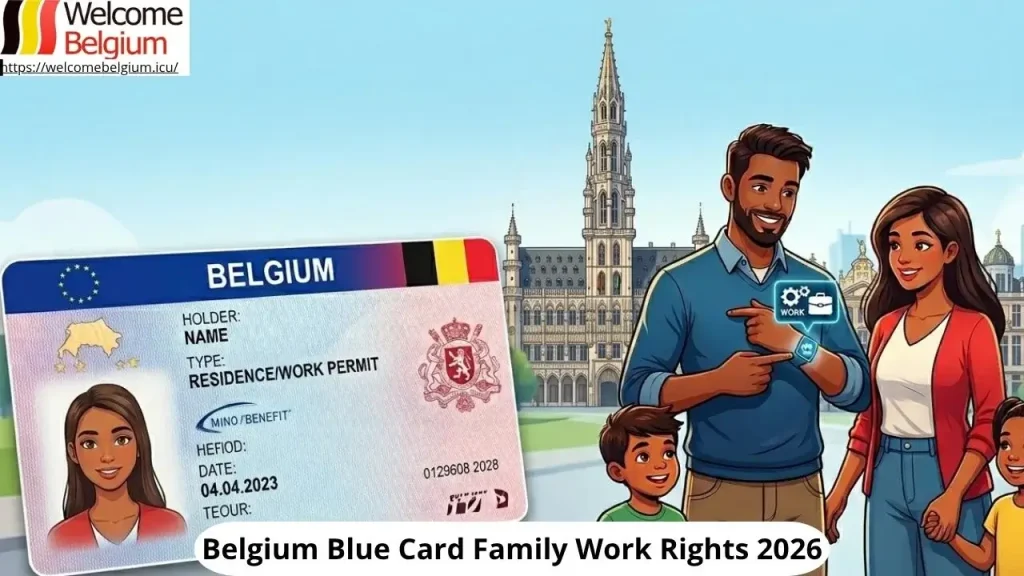
First, you receive a temporary document known as Annexe 15 (or Bijlage 15 in the Flemish region). Upon your first visit to the town hall after arrival, you will be issued this paper certificate with your photo. It is crucial to verify that it already contains the vital phrasing for employers: «Marché du travail: illimité» (Labor market: unlimited). Under this document, you have the full legal right to officially sign an employment contract without waiting for your physical card.
Second, you will be issued a permanent plastic residence permit (Type A Card). After a few weeks, the town hall will provide you with this standard electronic foreign ID card. It acts as a temporary residence permit but is renewed annually based on the validity of the primary applicant’s Blue Card. The card’s chip contains the exact same remark, guaranteeing unrestricted employment across any economic sector in Belgium.
Consequently, once you obtain these documents, you gain comprehensive automatic access to the labor market. This enables you to apply for vacancies on equal terms with local residents, while your employer faces no requirements to process any extra paperwork for your hiring.
Alex’s Advice:
If a local HR manager, out of unfamiliarity with the law, requests a standard Single Permit from you, simply point out the Marché du travail: illimité remark on your Annexe 15 or Type A card. In my experience running welcomebelgium, demonstrating this line and referencing the Royal Decree resolves all doubts in 99% of cases.
How to Obtain a Work Permit for a Spouse in Belgium: A Step-by-Step Guide
While having a theoretical right to work is an excellent foundation, navigating the practical administrative track requires a clear roadmap. To successfully manage the work permit process for a spouse in Belgium, the entire journey should be broken down into three consecutive stages. As an immigration specialist, I highly recommend preparing all documents concurrently with the primary applicant to mitigate any risks of delayed or separate family entry.
Securing a Long-Stay Visa D for Family Reunification
The very first step begins in your country of origin. Family members of an EU Blue Card holder must apply for a long-stay national visa, commonly known as a Visa D. This application is legally grounded in Article 10 of the Belgian Law of 15.12.1980.
To ensure that your Visa D for family reunification under a Belgium Blue Card is approved without administrative delays, you need to compile a comprehensive dossier. This includes the original document proving your marriage, which must feature an apostille and a certified translation into French, Dutch, or German.
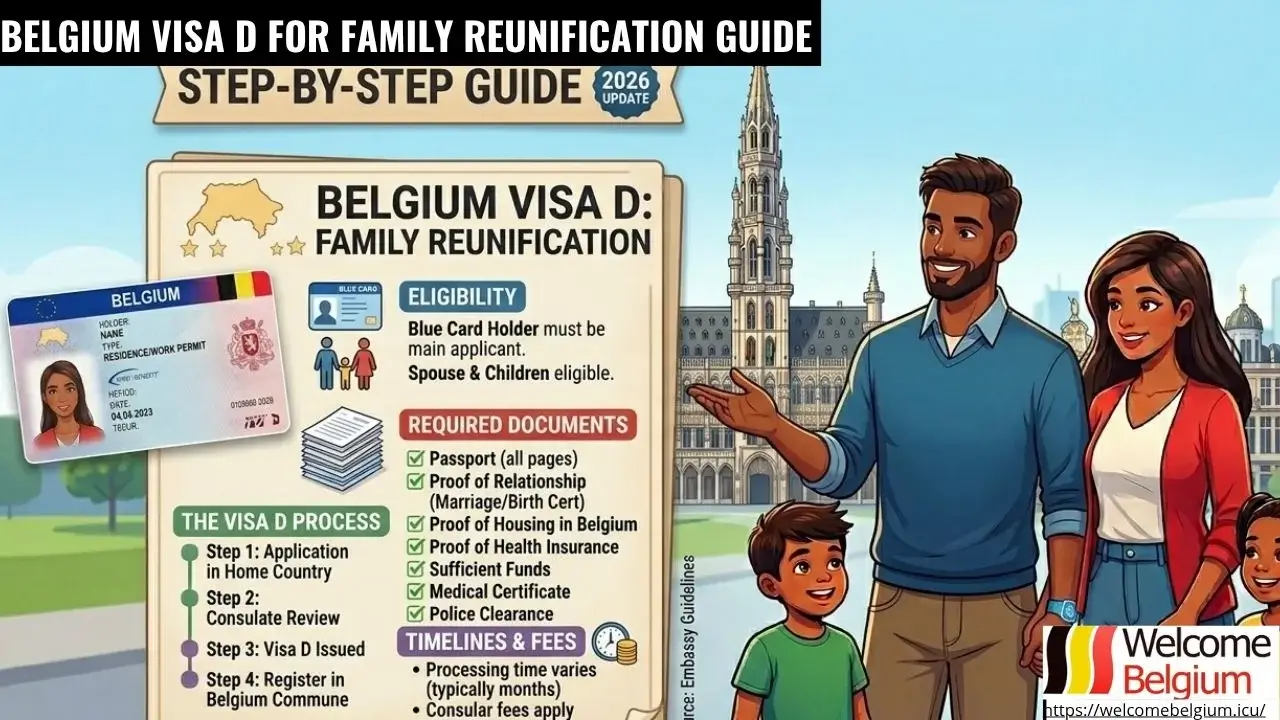
You will also need a clean criminal record certificate with an apostille, issued no earlier than six months prior to submission, alongside a medical certificate completed by a consulate-accredited physician. Finally, you must supply supporting documents proving that the primary Blue Card holder earns a sufficient income and maintains a valid health insurance policy to adequately cover the family.
While national visa processing times naturally fluctuate depending on the workload of the specific consulate or visa application center, files for Blue Card families are typically prioritized, generally taking anywhere from a few weeks to a month and a half.
Town Hall (Commune) Registration and Issuance of Annexe 15
Upon arriving in Belgium, you technically have three working days to notify local authorities, but the truly pivotal milestone is completing your official residential registration at the local municipal administration, known as the commune.
The registration process unfolds in a structured timeline:
- You submit your formal registration application at the town hall serving your specific municipality, providing your passports with the Visa D and your signed housing lease. Keep in mind that in highly sought-after expat neighborhoods like Ixelles or Etterbeek, appointment slots at the commune can be fully booked up to a month in advance, so it is vital to secure your slot early.
- The commune initiates a mandatory verification of your actual physical residence. A local neighborhood police officer, known as the agent de quartier, will usually drop by your home unannounced within one to three weeks after you submit your application.
- Once the police officer officially confirms your residence, the commune enters your data into the National Register of Foreign Nationals (Registre des étrangers). They will then collect your biometric data, including fingerprints and a digital photo, to order your physical residence card.
On the exact day your registration status is finalized, the commune issues a temporary paper document known as Annexe 15 (or Bijlage 15 in the Flemish region). This document officially serves as your temporary legal residence proof while your physical card is being manufactured.
Administrative processing timelines vary dramatically by location. In smaller Flemish municipalities, the entire process from your initial visit to the final document issuance can wrap up in three to four weeks. Conversely, in the heavily congested Brussels-Capital Region, the residential verification and card production phases frequently stretch over two to three months.
Can You Start Working Before Your Physical Residence Card Arrives?
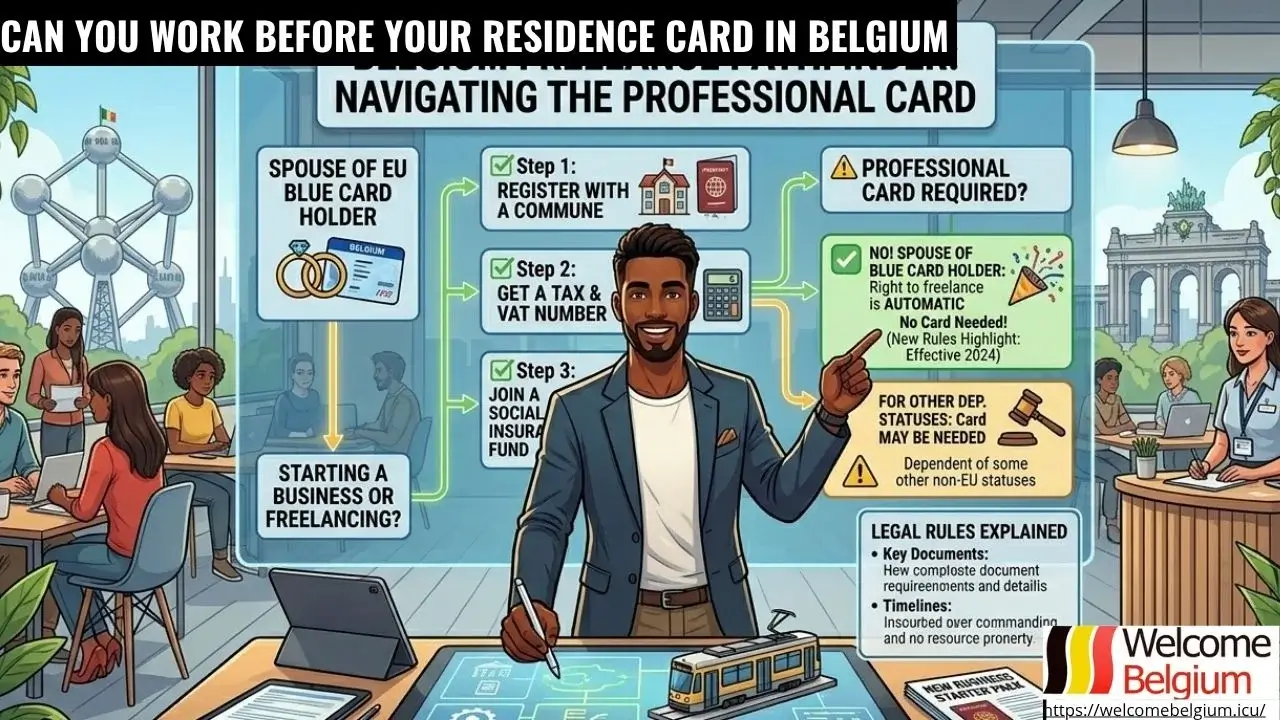
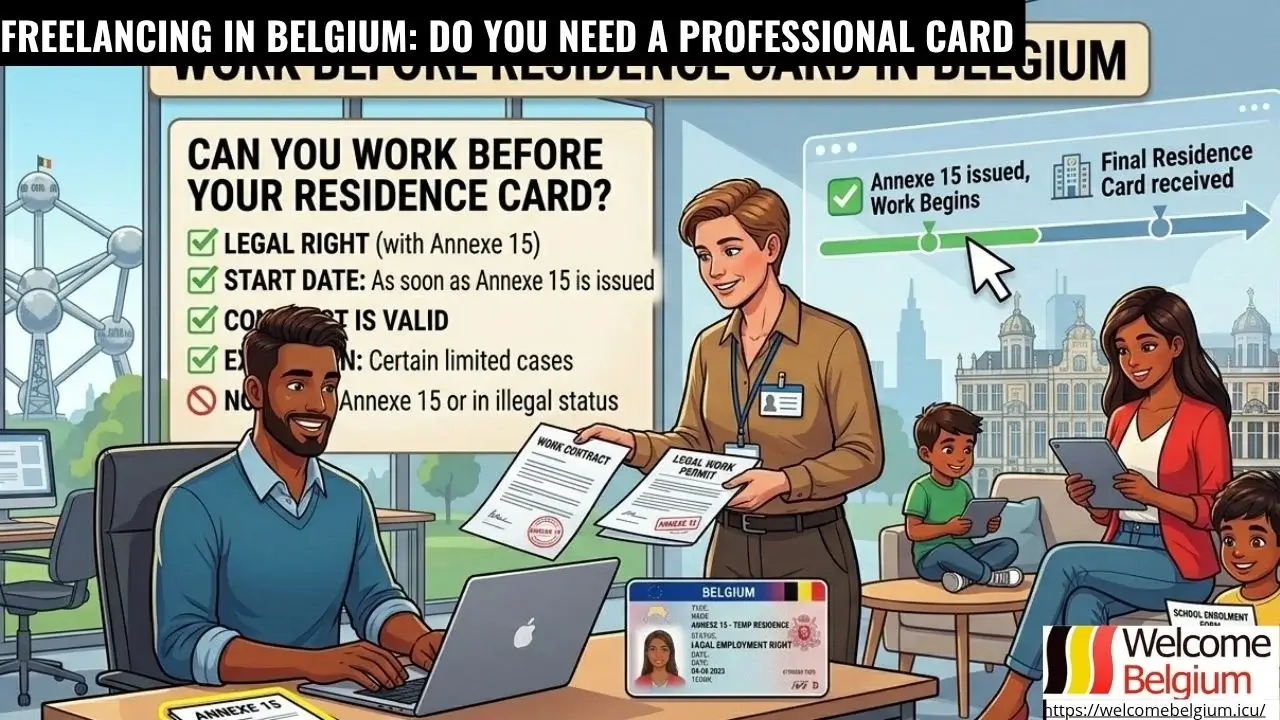
This is easily the most frequent question I answer during my consultations on welcomebelgium.icu. The definitive answer is yes, it is completely legal to start working with an Annexe 15.
In strict accordance with the official guidelines of the Belgian Immigration Office (Office des Étrangers), an Annexe 15 formally validates your legal stay in the country and secures all associated rights. If the section marked Marché du travail explicitly states illimité, you have the legal right to sign an official employment contract from the very day that paper certificate is printed.
Employers have every right to add you to their payroll. The only minor technical hurdle is that during the mandatory tax and social security onboarding process via the national Dimona system, the company’s payroll department will need to input your temporary Belgian identification number.
This is your National Number (Numéro national), which the commune prints directly on your Annexe 15 form. There is absolutely no legal requirement to wait for the physical Type A plastic card to kickstart your career.
On the ground, however, many families run into situations where an HR department sees an Annexe 15 for the first time and panics, requesting additional documents out of fear of fines for illegal employment. Quite often, company accountants or HR personnel simply do not know how to register an employee holding a paper certificate in the Dimona system and mistakenly insist on waiting for the plastic card.
Recently at welcomebelgium.icu, we resolved a case where a major retailer in Brussels halted a contract layout for an expat’s spouse due to suspicion over the paper form, requiring our direct intervention and the presentation of explicit circulars from the immigration authorities to unblock the hire.
Alex’s Advice:
During your crucial appointment at the commune to receive your Annexe 15, personally double-check that the administrative officer has correctly entered the proper labor market status into the system and onto the printout. Due to simple human error, officials occasionally forget to include this remark on the temporary certificate, a mistake that can easily stall your contract signing with a prospective employer for several weeks.
Available Forms of Employment: Salaried Work, Freelancing, and Starting a Business
Automatic access to the labor market removes most of the classic restrictions faced by foreigners, but the boundaries of what is permitted depend directly on your chosen format of activity. If you plan to build a career in Belgium as a salaried employee, the law is entirely on your side. However, if you are leaning toward independent earnings, you will need to account for several local legal nuances.
Salaried Employment: Complete Freedom of Action
To work on the payroll of a Belgian company, all economic sectors are open to family members — from retail to IT and the banking sphere. Unlike the primary Blue Card holder, whose position is strictly tied to a minimum salary threshold and specific qualifications, no such requirements apply to their spouse.
While the primary professional must track whether their contract aligns with the official EU Blue Card Belgium salary threshold requirements, your earnings as a spouse can safely start from the legal baseline of any economic sector.
You have the right to conclude an employment contract for any position, whether full-time or part-time, and for any salary amount that meets the minimum sector-specific rates in Belgium. There are also no restrictions on changing employers: you can resign and transition to other companies without any need to reprocess your documents at the commune.
Freelancing and Starting a Business: When Do You Need a Professional Card?
With a transition to a self-employed model or when wishing to register as a sole proprietor (IP), the situation changes. The automatic right to work secured in your Type A residence card covers salaried employment by default.
If a family member plans to conduct independent commercial activity, regional corporate law acts as the key regulator. On the official portals of the Belgian regions, such as the government resource of Flanders, Flanders.be, it is clearly stipulated that non-EU foreign citizens are required to obtain the status of a commerce operator. To achieve this, a Professional Card (Carte professionnelle) must be processed.
Unfortunately, the sheer fact of family reunification with a Blue Card holder does not fall under the list of automatic exemptions (dispenses) from this obligation, as is otherwise provided for spouses of Belgian or EU citizens.
Consequently, the algorithm for launching a business will look as follows:
- You submit an application for the issuance of a Carte professionnelle through an authorized business counters organization (Guichet d’entreprises).
- Your application is evaluated by the regional economic ministry (of Flanders, Wallonia, or Brussels) regarding its economic utility to the country, the viability of the business plan, and the availability of start-up capital.
- Only after the card’s approval can you officially register in the business crossroads bank registry (UBO/KBO), pay taxes as an independent entrepreneur, and issue invoices for your services.
Alex’s Advice:
If you plan to work for a foreign freelance market while residing in Belgium, do not attempt to do so under the radar. The Belgian tax authority strictly monitors the movement of funds, making the acquisition of a professional card and opening a legal sole proprietorship the only safe path to protect your residence status.
Status Changes and Risks Upon Job Loss by the Primary Blue Card Holder
One of the main anxieties that clients bring to my consultations is the vulnerability of a dependent residence permit. Relocating an entire family always involves risks, and a logical question arises: what happens to the spouse’s right to work if the primary applicant faces an unexpected dismissal or a planned termination of their contract? In 2026, Belgian and EU legislation offers clear protective mechanisms designed to reduce stress in such force majeure situations.
Guaranteed Grace Period: The 2026 Rules
If the primary Blue Card holder loses their job, this does not trigger an automatic and immediate cancellation of the Blue Card in Belgium, nor does it mean the loss of their family’s documents. Under Belgian national law, the expat is granted a specific unemployment protection grace period.
During this window, your residence status and, consequently, the automatic right to work for the spouse remain fully valid:
- 3 months of protection: If the Blue Card has been held by the primary applicant for less than two years.
- 6 months of protection: If the specialist has legally worked on a Blue Card in Belgium for more than two years.
Throughout this protective timeframe, you can continue to work officially in Belgium under your Type A card while your partner conducts an active job search and attends interviews.
Notification and Processing Mechanism
For the grace period to activate correctly and to prevent issues with the migration authorities, a strict protocol must be followed. The primary applicant is required to send an official notification regarding the loss of employment to the regional ministry of labor within the legally established timeframes, utilizing platforms like the Flanders.be digital portal or the relevant department of the Brussels region.
As soon as a new employer for the Blue Card holder is secured, the hiring company initiates the update procedure for their Single Permit. For the spouse, this process runs invisibly in the background. You do not need to submit new documents to the commune or re-request a work permit, as your Type A card automatically extends its validity based on the updated status of the primary family member.
Alex’s Advice:
If you find yourself in this situation and your current employer panics, thinking they must dismiss you following your spouse’s job loss, show them the official guidelines of the Belgian Immigration Office (Office des Étrangers). Your right to labor is fully protected by law for the entire duration of your partner’s official job search period.
Frequently Asked Questions (FAQ)
When planning a family relocation to Belgium in 2026, expats regularly face specific administrative details. Below are precise, no-nonsense answers to the most common questions.
No, Belgian legislation does not require passing any language proficiency tests to activate your automatic right to work. However, communication skills in Dutch or French remain the primary criteria for successfully securing local vacancies within the regions of Flanders, Wallonia, and Brussels.
A Belgian residence permit grants employment rights exclusively within the territory of Belgium. To physically work in another European Union member state, you will need a local work permit issued by that specific country, unless you are working remotely from your Belgian home.
The foundational checklist for family reunification in Belgium requires you to gather original marriage certificates and clean criminal record background checks. All these personal documents must feature an official apostille and be accompanied by a certified translation.
Yes, in the event of a marriage dissolution, the automatic right to work is canceled because the legal ground for family reunification no longer exists. In such a scenario, the spouse must swiftly secure a new employer willing to sponsor an independent Single Permit.
Yes, holding a Type A card or an Annexe 15 certificate gives you full rights to register with regional public employment services, such as VDAB in Flanders, Actiris in Brussels, or Forem in Wallonia. This registration grants access to free language courses.Does a spouse need to pass a language test to obtain a work permit?
Can a family member work in another EU country while residing in Belgium?
What documents from the country of origin must be prepared in advance?
Is the right to work lost upon a divorce from the primary Blue Card holder?
Can a spouse register with the Belgian labor exchange to search for jobs?
The automatic right to work for spouses of EU Blue Card holders shields expats in Belgium from career stagnation and unnecessary bureaucracy. For a seamless adaptation process, you simply need to legalize your documents in your country of origin ahead of time and double-check your registration remarks at the local commune. The WelcomeBelgium team is always ready to support you through every milestone of your relocation, ensuring your family’s integration is as smooth as possible.
Official Sources of Information
- EU Directive 2021/1883 (EU Blue Card Directive) — Official text on the EUR-Lex portal.
- Belgian Law of 15.12.1980 (Loi sur l’accès au territoire…) — Current version in the Justel database.
- Royal Decree of 02.09.2018 (Arrêté royal portant exécution…) — Text of the decree on the employment of foreign nationals on e-Justice.
- Belgian Immigration Office (Office des Étrangers / IBZ) — Family reunification and resident rights sections on the official agency website.
- Ministry of Labor of Flanders — Professional card business exemption guidelines on the be portal.
Legal Disclaimer
The information presented in this article is provided solely for informational purposes and reflects the regulations in force for the year 2026. It does not constitute official legal advice. Belgian migration legislation and the administrative practices of individual communes are subject to change. To resolve specific legal matters or review complex cases, we highly recommend consulting qualified immigration attorneys or contacting the diplomatic missions of Belgium directly.