

Last Updated on April 27, 2026 by Alex
Quick Summary (Featured Snippet)
In 2026, the STR/SRR tax regime in Belgium provides expats with:
- 35% Tax-Free Allowance: Up to 35% of gross salary is non-taxable.
- Annual Cap: €90,000 (where applicable).
- Salary Threshold: Minimum €70,000 gross per year.
- Key Requirement: Must have lived >150 km from the Belgian border for the past 5 years.
Introduction: Who Qualifies for the Tax Bonus in 2026?
In 2026, Belgium’s tax policy underwent significant updates aimed at boosting national competitiveness. The new STR/SRR regime is a core instrument of the state strategy to attract global talent. As of 2026, the RSII regime has been officially rebranded as STR (Special Tax Regime) and SRR (for Researchers).
The primary goal of the system is to reduce the tax burden on high-skilled professionals, ensuring net salaries remain competitive with neighboring countries like the Netherlands or Luxembourg.
Table: STR/SRR Qualification Groups for Tax Benefits (2026)
| Category | Salary Threshold (2026) | Primary Requirement | Bonus (Tax-free) |
| Executives / Specialists | From €70,000 gross/year | Distance >150 km from border | 35% of income |
| Researchers (R&D) | No minimum threshold | 80% of time spent on R&D | 35% of income |
It is important to note that the €70,000 mark is not the only financial criterion. For those planning a move beyond the STR program, it is essential to review the new salary thresholds in Belgium for 2026 to ensure your contract meets the general immigration requirements of the country.
Regulations and Application Process
Current limits and the regulatory framework are published on the SPF Finances portal, as approved by Circular 2026/C/18 dated January 15, 2026.
The tax authorities verify that the applicant has not been a Belgian tax resident for 60 months prior to hiring. If the contract meets these standards, the company submits an electronic application via the MyMinfin state system, ensuring the benefit applies from the very first paycheck.
This expat tax regime in Belgium is particularly lucrative in the long term, as it remains valid for 5 years, with an option to extend for an additional 3 years. Official amendment texts and sector-specific application rules can be found in the Moniteur Belge (Justel) database, where all STR/SRR Belgium 2026 updates are recorded.
Essentially, the state subsidizes part of your relocation and adaptation costs, allowing employers to legally save on taxes without compromising the employee’s standard of living.
Alex’s Pro-Tip:
Beware of the “150-kilometer trap.” If you lived in Lille (France) or Aachen (Germany) within the last 5 years, you lose the right to these preferences—even if your salary is half a million euros. The tax office verifies this against national registries. If you are planning a relocation, check the distance from the border to your last official residence on a map first.
Eligibility Criteria: Who Qualifies for the Benefit?
To obtain STR status, a candidate must meet a specific set of criteria. Discrepancies in the data submitted to the Belgian Tax Authority may lead to a rejection of the application without the possibility of a simplified review.
Core Requirements for Candidates in 2026:
- Minimum Salary for Expats: Your base annual gross salary must be at least €70,000. This refers to the “base” pay before taxes and does not include bonuses, variable compensation, or relocation allowances.
- Recruitment from Abroad: You must be recruited directly from outside Belgium. This can be via a direct contract with a Belgian company or through an intra-corporate transfer (ICT) within an international group.
- Tax Non-Resident Status: During the 60 months (5 years) preceding the start of employment in Belgium, you must not have:
- Been a Belgian tax resident;
- Lived within Belgian territory;
- Been subject to non-resident income tax due to working for a Belgian-based client.
Geographical and Contractual Restrictions
- The 150-Kilometer Rule: This requirement is the primary restriction for residents of neighboring regions. Your primary residence during the 5 years prior to relocation must have been more than 150 km away from any point on the Belgian border. This automatically excludes residents of border areas in France, Luxembourg, Germany, and the Netherlands.
- Contract Duration: The tax benefit is only applicable for contracts with a duration of at least 6 months.
The methodology for calculating the 150 km distance is established in the Government Decree of December 21, 2025, published in the Moniteur Belge.
Special Categories and Exemptions
For those employed in the scientific sector, the rules are significantly more flexible. Researchers and Scientists (R&D) are completely exempt from the €70,000 salary threshold. The only conditions are:
- Possession of a relevant degree (Master’s or PhD).
- Evidence that at least 80% of working time is dedicated specifically to research and development activities.
This regulation is governed by the Innovation Support Act No. 2025-842, which came into force on January 1, 2026, and is available in the Moniteur Belge database.
Important:
To officially verify your eligibility, I recommend consulting the latest circulars on the SPF Finances portal. There, you will also find detailed instructions on calculating the 150 km distance as approved in the Moniteur Belge database.
How the “35% Rule” Works
Technically, the reimbursement of expenses under the STR/SRR regime is not an additional payment on top of the salary, but a reclassification of part of the salary. If the contract meets the criteria, up to 35% of the gross salary is recognized as “expenses related to relocation and living in a foreign country.” This amount is deducted from the total payroll before income tax and social security contributions are applied to the remainder.
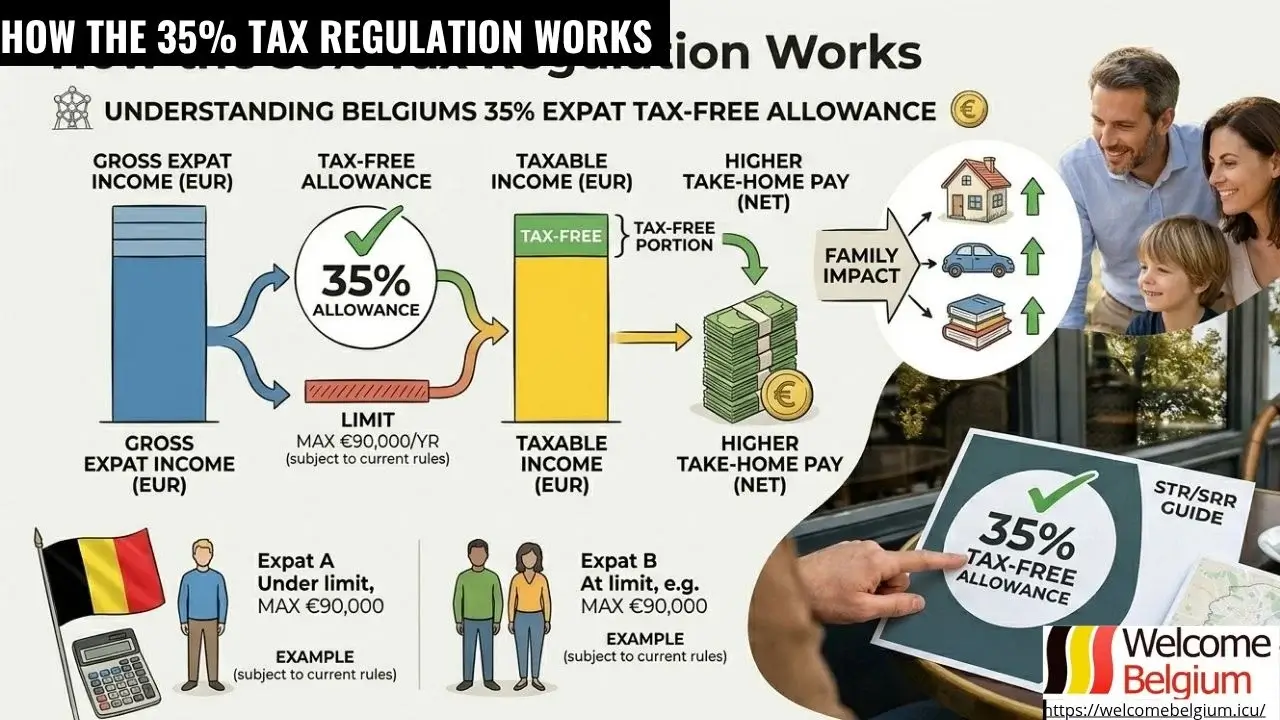
The major change in 2026 was the unification of the tax base and the implementation of fixed-rate cost reimbursements (lump sum). Previously, there were complex disputes regarding which specific costs could be covered (schooling, rent, travel), but the system now operates on a fixed-rate principle, significantly simplifying tax calculations in Belgium 2026.
Key parameters of the mechanism:
- Reimbursement Rate: A fixed 35% of gross income.
- Annual Cap of €90,000: This is the maximum tax-free compensation an employer can pay an expat per calendar year. Once this limit is reached, any further payments (even if they fall within 35% of the salary) are subject to standard taxation.
- Gross to Net: Because 35% of the amount is non-taxable (0% rate), the net income increases proportionally to the tax progression.
Calculation Examples (Estimated for 2026):
- Monthly Salary of €5,000 (Gross):
- Without the benefit: Taxes and social security are calculated on the full €5,000. Net pay is approximately €2,850–€3,000 (depending on family status).
- With STR/SRR: €1,750 (35%) is paid as a tax-free expense reimbursement. Income tax is only calculated on the remaining €3,250. You receive approximately €3,700–€3,850.
- Result: A net gain of about €850 per month.
- Monthly Salary of €10,000 (Gross):
- Without the benefit: At this income level, the Belgian progressive tax rate reaches 50%. Net pay is approximately €5,100.
- With STR/SRR: €3,500 (35%) is excluded from taxation. Taxes are calculated only on a base of €6,500. You receive approximately €6,800–€7,000.
- Result: A net gain of nearly €1,800 per month.
Detailed examples and calculators for various family situations can be found on the official SPF Finances portal. It is vital that this 35% is clearly stipulated in an addendum to the employment contract, the template for which is regulated by federal law via the Moniteur Belge.
Note on the Annual Limit:
When calculating benefits for ultra-high earners (over €257,000 per year), the legislative ceiling must be considered. According to Circular 2026/C/18, the maximum tax-free reimbursement under STR/SRR is limited to €90,000 per year. Anything exceeding this limit is taxed normally.
Conditions for Researchers (SRR)
Unlike the standard regime for executives, taxes for scientists in Belgium are calculated without being tied to a high minimum income level. While the “entry ticket” for a standard expat is €70,000, this threshold is completely waived for researchers. This allows labs to recruit postdocs and specialized engineers for entry-level positions while maintaining financial attractiveness through tax deductions.
Key Advantages for the R&D Sector:
- No Salary Minimum: You can qualify with any salary specified in the contract, provided the activity is recognized as scientific research.
- Academic Degree as a Passport: The primary requirement is a Master’s or PhD in relevant fields (STEM, medicine, applied sciences).
- Tax-Free Income: Researchers also receive the 35% tax-free allowance, which, combined with regional support programs, leads to a substantial “net” increase.
- Compatibility with Grants: Research grants and tax benefits often stack, allowing laboratories to pay world-class competitive salaries.
To confirm status, the company must submit a detailed project description to BELSPO (Belgian Science Policy Office). According to SPF Finances, the researcher’s activities are audited annually. If more than 80% of an employee’s time is spent on administrative tasks rather than science, the tax office may revoke the status.
All regulations regarding tax incentives for scientific activities are regularly updated in the Moniteur Belge. In 2026, the qualification verification process became fully digital, significantly accelerating approval for international specialists.
Important:
If you are coming to Belgium as a researcher, ensure that your contract or Addendum clearly defines your time allocation. BELSPO is extremely meticulous: if you are a “researcher” on paper but primarily handle sales or pure management in practice, the benefit may be revoked retroactively.
Application Procedure: Deadlines and Documentation
The procedure for obtaining the STR/SRR tax benefit in 2026 is a strictly regulated process. While the administrative burden primarily rests on the employer, the employee must monitor critical deadlines. In 2026, errors in dates or an incomplete document package lead to an automatic rejection with no possibility of re-application under the current contract.

Step-by-step application process (2026)
The application process is fully digitized and conducted through the Ministry of Finance portal. The benefit is not granted automatically—a formal application is required.
- Contract Preparation (Addendum): The employer must draft an addendum to the employment contract, officially recording the split between the taxable salary and the non-taxable expense reimbursement (35%).
- Electronic Application: The employer submits the request via the MyMinfin Access to the form is provided through the company’s official business cabinet on the SPF Finances website.
- Employee Confirmation: You will receive a notification (via eBox or MyMinfin), where you must officially confirm that you meet the criteria (the 150 km rule and non-resident status).
- Processing Time: The official review period is between 3 to 6 months. However, according to the clarifying Circular 2026/C/42 dated March 12, 2026, preliminary approval can be granted as early as the second month.
Critical Deadline: The “3-Month Rule”
In 2026, the 3-month rule remains strictly enforced: the application must be submitted no later than 3 months after your first working day in Belgium.
- If you miss the deadline: The system blocks the possibility of filing. The only legal way to regain eligibility is to change employers. Upon moving to a new company, the 3-month “clock” resets, and the new employer can re-apply (provided your total time in the country has not yet exceeded the program’s limits).
Costs and Required Documents
The application for STR/SRR itself is free of charge for the company (there is no state fee). However, many firms hire external auditors (e.g., Big4), whose services cost between €1,500 and €3,000.
Required Documents for STR/SRR Belgium:
- Copy of Passport and Residence Permit (Single Permit).
- Original Employment Contract with the tax benefit addendum.
- Proof of Residence outside Belgium: Extracts from national registries, utility bills, or tax returns from your country of origin covering the last 5 years.
- For Researchers: Diploma (Master’s/PhD) validated through the diploma equivalency service.
Obtaining a tax benefit runs parallel to the main legalization process. As most professionals relocate via a combined permit, we recommend checking our guide on Single Permit in Belgium 2026 to properly prepare your documents before submitting your application through MyMinfin.
The 2026 “Window of Opportunity”:
If you started working between January 1, 2025, and January 9, 2026, but did not apply due to the old (higher) salary thresholds, you have a “window of opportunity” until April 9, 2026, to apply under the new, more lenient rules. Check with your HR immediately—such amnesties are extremely rare. Official details on this transition period are available in the Moniteur Belge.
Tax Residency in Belgium 2026
In Belgium, your tax status is determined not by citizenship, but by the location of your “center of vital interests.” If your family lives in Brussels and your children attend a local school, you are considered a tax resident. This means you are required to declare your worldwide income, including rental income from property in your home country, dividends, or interest from foreign bank accounts.
However, thanks to Double Taxation Avoidance Agreements that Belgium has signed with most countries, you won’t pay tax twice—taxes paid abroad are usually credited or exempt the income from Belgian taxation.
The situation changes if you maintain “non-resident” status (e.g., your family remains in another country). In this case, you only pay taxes on income derived from Belgian sources. In 2026, following a landmark European Court ruling (the Chefquet case), Belgium was forced to revise additional surcharges for non-residents to make them fairer compared to residents.
Table: Status Comparison: Resident vs. Non-Resident (2026)
| Feature | Tax Resident | Tax Non-Resident |
| Declaration Requirement | Worldwide income | Only Belgian-source income |
| Municipal Tax | 0% to 9% (depends on commune) | Fixed 7% federal surcharge |
| Foreign Real Estate | Must declare (cadastral income) | Not declared in Belgium |
| Tax Deductions | Full package (children, mortgage, etc.) | Limited (if >75% of income is from BE) |
For a deeper dive, I recommend the “Living and working in different countries” section on the SPF Finances portal. If you hold assets in multiple countries, it is critical to check the current double tax treaty to correctly apply exemption or credit methods.
Residency status is often tied to family relocation. If you are moving with your relatives, make sure to read about the new family reunification rules in Belgium. This will help you calculate household taxes correctly and officially establish your center of vital interests.
A new Capital Gains Tax of 10% was introduced by the law of February 10, 2026. Important: The tax is not paid from the first euro—in 2026, a tax-free threshold of €10,000 per person (€20,000 for spouses) applies. Only net profits from the sale of stocks, bonds, and crypto-assets exceeding this threshold are taxed. Residents must report this in their annual tax return, while non-residents are only liable in exceptional cases. Official legal texts are available in the Moniteur Belge.
Alex’s Pro-Tip:
For Non-Resident tax status holders, this tax generally does not apply if the assets are held in foreign accounts and are not related to professional activities in Belgium.
Comparison with Neighbors: Belgium vs. Netherlands (30% Ruling)
In 2026, the Western European labor market saw structural changes. While the Netherlands began phasing out benefits (with the rate dropping to 27% in 2027), Belgium liberalized the STR/SRR system, making it more aggressive. This tax competition is shifting the flow of high-skilled specialists and scientists from Amsterdam to Brussels and Antwerp.
The main advantage of Belgium in 2026 is stability and the lack of a “declining rate.” While the Dutch regime has become a “descending staircase” (30-20-10%), the Belgian version remains constant for the entire duration of the contract.
Table: Comparison – Belgium (STR/SRR) vs. Netherlands (30% Ruling) 2026
| Parameter | Belgium (STR/SRR 2026) | Netherlands (30% Ruling 2026) |
| Benefit Percentage | 35% (Increased from 30%) | 30% (Dropping to 27% in 2027) |
| Duration | Up to 8 years (5 + 3) | 5 years (with decreasing rates) |
| Maximum Limit | Capped at €90,000 / year | Capped at ~€262,000 / year |
| Salary Threshold | €70,000 (Reduced) | €48,013 |
| Asset Tax (Box 3) | Protected via treaties | Full worldwide taxation |
As shown, Belgium 2026 offers a fixed 35% rate with a high €90,000 reimbursement ceiling, making the net salary significantly more attractive for high-paying positions. You can compare official instructions on the Belgian SPF Finances portal and the Dutch Belastingdienst.
For those planning a move, cost of living is also a factor. In 2026, rent in Brussels remains on average 25% more affordable than in an overheated Amsterdam.
Final Advice:
If you are planning a long-term career in Europe, choose Belgium. In the Netherlands, the “partial tax non-resident” status was fully abolished by 2026, meaning the tax office will target your global stocks, crypto, and real estate. Belgian norms allow for the effective use of international tax treaties to protect foreign assets.
FAQ: 10 Sharp Questions About Expat Taxes
In 2026, the rules have become more transparent. Here are the answers to the most pressing questions regarding taxes in Belgium, designed to help you avoid penalties and protect your preferential status.
What happens to the benefit if I change employers?
The STR/SRR status does not transfer automatically. Your new employer must submit a fresh application within 3 months. The specific transfer procedure is detailed in the SPF Finances Administrative Regulations dated February 2, 2026.
Are bonuses and premiums included in the 35% calculation?
Annual bonuses, performance premiums, and even the '13th-month salary' are included when calculating the 35% reimbursement. This significantly boosts your net income at year-end.
Do expats have to pay taxes on cryptocurrency?
As of January 1, 2026, a 10% tax applies to income from the sale of crypto-assets under 'normal capital management.' However, thanks to the €10,000 annual allowance, small investors are effectively exempt. If your activity is classified as speculative (day trading), the rate increases to 33%.
Is there a 'ceiling' on the tax benefit?
Despite the 35% rate, the maximum tax-free reimbursement under the STR/SRR regimes is capped at €90,000 per year. This makes the regime most profitable for incomes up to €257,000 per year (where 35% equals the limit).
Does the benefit affect my future pension?
Since taxes and social contributions are only paid on 70% of your salary, pension points are accrued on a lower amount. This is the trade-off for higher liquidity 'here and now.'
Do I need to file an annual tax return?
Even if your employer withholds taxes, every expat is required to submit an annual Tax Return via the MyMinfin system.
Can I get the benefit if I already live in Belgium?
Only if you applied within the first 3 months of your contract. If this deadline is missed, the only path is to resign and relocate again for a different employer.
Does the benefit pay for children’s schooling?
Not directly. However, in 2026, international school fees can be paid by the employer on top of the €90,000 annual limit as 'specific expenses', provided this is stipulated in your contract.
What if my salary falls below €70,000?
You immediately lose the right to the STR/SRR benefit. The Tax Authority monitors this threshold annually based on data recorded in the Moniteur Belge.
Does remote work for a foreign company count for the benefit?
You must have a contract with a Belgian legal entity or a Belgian branch of an international group.
Important:
If you have a complex income structure (stocks, options, real estate in multiple countries), seek professional advice. In 2026, the Belgian tax office began using AI to identify discrepancies in expat declarations; “forgetting” foreign income is now much riskier.
Sources and Official Authorities
For those who prefer to consult primary sources, below are the official resources. In 2026, legislation is dynamic; check these sites periodically for new circulars.
- Moniteur Belge (Belgisch Staatsblad) — The state gazette where all 2026 tax laws and amendments to the Income Tax Code are published.
- BELSPO (Belgian Science Policy Office) — The authority responsible for the qualification of researchers.
- MyMinfin — Your personal electronic tax portal for filing returns and communicating with authorities.
Final Thoughts:
The 2026 expat tax regime is one of the most effective tools to legally increase your income in Europe. However, do not rely solely on HR. Conducting your own audit of the criteria is your insurance against unexpected tax assessments later.
⚠️ Disclaimer:
This material was prepared by Alex for informational purposes only. This article does not constitute individual legal or tax advice. Belgian legislation is subject to change. Always consult with a certified Tax Attorney or accountant before making tax-planning decisions.