Last Updated on May 30, 2026 by Alex
Greetings! This is Alex, lead expert at the Welcome Belgium project. I know from experience that without a local diploma or certified regional qualifications, finding anything in Belgium beyond heavy, unskilled labor at minimum wage is virtually impossible.
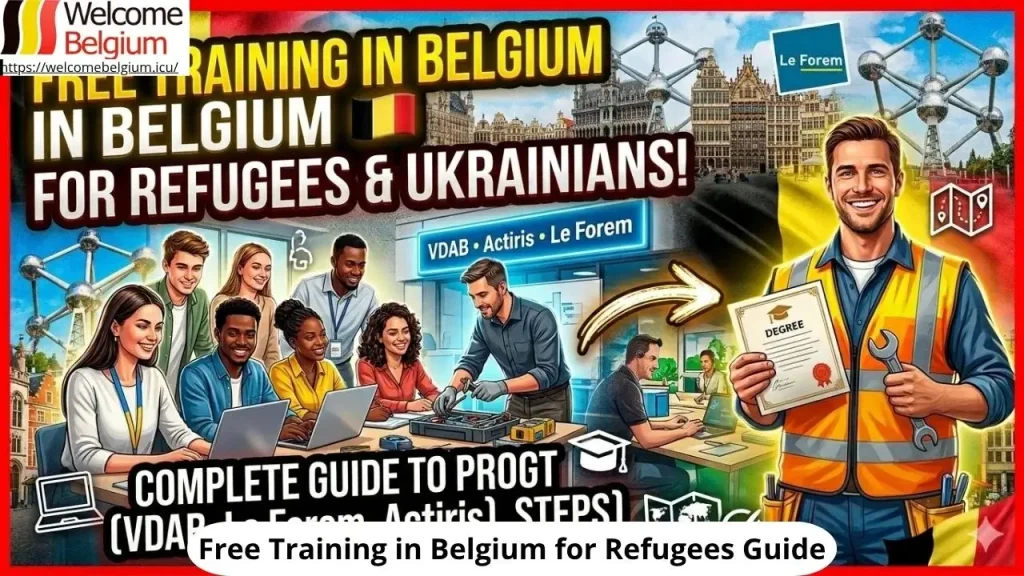
Professional training for refugees in Belgium is one of the most effective paths toward integration. It allows you to restart your career in a new country and secure a high-demand, stably compensated specialty.
Belgium’s regulatory framework is constantly adapting, and this year has brought critical reforms that substantially alter the current approach to job-seeker integration. To understand how these changes fit into the broader legal landscape, you can read our complete analysis of the 2026 Belgian migration policy updates.
Who is Eligible for Free Courses?
State-funded retraining programs are accessible strictly to specific categories of residents:
- Holders of Temporary Protection Status: Citizens of Ukraine and their family members.
- Recognized Refugees: Foreign nationals who have received official approval from the Belgian authorities.
- A Card (Carte A) Holders: Residents with a valid temporary residence permit.
- Annex 15 (Annexe 15 / Bijlage 15) Holders: Applicants currently awaiting the issuance or renewal of their primary residence document.
Possessing any of these legal statuses generally grants you the right to apply for free professional education programs.
How State Retraining Works in Belgium
Belgium does not operate a single, centralized federal employment agency. Instead, integration and career relocation matters are fully decentralized and managed at the regional level across Flanders, Wallonia, and Brussels.
To help you navigate this system, I have mapped out the core structure in the table below:
| Belgian Region | Official Authority (Employment Agency) | Key Benefits for Trainees |
| Flanders | Official portal vdab.be (Vlaamse Dienst voor Arbeidsbemiddeling en Beroepsopleiding) | Maintenance of the RIS social allowance, travel expense coverage, childcare subsidies, and free NT2 Dutch language courses. |
| Wallonia | Official portal leforem.be (Office wallon de la Formation professionnelle et de l’Emploi) | Additional hourly training bonus (Formation rémunérée) and transportation reimbursement. |
| Brussels | Official portal actiris.brussels + bruxellesformation.brussels (French-language courses) | Accelerated employment tracks in capital-specific sectors (IT, healthcare, finance). |
Welcome Belgium Expert Insights: Critical Mistakes to Avoid
Based on internal observations and client cases handled by Welcome Belgium consultants over recent years, roughly 65% of applicants make critical mistakes at the starting line, which can delay their support approval by weeks or even months.
- Bypassing the CPAS during registration: Applicants frequently discover a course via Le Forem or VDAB, sign up independently, and present their social caseworker with a fait accompli. This practice often triggers additional administrative verifications by the CPAS and stalls the onboarding process. The Solution: Always secure a written notification and green light from your caseworker before committing to a course.
- Disregarding the language module: Many try to jump straight into technical training with zero or weak foundational language skills, expecting to catch up along the way. In 2026, regulations tightened significantly. Without passing an initial language screening and proving a foundational baseline, you will simply not be permitted to enter the mandatory corporate internship phase.
The strength of the Belgian framework lies in its comprehensive state backing. You are provided with free education alongside conditions that protect your baseline income:
- Retention of CPAS (OCMW) benefits: You continue to receive your social allowance (Revenu d’intégration sociale — RIS) throughout the entire duration of your studies.
- Direct expense coverage: Regional centers cover the purchase of your work clothing and technical tools, reimburse public transit commutes (trains, buses), and can even subsidize childcare costs while you attend classes.
- Course durations: Depending on the target economic sector, training tracks span from 3 weeks (short-term modules) up to 12 months (comprehensive qualifications including a corporate internship — stage).
This setup operates under strict Belgian and EU statutory frameworks. The foundational legal pillar is the Belgian Aliens Act of December 15, 1980 (Loi sur l’accès au territoire, le séjour, l’établissement et l’éloignement des étrangers). Up-to-date rules regarding temporary protection are regularly maintained and updated via the Official IBZ (Dofi) website. Your rights to integration, social welfare, and coordinated regional agency deployment are governed by the Royal Decree of July 11, 2002 (Loi concernant le droit à l’intégration sociale).
Key 2026 Regulatory Update:
The official Wallon Program Decree of March 26, 2026 (Décret-programme portant des mesures diverses) has officially come into force. This document provides the statutory foundation for seamless data exchange and case coordination between the Le Forem employment office and local CPAS social services. By establishing a unified digital applicant profile, it significantly mitigates bureaucratic delays when approving training programs for immigrants and refugees.
Alex’s Pro-Tip:
Never enroll in any training program behind your CPAS social caseworker’s back — always secure written confirmation prior to the start date. Once the employment agency and social services approve your customized retraining path, you generally retain your full rights to your allowance and can confidently claim additional stipends for transport and childcare.
Training in Flanders: Free VDAB Courses
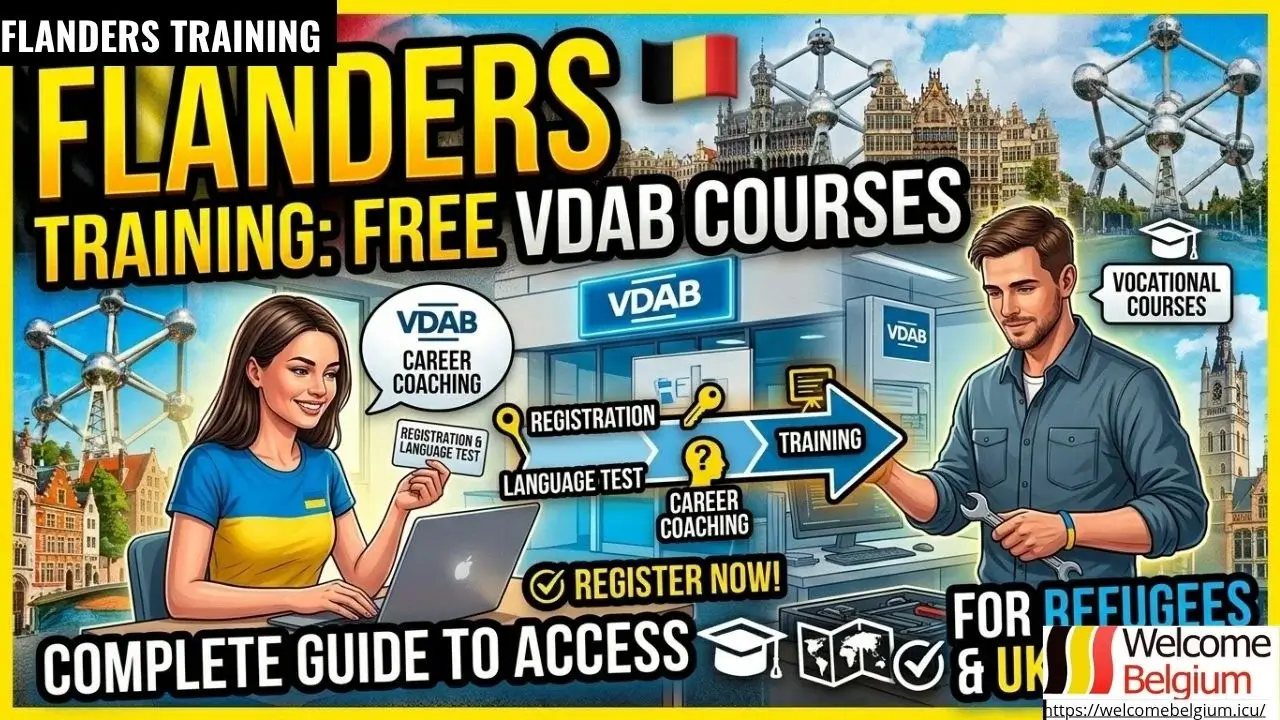
If you reside in the Flemish region of Belgium, your primary point of entry for job hunting and career retraining is the VDAB (Vlaamse Dienst voor Arbeidsbemiddeling en Beroepsopleiding). The agency provides extensive support programs, including specialized professional training courses for foreign nationals, which can be explored directly on their official platform.
Step-by-Step Registration and Course Selection
To access state-funded programs and organize free training in Flanders for Ukrainians and refugees, you need to complete four key stages:
- Candidate Registration: Head over to the official be website and set up your personal account (“Mijn Loopbaan”). If you find it challenging to navigate the system in Dutch, you can visit your local VDAB office in person, where the staff will assist you in creating your profile.
- Language Screening: Since the instruction is delivered in the local regional language, you will be scheduled for a language assessment. If your proficiency level is insufficient, you will be offered a free, intensive Dutch language course tailored for employment (NT2 module).
- Coach Interview: You will be assigned a personal career consultant (trajectbegeleider). Together, you will assess your past professional skills and map out an educational path—ranging from foundational technical trades and logistics to advanced IT certifications.
- Commencing Training and Internship: Once your customized trajectory is officially approved, you will proceed to theoretical classes, which strictly culminate in a practical internship phase within a real Belgian enterprise.
Real Case Study: From Language Learning to a Fixed-Term Contract
This story is based on a typical scenario experienced by Welcome Belgium project clients. Personal data has been altered for privacy.
The Case of Igor (34 years old, Kharkiv)
Igor relocated to Antwerp under temporary protection status. At the start, he spoke only foundational English and possessed no qualifications in high demand on the Belgian labor market. He officially registered on the vdab.be portal and requested career advancement support.
The VDAB immediately routed him to a free intensive Dutch language track (NT2 module). As soon as Igor achieved a baseline conversational proficiency, his coach matched him with a targeted 6-month training program for forklift operators (heftruckchauffeur).
During his studies, Igor completed a mandatory corporate internship at a large logistics warehouse located within the Port of Antwerp. He performed exceptionally well on-site, and upon course completion, the enterprise signed a permanent, open-ended contract (Vast contract) with him. Crucially, throughout his months of language acquisition and trade mastery, the local CPAS social utility fully maintained Igor’s baseline social allowance.
Important Note:
If you plan to build a career in logistics, transportation, or manufacturing, Flanders is an ideal region. Do not let the language barrier deter you: VDAB training tracks for international residents are structured so that you pick up professional, job-specific Dutch directly during hands-on practical modules, while the industry demand for qualified operators in the Port of Antwerp vicinity remains consistently high.
Training in Wallonia: The Le Forem Course Catalog
For those who have settled in the French-speaking part of the country, the primary public provider of educational tracks is Wallonia’s employment service. Professional training programs in Wallonia are highly popular among immigrants for good reason: the regional employment exchange offers some of the most financially advantageous conditions for career retraining nationwide.
Advantages of Retraining via Le Forem
If you are officially registered as a job seeker (demandeur d’emploi) on the official leforem.be portal, an extensive catalog of professional training options becomes accessible to you.
Aside from the fact that Wallonian professional courses are provided completely free of charge, the state also grants qualified candidates a specific financial training stipend. For professional training tracks (formations métiers) lasting over 140 hours that commenced after April 1, 2026, a fixed Le Forem premium of 2 € gross per hour of attendance is provided, subject to specific social criteria.
This bonus is paid directly on top of your standard social allowance, serving as an excellent baseline incentive for successfully mastering a new profession.
Step-by-Step Registration in Wallonia
Securing a training referral in the French-speaking region involves a specific administrative approach:
- Initial Contact (Crucial): If you are a foreign national (including Ukrainians under temporary protection), the system will prevent you from completing your initial onboarding online. You must either call the official hotline at 0800 93 947 or physically visit your nearest local Le Forem office so that a customer service representative (Service Clientèle) can verify and activate your registration profile.
- Account Activation: Once a staff member inputs your documentation into the central database, you will receive access to your personal digital portal (Mon Espace Forem). At this point, you officially hold the status of a job seeker (demandeur d’emploi).
- Interview and Course Selection: You will be assigned a French-speaking career consultant. You will evaluate the Le Forem professional training options and pick your target trade. If your current French level is insufficient, your initial step will be an official referral to free language training directly through the employment bureau.
- Signing the Training Contract: Before classes begin, you sign a formal educational agreement. From this moment on, all student benefits are activated, including complimentary public transport passes and the hourly training bonus (formation rémunérée).
Real Case Study: Career Redirection with a State Financial Bonus
This story is based on a typical scenario experienced by Welcome Belgium project clients. Personal data has been altered for privacy.
The Case of Elena (41 years old, Kyiv)
Elena lives in Liège under temporary protection status. Holding a degree in economics from her home country, she realized that without near-native French skills, securing an immediate position in her field would be unrealistic, so she opted to pivot toward administrative support. She approached her local employment office and enrolled in a public professional training program via Le Forem.
The state fully funded Elena’s 8 months of intensive training. Furthermore, because the course qualified as a formation rémunérée, Le Forem paid her an attendance-based stipend (roughly 150 € per month over her baseline CPAS benefits) and entirely covered her train commutes from her residence to the educational center.
Elena passed her final exams, secured an officially recognized Belgian certificate, and immediately transitioned into a workplace role at a local medical commune.
Alex’s Pro-Tip:
When browsing the Le Forem catalog, prioritize training tracks marked as “formation qualifiante” (qualifying). It is within these specific frameworks that Le Forem Wallonia structures its curriculum to ensure you are legally entitled to receive a diploma recognized by regional employers upon passing your exams. The added hourly bonus further assists in covering minor household expenses throughout your studies.
Courses in Brussels: Actiris and Bruxelles Formations
The Brussels-Capital Region operates within its own distinct administrative framework. As an officially bilingual territory, the local job market places elevated language demands on candidates. However, the potential career growth and financial upside here are substantially higher than in provincial areas.
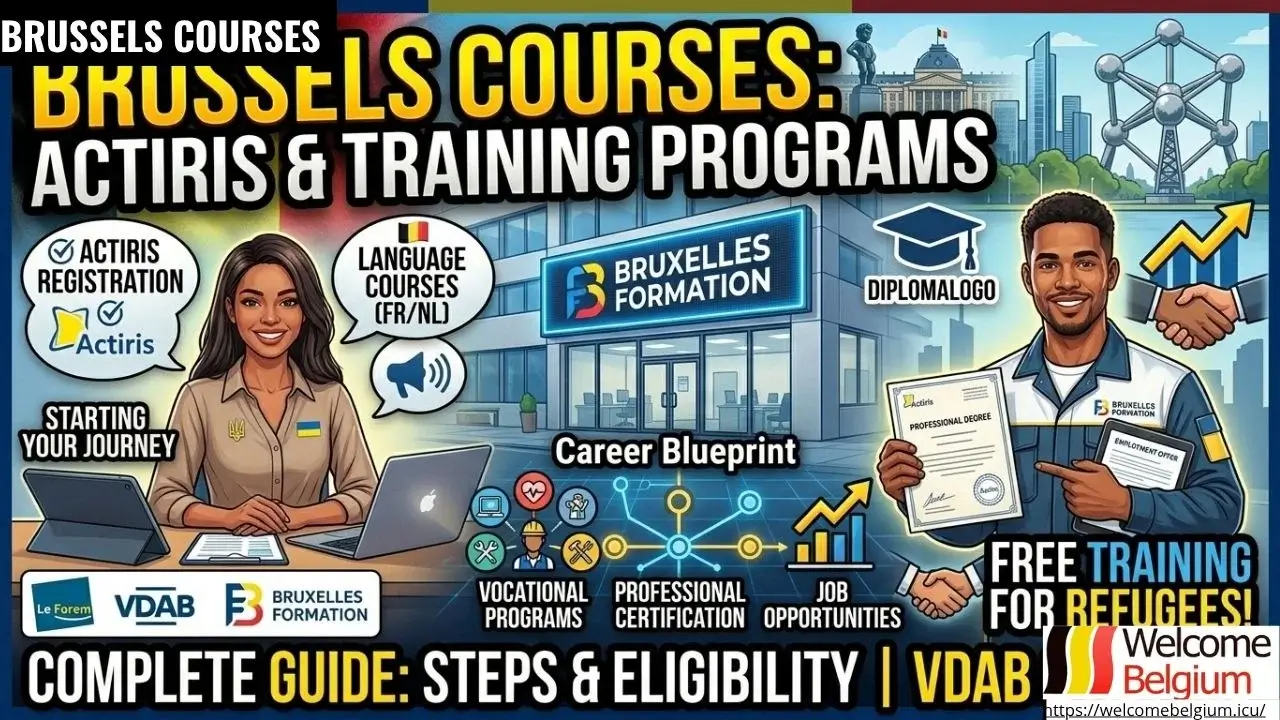
In the capital, the public network is split into two specialized divisions: job placement and candidate tracking are managed by Actiris, while professional training delivered in French is administered by Bruxelles Formations.
How the Capital’s Training Framework is Structured
To gain access to free public educational programs in the capital, you will interact simultaneously with both regional offices:
- Registration with Actiris: This is your primary, mandatory baseline step. You must register as a job seeker on the official brussels portal. Once onboarding is complete, a personal counselor will handle your file, and you can officially request free language vouchers. Brussels offers an immense variety of language modules (French, Dutch, and English), as local integration is practically impossible without them.
- Selecting a Program at Bruxelles Formations: Once your job-seeker status is active, you can select specialized training tracks. Actiris works in direct structural partnership with the brussels educational center, which acts as the primary hub aggregating all state-funded professional programs.
Thanks to direct public funding, an extensive selection of high-tier tracks is accessible to you completely free of charge—ranging from corporate accounting and logistics administration to in-demand medical nursing and specialized IT paths (including software programming, cybersecurity, and systems administration).
Official Employment Statistics
Capital training hubs operate in continuous, direct alignment with real corporate employers. According to independent employment insertion data published by Bruxelles Formations, the transition-to-work rate for graduates of these professional courses consistently stabilizes around 70%, peaking within higher technical and specialized secondary training tracks.
This stands as one of the highest employment rates in the country. The rationale is straightforward: Bruxelles Formations fine-tunes its educational curricula to match real-time regional labor shortages, meaning that graduates frequently secure a job offer while still completing their corporate internship phase.
How Much Can You Earn After Training?
To give you a clear understanding of the financial return on your 3-to-12-month commitment to training and practical stages, we have compiled an estimated overview of median entry-level salaries in Belgium across high-demand trades commonly pursued by public program graduates:
| Specialty Trade | Target Belgian Region | Average Starting Salary (Gross Monthly) |
| Certified Welder | Flanders | 2800 – 3800 € |
| Industrial Electrician | Wallonia | 2600 – 3700 € |
| Forklift Operator (Heftruckchauffeur) | Flanders / Brussels | 2500 – 3400 € |
| Multilingual Administrative Assistant | Brussels | 2700 – 3500 € |
If you are looking ahead to your post-training employment options, find out how to secure a Belgian residency after a corporate internship.
Important Note:
Capital training cohorts are assembled around strict, predefined calendar enrollment deadlines, and the candidate application queue is highly competitive. Do not delay your document submission: the moment you identify a suitable track in the catalog, immediately request an official testing referral from your designated Actiris consultant.
Immigrant Training in Belgium: 2026 Regulatory Updates
Belgium’s regulatory framework is constantly adapting, and this year has brought critical reforms that substantially alter the current approach to job-seeker integration. If you are planning to launch your career retraining track right now, you must take into account the new rules implemented by regional employment agencies and the federal government.
Key Innovations for Refugees and Holders of Temporary Protection
Let us look at the three major legal and practical updates Belgium has introduced for refugees and status holders:
- Official Extension of Status Until 2027: The most important news, which completely eliminates past legal uncertainty, is the official extension of temporary protection within the EU and Belgium until March 4, 2027. This means your A Card (Carte A) remains fully valid. You now hold a definitive legal right to enroll in long-term, year-long courses under existing compliance metrics, allowing you to complete your training and qualify for a diploma.
- Integration Reform in Wallonia via Le Forem: Starting this year, integration tracks in the French-speaking region have been officially expanded. While the standard process was previously capped at 18 months, Le Forem’s regional reform has shifted focus toward long-term applicant support and employment wage subsidies spanning up to 3 years post-training. Integration hubs now place immense structural emphasis on socio-professional orientation. Furthermore, language entry barriers have been significantly lowered: to access professional training, a flawless command of French is no longer mandatory—for a wide range of technical specialties, proving a basic intermediate baseline (A2 level) is now sufficient.
- Radical Labor Market Realignment in Flanders: The Flemish employment service has published its official VDAB list of labor-shortage occupations for 2026 (Knelpuntberoepen 2026). Public funding priorities have systematically pivoted away from unskilled labor toward the training of heavy truck and industrial machinery operators, roofers, technicians, and accountants.
Be sure to carefully examine the updated shortage lists in your specific region before applying. Training paths corresponding to occupations on these registers are routinely approved by social services on a priority basis, which substantially increases the likelihood of successful employment immediately upon graduation.
What Documents to Prepare in Advance
To maximize your enrollment speed and prevent processing backholds by reviewing agencies, compile the following document package required for training in Belgium:
- Identity Verification and Legal Status: A valid plastic A Card (Carte A) or the official written decision granting temporary protection.
- Municipal Registration: A certificate of registration at your place of residence (Annexe 15 / Bijlage 15) or an extract from the national registry confirming your physical address within your specific region.
- National Identification Number: Your unique national registry number (Numéro de registre national / Rijksregisternummer) — located directly on the reverse side of your ID card.
- An Updated Resume (CV): Tailored in the primary language of your region (French or Dutch). Your CV must explicitly outline your entire historical work history and educational achievements completed in your home country.
- Diplomas and Certifications (if available): Copies of your educational credentials. Even if they have not yet undergone official equivalence (academic recognition) review in Belgium, they enable the employment office coach to accurately evaluate your academic background.
- Written Authorization from the CPAS: Official signed consent from your assigned social caseworker approving your chosen training track (strictly required to maintain your social assistance payouts). If you are new to this system, check out our dedicated guide on navigating the CPAS (OCMW) social assistance system in Belgium.
What to Do Right Now: An Applicant’s Checklist
If you are ready to initiate your professional retraining path, execute this streamlined action plan based on your designated region of residence:
If you live in Flanders:
- Register online at the official be platform or visit a local branch office in person.
- Undergo the mandatory regional language screening to determine your current Dutch proficiency.
- Get in touch with your case manager at the CPAS and obtain a written confirmation verifying that they approve your educational trajectory.
- Request an official enrollment referral from your VDAB career coach for a selected course featured on the active shortage occupations list.
If you live in Wallonia:
- Reach out in person or via the central telephone hotline to Le Forem at 0800 93 947 (note that initial digital registration is unavailable for international residents).
- Declare your formal intent to enter an integration pathway and select your desired trade course from the public catalog on be.
- Request a specialized language screening (an A2 baseline is fully sufficient for numerous training tracks in 2026).
- Sign your formal training contract to activate your student benefits, including the hourly stipend of 2 €.
If you live in Brussels:
- Register as an active job seeker on the official brussels portal.
- Request a state voucher to access free foundational language courses (French or Dutch).
- Select your target professional profile within the brussels educational catalog and submit your application for programmatic entry testing.
Frequently Asked Questions (FAQ)
No, but your social allowance from the CPAS (OCMW) or unemployment benefits are fully maintained. In Wallonia, through Le Forem, an additional bonus of 1–2 euros is paid for each hour of class, and travel expenses are covered.
The vast majority of courses are conducted in French or Dutch. Exceptions include certain specialized IT tracks and international programs in Brussels and major cities across Flanders.
No, provided that the training program has been officially coordinated and approved by your social caseworker and the regional employment agency.
Tracks range from 3–6 weeks (short practical modules) up to 6–12 months (comprehensive qualifying programs that include a corporate internship).Is a student stipend paid during free training in Belgium?
Is it possible to study in English?
Will the CPAS revoke my allowance if I enroll in a course?
How long does professional retraining for immigrants last?
Free career retraining in Belgium is a definitive opportunity to secure a stable income. The state fully funds your education, covers accompanying expenses, and assists with language acquisition. The sooner you initiate the registration process with your regional employment service, the faster you will acquire a new qualification and enter the Belgian labor market.
List of Official Sources:
- Belgian Immigration Office —ibz.be
- Employment Agency of Flanders — vdab.be
- Employment Agency of Wallonia — leforem.be
- Employment Agency of Brussels — actiris.brussels
- Brussels Training Center — bruxellesformation.brussels
Disclaimer
This article is for informational purposes only. Regulatory rules and institutional shortage registers are subject to modification. For precise individual verification, always consult directly with your assigned CPAS caseworker or regional employment bureau representative.