Last Updated on June 1, 2026 by Alex
Hello! I am Alex, an Integration and Administrative Consultant at welcomebelgium.icu. In immigration and relocation planning, foster care (foster care in Flanders / accueil familial in Wallonia) is frequently confused with legal adoption (adoption). However, fostering a child or an adult in Belgium is not a change of legal parentage. It is a strictly state-monitored framework that provides temporary residence in a Belgian household for children or vulnerable adults during a crisis, ensuring their official biological family ties remain legally intact.
Belgian family and social legislation is highly decentralized, meaning that procedures in Flanders and Wallonia are governed by entirely separate government agencies. Today, navigating this framework is equally critical for both Belgian nationals and expats planning to step into a caretaking role. Understanding these regional administrative nuances is the only way to avoid legal traps and seamlessly integrate into the Kingdom’s social support structure.
Legal Models: Types of Host and Foster Families
To help you quickly grasp the structural layout of Belgian foster care, I have compiled a comprehensive summary table. This matrix outlines how legal responsibilities and placement timelines are distributed across different legal models, complete with direct links to the relevant authorities:
| Care Model | Target Audience | Average Placement Timeline | Governing Authorities (By Region) |
| Emergency Placement
(Accueil d’urgence / Crisisopvang) | Children in acute crisis situations | 15 to 45 days | Flanders: Opgroeien Wallonia: ONE Brussels: Couleur Café Assistance / Local Services |
| Long-Term Foster Care
(Longue durée / Perspectiefbiedend) | Minors lacking stable parental care | Years (up to 18 years old) | Regional Youth Courts and regional child protection agencies (Pleegzorg) |
| Adult Foster Care
(Accueil familial pour adultes) | Adults with mental or physical disabilities | Indefinite / Lifelong | Flanders: VAPH Wallonia: AVIQ |
| Cultural Exchange
(Host Family / Au Pair) | International students and Au Pair participants | 3 to 12 months | Federal Level: Belgian Immigration Office (IBZ) |
The family placement ecosystem is strictly regulated by regional statutory decrees. In the Flemish Region, the primary legal foundation is the Decreet houdende de organisatie van de pleegzorg, with all field operations centralized under the state agency Opgroeien.
In the French-speaking community (Wallonia and Brussels), activities are legally anchored by the Décret portant organisation de l’aide d’urgence et de l’accueil familial, where the Administration de l’Aide à la Jeunesse serves as the central administrative body. These regional statutes dictate exactly how temporary residence within a Belgian household must be executed.
State social services categorize family placements into several primary operational models based on the host’s legal obligations:
- Short-Term (Emergency) Placement (Pleegzorg in nood / Accueil d’urgence): The immediate, urgent placement of a minor for a duration spanning from a few days to a few months. This acts as a buffer window while authorized regional caseworkers assess and resolve the acute crisis within the biological family.
- Long-Term Foster Care (Perspectiefbiedende pleegzorg / Accueil de longue durée): A stable, long-term arrangement where the child resides with a foster family in Belgium for multiple years, often until they reach legal adulthood at 18.
- Adult Foster Care (Pleegzorg voor volwassenen / Accueil familial pour adultes): A specialized segment of Belgian caregiving designed for adult individuals with cognitive or physical disabilities. This framework provides a dedicated family environment (host family care) as a humane, community-based alternative to long-term institutionalization in a medical center.
Beyond social welfare placements for vulnerable individuals, international educational exchange programs follow a separate path. Standard cultural exchange initiatives enable foreigners (students or Au Pairs) to live in Belgium via short-term contracts signed directly with a local host family. This specific format is regulated strictly by Belgian immigration and labor laws, binding the host family to strict integration and domestic support parameters.
Real-World Case Study: Navigating an Emergency Foster Care Placement
In my day-to-day practice as an administrative consultant handling family cases in Wallonia, I managed a case involving the French-speaking child protection services. Following an expedited ruling by the regional Juvenile Court (Tribunal de la jeunesse), a minor was removed from their biological home due to an immediate safety crisis and placed with certified foster parents under the accueil d’urgence emergency protocol.
The defining characteristic of this case was the uncompromisingly rigid timeline built into the state contract. The initial placement was capped at exactly 45 days. Throughout this temporary window, the caretakers were legally responsible for day-to-day upbringing but possessed zero authority to make strategic, life-altering decisions—such as changing the child’s school. Absolute legal custody remained with the state-appointed legal guardian (tuteur aux biens/personnes).
Upon the expiration of the 45-day mark, the state caseworker officially authorized a single extension for an identical period. This extra window was mandatory to allow social services to conclude a rigorous audit of the biological parents’ living conditions. This case reinforces a vital administrative reality: emergency foster care in Belgium is a strictly temporary mechanism operating under the absolute, microscopic oversight of the judicial system.
Expert Commentary (Alex, welcomebelgium.icu):
Throughout my years coordinating integration cases with regional caseworkers at ONE and Opgroeien, I have learned that Belgian social services never view emergency or short-term fostering as a “backdoor” or a shortcut to adoption. If your primary family goal is permanent legal adoption, applying for foster programs is a severe administrative misstep. The Belgian family courts will always prioritize reunifying the child with their biological parents the exact moment their domestic situation stabilizes.
Who Can Become a Foster Family in Belgium: Requirements and Criteria
Selection standards for candidates at the state level are strict. Belgian social services perform detailed background checks on applicants. Anyone seeking to understand how to become a foster family in Belgium must meet these baseline parameters.
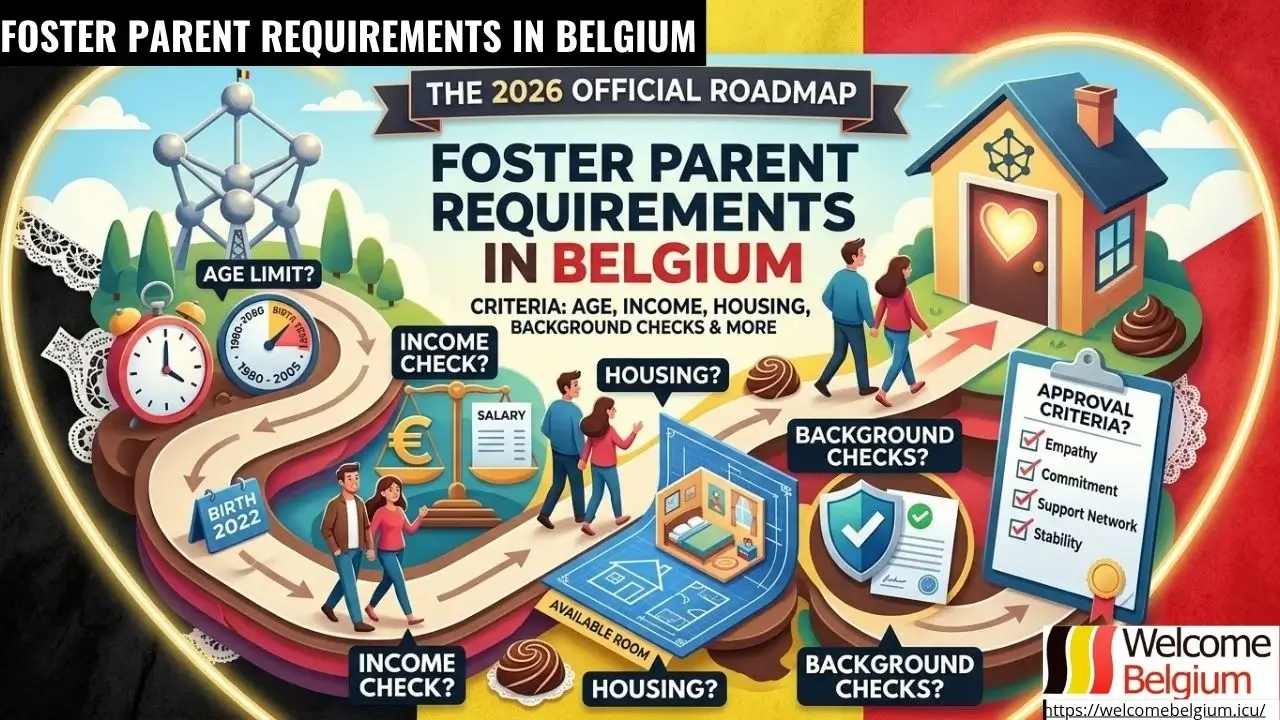
There are no restrictions regarding marital or civil status in the legislation. Foster caretakers can be married couples (including same-sex unions), individuals in official or de facto cohabitation, or single applicants. The minimum age for a candidate is 18 years old, but in several long-term programs in Flanders and Wallonia, the threshold is shifted to 21 or 25 years.
The legal foundation establishing the core status of foster caretakers and candidate selection criteria at the federal level is the law Loi relative au statut juridique des accueillants familiaux (Law on the Legal Status of Foster Parents). This statutory act rigidly regulates the balance of rights and obligations between the host family, biological parents, and social welfare agencies.
The main requirements for a foster family in Belgium include four strict criteria:
- No Criminal Record: All adult household members must provide a criminal record certificate (Extrait du casier judiciaire / Model 596.2). Any history of offenses involving violence or neglect of duties results in an automatic rejection.
- Financial Stability: The family must have independent sources of income that fully cover their own baseline needs. Foster care allowances cannot be considered as the primary source of household budgeting.
- Psychological Readiness: Candidates undergo a multi-stage psychological test and a series of in-depth interviews with social workers to assess motivation and stress resilience.
- Living Space: Housing must meet strict regional sanitary codes. The main condition is a separate, isolated room for the foster child to ensure their personal space.
Finding the right property is a crucial step for any expat. Check our accommodation options in Belgium to see what type of housing suits your goals.
Many are concerned about whether living in a foster family in Belgium is accessible to foreigners as a host family. Yes, it is legal. The Kingdom’s legislation allows expats to become foster caretakers if they are residing in the country on legal grounds.
Foreign candidates must hold a long-term residence permit or permanent residency (type B, C, D, L cards or equivalents). A permanent employment contract and a verified tax contribution history, displayed in the personal profile of the MyMinfin tax service portal, are also required.
Practical Case Study: Housing and Income Audit
Recently, I was helping a married couple of expats from Antwerp with their documents, and their story is a classic example of how things can fall through over small details. The guys had everything perfect: long-term residence cards, permanent contracts (CDI) with an excellent income, which we checked together through MyMinfin, and a gorgeous designer loft with an area of more than 120 square meters. They passed the financial checklist without a single hitch. But at the stage of the inspector’s visit from Pleegzorg, everything stalled.
The loft had an open-space layout, and the child’s area was separated from the living room by a beautiful sliding screen. The inspector rejected the case on the spot: according to strict Belgian safety standards, a child must have full privacy—solid walls and a solid door that closes from the inside. The guys had to urgently move and rent a classic house to pass a second audit.
Advice:
No matter how much I talk to Belgian social workers, they always admit: one of the main hidden triggers for rejecting expats is a “borderline” status of documents. If you plan to launch a screening, check your residence card. If there is less than a year left until its renewal (especially regarding temporary Type A cards), the procedure will most likely be frozen.
Care agencies are terrified of administrative instability for the child, so I recommend submitting the application immediately after you update the plastic card at your commune.
Step-by-Step Application Process: From Application to Placement
To fully understand how to become a foster family in Belgium, it is necessary to navigate a strictly regulated administrative route. The procedure is standardized, but the point of entry and the coordinating agencies depend entirely on your region of residence.
Below is the step-by-step algorithm that awaits every guardianship candidate in Belgium.
Step 1: Submitting the Initial Application
You need to contact the relevant state agency in your region by filling out a form on the official website or by calling:
- Flanders: The Opgroeien Initial contact is made through regional branches of the Pleegzorg service. Central office phone: +32 2 533 12 11. Official application website: pleegzorg.be.
- Wallonia: The ONE (Office de la Naissance et de l’Enfance) service. Phone: +32 2 542 12 11. Official website: be.
- Brussels: The choice of agency depends on the language community. French-speaking residents apply to the Aide à la Jeunesse service, while Dutch-speaking applicants submit documents through the specialized branch of Pleegzorg Vlaams-Brabant & Brussel.
Step 2: Mandatory Training and Screening (Screening / Training)
After registering the application, candidates are directed to specialized information sessions and preparatory courses. This stage lasts from 3 to 6 months. The program includes lectures by psychologists, analysis of the legal aspects of co-guardianship, and basic medical training. The goal of this stage is the thorough validation of the candidacy and testing the psychological resilience of future guardians.
Step 3: Social Audit and Home Inspection
An assigned social worker will visit your home. They conduct a series of interviews with all family members and perform a physical inspection of the living space. Experts evaluate the sanitary condition of the home, the safety of the environment, and the presence of an isolated room.
Step 4: Obtaining Certification (Approval)
Based on reports from psychologists and social inspectors, the regional commission decides on issuing an official approval (certificate of conformity). This document confirms the right to arrange a foster family placement in Belgium.
Step 5: Matching Process and Waiting Period
After certification, the profile is entered into a closed state registry. The waiting time for a match is individual. In emergency care (accueil d’urgence), a call from the service may arrive within a few days. For long-term placement (longue durée), the process of finding a child who perfectly fits your family’s conditions can take from 6 to 18 months.
Possible Reasons for Rejection and What to Do in These Cases
Even with a sincere desire to help, candidates may face an official rejection from social services during the screening or audit stage. The most common legal and social reasons for rejection include:
- Inadequate Housing Conditions: The lack of an isolated personal space for the foster child or an unsatisfactory sanitary and technical condition of the property.
- Financial Instability: Absence of regular income (such as permanent CDI contracts), high levels of debt, or the discovery that the candidate expects to live solely on the foster care allowance.
- Health Issues or Psychological Risks: Detection of emotional instability during tests, hidden motives (for example, an attempt to replace the loss of one’s own child), or the presence of severe chronic illnesses that prevent proper care.
- Administrative Risks for Expats: A short-term residence permit (VHN) that does not guarantee the long-term stable presence of the guardian within Belgium.
Algorithm of Action Upon Receiving a Rejection:
- Request an official reasoned protocol. The social service is required to issue a written conclusion detailing the specific reasons. This will allow you to understand whether the rejection is final or if it can be corrected.
- Eliminate material markers. If the rejection is related to housing or income, you have the right to remedy the situation—change properties, do renovations, or provide new tax statements from MyMinfin after a change of job. Following this, an application to reopen the case is submitted.
- File an appeal. If you do not agree with the conclusions of the psychologists or social workers, you can contest the commission’s decision. In Flanders, the appeal is sent to the administrative board of the Opgroeien agency; in the French-speaking community, it goes to the higher authority, the Administration de l’Aide à la Jeunesse, within 30 days of receiving the notification.
Important from Alex:
Filing an appeal is a complex procedure. If you received a rejection due to psychological incompatibility confirmed by independent tests from the ONE or Opgroeien agencies, contesting it without involving a specialized family law attorney is practically impossible. The court and commissions always interpret any doubts strictly in favor of the child’s safety and interests, rather than the candidates’ ambitions.
Rights, Responsibilities, and Integration: How to Help a Child Adapt
When organizing a foster family placement in Belgium, the host party inevitably faces a clear division of legal authority. The Belgian legal system operates under the principle of split parenting. This means that the rights of foster parents in Belgium are significantly limited compared to classic adoption.
To avoid confusion regarding areas of responsibility, please refer to this summary table:
| Decision Sphere | Foster Parents | Biological Parents | Social Services / Court |
| Daily Life
(food, clothing, pocket money) | Decide independently | Have the right to know the conditions | Monitor the overall situation |
| Education
(school choice, changing academic profile) | Help with studies, attend parent-teacher meetings | Make decisions and sign documents | Act as an arbitrator in case of disputes |
| Medicine
(routine treatment vs. surgeries) | Resolve routine issues (colds, minor injuries) | Approve surgeries, hospitalization, and vaccination | Give consent in emergency cases |
| Travel
(leaving the home/country) | Can travel within Belgium | Give consent for travel outside the EU | Coordinate travel within the Schengen Area |
Division of Legal Rights and Responsibilities
Guardians take on the day-to-day upbringing and basic provisions for the minor, but strategic decisions always remain with the biological parents or a court-appointed state curator.
The foster family independently manages the daily educational process: monitoring performance, buying textbooks, and attending parent-teacher meetings. However, choosing a school or changing the form of education requires the mandatory written consent of the biological parents.
A guardian has the right to resolve routine medical issues, such as buying standard medications or taking the child to a family GP for a cold. Any surgical operations, vaccinations, or scheduled serious medical procedures must be approved by the official legal representatives. In life-threatening emergency situations, the decision is made by the hospital’s on-duty doctor.
Holiday trips within the Schengen Zone require advance notification to your social worker. If a trip with the child outside the European Union is planned, an official notarized authorization from the biological parents or the judicial authorities of Belgium must be issued.
Psychological Aspect: Adapting to Belgian Daily Life
The successful adaptation of a child into a Belgian family requires guardians to have a deep understanding of the local mentality and the structure of the social environment. If the child has a migration background, refugee status, or has been displaced from another linguistic region of the country, overcoming cultural shock comes to the forefront.
Daily life in Belgium follows a strict schedule: from the early start of school classes to the tight timing of extracurricular activities. Social integration becomes more complicated if the foster child is unfamiliar with local traditions, the rules of urban cohabitation, or the specifics of Belgian domestic life.
Psychologists identify several critical factors that the host family should pay attention to during the integration process:
- Overcoming the Language Barrier: The main trigger of stress is often not knowing the language spoken in the family or at school. Experts recommend not forcing things in the first weeks of living together. The adaptation process should happen smoothly, with an emphasis on using non-verbal communication methods at the initial stage.
- Synchronizing Daily Habits: The Belgian mentality involves precise daily planning (early wake-ups, fixed times for lunch and sleep). A child from a different cultural or family environment will need time and gentle support to get used to the new schedule.
- Accepting the School System: Belgian schools have their own characteristics and high requirements for independence. It is important for guardians to explain the rules of classroom behavior to the child step-by-step and help with their first homework assignments without creating unnecessary pressure over grades.
- Preserving Cultural Identity: The child may experience an internal conflict between the traditions of their biological family and the lifestyle of their new home. The task of the guardians is to create a safe emotional atmosphere where their past is respected.
Practical Case Study: Language Adaptation
When a Flemish family who had taken in a 9-year-old boy from the French-speaking region of Wallonia came to me for a consultation, they were panicking. The child did not understand Dutch at all, became withdrawn, and flatly refused to go to the local school in Ghent.
We quickly contacted their curator from Opgroeien and brought in a proven solution—specialized OKAN integration classes. Usually, migrant children are sent there, but the system works perfectly for internal language barriers as well. The boy was placed in a group where, instead of the standard curriculum, he was gently immersed into the Flemish environment through games and socialization.
Plus, the social service allocated a bilingual child psychologist. The result: after 8 months, the kid spoke Dutch fluently and transitioned to a regular class without any stress.
Advice:
From my experience interacting with regional curators from ONE and Opgroeien, Belgian social services are extremely sensitive about maintaining a balance regarding the child’s identity. As part of case administration, I always remind clients: you do not have the right to impose your religious views on the foster child or isolate them from their native cultural environment. The guardian’s task is to become a reliable guide into Belgian social life, while fully maintaining respect for the child’s past and roots.
The Financial Side of the Matter: Taxes, Allowances, and Compensations
Placing a child in a family is supported financially by the state. Host parents are entitled to monthly payments designed to compensate for the costs of maintenance, utilities, food, clothing, and pocket money for the foster child.
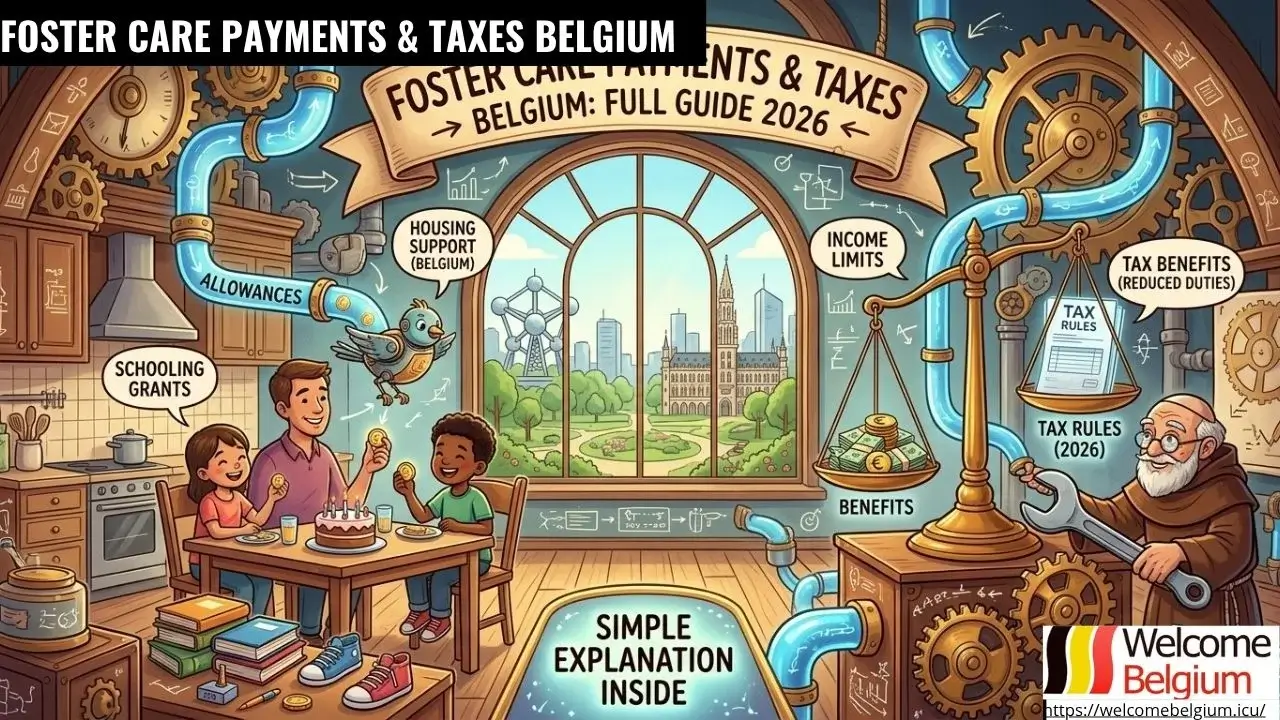
The amount and format of the subsidy depend on the type of care and regional legislation. The tax status of these payments has a number of important legal nuances that must be taken into account when filling out a tax return.
Foster Child Allowance in Belgium: Types of Material Assistance
In Belgium, the basic material support system consists of two key elements:
- Foster care allowance (Monthly cost compensation): Paid directly by the child care services to cover the daily needs of the foster child. The amount is calculated in the format of a daily rate (dagvergoeding). Its size depends on the age of the child. In Flanders, the current rates are set as follows: €17.50 per day for a child from 0 to 6 years old, €18.04 per day from 6 to 12 years old, €20.46 per day from 12 to 15 years old, and €22.34 per day from 15 to 18 years old.
- Child financial assistance package (Groeipakket / Allocations familiales): In addition to the basic expense compensation, a child placed in a foster family is entitled to a special allowance added to the child benefit (pleegzorgtoeslag). It amounts to a fixed €71.30 per month. The procedure for its payment depends on the format of care: in long-term placement (perspectiefbiedende pleegzorg), the allowance is transferred to the foster parents, while in short-term placement (perspectiefzoekende pleegzorg), it is retained by the biological parents.
Taxation and the Position of MyMinfin
The most crucial legal detail, officially established by the Federal Public Service Finances of Belgium (SPF Finances / MyMinfin), is as follows:
Official Rule: All state social payments, expense compensations, and foster care allowances (indemnités d’accueil / pleegzorgvergoeding) are exempt from income tax (exonéré d’impôt). They are recognized strictly as cost reimbursements rather than the personal earnings of the guardians. When filling out the annual tax return on the MyMinfin portal, these amounts do not need to be declared. They do not increase your taxable base and do not push you into a higher salary bracket on Belgium’s progressive tax scale.
In addition, foster parents are entitled to significant tax deductions. If the foster child is under long-term care and officially registered at your address, you can declare them as a “dependent child” (enfant à charge / kind ten laste). This increases your tax-free minimum (quotité exemptée) by a fixed amount. The deduction grid is structured as follows:
- 1 dependent child: increases the tax-free minimum by €1,980;
- 2 children: by €5,110;
- 3 children: by €11,440;
- 4 children: by €18,510.
If the child has a confirmed disability, the deduction amount for them is doubled.
Additionally, you are entitled to a tax deduction of 45% of officially documented expenses for kindergartens, after-school care, school clubs, or certified summer camps (frais de garde). The limit of eligible expenses is up to €17.30 per day for each child under the age of 14.
Where to Apply for Financial Assistance and Consultations
All payments are coordinated through official regional child benefit funds and tax offices. You can directly contact the following agencies regarding financial matters:
- Flanders (Groeipakket Fund): The central portal is be. Payments are made through authorized state funds such as FONS, Parentia, or KidsLife. Fund hotline phone: 02 897 11 00.
- Wallonia (Famiwal Fund): The main public operator of family allowances in Wallonia. Official website: be. Information phone: 0800 13 008.
- Brussels (Famiris Fund): The single child allowance distribution fund for the capital region. Website: brussels. Phone: 0800 35 123.
- Federal Tax Service (SPF Finances / MyMinfin): To check deductions, return codes (specifically code 1384 for childcare expenses), and personal data. Official reference portal: belgium.be. Central contact center: +32 2 572 57 27.
Important from Alex:
Please note that the dependent child tax deduction and the childcare/camp expense tax deduction for children under 3 years old are mutually exclusive options in the MyMinfin system. You must choose one or the other. Be sure to calculate both options using the Tax-Calc calculator on the Ministry of Finance website before submitting your return to understand which savings format is more beneficial for your specific income scale.
Specifics for Foreigners: Living in a Belgian Family under Exchange and Au Pair Programs
In addition to the state care system for vulnerable categories of citizens, international cultural exchange is highly popular in the country. A host family in Belgium for foreigners can act as a host party within educational initiatives or the Au Pair youth volunteer program.

This format is unrelated to social adoption. Exchange programs in Belgium involving living with a family are regulated by migration and labor law standards, aiming for language integration and mutual cultural enrichment.
Requirements for Participants and Visa Processing
To come to Belgium as an international guest under the Au Pair program, the candidate must meet strict criteria approved by the Kingdom’s Ministry of the Interior:
- Age Limit: At the time of filing documents, the participant must be between 18 and 25 years old inclusive (for citizens of non-EU countries).
- Basic Language Skills: The candidate must speak the basics of one of the official languages of Belgium (Dutch, French, German) or English at a conversational level.
- Education and Status: A minimum of a full secondary education certificate is required. Furthermore, the candidate must not have any previously issued work visas to Belgium.
- Mandatory Enrollment: The participant undertakes to enroll in certified language courses in Belgium and attend them regularly throughout the entire period of stay.
Foreigners from third countries are required to obtain a long-term student visa (Type D visa). The basis for its issuance at the consulate is an official work permit (the labor standard for Au Pairs), previously approved by the regional Ministry of Labor of Belgium at the request of the host family. A certified medical certificate and a clean criminal record extract must be attached to the application package.
If you plan to stay in the country after the program ends, we recommend that you study the requirements for obtaining a work visa in Belgium in advance.
Responsibilities of the Parties and Strict Limitations on Working Hours
The Au Pair program is based on a residence contract that stipulates the balance of mutual obligations. The foreigner receives free accommodation from the host family (a separate furnished room with a window), three full meals a day, and fixed pocket money.
Their legal minimum in Belgium is €450 per month. The payment is made strictly via non-cash transfer to a bank card; cash payments are forbidden.
In exchange for this, the guest assists the family with household chores (light cleaning, preparing simple meals) and helps with raising the children. However, Belgian legislation sets strict limits on the participants’ schedules to protect them from labor exploitation:
- Maximum working time is no more than 4 hours per day and no more than 20 hours per week. This limit fully includes all hours of babysitting and household help.
- The schedule must be fixed in the contract, and the participant is guaranteed at least one full day of rest per week.
- Au Pair participants are strictly prohibited from performing heavy physical labor, cleaning the entire house, caring for severely ill relatives, or being pulled into overtime hours.
If a family violates this limit, by law their contract is voided, and the relationship is reclassified into the status of a classic domestic worker employment, requiring the payment of the full minimum wage according to Belgian tariffs along with fines paid to the social security fund.
Practical Case Study: Changing Families under the Au Pair Program
I regularly receive messages from girls who came to Belgium under the Au Pair program and ended up in a domestic nightmare: the host family starts demanding deep cleaning of the entire house 24/7, completely forgetting about the 20-hour weekly limit.
Remember my main piece of advice: if a severe conflict erupts, never slam the door in the middle of the night to go “nowhere.” Leaving the home where you are officially registered on your own accord is a direct path to the cancellation of your Type D visa and deportation. We always navigate our way out of this dead end strictly according to the law: first, we write an official 2-week notice (délai de préavis), then I help them contact human rights advocates from Fairwork Belgium, who document the violations on the family’s part.
While this two-week period is running, a new host is selected through an accredited agency, who re-approves the contract at the Ministry of Labor. Only after this do we go to the commune and legally reissue the Electronic Residence Card (A Card).
Important:
Never leave a host family for “nowhere” by simply packing your bags in the middle of the night, unless your life or health is in direct danger. Leaving your place of registration without officially launching the contract termination procedure gives the host family the right to cancel your work permit unilaterally. The commune will automatically close your file, the Type D visa will become invalid, and you will instantly fall into the status of an illegal migrant under threat of deportation. Always document every step through an official agency.
FAQ: Frequently Asked Questions About Foster Care in Belgium
Can a single person arrange a foster family placement for a child in Belgium?
Yes. Belgian legislation allows single citizens and residents to become foster parents. The main condition is meeting the criteria for income stability and passing a psychological screening.
Is the foster care allowance in Belgium taxed?
No. According to the rules of the Federal Public Service Finances of Belgium (MyMinfin), foster care allowances are completely exempt from income tax and are not declared as personal earnings.
Can expats holding a residence permit (RP) become a host party for exchange programs?
Yes, provided you hold a long-term residence permit (Type B, C, D, L cards) and have a stable legal income. For individuals with temporary statuses, the option to register as a host family is unavailable.
What should be done if a child experiences adaptation problems while living with a Belgian family?
Immediately contact your personal social curator (from the ONE or Opgroeien agencies). The state provides free assistance from specialized psychologists, language coordinators, and mediators.
What is the minimum and maximum age of a child for long-term foster care in Belgium?
Minors from birth up to 18 years of age are accepted into care. At the same time, within the framework of specialized support programs for adults with disabilities (the VAPH system), care can continue indefinitely.
Is compensation paid if a child stays in a foster family temporarily over the weekend?
Yes. Belgium operates a flexible system of daily rates (dagvergoeding). The host family receives official monetary compensation for each actual day the child spends in the home.
Also, do not forget that for any type of long-term stay, having valid health insurance in Belgium is a mandatory requirement for document compliance.
The system of foster care and integration in Belgium is a tightly regulated structure where every step is supervised by the state. Regardless of the format (social care, support for adults with disabilities, or Au Pair exchange programs), candidates must undergo an audit of income, housing conditions, and psychological screening. Interaction with social curators (Opgroeien, ONE) and the correct use of tax preferences via MyMinfin will help make the child’s stay in the family comfortable and legal.
Official Sources of Information
- Belgian Federal Law on the Legal Status of Foster Parents: Loi relative au statut juridique des accueillants familiaux.
- Official Portal of the Government of Flanders on Foster Care: be — Pleegzorg
- Flemish Agency for Persons with Disabilities: VAPH (Vlaams Agentschap voor Personen met een Handicap)
- Official Page on Placing Adults in Foster Families: Pleegzorg Vlaanderen — Pleeggast
- Regional Dutch-speaking Foster Care Branch of Brussels: Pleegzorg Vlaams-Brabant & Brussel
- French-speaking Public Child Protection Agency (Wallonia): ONE (Office de la Naissance et de l’Enfance)
- Official Portal of the Ministry of Finance of Belgium: SPF Finances / MyMinfin
- Central Child Benefit Portal of Flanders: Groeipakket
- Human Rights Organization for the Support of Foreign Workers and Au Pairs: Fairwork Belgium
Disclaimer
The information in this article is for informational purposes only. Belgian legislation is regularly updated, and rules vary depending on the region of residence. This material does not constitute an official legal opinion. Before submitting foster care, applications or filing declarations via MyMinfin, it is recommended to obtain a personalized consultation from a specialized family law attorney or an accredited social worker.