Last Updated on May 26, 2026 by Alex
Greetings! Alex and Welcome Belgium are here to guide you. The first and most crucial thing to understand right away is that Belgium does not have a single, unified set of immigration rules. As soon as you begin your paperwork, you will find that the country is divided into three autonomous regions. The state-run integration programs in Belgium are a prime reflection of this decentralized structure.
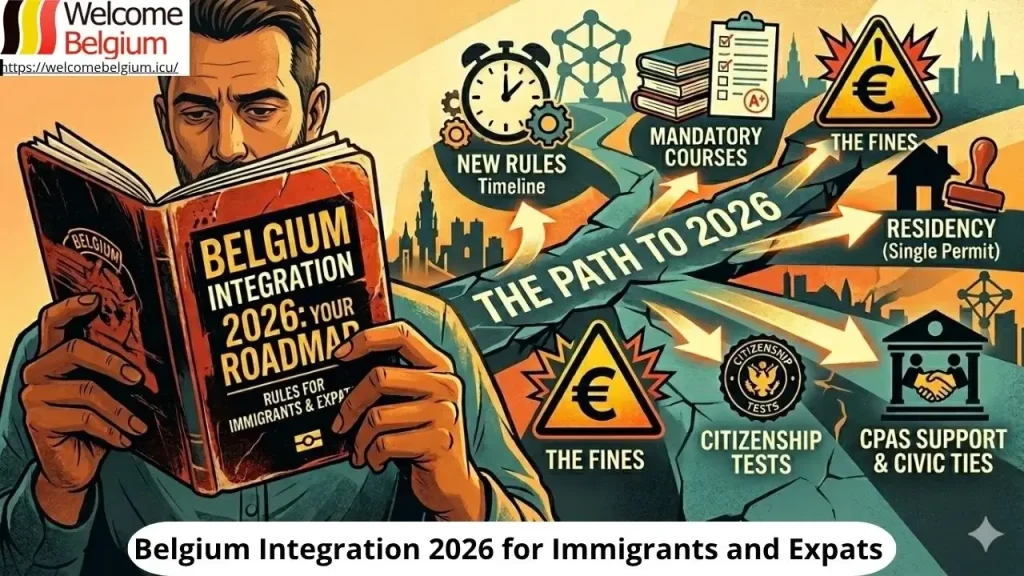
Among immigrants, there is a common misconception that integration courses in Belgium (Inburgering) are always entirely voluntary. However, in 2026, this is no longer the case: for many categories of residents, civic adaptation has become an official legal procedure.
Adaptation requirements depend entirely on your specific residency status. To save time, take a look at our summary table below. It quickly outlines whether integration in Belgium is required for your particular case, how much it costs, and which official bodies are responsible for it. Let’s dive into the details.
Integration Programs in Belgium in 2026: Summary Table and Requirements
The Kingdom’s legislation clearly categorizes foreign nationals based on their purpose of entry, establishing a specific residency status for each group. Consequently, the types of integration tracks and the depth of administrative oversight vary significantly.
Legal expectations in Belgium depend on the specific immigration “stream” you belong to. For some, an integration course in Belgium is a mandatory legal requirement, while for others, it serves as an administrative tool providing exemptions from certain bureaucratic tests, or a powerful bonus for future naturalization. To find your bearings, review the current requirements for 2026:
| Immigrant Category | Program Status (2026) | Responsible Authority | Cost | Impact on the Future |
| Refugees / Temporary Protection (Card A / Y) | Mandatory (In Flanders and Brussels) | Agentschap Integratie / CRI / CPAS | Free | Risk of CPAS benefit adjustments in case of non-compliance. |
| Expats / Employed Professionals (Single Permit / Blue Card) | Voluntary (Exempt if employed) | Agentschap Integratie / CRI | Depends on the region (from free to a nominal fee) | The certificate is a primary asset for obtaining Belgian citizenship after 5 years. |
| University Students (Card C) | Voluntary | University language centers | Paid (with student discounts) | Facilitates local adaptation and part-time employment during studies. |
| Family Reunification (Immigration to join a resident) | Mandatory (In most cases) | Commune / Integration Agency | Free / Paid (depends on the sponsor’s status) | A direct factor considered for the renewal of the residence permit (RP) for the following year. |
Who is Required to Take the Integration Course and Who is Exempt?
All types of civic integration pathways are governed by strict regional regulations published in the official state gazette of the Kingdom — Moniteur Belge.
- In Flanders (Northern Region): The foundational legal framework is the Decree of the Flemish Government of June 7, 2013, on integration and civic adaptation policy (Decreet betreffende het Vlaamse integratie- и inburgeringsbeleid). Under this decree, civic integration in Belgium is mandatory for immigrants arriving via family reunification with third-country nationals, as well as for individuals holding international protection status.
- In Wallonia (Southern Region): The Walloon Code of Social Action and Health (Code wallon de l’Action sociale et de la Santé) applies here. Recent updates have expanded the scope of the integration trajectory, making it mandatory for the majority of categories who do not hold a permanent employment contract.
- In the Brussels-Capital Region: The mandatory integration path for “primo-arrivants” (newcomers) is regulated by the Ordinance of the United Joint Commission (COCOM) dated July 20, 2023 (Ordonnance concernant le parcours d’accueil et d’accompagnement des primo-arrivants).
Exemptions:
High-skilled professionals arriving under a Single Permit or an EU Blue Card, as well as self-employed entrepreneurs and university students, are officially exempt from entering into an integration contract due to their ongoing economic or educational activity. For these individuals, the program operates on an entirely voluntary basis.
Tuition Costs and Financial Nuances
For refugees and individuals under temporary protection, all integration courses in Belgium (including intensive language classes up to the A2 level) are fully funded by the state.
For expats and financially independent residents, tuition costs depend on the specific region. In Flanders, a fixed administrative fee (approximately €90 per course component) may be charged for certain digital introductory modules or language assessments for economic migrants. Students cover their language courses independently, though they can access reduced rates through university language centers such as ILT (KU Leuven) or UCT (Ghent University).
Potential Consequences of Integration Contract Non-Compliance
If your status requires mandatory integration, your local municipality (commune) will request that you sign a contract within the first few months of receiving your residence permit. Non-compliance with the terms of this contract may lead to a number of legal and financial complications:
- For Refugees: Federal legislation coordinates social assistance with integration efforts. According to the Federal Law of May 26, 2002, on the right to social integration (Loi concernant le droit à l’intégration sociale), if systematic, unexcused absences from courses are recorded without a valid medical reason, the social welfare service (CPAS) is authorized to review your case. This may result in a partial suspension or a temporary reduction of your monthly social allowance within the framework of the Individual Social Integration Project (PIIS/ISIP).
- For Family Immigrants: Pursuant to the national Immigration Act of December 15, 1980, if a resident fails to show progress in their integration track or declines to participate, the commune is entitled to initiate a status review. The case may then be forwarded to the Immigration Office (Office des Étrangers) to determine whether your residence permit should be renewed for the following year.
- Administrative Fines: In addition to potential immigration review, regional decrees authorize integration agencies to report non-compliance to local municipalities, which may lead to administrative fines ranging from €100 to €2,500.
Case Study (Family Reunification):
Irina moved to join her husband in Antwerp (Flanders) and overlooked three official letters from the commune inviting her to sign the Inburgering contract, assuming that since she was temporarily unemployed, the courses were optional. Four months later, instead of a standard reminder, the family received an administrative fine of €250, and the commune temporarily paused the processing of her residence permit renewal until she provided proof of registration with the Integration Agency.
Connecting the Single Permit to Citizenship
Even if you arrived in Belgium on a work visa (Single Permit) and are officially exempt from the mandatory integration trajectory, I strongly advise against bypassing this program. Let’s look five years down the road, when your work visa or Blue Card qualifies you to apply for a passport from the Kingdom of Belgium.
According to the current nationality law, which can be reviewed in detail via the Moniteur Belge database, naturalization after 5 years of legal residency requires you to satisfy three main criteria: economic activity, language proficiency (minimum A2 level), and proven social integration into Belgian society.
An official certificate of completion from an Inburgering course is an officially recognized document that confirms you have met this requirement. This document serves as a substantial legal asset proving your social adaptation to the migration authorities. Immigrants who do not hold this certificate often have to take separate certified language examinations, provide extensive proof of uninterrupted employment, and undergo more detailed checks at the commune.
If your work schedule permits, completing this course voluntarily is a practical investment that can save you significant time and administrative stress when applying for Belgian citizenship in the future.
Regional Features of Integration in Belgium in 2026
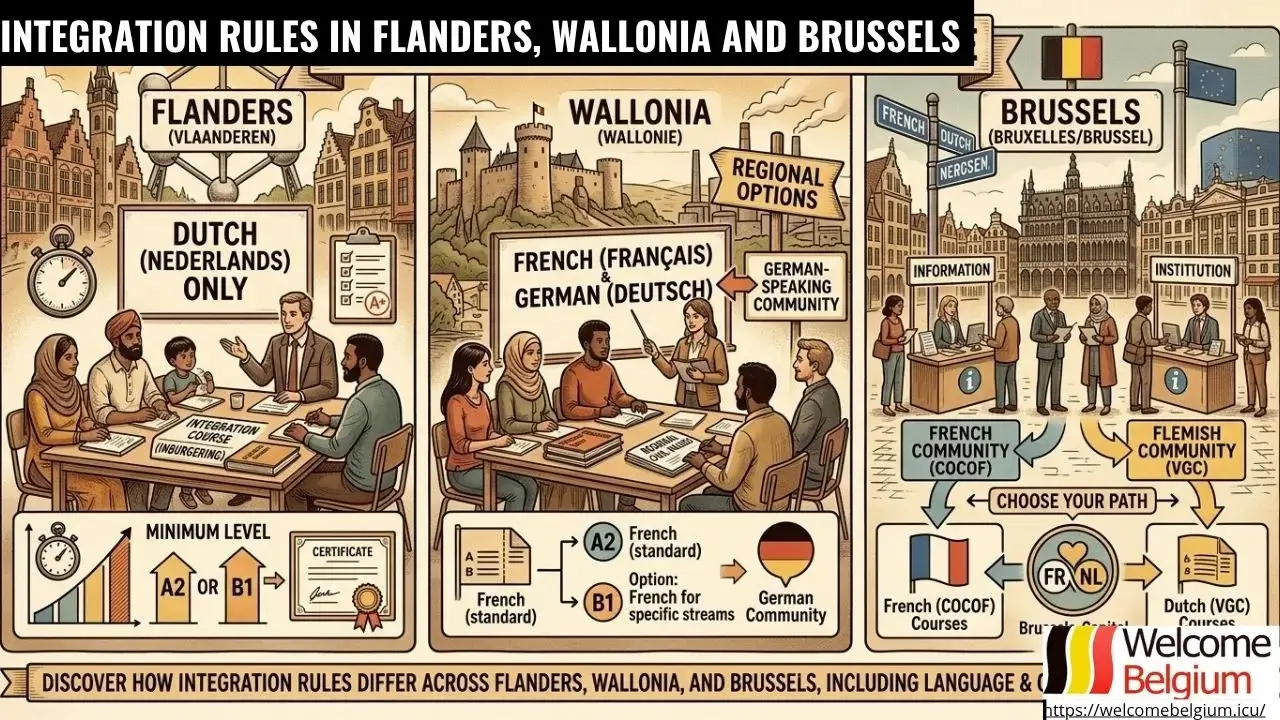
Due to variations in local legislation, what appears on paper as a single integration system in Belgium translates in practice into three distinct administrative procedures. Because authority over integration policy is decentralized to regional bodies, specific requirements, responsible agencies, and even the conditions for financial penalties depend entirely on the municipality (commune) where you are officially registered.
If you change your place of residence and relocate to a different region within Belgium, you will be required to notify your new local administration and re-register or modify your integration contract.
Flanders (Northern Region): A Consistent Approach and the Dutch Language
The Flemish Community traditionally places a strong emphasis on comprehensive language preparation. In this region, the entire process is overseen by the state-run Flemish Agency for Civic Integration (Agentschap Integratie en Inburgering). The program focuses primarily on the acquisition of the Dutch language.
- Language Track: The official language of the region is Dutch. The integration pathway requires the immigrant to develop language proficiency up to at least the basic communication level (A2). The Agency does not conduct the language classes directly; instead, it assesses your profile and issues an official referral to certified adult education centers (Centrum voor Volwassenenonderwijs — CVO).
- Specific Features: The integration pathway for refugees in Flanders, which has seen increased participation, includes a mandatory “social networking” component (the Network Buddy project). Under this framework, residents are expected to complete a minimum of 40 hours of volunteering or participation in local cultural projects to facilitate smoother adaptation into Belgian society.
Wallonia (Southern Region): Academic French Language Course
In the southern part of the country, integration policy is regulated by the Walloon Ministry of Social Action. Here, coordination is managed by regional integration centers known as CRI (Centres Régionaux d’Intégration), which are distributed across major cities such as Charleroi, Liège, Namur, and others.
- Language Track: All training and instruction within this track are centered entirely around the French language.
- Specific Features: The current integration program in Wallonia places a heavy emphasis on mandatory academic hours. The French language course requires an obligatory 400 hours of attendance (unlike Flanders, where the focus is on achieving a specific proficiency level rather than a fixed number of classroom hours). An additional 60 hours are allocated to mandatory lectures covering civic rights, duties, and the constitutional structure of the state.
Brussels-Capital Region: Bilingual Status and Freedom of Choice
As an officially bilingual region, Brussels offers unique legal conditions for foreign nationals. Integration in Belgium within the capital allows the immigrant to independently choose the language track and the regulations of the community (Flemish or French) under which they prefer to complete their adaptation.
- Choosing Your Trajectory: If you opt for the French-speaking framework, you will be directed to the reception bureau BAPA (Bureaux d’Accueil pour Primo-Arrivants). If you prefer the Dutch-speaking track, your process will be managed through the House of Dutch (Huis van het Nederlands).
- Specific Features: Although civic integration courses have become mandatory for most “primo-arrivants” (newcomers) in the capital, the high population density and subsequent waiting lists at administrative offices mean that newcomers are frequently granted extended timeframes (up to several months) to secure an available placement in social orientation groups.
Oversight System: Attendance, Medical Certificates, and Administrative Penalties
In 2026, immigration and social authorities operate with synchronized databases. Integration agencies report contract non-compliance or unexcused lapses in progress directly to the respective communes. Attendance at both social orientation lectures and language schools is monitored via digital registration systems.
- Standard of Attendance: The only legally recognized ground for missing a social orientation session or a language class is an official medical certificate issued by a registered physician in Belgium (attest). This document must be submitted to your integration counselor within 48 hours of the absence. General personal matters, transport delays, or routine personal schedule conflicts are generally not accepted as valid justifications by the authorities.
If a resident systematically misses scheduled sessions without a verified, justifiable reason, the case file may be forwarded to a specialized administrative commission within the local municipality. Following an evaluation of the circumstances, the commune is authorized to issue administrative penalties.
Please Note:
The baseline administrative fine for an initial proven unexcused absence or an unjustified delay in commencing the integration track starts at €100. In cases of persistent non-compliance or a explicit refusal to sign the required integration contract, the penalty may be scaled up to a maximum of €2,500.
Furthermore, continued non-compliance without legal justification serves as an official ground for the commune to initiate a review of your file, which may negatively impact the renewal of your residence permit.
Integration in Belgium for Immigrants with Employment Contracts and Expats
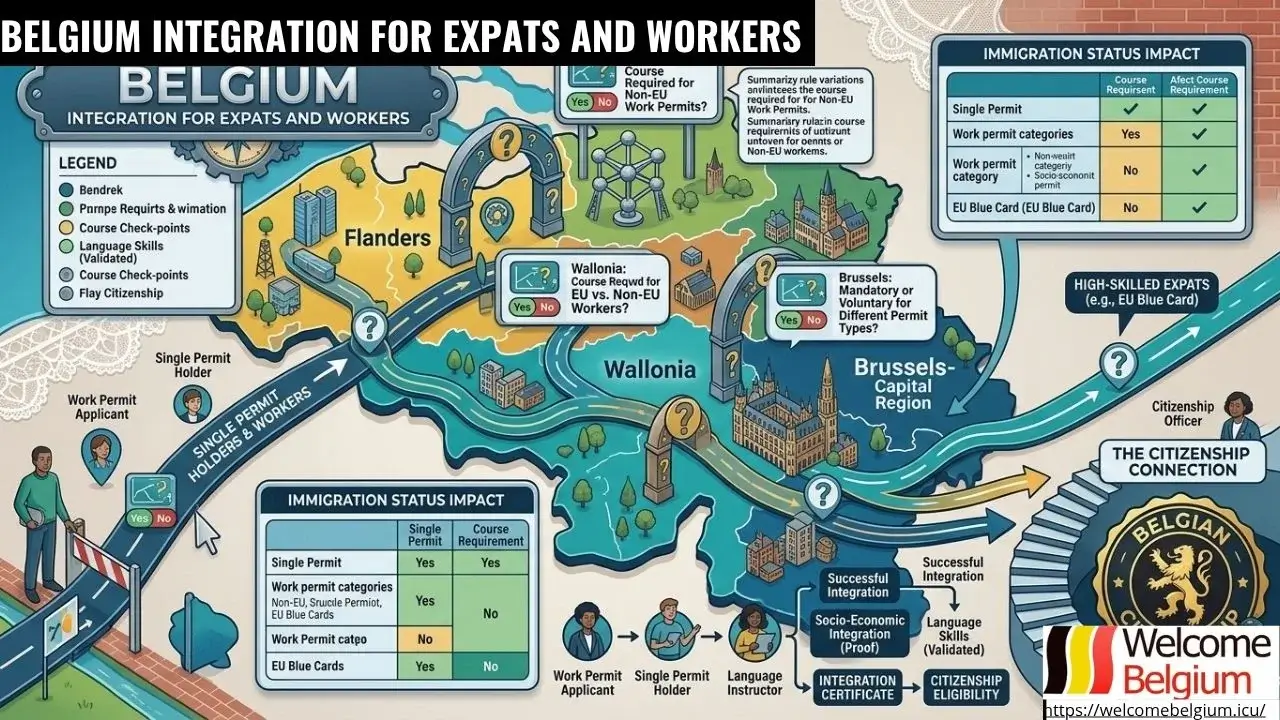
Commercial relocation places entirely different obligations on a foreign national compared to humanitarian migration pathways. If you arrived in the country as a highly qualified specialist (for instance, under the Single Permit program or an EU Blue Card), local legislation provides an exemption for your case. Holding a stable workplace and a verified income indicates that you are already contributing to the economy; therefore, official civic integration in Belgium for immigrants with employment contracts operates on a voluntary basis.
Legal Status of an Expat: Exemption from Courses
According to the Flemish decree on civic adaptation and the regulations of the Walloon employment agency Le Forem, foreign nationals holding a valid employment contract and a corresponding work visa receive an official exemption from mandatory integration courses. The immigration authorities operate on the assumption that the professional integration of expats occurs directly within the workplace, while the initial adaptation of expats in Belgium is supported by the employer.
However, there is an important nuance within this framework that many residents discover too late. If you decide to change employers while residing under this status, your legal obligations and exemptions may be subject to review. For a detailed breakdown of this process, see our practical guide on how to change jobs in Belgium with a Single Permit.
As a result, you will not receive a mandatory invitation letter from the commune requiring you to report to an integration agency, and no administrative penalties will apply to your situation. However, there is an important nuance within this framework that many residents discover too late.
The Connection Between the Single Permit and Citizenship
Even if you arrived in Belgium on a work visa (Single Permit) and are officially exempt from the mandatory integration trajectory, it is highly recommended not to overlook this program. Let us look five years down the road, when a work visa or an EU Blue Card qualifies a resident to apply for a passport from the Kingdom of Belgium.
According to the current nationality law, which can be reviewed via the Moniteur Belge database, naturalization after 5 years of legal residency requires you to satisfy three main criteria: continuous economic activity, language proficiency in one of the national languages at a minimum level of A2, and proven social integration into Belgian society.
The connection between a Single Permit and Belgian citizenship functions smoothly if you hold an official civic integration certificate. This document is viewed by migration authorities as primary evidence of social integration. Immigrants who do not hold this certificate are frequently required to take separate certified language examinations, provide extensive documentation proving uninterrupted employment, and undergo more detailed verification processes at the commune.
Voluntarily completing the integration track today provides a direct optimization of time and administrative effort when applying for Belgian citizenship in the future. If your work schedule permits, completing this course voluntarily serves as a practical long-term investment toward securing a European passport.
Training Formats for Working Professionals
Integration authorities—both the Agentschap Integratie en Inburgering in Flanders and the French-speaking bureaus in Brussels—recognize that highly qualified employees are fully occupied in offices throughout the day. Consequently, highly flexible conditions are provided for expats:
- Evening Courses: Language instruction and social orientation lectures are conducted on weekdays after 18:00 or 19:00.
- Saturday Groups: Intensive study blocks allow participants to cover the program requirements once a week over the weekend.
- Online Formats: The majority of theoretical lectures regarding the state structure, taxation, and local law have been transitioned into digital formats. You can complete these modules remotely at your own pace through specialized educational portals.
Case Study (Expats / Single Permit):
Andrey, an IT specialist based in Brussels, decided to complete the integration program voluntarily to streamline his future citizenship application despite his official exemption. He contacted the Huis van het Nederlands, where he was matched with an evening online Dutch language course (twice a week from 19:00 to 21:30) and a remote social orientation module that he completed on weekends. Consequently, after 8 months, Andrey received his certificate without disrupting his primary office responsibilities.
Advisor Insight from Alex:
If your goal is to remain in the Kingdom long-term, eventually secure permanent residency (PR), and obtain a passport, contact the local agency within your commune to request an integration track tailored for working residents. This is a fully compliant approach to clarify any future inquiries from migration authorities beforehand.
Mandatory Integration Courses in Belgium for Refugees
While state programs function primarily as recommendations for economic migrants and highly qualified specialists, the regulations are significantly different for individuals arriving via humanitarian channels. Foreign nationals who have been granted official refugee status or who fall under the EU directive known as Temporary Protection (and hold a registration Card A) are subject to strict regulatory frameworks.
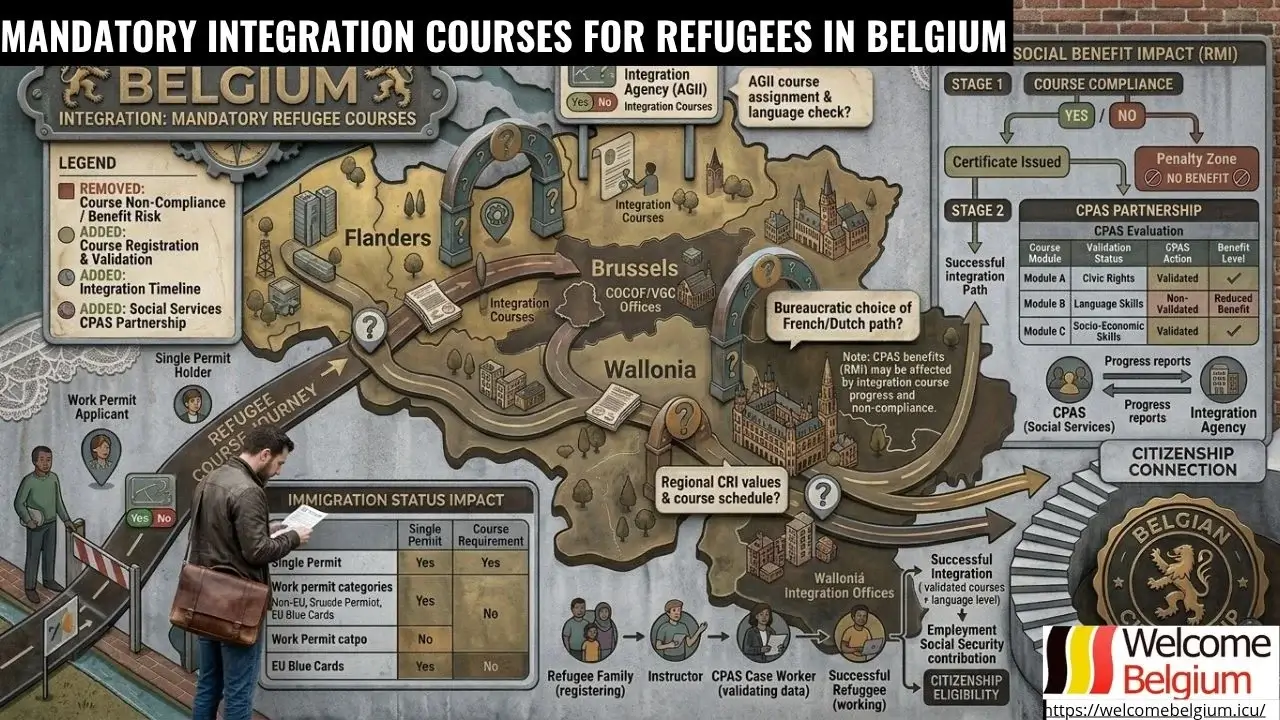
In these cases, civic integration courses in Belgium for refugees constitute an essential and legally mandatory phase of legalization within the Kingdom.
The Adaptation Trajectory: From the Center to the Commune
The state-sponsored social program for refugees commences upon the formal submission of an asylum application. The entire process is structured into two primary phases:
- Initial Reception: This phase is managed by the federal agency Fedasil, which is responsible for accommodation in reception centers, addressing basic medical requirements, and organizing introductory informational sessions.
- Local Integration: Upon receiving official status or protection documentation, the resident transitions out of the reception center, secures social housing with the support of local services, and registers within a specific municipality. From this juncture, the local municipality (commune) and the regional integration agency assume responsibility for the individual’s adaptation process.
Case Study (Temporary Protection / CPAS):
Maksim, who resides in Ghent under the temporary protection program, took a three-week holiday without notifying his case manager and missed the introductory social orientation course. The institution’s administration recorded the extended absence and notified the CPAS. Consequently, his monthly social allowance was temporarily suspended pending a review of the situation. The assistance was reinstated only after Maksim provided a written explanation and re-registered for the next available course session.
All specialized lectures, seminars, and subsequent multi-level language training at certified centers are fully funded by the state budget. The program is designed to facilitate the social adaptation of refugees and assist them in becoming economically self-sufficient residents.
Financial Interdependence: How Courses Impact CPAS Benefits
A defining feature of the state framework is the close operational coordination between integration agencies and social support services. As soon as a foreign national registers with the local social welfare bureau—the Public Centre for Social Welfare (CPAS)—a dedicated social worker is assigned to their case.
As soon as a foreign national registers with the local social welfare bureau—the Public Centre for Social Welfare (CPAS)—a dedicated social worker is assigned to their case. To better understand the structure, competencies, and general operation of this institution, you can review our comprehensive guide on the CPAS in Belgium. Following registration, the resident and the CPAS enter into a formal agreement known as the Individualized Social Integration Project (PIIS / ISIP).
The resident and the CPAS enter into a formal agreement known as the Individualized Social Integration Project (PIIS / ISIP). Pursuant to the Federal Law on the Right to Social Integration, the disbursement of the monthly social allowance, which functions as a legal minimum income (Revenu d’intégration), is conditional upon compliance with agreed integration steps.
The Direct Link Between Integration and Assistance Payments
To maintain access to the full scope of assistance programs for refugees in Belgium, it is essential to adhere strictly to the scheduled course attendance. A practical approach is to treat the integration contract with the same diligence as fixed, full-time professional employment.
Currently, CPAS social services and integration agencies operate within an integrated digital monitoring system. If a resident misses state language classes, systematically skips lessons, or fails to attend social orientation lectures without a valid justification—verified exclusively by an official medical certificate (attest) from a registered physician—the integration agency issues a formal notification to the CPAS.
Based on this report, the social worker is authorized to present the case to the CPAS Board to evaluate a potential adjustment or temporary suspension of the monthly allowance. Reinstating these benefits retroactively involves a complex administrative process, making compliance with the contract terms a primary priority during the initial months following relocation.
How Language Integration in Belgium Connects to the Job Search
The ultimate objective of any integration track is to support the economic independence of the new resident. The state funds these courses not only for cultural adaptation; rather, the structured integration framework in Belgium is designed to transition individuals into the local labor market as efficiently as possible.
Once a resident completes the foundational phase of social orientation, their integration trajectory seamlessly transitions into the framework of specialized state employment services.
Regional Employment Agencies: The Three Primary Bodies
Depending on the region of official registration (commune), professional career tracking, job placement assistance, and advanced language training in Belgium are managed by one of three regional employment agencies. The primary responsibilities and regional jurisdictions are summarized below:
| Region of Belgium | Official Employment Agency | Language Focus | Immigrant Support Programs |
| Flanders | VDAB (Vlaamse Dienst voor Arbeidsbemiddeling en Beroepsopleiding) | Dutch Language | Workplace language coaching, professional training courses. |
| Brussels | Actiris | French / Dutch | Free language vouchers (chèques), internship initiatives. |
| Wallonia | Le Forem | French Language | Retraining initiatives tailored for high-demand technical occupations. |
Each employment agency maintains its own digital ecosystem where the resident must register as an official job seeker (Jobzoeker / Demandeur d’emploi).
Step-by-Step Consultant Support: From CV to Diploma Recognition
Following registration, a personal career consultant is assigned to provide comprehensive guidance across several key areas:
- Developing a Local CV (Resume): The Belgian labor market operates under specific formatting standards for professional documentation. Your consultant assists in adapting your CV to meet local expectations, accurately highlighting skills, and drafting appropriate cover letters (lettre de motivation / motivatiebrief).
- Tuition-Free Retraining Programs: If a resident’s prior specialization is not in high demand or requires specific local certifications, VDAB, Actiris, or Le Forem can arrange access to specialized training. This includes short-term courses (e.g., logistics, administration, IT) or comprehensive retraining for technical trades experiencing labor shortages. Social assistance payments remain fully active during these approved training periods.
- Diploma Recognition (Equivalence): This represents an important administrative step for immigrants seeking professional employment in Belgium. Employment services facilitate the recognition process for foreign educational credentials through the respective ministries: NARIC in Flanders or the Equivalences Fédération Wallonie-Bruxelles for the French-speaking community. In specific cases, with a consultant’s endorsement, translation and administrative processing fees may be subsidized by the state.
This represents an important administrative step for immigrants seeking professional employment in Belgium. The employment services facilitate the recognition process for foreign educational credentials through the respective ministries, such as NARIC in Flanders or the Equivalences Fédération Wallonie-Bruxelles. To prepare your application correctly and learn about potential state subsidies, read our step-by-step guide on how to recognize a foreign diploma in Belgium.
Legal Rights on the Labor Market (Marché du travail)
Many immigrants holding humanitarian status overlook valid employment opportunities due to misunderstandings regarding Belgian permit categories and residency cards.
- Key Clarification from Alex: Individuals holding official refugee status or operating under the temporary protection framework are not required to apply for a standard work permit (Single Permit). The physical residence card (Card A) explicitly specifies the individual’s employment rights under the section “Access to the labor market” with the official notation: “Marché du travail: illimité” (Labor market: unlimited).
This designation confirms that you hold identical employment rights to Belgian citizens. You are legally authorized to enter into temporary contracts (Intérim) as well as indefinite employment contracts (CDI / Vast contract) from the first day your card is issued. The sole requirement is that the employment must be fully registered and official.
Undocumented or undeclared employment that bypasses the taxation system constitutes a serious legal violation. Engaging in such activity can result in a formal review of an individual’s migration status and may lead to an administrative order to leave the territory.
Frequently Asked Questions About Integration in Belgium
Yes, in Flanders and Brussels, this obligation is established by law for the majority of individuals in this category. Systematic absences from classes without a valid reason can serve as a ground for administrative penalties or the temporary suspension of social assistance payments. In Wallonia, participation in the program currently operates on a recommended basis.
In many cases, the official certificate of completion from the integration program is utilized as formal evidence of language proficiency and social integration when applying for Belgian citizenship.
There are no negative administrative consequences; the assessment can be retaken. The integration system does not penalize participants for poor test results. Administrative fines are issued exclusively for non-compliance with the program's framework, such as systematic unexcused absences.
Yes, your integration counselor can transition your track to an evening or online format upon submission of a copy of your employment contract. The contract itself will not be canceled, but the schedule will be adapted to accommodate your professional hours.
You must notify your current integration office and re-register your contract at your new place of residence. If you relocate to a different region (for example, moving from Flanders to Wallonia), you will be required to complete the program under the regulations of the new region.
No, they are exempt based on age criteria. The program is mandatory only for able-bodied adults. Minors under the age of 18 integrate through the local school system, while individuals of retirement age receive an automatic exemption.
No, the certificate itself does not alter your residency card status. While it serves as a primary asset for citizenship applications, obtaining permanent residency still requires you to separately satisfy the standard criteria of 5 years of continuous residence and a stable, sufficient income.Is Inburgering mandatory for Ukrainians under Temporary Protection in 2026?
Does the integration certificate help in obtaining Belgian citizenship?
What happens if a resident fails the final assessment?
Can the integration contract be paused if I secure employment?
What steps should be taken when relocating to a different commune or region?
Are children and retirees required to complete these courses?
Does the certificate grant an automatic right to permanent residency?
Civic integration in Belgium is not merely a matter of formal attendance at orientation sessions; it serves as your primary legal foundation within the Kingdom. The regulations in 2026 demand discipline from newcomers, but in return, the state provides practical tools for long-term adaptation—ranging from fully funded language training to assistance with diploma verification and job placement.
The most effective strategy is to respond promptly to all correspondence from your commune, maintain the required attendance standards, and utilize voluntary programs as a direct investment toward your future Belgian passport. Good luck with your studies, and welcome to Belgium!
Official Sources and Legislative Frameworks
To register for courses or verify current administrative requirements, please consult exclusively the official portals of the relevant authorities:
- Federal Level: Fedasil — Reception and accommodation services.
- Flanders: Agentschap Integratie en Inburgering — The Flemish integration agency.
- Wallonia: Portail de l’Action sociale en Wallonie — Coordination platform for regional CRI centers.
- Brussels: Newcomers in Brussels — The unified administrative portal for the capital region.
Legal Disclaimer
The information provided in this article is current for the year 2026 and is intended solely for informational purposes. While every effort is made to track regulatory updates promptly, Belgian administrative law is highly decentralized. Each local municipality (commune) retains the legal authority to adjust specific regulations, modify deadlines, and establish individual oversight procedures. Official directives and written instructions issued by the administration of your specific commune always hold the highest legal priority for your case.