Last Updated on April 29, 2026 by Alex
Are you eligible for OCMW/CPAS assistance?
Requirements for receiving aid:
- Registration: You are officially registered in a commune (you have a registered address).
- Income: Your monthly income is below the subsistence level (Leefloon).
- Legal Status: You are residing in Belgium legally (Card A, B, C, D, F, or refugee status).
- Willingness to Work: You are prepared to work, provided your health condition allows it.
- Lack of Assets: You do not possess significant savings or real estate.
Meeting all these criteria does not guarantee automatic payments, but it represents the minimum threshold for filing an official application with OCMW/CPAS.
In 2026, you can receive:
- From €885 (cohabitants)
- Up to €1,794 (families with children)
Introduction
Many people look for ways to obtain CPAS in Belgium and wonder what social assistance is available to foreigners in 2026. The primary financial support is the Leefloon (living wage), the amount of which is indexed annually. In this guide, we will break down how OCMW Belgium operates and the requirements for applicants with different types of residence permits.
OCMW and CPAS in Belgium: What are they?
In Belgium, social assistance is decentralized and managed at the level of each individual commune (municipality). According to the federal social security portal, their common goal is to guarantee every resident the right to live a life of dignity.
Main Functions of the Organization
| Function | Description (OCMW / CPAS) |
| Financial Aid | Payment of the subsistence minimum (Leefloon / Revenu d’intégration) |
| Medical Support | Payment of medical bills and arrangement of social insurance |
| Housing & Utilities | Assistance in finding housing, paying heating and water bills |
| Integration | Help with job searching, training, and language learning |
| Legal Aid | Consultations on legal issues and debt management |
OCMW in Flanders (Openbaar Centrum voor Maatschappelijk Welzijn)
If your place of residence is in the Flemish Region, OCMW is responsible for state support. The activities of these centers are regulated by regional legislation on local government.
As noted by the VVSG association, the focus here is shifted toward the “activation” of the citizen—not just paying benefits, but assisting in the return to financial independence. This aligns with the principles of the Law on the Right to Social Integration of May 26, 2002, which establishes a close link between financial aid and a person’s willingness to work or study.
Features of OCMW Operations:
- Language Integration: Priority is given to learning Dutch as a key factor in job seeking. This is enshrined in the Flemish Integration Policy (Inburgeringsbeleid).
- Cooperation with VDAB: A close connection with the Flemish employment service for professional retraining and monitoring applicant activity.
- Local Initiatives: In large cities like Antwerp or Ghent, OCMW oversees social enterprises (second-hand shops, social restaurants) providing workplaces for practice.
In Flanders, the approach to verifying living conditions can be quite strict: a social worker will verify your efforts to find work and integrate into society based on an Individualized Project for Social Integration (GPMI).
CPAS in Wallonia and Brussels (Centre Public d’Action Sociale)
For residents of Wallonia and the French-speaking communes of Brussels, social protection is implemented through CPAS. The activities of these centers are governed by the same fundamental Organic Law on Public Social Welfare Centres of July 8, 1976, but their operational work in these regions has its own specifics.
As federal sources confirm, the mission of CPAS is broader than just the financial fight against poverty—it is a comprehensive effort with vulnerable populations aimed at protecting human dignity in accordance with Article 23 of the Belgian Constitution.
Features of CPAS Operations:
- Comprehensive Care: Great attention is paid to family support, including subsidizing childcare and children’s clubs. This is regulated by regional norms on child and family protection.
- Medical Card (Aide Médicale): Well-established mechanisms for exercising the right to medical assistance for those without standard insurance (Mutuelle). In Brussels and Wallonia, CPAS often works directly with public hospitals.
- Debt Mediation (Médiation de dettes): Specialized departments for debt mediation, regulated by the Law of June 12, 1991, on Consumer Credit. Social workers help restructure debts to utility companies and creditors.
Information support in CPAS is often available in several languages, given the multinational composition of Brussels, which simplifies the first contact for migrants and allows for more effective compliance with administrative procedures.
Advice from Alex:
It is important to keep in mind that regardless of which part of the country you are in, the municipality does not have the right to refuse to accept your application. If you mistakenly applied to CPAS when your case should be handled by OCMW (or vice versa), the organization is legally obliged to officially forward your request to the competent center within 24 hours.
This obligation is enshrined in the Organic Law of July 8, 1976, on Public Social Welfare Centres (Loi organique des centres publics d’action sociale / Organieke wet betreffende de openbare centra voor maatschappelijk welzijn).
According to Article 71 of this law and clarifying Royal Decrees, in the event of disputes over territorial competence, the first center to which the applicant applied must immediately transfer the file to the proper authority to prevent any violation of the citizen’s right to social assistance.
Who is Eligible for CPAS and OCMW Benefits in Belgium in 2026?
The social protection system in Belgium is not unconditional. In 2026, Belgian legislation clearly distinguishes access to assistance based on migration status and financial standing.
Those who are already a permanent resident of Belgium (holding cards B, C, D, F, or L) can access social assistance on equal footing with Belgian citizens without jeopardizing their residency status.
Criteria for Receiving CPAS / OCMW Assistance
According to the Law of May 26, 2002, “On the Right to Social Integration” (Loi concernant le droit à l’intégration sociale), a basic “entry threshold” must be met for your application to be considered:
- Legal Residency: You must have an official place of residence (registered address) in the commune where you file the request. This is established by the Law of July 8, 1976 (Loi organique des CPAS), which defines the territorial competence of the centers.
- Insufficient Means: Your income is below the subsistence level, and you are unable to improve this situation independently.
- Willingness to Work: You are required to demonstrate efforts to find employment, unless health conditions or exceptional circumstances exempt you from this duty under Article 3 of the aforementioned 2002 Law.
Residency Status and Permits
The right to receive the subsistence minimum (Leefloon) depends directly on your legal status in the country, as regulated by Article 3 of the Law on the Right to Social Integration:
- Belgian and EU Citizens: They have the most streamlined access to the system. However, for EU citizens, according to Directive 2004/38/CE and the Law of December 15, 1980, the right to assistance may be limited during the first three months of stay or until worker status is acquired.
- Foreign Nationals with Permanent Residence (Cards B, C, D, F): These holders have rights to social assistance equivalent to Belgian citizens.
- Holders of Temporary Status (Card A): Access to aid is possible but often restricted. For example, recognized refugees access the Leefloon based on their status, while other categories may only qualify for “Equivalent Financial Social Assistance” (Aide sociale financière équivalente), governed by federal standards on the Social Security Belgium portal.
- International Students: Generally, students are not eligible for the Leefloon, as proof of sufficient means is a prerequisite for a student visa.
Financial Assessment and Means Testing
Social assistance for both migrants and citizens is always preceded by a “social inquiry” (means test), the rules of which are detailed in the Royal Decree of July 11, 2002. A social worker is mandated to analyze:
- Current Income: Wages, benefits, and income from assets.
- Savings: The presence of significant funds in accounts or real estate ownership, including assets held abroad (in accordance with 2026 international transparency principles).
- Cohabitation: The income of individuals you live with (status of “cohabitant“) is taken into account when calculating the payment amount.
To review current payment thresholds and legislative initiatives, I recommend consulting the list of OCMW centers and current laws on the MI-IS portal.
Social Assistance vs. Unemployment Benefits
It is vital not to confuse OCMW/CPAS assistance with Unemployment Benefits (Allocation de chômage).
Unemployment benefits are paid based on your work history (social security contributions). If an individual does not qualify for these, they turn to the OCMW. According to the 2026 guidelines from the VVSG association, receiving aid is now inextricably linked to the fulfillment of the Individualized Project for Social Integration (GPMI)—a mandatory contract between the center and the applicant.
Alex’s Pro-Tip:
Before visiting the CPAS/OCMW, be sure to gather evidence of your attempts to find work or training over the past few months. In 2026, social workers pay special attention to the “Willingness to Work” section.
Having a folder ready with rejection letters from employers or certificates from language courses significantly increases the chances of your application being approved on the first attempt.
How Much Does CPAS Pay (Leefloon) in Belgium in 2026?
The amount of social assistance in Belgium in 2026 depends directly on your family status. The primary factor in the calculation is whether the applicant is “single” or “cohabiting.” Below are the current Leefloon 2026 amounts.
The following table indicates the monthly payment amounts based on the household category:
| Recipient Category | Description | Monthly Amount (2026 Est.) |
| Category 1: Cohabitants | Individuals living with someone with whom they share expenses (not limited to spouses) | ~€885.50 |
| Category 2: Single | Individuals living alone and bearing all household expenses independently | ~€1,328.20 |
| Category 3: Families with Dependents | Individuals with at least one minor child as a dependent | ~€1,794.80 |
Note: These figures are estimates. Exact amounts depend on the consumer price index and official decisions of the Federal Government (SPP Intégration Sociale).
Types of Additional Support in Belgium
The activities of OCMW and CPAS in 2026 cover almost all aspects of social life. It is important to understand: even if your income slightly exceeds the threshold for the subsistence minimum (Leefloon), you may still be entitled to targeted assistance in specific life situations.
I have prepared a table below to structure the main areas of support available beyond direct cash payments:
| Type of Assistance | What it Includes | Legal Basis / Regulation |
| Medical Support | Payment of bills, medication, and issuance of the Medical Card (Aide Médicale) | Organic Law of 1976 |
| Housing & Energy | Rent assistance, payment of heating, water, and electricity bills | Federal Gas and Electricity Fund |
| Integration | Payment for language courses, vocational training, and job search support | GPMI Program (Law of 2002) |
| Legal Aid | Consultations with lawyers and Debt Mediation | Social Security Code |
| Psychological Help | Payment for therapy sessions and support in crisis situations | Regional Health Programs |
How to Access These Benefits:
The mechanism for receiving these benefits differs from the automatic disbursement of allowances. Each request is reviewed individually as part of your “social file.”
- Request for Medical Aid: If you need a CPAS Medical Card or coverage for expensive treatment, you provide medical bills or prescriptions to your social worker. Based on your financial profile, the center may issue a letter of guarantee (Réquisitoire) that covers costs at pharmacies or hospitals.
- Housing and Energy Assistance: Belgium allocates special subsidies to combat energy poverty. If you cannot afford heating bills, you can request intervention from the “Energy Fund.” Additionally, CPAS helps with social housing by providing priority registration documents for housing companies.
- Integration Courses and Training: As part of your Individualized Project for Social Integration (GPMI), the center may fully cover the costs of integration courses or professional retraining if it facilitates your entry into the labor market.
- Legal Consultations: Many branches have staff lawyers or collaborate with legal aid bureaus. If you have disputes with a landlord or credit debts, a social worker will refer you to the Debt Mediation (Médiation de dettes) department.
You can check current application forms and the list of required documents for each type of support on official resources: socialsecurity.belgium.be and www.mi-is.be.
Important Note:
When applying for housing assistance (such as a rental deposit or bill payment), always keep all correspondence with your landlord or energy provider. For the OCMW, it is critical to see that you attempted to resolve the issue independently before seeking government intervention.
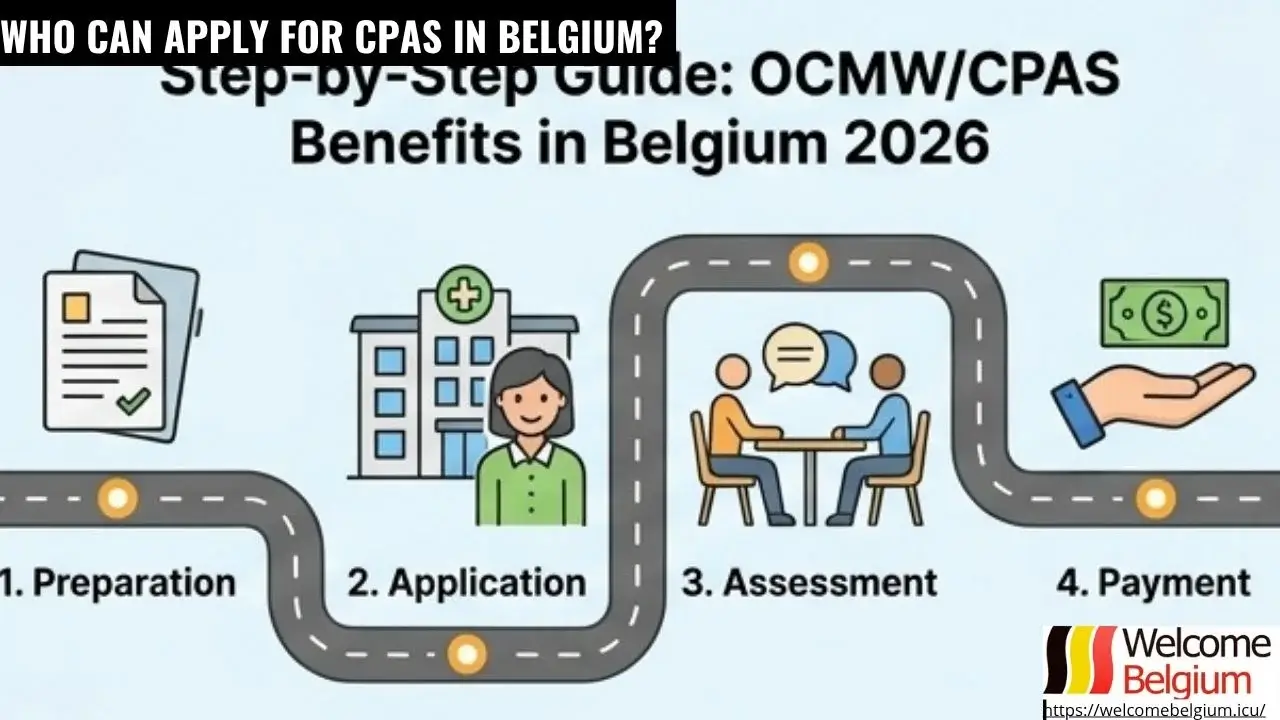
How to Obtain CPAS in Belgium: A Step-by-Step Guide
The procedure for applying to social services in Belgium in 2026 is strictly formalized. To minimize the risk of rejection, follow this proven action algorithm.
Step 1: Determining Territorial Competence
You must apply strictly to the center that serves your commune (place of registration).
- Search in Flanders: Use the official OCMW Belgium search portal (VVSG) to find the center for Flemish communes.
- Search in Brussels and Wallonia: Check your commune’s official website or use the Social Security Belgium portal.
Step 2: Filing the Application and Obtaining Confirmation
A request can be submitted in person, in writing, or (in some communes) via an online form. According to the Organic Law on CPAS of July 8, 1976, the center is obliged to issue a document confirming the registration of your application on the day of submission.
Step 3: Social Inquiry and Interview
This is the key stage of your means test. You will be scheduled for an interview with a social worker for a detailed assessment. Be prepared for a home visit—this is a standard procedure to verify family composition and living conditions.
Step 4: Decision and Notification
The committee is required to issue a decision within 30 days. You will be notified by official letter, which will state the amount of assistance or the reasons for refusal.
Common Mistakes and How to Avoid Them
Even when meeting all criteria, applicants often make mistakes that lead to delays or sanctions.
| Common Mistake | Consequences | Correct Action |
| Concealing assets (accounts, cars, property abroad) | Rejection and fraud charges | Declare everything. In 2026, data exchange between EU countries is automated. |
| Incomplete bank statements | Suspension of the inquiry | Provide statements for the last 3 months for all accounts, including savings. |
| Ignoring the GPMI (Integration Plan) | Termination of payments | Treat the contract with the center as a professional obligation; fulfill all job search requirements. |
| Unapproved trips abroad | Fines and repayment of benefits | Any departure from Belgium longer than the set limit must be approved in writing by your social worker. |
Alex’s Pro-Tip:
If you have an appointment but cannot attend for a valid reason, inform them in advance. In 2026, a “no-show” without prior notice is often interpreted as a “lack of will to collaborate” (manque de volonté de collaboration), which can serve as formal grounds to close your case without the right to immediate reopening.
The Impact of Social Assistance on Residency and Citizenship
Many foreigners in Belgium live in extreme hardship for years, fearing that approaching the OCMW/CPAS will lead to deportation or the non-renewal of their documents. In 2026, immigration laws have become even more sensitive to the issue of economic self-sufficiency.
The rules for family reunification in Belgium 2026 are particularly strict regarding income. If a family member applies for CPAS aid, it may trigger a review of the sponsor’s financial stability.
Social Assistance and the Risk to Card A
The primary risk is linked to the legal concept of an “unreasonable burden on the social assistance system” (charge déraisonnable pour le système d’aide sociale). This mechanism is governed by the Law of December 15, 1980, on the access of foreigners to Belgian territory.
- Card A (Temporary Status): If you received your residency based on work or family reunification, your right to stay is tied to having sufficient means. Applying for regular benefits signals to the Immigration Office (Office des Étrangers / Dienst Vreemdelingenzaken) that the conditions under which your card was issued are no longer being met. This can trigger a review or revocation of your status.
- Family Reunification: In 2026, income requirements for the sponsor are strictly monitored. If a family member who arrived via reunification applies for CPAS aid, it jeopardizes the status of both parties, as the sponsor officially guaranteed the financial maintenance of the dependent.
Impact on Obtaining Citizenship
According to the Belgian Nationality Code (Code de la nationalité belge), naturalization requires proof of “economic integration.”
- You must prove employment over the last 5 years (minimum of 468 working days).
- Periods of receiving assistance from OCMW/CPAS do not count toward this requirement and may serve as grounds for refusal, as they demonstrate a lack of financial independence.
When is it Safe to Contact CPAS?
Certain categories of persons are protected from immigration sanctions regarding social aid:
- Recognized Refugees: Receiving aid is a legal right for this category and does not lead to loss of status.
- Holders of Permanent Residency (Cards B, C, D, F, L): These statuses grant the right to social assistance on equal footing with Belgian citizens without the risk of losing residency.
Current directives on the assessment of the “burden on the system” can be found on the Social Security Belgium portal.
Alex recommends:
If you are in Belgium on a Card A (work or reunification) and face temporary difficulties, try to request one-time targeted aid from the CPAS (e.g., payment of a single medical bill or heating assistance) rather than the regular monthly subsistence minimum (Leefloon).
Real Cases: Practice and Error Analysis
Analyzing specific situations helps illustrate how legal norms are applied in practice and where applicants most often stumble.
Case 1: “Hidden Assets” (Refusal and Fine)
- Situation: A family of three (Card A, reunification) applied for a top-up to the subsistence minimum in Antwerp, claiming zero income.
- The Error: During a 3-month bank statement audit, the social worker found regular €200 transfers from a foreign account. It was revealed the head of the family owned and rented out an apartment in their home country.
- Result: Assistance was denied under Article 16 of the Law of May 26, 2002. The family was ordered to repay emergency aid already received and faced an administrative fine for providing false information.
Case 2: “Passive Integration” (Suspension of Payments)
- Situation: A young man (refugee status) had been receiving Leefloon for a year. His GPMI contract required him to attend Dutch classes and send at least 5 resumes weekly.
- The Error: He skipped classes without a medical certificate and failed to keep a history of job applications, viewing them as a mere formality.
- Result: CPAS Brussels suspended payments for one month following an official warning. Payments were only restored after a full job-search report was submitted via the employment service (Actiris).
Case 3: “Successful Medical Assistance” (Positive Experience)
- Situation: An international student was in a car accident. Insurance covered only part of the costs, leaving a €1,500 hospital bill—unaffordable for his budget.
- The Solution: Although students generally aren’t eligible for Leefloon, he applied for one-time emergency aid. The social worker analyzed his income and expenses.
- Result: Based on the Organic Law of 1976, the center issued a letter of guarantee (Réquisitoire) and paid the hospital directly. This had no impact on his student visa, as the aid was one-time and targeted.
Case 4: “Risky Reunification” (Residency Issues)
- Situation: A wife joined her husband via family reunification. The husband lost his job, and the family applied for full benefits for both.
- The Error: Filing the application while on temporary status (Card A) without prior legal consultation.
- Result: Two months after payments began, the Immigration Office sent a notice of intent to revoke the wife’s residency permit because the sponsor no longer met the financial independence criteria.
Frequently Asked Questions (FAQ)
How much do they pay in 2026?
The Leefloon amount ranges from €885 to €1,794 per month, depending on your family composition.
Who is eligible for assistance?
Residents with a legal residence permit (VNP) whose income falls below the subsistence minimum.
What is the application processing time?
The center is legally required to issue a decision within 30 days.
Can I get CPAS assistance with a Card A?
Yes, it is possible, but there is a significant risk regarding the renewal of your residence permit.
Can I receive OCMW assistance in Belgium if I own a car?
Yes, provided it is a budget-friendly vehicle necessary for work or family needs. Owning an expensive car will likely lead to a rejection once maintenance costs are audited.
What happens if I hide 'under-the-table' work (black labor)?
This is considered social fraud. If hidden income is discovered via bank monitoring, benefits will be canceled, and you will be required to repay all funds received previously.
How do I get discounts on utility bills?
Status with the CPAS/OCMW grants you the right to the Social Tariff (electricity, gas, internet). It is often applied automatically, but you should provide a certificate from the center to your service provider to ensure coverage.
Is it mandatory to let a social worker into my apartment?
Yes. A home visit is a legal part of the social inquiry to verify family composition. Refusing access without a valid reason leads to the closure of your case.
What should I do if my OCMW or CPAS application is rejected?
You have 3 months to file an appeal with the Labour Court (Arbeidsrechtbank). For low-income individuals, the legal process and a lawyer (Pro bono) are free of charge.
Does assistance affect the renewal of a Card A?
Yes. Regular payments may be viewed by the Immigration Office as an 'unreasonable burden,' jeopardizing the extension of temporary status.
Can I travel abroad while receiving benefits?
Yes, but for no more than 28 days per year. You must notify your social worker in writing in advance of any trip; otherwise, payments will be suspended.
Does the OCMW help with the rental deposit?
The center can provide a bank guarantee (Garantie locative) for your rent, which you will gradually pay back from your monthly allowance.
Is assistance available to international students?
Generally no, as having sufficient funds is a visa condition. Exceptions are made for emergencies (e.g., an accident or sudden loss of a sponsor), where one-time emergency aid is requested.
Is the income of cohabitants taken into account?
Yes. The allowance amount depends directly on whether you live alone (isolé) or with others (cohabitant). The income of all household members is aggregated when calculating the payment.
It is essential to stay informed about the latest Belgium migration reform 2026, as the criteria for “unreasonable burden” on the state have become more clearly defined this year.
Sources and Official Contacts
To obtain up-to-date information, verify current subsistence rates, and find local social assistance offices in 2026, use only official Belgian government resources:
- Federal Public Planning Service Social Integration (MI-IS) – The primary body drafting social assistance legislation. This is where the official Leefloon amounts and audit rules are published.
- Social Security Belgium Portal – The official federal government site with comprehensive information on citizen rights to medical and financial support through the CPAS system.
- Association of Flemish Cities and Municipalities (VVSG) – The main resource for finding contacts and operational rules for OCMW centers in the Flemish Region.
- Brussels-Capital Region Municipal Portal – For a direct list and contact details of all CPAS branches in Brussels.
Disclaimer
This material has been prepared by the Welcome Belgium editorial team for informational purposes only. We are not a government agency or official representatives of the OCMW/CPAS. Belgian social legislation changes regularly, and decisions regarding assistance are made individually by each commune. We recommend consulting with a lawyer or social worker before making any decisions.