Last Updated on April 20, 2026 by Alex
Quick Start: 2026 Applicant’s Checklist
A concise roadmap for those planning to seek international protection on Belgian territory.
- Deadlines Matter. Your application must be submitted within 8 working days of crossing the border. Ignoring this timeframe significantly lowers your credibility in the eyes of the CGRS.
- Point of Entry. Registration must be done in person at the “Petit-Château” center (Brussels) or at the border (airport). Current slots are booked through the IBZ portal.
- Identification & Biometrics. Be prepared for the seizure of your national passport and fingerprint scanning for the Eurodac If you hold visas for other EU countries, the “Dublin Regulation” will be triggered.
- Evidence Base. Gather all available proof of persecution (court records, medical certificates, photos, screenshots). In 2026, priority is given to verified digital data.
- Legal Status. Upon registration, you receive an “Orange Card” (Annex 26). This grants the right to stay in Belgium and access the labor market after 4 months, but strictly prohibits travel abroad.
- Social Support. The Fedasil agency provides housing and medical assistance. Placement in a specific city is automatic, based on current availability.
Introduction
In 2026, the asylum procedure in Belgium has become more formalized and digitized. Applicant data is cross-referenced through EU-wide information systems, including the Eurodac database, allowing authorities to track border crossings and previous applications within the EU.
Hi, I’m Alex, and I’m here to guide you through this bureaucratic quest. While Fedasil centers are currently at capacity and the “Dublin Regulation” is being enforced at its peak, the goal isn’t just to file a claim at “Petit-Château”—it’s to build a flawless legal strategy from day one.
My experience shows that in 2026, Belgium only grants protection to those who know how to play by the rules of its system. We’ll break down everything—from registration to the final interview—so you know where the “landmines” are and how to secure your status without risking deportation. Let’s get into the facts.
Asylum Legislation in Belgium: Official Acts and 2026 Statistics
Several agencies handle asylum in Belgium, but the “final word” always rests with the CGRS (Commissioner General for Refugees and Stateless Persons). According to SPF Intérieur, this is a fully independent body that assesses whether it is truly dangerous for you to return home. In 2026, their operations have become more transparent, yet stricter regarding evidence verification.
The entire process is governed not by local commune preferences, but by international law. The cornerstone document is the Aliens Act of December 15, 1980, which received several key amendments in 2026 regarding the accelerated processing of digital data.
Official Framework: Laws and Sources 2026
| Law / Regulation | Source (Official Site) | What it regulates for the applicant |
| Geneva Convention | UNHCR.org | Basic definition of refugee status and the right to protection. |
| Aliens Act (1980) | Ejustice.just.fgov.be | Belgium’s primary law on entry, residence, and removal. |
| “Dublin III” Regulation | CGRS.be | Determining which EU country is responsible for your case. |
| EU Reception Directives | Eur-lex.europa.eu | Standards for housing (Fedasil) and financial assistance. |
According to recent CGRS reports, approval trends in 2026 have stabilized but vary significantly by region of origin. Based on my data, the system now automatically prioritizes applications from active conflict zones, while “economic” stories face longer processing times.
- High Approval Rate Countries (70-90%): Syria, Afghanistan, Eritrea. Here, Belgium most frequently grants full “Refugee Status.”
- Subsidiary Protection Zones (40-60%): Regions with general instability (parts of Ukraine, certain areas of Iraq).
- Low Success Rate (Under 10%): Countries recognized by Belgium as “safe” (the Balkans, Georgia, Moldova). In 2026, applications from these regions are handled via the “Fast-track”
Alex’s Pro Tip:
If your country is on the “safe” list, your only chance lies in an exceptional, documented personal story. Simply citing the general situation in your country in 2026 will not be enough.
Where to File Your Application: Registration and First Steps (Phase 1)
In 2026, the entry point for most asylum seekers remains centralized—the registration center in Brussels. However, the “Petit-Château” building (or Klein Kasteeltje in Flemish) now operates under a hybrid system.
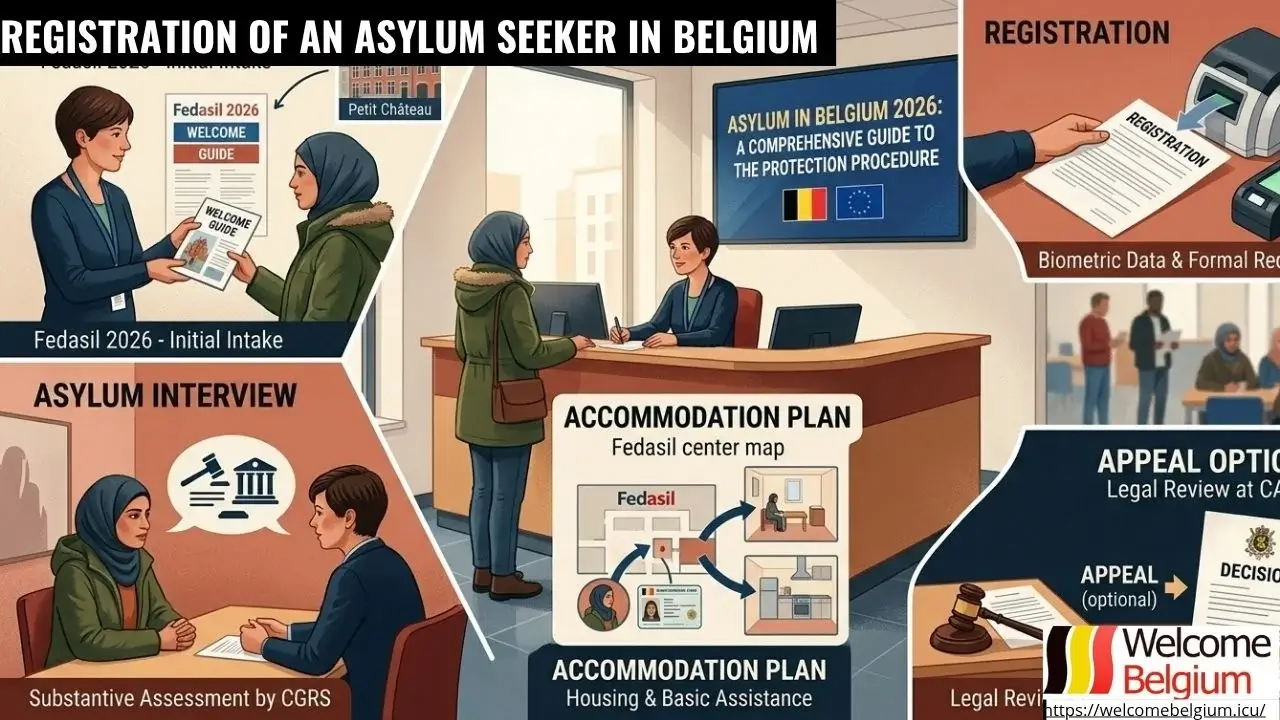
Arrival: The “Petit-Château” Center
Your journey begins here. As of May 2026, standing in a physical queue from 4:00 AM is no longer strictly necessary for registration. You can verify the official procedure and current operating hours on the official IBZ (Immigration Office) portal.
- Address: Boulevard de la Neuvième de Ligne, 1000 Bruxelles.
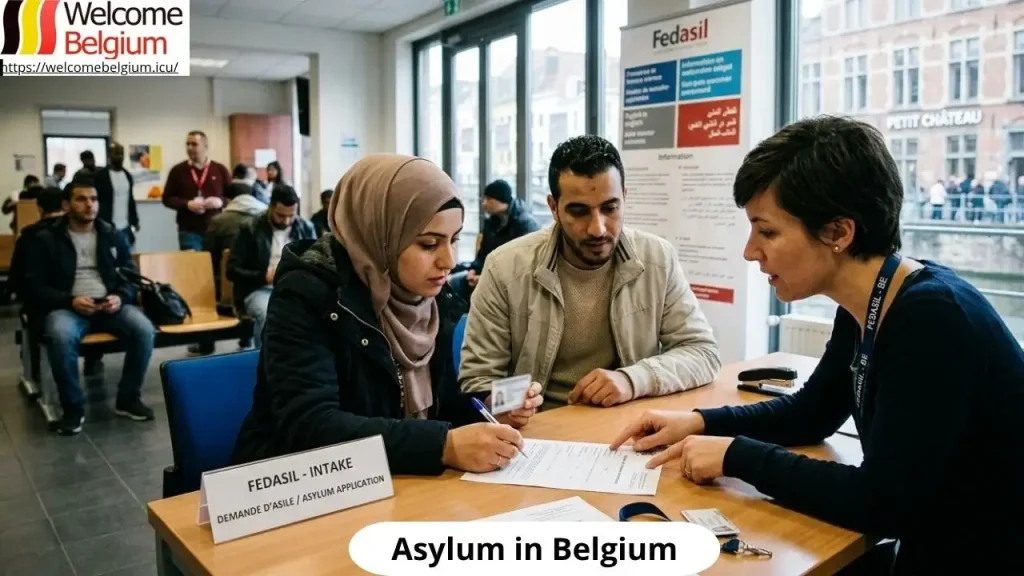
- The Process: IBZ officers check documents, take fingerprints, and conduct an initial interview. This is where it is determined which EU country is responsible for the case under the “Dublin Regulation.” Detailed registration rules are also available on the Fedasil website.
Deadlines: The 8-Day Rule
Under the 1980 Aliens Act (with 2026 amendments), you are required to declare your intent to seek protection within 8 working days of entering the country.
Why this is critical: According to SPF Intérieur, delays without a valid reason are often interpreted as an attempt to simply prolong one’s stay in the EU. If you have been in Belgium on a tourist visa and apply on its final day of validity, it undermines the credibility of your story before your first interview even begins.
Case Study from Alex: Registration at the Border (Zaventem):
If you arrive at Brussels Airport (Zaventem) and claim asylum at passport control, you fall under the “Border Procedure.”
Alex’s Real-World Case (2026): > One of my clients applied at the airport. Instead of an open reception center, he was temporarily placed in the “Caricole” closed transit center.
- The Risk: At the airport, decisions are made on an accelerated basis. Based on my statistics, these cases often end in a refusal if the story isn’t backed by solid documentation. You can find more details on border centers on the CGRS website.
Important – The “Digital Footprint”:
In 2026, during registration at “Petit-Château,” applicants may be asked to explain their travel route and confirm it with available evidence (e.g., documents, tickets, or other indirect data). Discrepancies in this information can negatively impact the overall credibility assessment of your case.
Review Procedure and Interviews (Phase 2)
Once registered, your file enters the active examination phase. The process is divided into two key interviews, each serving a distinct purpose.
The First Interview: Eurodac Filter and “Dublin”
This is a technical interview conducted by an officer from the Immigration Office (known as IBZ or OE).
- Primary Goal: To establish your identity and determine which EU country is legally responsible for examining your claim.
- Eurodac Verification: Your fingerprints are instantly cross-referenced against the pan-European database. As of 2026, the system is fully integrated with Frontex border control databases. If you previously applied for a visa in Poland or left prints in Italy, Belgium will trigger the “Dublin Regulation” and initiate a transfer to that country.
- The Asylum Questionnaire: You will be given a form to briefly outline your reasons for seeking protection. In 2026, this data is digitized via the IBZ Portal and becomes the “baseline” of your case. Any changes to these details during the main interview will result in a significant loss of credibility.
The Main Interview at the CGRS
This is a personal hearing with a protection officer from the CGRS (Commissioner General for Refugees and Stateless Persons). It can last anywhere from 3 to 8 hours. This is where the decision on your status is made.
What you need to know about the 2026 Main Interview:
- Evidence of Persecution: It is not enough for an officer to hear “I am afraid.” In 2026, the risk of rejection is high unless the claim is supported by physical or digital evidence: summons, court acts, medical certificates, or video recordings of threats.
- AI-Assisted Verification: During the review, special attention is paid to the internal consistency of your testimony. Analysis tools highlight discrepancies in dates, details, or the sequence of events.
- The Interpreter: You have the right to a free interpreter. My advice: if you feel the translation is inaccurate, state this immediately so it can be recorded in the official minutes.
Alex’s Note: How to prepare your “Story”
In 2026, your “story” shouldn’t just be heartbreaking; it must be legally sound. It needs to answer three specific questions:
- Why are you personally being targeted?
- Why can’t you simply move to another city in your home country (Internal Flight Alternative)?
- Why can’t (or won’t) the authorities in your country protect you?
Risk Analysis: Common Interview Mistakes in 2026
| Typical Mistake | Why it’s dangerous | Prevention | How to fix if already made |
| Discrepancy with the IBZ form | You appear dishonest. 2026 AI analysis instantly highlights mismatches in dates/names. | Keep a copy of your Phase 1 form from the IBZ website. Re-read it before the CGRS interview. | State at the start: “I made a mistake in the initial form due to stress; I wish to correct it now.” |
| “Scripted” stories | Officers recognize patterns from the web. If it sounds like a manual, it’s a refusal. | Talk about personal feelings and small daily details. Avoid legal clichés found on Wikipedia. | If the officer calls it “standard,” add personal details (neighbor’s names, the color of your front door). |
| Hiding a “Dublin” case | Attempting to hide a Polish visa or stay in Germany. Eurodac will find it. | Be honest. It’s better to admit a Dublin hit and argue why you specifically need Belgium. | If prints are found, immediately find a lawyer to submit arguments based on Art. 3 of the ECHR (humanitarian grounds). |
| Lack of “Digital Proof” | In 2026, not having photos/chats while owning a smartphone looks suspicious. | Do not delete threatening messages. Back up your cloud. Officers may check metadata on CGRS request. | If you have no phone, prepare witness statements from people who can confirm the events remotely. |
| Aggression or Flattery | Attempting to manipulate emotions. In Belgium, this backfires and creates bias. | Stay polite and neutral. The officer is a registrar of facts. | If you lose your temper, apologize and ask for a 10-minute break to compose yourself. |
Alex’s 2026 Field Practice:
A client claimed they were being followed. During the interview, the CGRS officer asked to see their Google Maps location history for a specific day. Because the client’s story was true, the digital data matched the testimony perfectly. In 2026, digital evidence carries more weight than a thousand words.
The Dublin Regulation and the New 2026 Pact
Many mistakenly believe they can choose their country of asylum. In 2026, this misconception can lead to deportation. Under the Regulation on Asylum and Migration Management (RAMM), which replaced the Dublin III system, the responsibility for your case lies with the EU country where you first left a “trace.”
How the Distribution System Works in 2026:
- The “First Touch” Principle. If you crossed the EU border in Poland, received a visa at a German embassy, or simply left fingerprints in Italy—Belgium is legally obligated to send you back there.
- Upgraded Eurodac. The database now stores not just fingerprints but also facial biometrics. Information from SPF Intérieur databases is processed rapidly, allowing migration authorities to instantly verify an applicant’s travel history within the Schengen Area.
- Mandatory Solidarity. A distribution quota system was introduced in 2026. If Belgium is “over capacity,” you could (theoretically) be redirected to another EU country that hasn’t met its quota. In practice, however, Belgium usually accepts those who have reached its territory if no “Dublin trace” is found elsewhere.
If a check reveals a trace in another country, Belgium issues a Transfer Decision.
| Country of Return | Reason for Return | 2026 Status |
| Croatia / Italy | First countries of entry (“coastal” states). | High risk of return; procedures are well-established. |
| Germany / France | If you held a visa or previously applied there. | Almost automatic return within 6 months. |
| Poland | The most frequent transit hub for the eastern route. | Active data exchange; Belgium strictly adheres to the regulation. |
Critical “Dublin” Update 2026:
Previously, one could “hide” for 18 months until a country’s responsibility expired. In 2026, this period has been increased to 3 years. Evading the migration service has become pointless—the system will wait for you.
Social Guarantees from Fedasil
In 2026, an applicant’s journey begins in a collective Fedasil center, providing full board, including meals and medical support. After a 4-month waiting period, you gain the right to request a transfer to individual housing (LOI) under the auspices of a local commune. However, due to high system loads confirmed by SPF Intérieur reports, many choose to move to the private sector, retaining only the right to medical assistance.
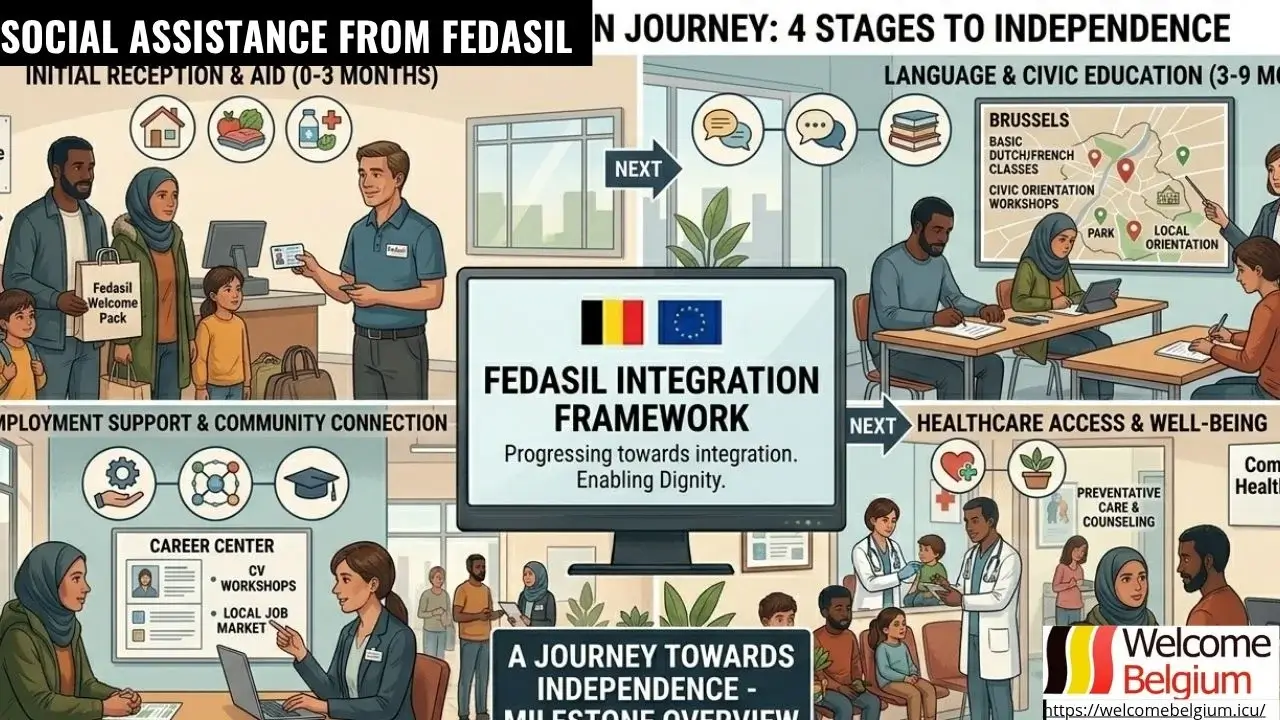
Housing Options:
- Collective Centers. Your first stop. These are dormitories providing food, medical care, and social workers. You can leave the center, but you will lose your right to food and cash allowances.
- Individual Housing (LOI). After 4 months in a center, you can request a transfer to an individual apartment managed by a local commune (CPAS/OCMW).
- Private Housing. You can live with friends or rent privately, but you will only retain access to free medical care.
2026 Financial Support Model:
The support depends on your type of accommodation:
- In a Center: You receive only “pocket money” of approximately €8.20 per week, as basic needs (food/housing) are covered by the state according to Fedasil directives.
- Outside a Center (LOI/Private): Those transitioning to independent living in communes may qualify for the RIS (Revenu d’Intégration Sociale), which is approximately €1,340.47 for a single adult, administered by local CPAS/OCMW
- Employment: This is your strongest asset. 4 months after filing your application, your “orange card” grants you the right to work without restrictions. Any income earned must be declared and may be partially withheld as a solidarity contribution to the reception system.
Alex’s Advice:
In 2026, Belgium actively encourages working refugees. If you find a job, a portion of your salary will go toward your stay in the center, but your remaining take-home pay will be significantly higher than the allowance. Plus, employment is the best proof of integration for the CGRS.
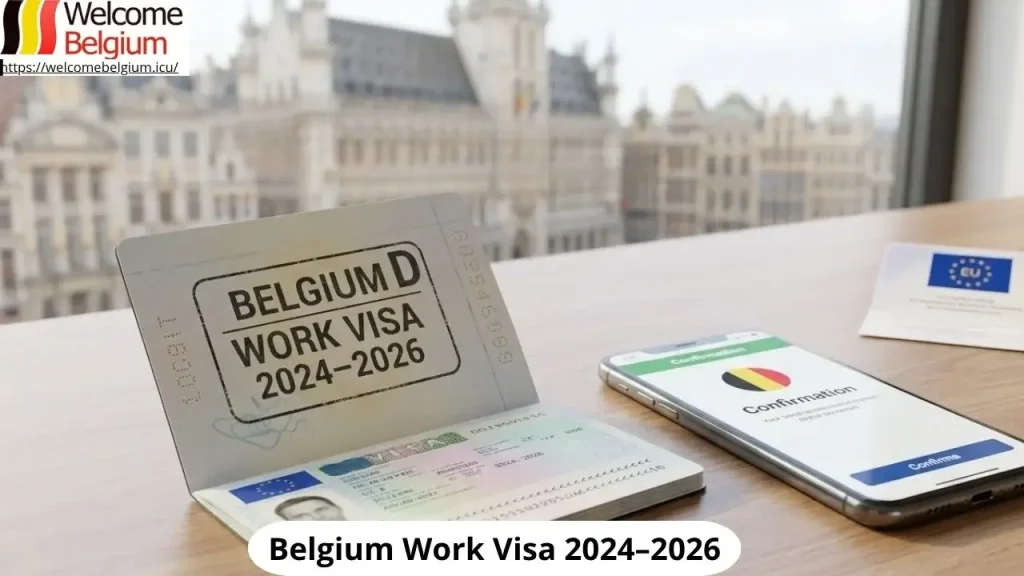
While waiting for your decision, you may want to explore other legal paths to residency. For those with specific professional skills, understanding how a work visa to Belgium functions can provide a broader perspective on the transition from humanitarian to economic migration in 2026.
Rights and Obligations of the Applicant
Once your application is accepted for consideration, you will receive a temporary identity document—the Attestation d’immatriculation (AI), commonly known as the “Orange Card” or Annex 26. In 2026, this document defines the boundaries of your freedom in Belgium.
The “Orange Card” is not just an ID; it is a legal contract with the state.
- What is permitted:
- Freedom of Movement: You can travel freely throughout the entire territory of Belgium.
- Education: Your children have an unconditional right to attend school, and you have the right to attend language courses (French/Dutch).
- Work: As previously mentioned, 4 months after filing your application, you gain full access to the labor market.
- What is strictly prohibited:
- Traveling Abroad: The “Orange Card” does not grant the right to leave Belgium. Any border crossing (even to neighboring France or the Netherlands) makes you undocumented in that country and may lead to the cancellation of your case in Belgium.
- Changing Address Without Notification: You are required to notify the commune and the Immigration Office (IBZ) of any move within 8 days. In 2026, this is strictly monitored through regular visits from the local police (wijkagent).
Medical Care: The Path to Treatment
Belgium guarantees asylum seekers access to healthcare, but the method of access depends on your place of residence.
- For those living in Fedasil centers: You visit the medical point within the center. If a specialist is needed (dentist, surgeon), Fedasil issues a Requisitoire—a guarantee of payment letter. Full details are available on the Fedasil Info
- For those in private housing: Healthcare is covered by the local CPAS/OCMW center through the equivalent social assistance system. You must apply for a “Medical Card,” which allows you to visit doctors almost free of charge.
- Emergency Care: Available 24/7 for everyone, regardless of status, by dialing 112.
Please Note:
In 2026, Belgium places immense focus on the psychological health of applicants. If you suffer from PTSD or depression due to events in your home country, ensure this is recorded by a Fedasil doctor. These medical certificates serve as powerful evidence of your vulnerability and persecution during your CGRS interview.
It is important to note that administrative backlogs can occur. Many applicants currently face questions about why people are waiting for an Orange Card for more than 6 months. In 2026, these delays are often linked to increased security screenings and commune workloads.
Decisions on the Case: Protection Statuses and Appeals
After officers analyze the interview and evidence, a verdict is reached. In 2026, the differences between types of protection have become more distinct regarding family reunification and travel.
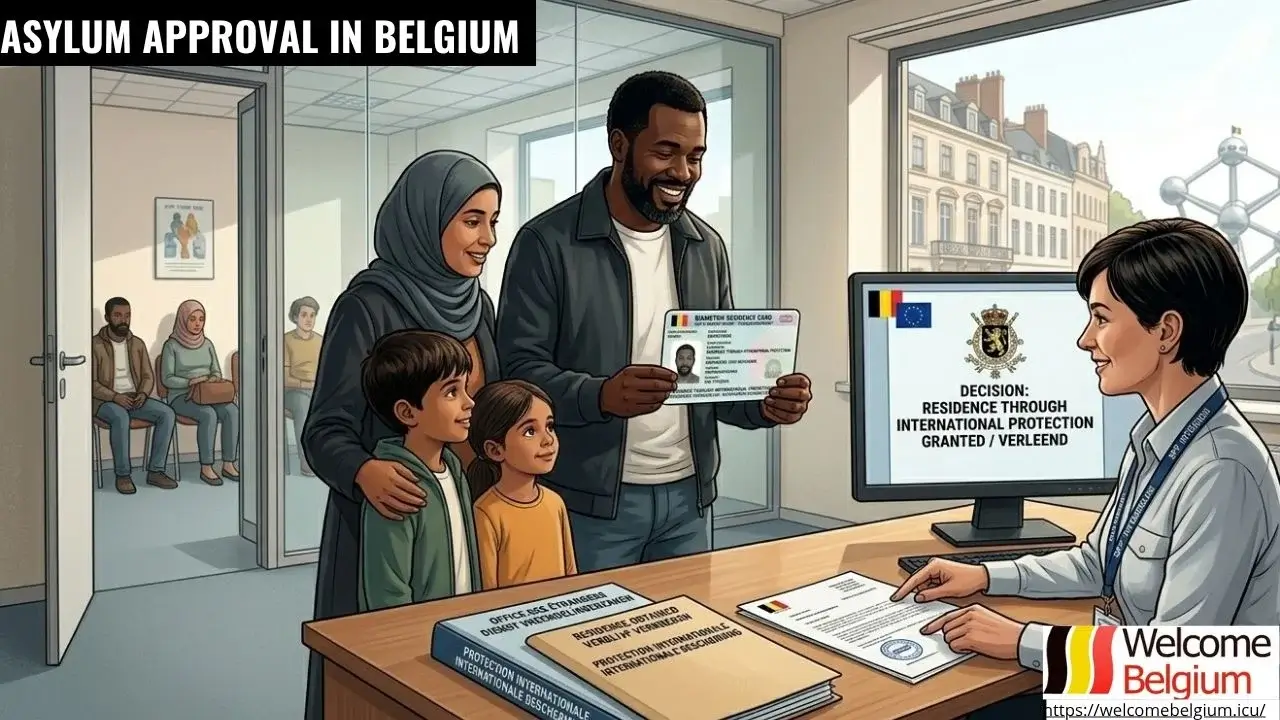
- Refugee Status (Geneva Convention)
This is the “golden ticket.” You receive it if you prove personal persecution based on race, religion, nationality, political opinion, or membership in a particular social group.
- Rights: You receive a residence permit (VNR/ВНЖ) for 5 years (Card type A; in 2026, this is the digital EU-L card).
- Documents: You are issued a refugee travel document (the “blue passport”), allowing travel almost worldwide except to your country of origin.
- Perspective: After 5 years of residence, you are eligible to apply for permanent residency or Belgian citizenship.
- Subsidiary Protection
Granted when you do not qualify for refugee status, but there is a risk of war, torture, or violence in your country.
- Differences: The permit is initially issued for 1 year with subsequent renewals (becoming indefinite after 5 years).
- Travel: You continue to use your national passport. In 2026, obtaining a Belgian travel document (the “grey passport”) has become significantly harder; you must prove it is impossible to contact your embassy.
- Market Access: Same as refugee status—you can work without restrictions.
The Appeal Process: CCE/RVV
If the CGRS issues a negative decision, it is not the end. You have the right to appeal to the Council for Alien Law Litigation (CCE/RVV).
- Deadlines: Usually, you have 30 days (or 15 days under accelerated procedures) to file an appeal.
- Nature of the Process: In 2026, the CCE usually reviews the case de novo (on its merits). This means a judge re-examines the facts entirely.
- Legal Counsel: At this stage, a lawyer is mandatory. If you lack funds, the state provides a free (pro bono) lawyer through the Bureau of Legal Aid.
Don’t panic if you receive a refusal. In 2026, approximately 25% of negative decisions are overturned or sent for review at the CCE appeal stage. The key is to find a lawyer who specializes in your specific country rather than a generalist.
Success in your asylum claim is the first step toward a stable future. After five years of legal residence, you will have the opportunity to become a permanent resident of Belgium, granting you almost identical rights to those of Belgian citizens, including long-term security.
FAQ: 10 Tough Questions About Asylum in Belgium
These are the answers to the questions people are often afraid to ask the official interpreter at the CGRS.
- Can I go home or on vacation while waiting for a decision?
Strictly no. While your case is pending, you are not permitted to leave Belgium. In 2026, Schengen border databases are fully synchronized; if you are detected departing from another EU country, your case in Belgium will be closed automatically due to a presumed “lack of interest” in protection.
- Do they take my passport when I apply?
Yes. Your national passport is seized by the Immigration Office (IBZ) for the duration of the procedure. In its place, you receive the “Orange Card” (Annex 26). Your passport is only returned if you receive a final refusal and depart the country, or it is replaced by a Blue Refugee Passport upon a positive decision.
- What happens to my family?
If your family is already in Belgium, they apply alongside you. If they are in your home country, you can only apply for Family Reunification after receiving a positive decision. Under 2026 rules, recognized refugees have a simplified reunification window during the first year of their status.
- Can I choose which city to live in?
No. Placement through Fedasil depends on available capacity in the reception network. However, after the 4-month waiting period when you gain the right to work, you may rent housing in any commune at your own expense.
- Do I need to know the language (French/Dutch) to get status?
For the status itself—no. However, in 2026, the Integration Path (Inburgering) has become a vital factor. Demonstrating that you are already enrolled in language courses serves as strong proof of your intent to build a life in Belgium.
- What if I lose my “Orange Card”?
Report the loss to the police immediately to get an official certificate, then visit your local commune. In 2026, most identity documents are also available digitally via the Digital ID Belgium ecosystem, simplifying the replacement process.
- Do they check my social media?
Yes. In 2026, migration authorities utilize OSINT (Open Source Intelligence) tools. If you seek asylum due to political persecution but post recent vacation photos from your home country on Facebook, expect a rejection based on a lack of credibility.
- How long is the actual wait for a decision in 2026?
The average timeframe ranges from 8 to 14 months. If your application is from a “Safe Country of Origin,” a decision may arrive within 15 days under the Fast-track procedure.
- Can I change my lawyer in the middle of the process?
Yes, you have the right to change legal counsel at any time. Keep in mind, however, that a new lawyer will need time to review your extensive file at the Council for Alien Law Litigation (CCE/RVV).
- Can I change my mind and withdraw my application?
Yes, this is known as a “Voluntary Withdrawal.” In such cases, Belgium can assist with your return through the REVI (Voluntary Return) program.
Conclusion
Seeking protection in Belgium in 2026 is a disciplined legal process, not a lottery. The system has become more transparent through digitalization but also more rigorous regarding the consistency of your testimony. Remember, refugee status is the foundation of your integration. Use your waiting period to master the language and seek employment; your proactive, law-abiding behavior is the ultimate proof that your future belongs in Belgium.
⚠️ Important Notice (Disclaimer)
This article is for informational purposes only and reflects migration policies as of April 2026. This information does not constitute formal legal advice. For case-specific assistance, we recommend contacting the CGRS (CGVS) or a licensed attorney specializing in immigration law.