

Last Updated on May 5, 2026 by Alex
When people ask me about the minimum salary for STR in Belgium in 2026, they usually think it’s just a formal requirement. In reality, it’s one of the main decision filters. If the SRR salary requirement in Belgium is not met — or the offer looks “off-market” for the role — the chances of refusal increase significantly.
To dive deeper into the legal nuances of these statuses and understand which one suits you best, check out our detailed guide: What is STR and SRR in Belgium: A complete overview.
The key point is this: Belgium does not apply a single national salary threshold. Instead, there is an income threshold for residence based on employment, which varies depending on the region and job category and is updated regularly. The official framework for this procedure is outlined here: Single Permit in Belgium.
What are STR and SRR in Belgium (simple explanation)
To keep it simple: STR (Short-Term Residence) refers to a temporary residence status used in limited short-stay situations. It is not the main route for labour migration and rarely plays a role in employment-based relocation.
In practice, what really matters is SRR, which refers to the Single Permit system — the combined work and residence permit. This is the standard pathway for most non-EU workers coming to Belgium. It is a single administrative approval that gives both the right to live and work in the country and defines the main types of residence permits for employment in Belgium.
Who this system applies to
In real cases, the Single Permit system is mainly used for:
- non-EU foreign workers relocating for employment
- highly skilled professionals hired by Belgian companies
- candidates who already have a signed job contract with a Belgian employer
STR vs SRR (Single Permit) — key differences
| Parameter | STR (Short-Term Residence) | SRR (Single Permit / Work & Residence) |
| Meaning | Temporary stay permission | Combined work and residence authorization |
| Purpose | Short-term presence | Long-term employment-based migration |
| Work rights | Limited or not applicable | Full legal right to work |
| Role in practice | Secondary / occasional | Main immigration route for workers |
| Usage frequency | Rare | Standard for non-EU employment cases |
Legal framework
Belgium’s labour migration system is based on a clear legal structure:
- Law of 15 December 1980 on the access to the territory, residence, establishment and removal of foreigners
(Immigration framework law governing entry, residence, and removal of foreign nationals) - Royal Decree of 2 September 2018 implementing the Single Permit procedure
(Regulation defining the Single Permit application process for work and residence)
In addition, regional authorities (Flanders, Wallonia, Brussels) set their own labour market rules, including salary thresholds and eligibility criteria.
From practical experience:
STR is mainly a technical, short-term residence concept. SRR (Single Permit), on the other hand, is the real gateway for labour migration in Belgium. In most cases I deal with, it is the decisive factor — not the paperwork quality, but whether the salary and job profile fit the regional requirements.
Minimum Salary for STR/SRR in 2026
Let me be direct from experience: the minimum salary in Belgium 2026 is not a single fixed number, but a system of thresholds. And this is exactly where most applicants make mistakes. It’s not enough to simply “meet the minimum” — the salary must match the job category and market level, otherwise even a formally sufficient offer can be rejected.
Keep in mind that to apply for SRR tax benefits, meeting the territorial criteria is crucial. Learn how to correctly calculate the 150 km distance from the Belgian border to ensure you qualify for these preferences.
Salary requirements for the salary threshold Belgium 2026 depend on the type of permit and the applicant’s status. The official Single Permit procedure is explained here: workinginbelgium.be.
Salary threshold guidelines in 2026
Below is the practical structure actually used by immigration authorities (important: this always refers to gross salary Belgium, meaning before taxes):
- General workers
- Base level aligned with labour market standards and collective agreements
- Employment position is often reviewed for consistency
- Key requirement: the salary must look “realistic” for the profession
Example: offering a waiter €5,500–€6,000 gross may raise questions, even if it formally exceeds minimum thresholds.
- Highly skilled workers (high skilled migrant Belgium)
- Higher salary threshold requirement
- In some cases, simplified procedures apply
- Main criteria: salary level + experience + qualifications
Example: for an IT engineer or technical specialist, €4,000–€4,800 gross may be acceptable, while €3,200–€3,400 is often considered too low for this category.
- EU Blue Card (if applicable)
- Highest annual income requirement
- Designed for university-level professionals
- Regulated at EU level: EU Blue Card – European Commission
From Alex’s experience:
The most common mistake is focusing only on the legal minimum. In reality, authorities evaluate three things at once: gross salary level, job relevance, and market logic. If even one of these factors is inconsistent, the application can be refused even if the salary technically meets the threshold.
Differences in Requirements Across Belgian Regions
In Belgium, labour migration conditions depend heavily on the region. That’s why search queries like salary in Flanders work permit, salary Brussels work permit, and Wallonia work requirements can lead to different outcomes even for the same job and salary level.
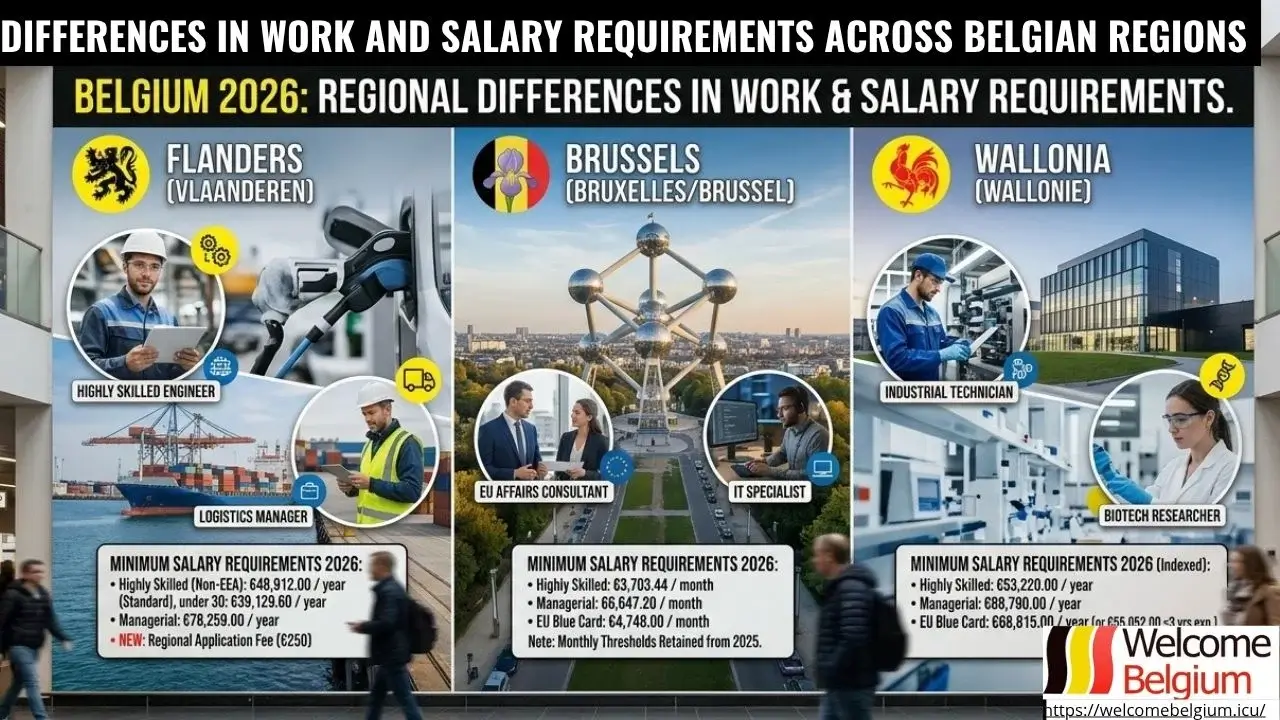
This is due to the decentralised system: key decisions are made by regional authorities Belgium, not a single federal body. The overall legal framework is based on the Law of 15 December 1980: https://www.refworld.org/legal/legislation/natlegbod/1980/114094.
Comparison of Belgian regions
| Criterion | Flanders | Wallonia | Brussels |
| Assessment approach | Strict and formalised | More flexible | Market-driven, international |
| Main focus | Salary and labour market compliance | Employer’s labour shortage | Market competitiveness |
| Salary scrutiny | Very detailed | Moderate flexibility | Flexible, market-oriented |
| Approach to foreign workers | Strict control | Sector-based assessment | More open to expats |
| Key decision factor | Flemish region salary requirement | Occupation shortage | salary Brussels work permit |
Flanders
Flanders is the strictest region when it comes to labour migration. Authorities pay close attention to the Flemish region salary requirement, job-market alignment, and justification for hiring a foreign worker.
- highly formalised procedures
- strict salary and job evaluation
- priority given to the domestic labour market
From Alex’s experience: Flanders most often rejects applications not due to missing documents, but because the salary does not align with market logic.
Wallonia
Wallonia is more flexible, especially in shortage occupations. Here, the focus is more on the actual need of the employer rather than rigid thresholds.
- more flexibility across sectors
- emphasis on labour shortages
- case-by-case assessment
Brussels
Brussels is the most international region. Salary evaluation often follows global labour market standards.
- strong international employer presence
- market-based salary expectations
- more flexible approach for highly skilled workers
Official regional information: https://economy-employment.brussels
From Alex’s experience:
Formally, the rules are unified at the national level, but in practice the region determines the outcome. The same salary and job profile may be approved in one region and rejected in another without any change in documents.
Salary in Belgium: how it is calculated, why refusals happen, and how income is verified
In Belgian immigration procedures, salary is not just a number in a contract. It is assessed on several levels: structure (gross/net), market consistency, job credibility, and documentary proof. This is where most applicants make critical mistakes that lead to immigration refusal Belgium.

Gross or net: how salary is calculated
In Belgium, only the gross salary Belgium (gross salary) is considered — meaning income before taxes and social security contributions. This is the figure used when assessing eligibility for residence permits and work permits.
Key points:
- only gross income (taxable income Belgium) is considered
- net salary (take-home pay) is irrelevant for immigration thresholds
- bonuses are only counted if explicitly stated in the employment contract salary and guaranteed by the employer
Since taxes in Belgium can take up a significant portion of your income, we recommend studying the expat tax regime in Belgium in advance to optimize your payments.
A common mistake is focusing on net income, while immigration authorities evaluate the full payroll structure.
How salary is calculated in practice (examples)
To understand real figures, it’s important to see the gross-to-net difference. Below are simplified examples (actual taxation varies depending on marital status, region, and tax benefits):
Example 1: standard employee
- Gross salary: €3,500
- Social security + taxes: ~35–45%
- Net salary: approximately €2,000–€2,300
Example 2: highly skilled professional
- Gross salary: €5,000
- Social security + taxes: ~38–50%
- Net salary: approximately €2,600–€3,100
Example 3: management position
- Gross salary: €7,000
- Social security + taxes: ~40–52%
- Net salary: approximately €3,300–€4,200
Important:
Immigration authorities always assess gross income, not take-home pay. Even if net salary looks modest, it has no impact on work permit eligibility.
Common salary-related refusal reasons
In practice, refusals for residence or work permits in Belgium are often not about missing documents, but about salary structure issues:
- salary below the required threshold
- mismatch with labour market standards (labor market test)
- incorrect contract structure
- artificially inflated salary without economic justification
These fall under standard compliance salary checks and document verification Belgium procedures.
Important (from Alex’s experience):
If the salary is “on the edge”, approval often depends on strengthening the case: experience, shortage skills, and employer justification. In some cases, this matters more than the formal salary figure itself.
How salary is proven during application
To prove income for a work permit or residence application, the following documents are typically required:
- employment contract (employment contract Belgium)
- official job offer
- payroll / payslips
- employer confirmation of hiring
The employer plays a key role through employer sponsorship Belgium, confirming the job conditions.
Important (from Alex’s experience):
Even a strong contract can be rejected without proper supporting documentation. In Belgium, it is not only the salary amount that matters, but also how logically and transparently it is documented.
Changes in 2026: what you need to know
In 2026, Belgium’s labour migration system was not radically rewritten, but its practical application became significantly stricter. This is less about new laws and more about stronger enforcement, automatic salary indexation, and deeper scrutiny of job-market alignment. This directly affects Belgium immigration changes 2026, new salary requirements Belgium, and how work permit applications are updated and assessed.
The core legal framework remains unchanged:
- Law of 15 December 1980 on the access to the territory, residence, establishment and removal of foreigners
- Royal Decree of 2 September 2018 implementing the Single Permit procedure
Before / After: key changes in 2026
| Before | After |
| More flexible salary assessment | Stricter alignment with labour market standards |
| Borderline salaries often accepted | Borderline cases now require strong justification or are rejected |
| Formal job verification | Deeper analysis of role reality and business justification |
| Moderate employer scrutiny | Stronger checks on employers and job offers |
| Regional flexibility in practice | More harmonised evaluation approach |
Key changes in 2026
- Salary indexation increases effective thresholds
Automatic indexation leads to rising minimum salary levels without formal legal amendments. This directly impacts salary thresholds Belgium, especially for skilled categories. - Stricter assessment of salary-market alignment
Even a formally sufficient salary may be questioned if it does not match industry standards and job reality. - Stronger employer and job verification
Authorities assess the real existence of the role, economic necessity, and company structure more strictly. - Tighter labor market test application
More detailed evaluation of the availability of EU and local candidates. - Reduced flexibility in borderline cases
Previously acceptable “grey zone” applications now require strong documentation and justification.
Important:
The main shift in 2026 is not new legislation, but stricter enforcement of existing rules. The system is less tolerant of borderline salaries and weak justifications. Today, approval depends not only on the number in the contract, but on the overall logic of the case: market demand, job role, and economic necessity.
Frequently Asked Questions (FAQ)
This section covers the most common FAQ working in Belgium, typical Belgium residence permit questions, and practical work permit answers. Short and to the point, based on how these cases are usually assessed in practice.
Can I get a permit with a salary below the minimum?
Usually no. The threshold is mandatory. Exceptions are rare and only possible with strong justification (shortage occupation, highly specific role, strong employer argument).
Are bonuses included in salary calculations?
Yes, but only if they are guaranteed and explicitly stated in the contract. One-off or 'potential' bonuses are not counted.
Can I change employer after receiving a residence permit?
Yes, but in many cases you must notify authorities or obtain a new authorization, especially in the early period after approval.
What happens if my salary decreases after obtaining the permit?
It may affect renewal. If income drops below the required level, additional checks can be triggered.
Is the actual salary payment checked or is the contract enough?
Both are checked: the contract and actual payroll payments. A contract alone is usually not sufficient.
In Belgium, it’s better to look beyond minimum thresholds and focus on market-level salary for a specific profession. Even if the formal requirement is met, approval often depends on whether the salary makes sense for the role, experience, and industry context. A safer strategy is to aim slightly above the minimum and account for the worker’s category.
Ultimately, Belgian immigration decisions are not based only on a number in the contract, but on its logic: alignment with the labour market, job role, and overall hiring structure. The stronger and more coherent the profile, the more predictable the outcome.
Sources and Legal References
Below are the main official sources and legal acts used as the basis for the information in this article on salary requirements and labour migration in Belgium.
- Law of 15 December 1980 on the access to the territory, residence, establishment and removal of foreigners
The fundamental law governing entry, residence, settlement, and removal of foreign nationals in Belgium. It forms the backbone of Belgian immigration law. - Royal Decree of 2 September 2018 implementing the Single Permit procedure
Royal Decree regulating the Single Permit procedure, which combines work and residence authorization for most labour migration cases. - Working in Belgium – Single Permit (official information)
Official portal explaining the Single Permit procedure, including requirements for employers and foreign workers. - Federal Public Service Employment, Labour and Social Dialogue (Belgium)
Government authority responsible for employment, labour law, and working conditions in Belgium. - Brussels Economy and Employment
Official Brussels region website with information on work permits and regional employment rules.
Disclaimer
This article is for informational purposes only and does not constitute legal advice. Immigration rules in Belgium may change, and requirements can vary depending on the region, job category, and individual applicant’s case. Before submitting any application, it is recommended to verify the latest information on official government sources or consult qualified professionals.