
Last Updated on April 28, 2026 by Alex
Checklist: The 150 km Rule for STR/SRR Tax Regimes
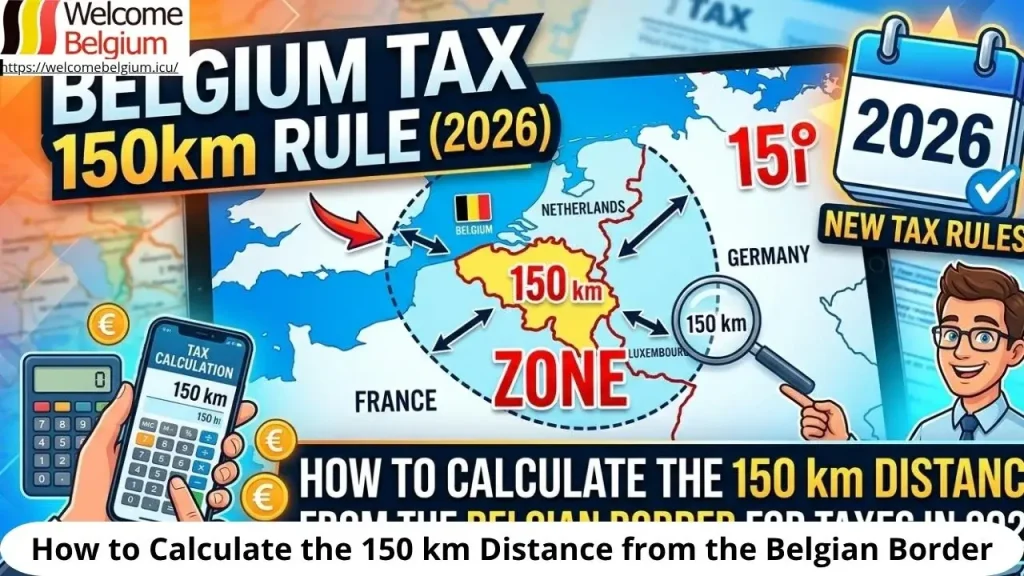
- Method: Strictly in a straight line (“as the crow flies”), not by road distance.
- Reference Point: From the closest point on the Belgian border to your home address.
- Distance: Minimum of 150 kilometers.
- Timeline: You must have lived outside this zone for the last 60 months.
- Rejection: If the distance is less than 150 km, you do not meet the requirements and cannot apply.
How to Measure
To calculate the 150 km distance from the Belgian border, you must measure the straight-line distance from your address to the nearest border point using the “Measure distance” tool in Google Maps.
150 km Calculation Examples: Analyzing Border Cases
To qualify for STR/SRR tax benefits in Belgium under Circular 2026/C/51, you must prove that for the last 5 years, you resided at least 150 km away from the Belgian border.
All current changes in the application procedure and the latest departmental clarifications are analyzed in detail in my extended guide: Belgium Taxes 2026 for Expats: STR/SRR Regime.
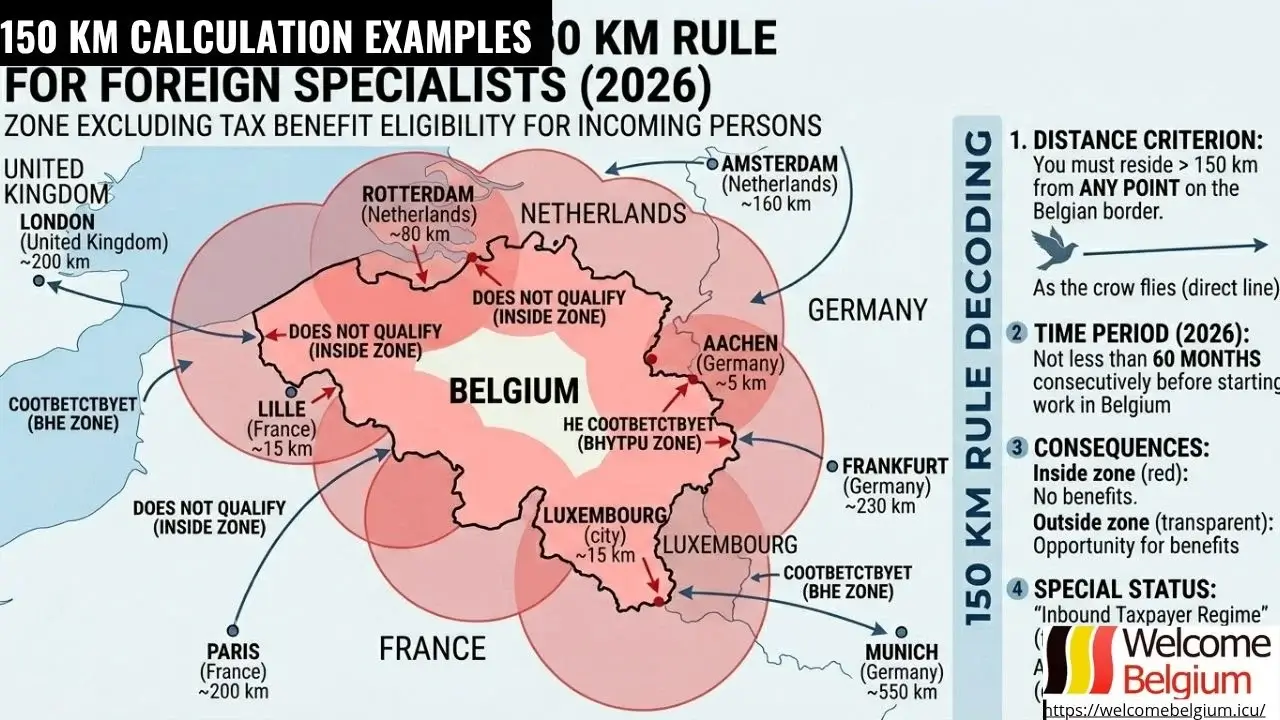
To understand how the system works in practice, let’s look at typical examples for residents of border regions. Remember: the tax authorities do not consider travel time, only geometry.
- Example 1: Düsseldorf (Germany)
Many expats make the mistake of relying on the 170 km driving distance via the autobahn. However, when measuring a straight line from the southern districts of the city to the Belgian border, the distance may be approximately 148 km.
- Verdict: Requirement not met. Application rejected.
- Example 2: Maastricht and Eindhoven (Netherlands)
Despite being major cities with advanced infrastructure, they fall almost entirely within the 150-kilometer radius.
- Verdict: Residents of these zones are by default ineligible for the STR/SRR regime.
- Example 3: Frankfurt am Main (Germany)
Here, both by road and “as the crow flies,” the distance confidently exceeds 150 km (approximately 190 km in a straight line).
- Verdict: Distance condition fulfilled.
Pro Tip:
If your measurement shows 150.5 km or 151 km, you are in the “risk zone.” Online map accuracy can vary by 1-2 km. In such cases, be sure to save a screenshot with the radius overlay from FreeMapTools or a similar service as part of your initial dossier.
Top Online Services for Verifying the 150 km Rule
To provide a solid justification to the Belgian tax authorities (SPF Finances), you must have precise data. Below are three proven methods to independently verify the distance:
- Google Maps (“Measure Distance” Tool): The most accessible method. Right-click on your home address, select “Measure distance,” and click on the nearest point of the Belgian border. Ensure the resulting straight line is at least 150 km.
- FreeMapTools (Radius Around Point): A specialized resource for geo-analysis. Enter your address and set a radius of 150 km. If any part of Belgium falls inside the circle, you are too close to qualify for the benefit.
- CalcMaps: A user-friendly visual service for drawing and saving radii on a map. This is useful for preparing screenshots that clearly demonstrate your compliance with the criteria.
Important:
Tax authorities use their own professional GIS (Geographic Information Systems). If your result fluctuates between 150–152 km, the margin of error in standard online maps can be critical. In such “borderline” cases, I recommend obtaining formal confirmation from a professional tax consultant.
Geography and Timelines: Critical Zones and the 60-Month Rule
When calculating distance, it is crucial to consider not only the measurement method but also the geographic specifics of border regions and your residency timeframe.
Critical Zones for Expats:
- Germany: Cities such as Aachen, Cologne, and Düsseldorf are under close scrutiny. Their distance to the nearest official point of the Belgian border is often near the 150 km threshold.
- The Netherlands: Practically the entire southern part of the country, including Maastricht and Eindhoven, falls within the 150-kilometer zone, making residents of these areas ineligible for the benefit.
If your calculations show a minimal margin (e.g., 151 km), be prepared for a detailed audit. The SPF Finances apply professional geodetic tools with precision that may differ from consumer-grade online services. In disputed situations, I recommend consulting a tax lawyer and preparing a residence certificate (Meldebescheinigung or equivalent) to confirm your exact historical address.
Compliance with the 150 km distance is only one part of the requirements. According to Circulaire 2026/C/51, you must prove you resided outside this zone for at least 60 months (5 full years) prior to starting your professional activity in Belgium.
Key Reminder:
Any official residence within the 150 km radius during this 5-year period automatically disqualifies you from the STR/SRR tax regime.
FAQ: Troubleshooting Errors and Disputed Cases
The main reason is the difference in geodetic databases. The Belgian tax office uses official state maps with high precision. Standard services may have a 1–2 km margin of error. If your result is in the 150–153 km range, it is considered a 'risk zone' requiring official verification.
No. Belgian tax law does not provide for rounding rules in favor of the taxpayer for this regime. If the actual distance is 149.8 km, the condition is not met. The distance must be strictly 150 km or more.
Different algorithms may use different Earth models (such as the WGS84 ellipsoid). For accuracy, rely on straight-line measurements in Google Maps or specialized tools like FreeMapTools.
Any official place of residence (registration) within this radius during the last 60 months is grounds for rejection. Short-term visits or tourism do not affect this rule.Why does the service show 151 km, yet the benefit might be denied?
Can I round the distance up?
Why do different websites show different figures for the same address?
Does temporary residence in the 150 km zone (e.g., a business trip) count?
Official Sources and Useful Links
The following official data and expert clarifications were used to prepare this article:
- Circulaire 2026/C/51 – A detailed breakdown of the regime updates via Fisconetplus, the official database of Belgian tax legislation.
- SPF Finances (Public Federal Service Finance) – The primary portal for Belgian tax authority information.
Disclaimer
The information provided in this article is for informational purposes only and is current as of April 2026. Belgian tax legislation and the interpretation of administrative circulars are subject to change. Welcome Belgium and the author are not responsible for decisions made by tax authorities regarding your specific case. Before submitting an official application, we strongly recommend consulting a certified tax expert in Belgium.