
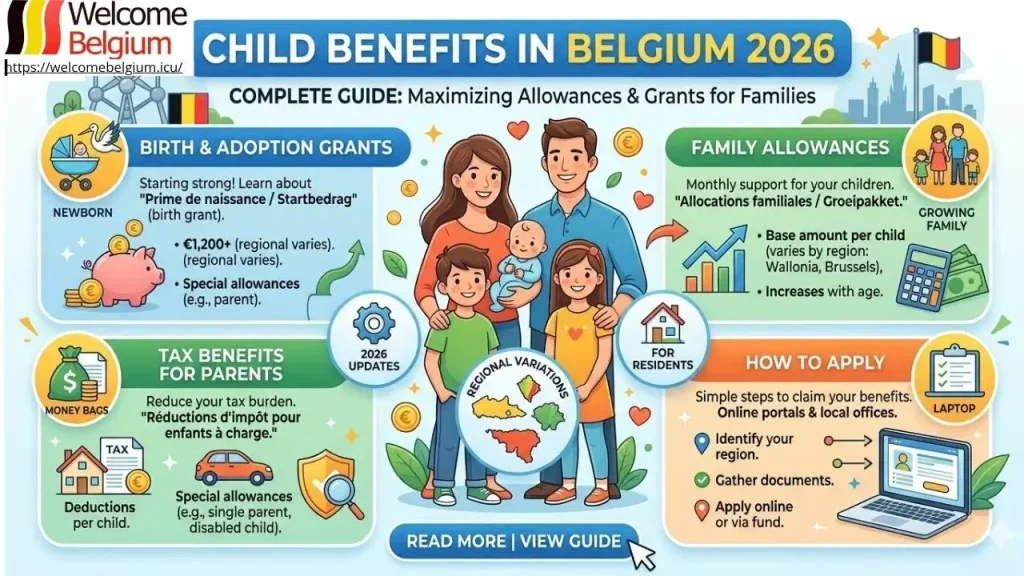
Last Updated on June 10, 2026 by Alex
Alex here. It is crucial to understand that social support for families in Belgium is completely decentralized. As soon as expats obtain immigrant status and become residents, they are tied to the regulations of their specific region (Flanders, Wallonia, Brussels), where each family fund calculates and distributes funds according to its own rates through the local ministry of social welfare.
All child benefits in Belgium are divided into two main categories: a newborn starter kit (known as Groeipakket in Flanders) and monthly financial assistance. For immigrants, these payments become a substantial financial backbone. However, to initiate disbursements on time, you must strictly follow bureaucratic procedures and gather an exact set of documents.
Expert Verification and Data Relevance
- Information Status: Verified and up to date as of June 9, 2026.
- Basis of Verification: Continuous monitoring of official statutory acts of the Kingdom of Belgium, updates to the tariff grids of regional funds, and circulars from the Ministry of Finance.
- Primary Sources Used:
- Federal Public Service Finance [SPF Finances (Enfants à charge / Attestation 281.86)].
- Official Gazette [Moniteur Belge (Tax Code CIR 92 / WIB 92)].
- Regional ministries of social welfare and payment funds: [Groeipakket] (Flanders), [Famiris] (Brussels), [Famiwal] (Wallonia).
Lump-Sum Birth Grant and Family Payments: Amounts by Region
The newborn starter payment is regulated by regional laws: in Flanders by the Decree of July 13, 2018 (Decreet Groeipakket), in Wallonia by the Decree of February 8, 2018 (Décret relatif à la gestion et au paiement des prestations familiales), and in Brussels by the Ordinance of April 25, 2019 (Ordonnance réglant l’octroi des prestations familiales). You can apply starting from the 24th week of pregnancy.
| Region | Benefit Name | Amount (2026) | Application Deadlines | Authorized Funds |
| Flanders | Startbedrag | €1,269.00 | From the 6th month | Parentia, Infino, Kidslife |
| Wallonia | Allocation de naissance | €1,394.94 | From the 6th month | Famiwal, Parentia, Infino |
| Brussels | Prime de naissance | €1,394.94 | From the 6th month | Famiris, Parentia, Kidslife |
Each region calculates child benefits in its own way:
- Flanders: The amount is fixed. You receive €1,269.00 for the first child as well as for all subsequent children.
- Wallonia: The fund pays €1,394.94 for the first child. Starting from the second child, the payment is €620.00.
- Brussels: The system is identical to Wallonia’s. €1,394.94 is allocated for the firstborn, and €620.00 for subsequent children.
To have the money transferred to a bank account, an online application must be filed, accompanied by a certificate from an obstetrician-gynecologist. If you manage to submit the documents by the seventh month of pregnancy, the starter sum arrives before the birth. If you miss this deadline, you can still claim your [maternity money in Belgium] and collect the starter capital post-factum, but this must be done on the basis of the birth certificate.
By law, the right to claim the birth grant is preserved for five years after childbirth, and the final size of the child benefit is locked in at the moment the application is registered.
Important:
Approval of the payment depends strictly on the region of your official registered address. If you change housing and move to another region before giving birth, you will have to submit a new application to the fund corresponding to your new place of residence.
Regional Calculator: Monthly Child Benefits in Belgium and Calculation Rules
To calculate regular family support, you must take into account the internal administrative structure of the country. The accrual of funds begins the month following the registration of the child’s address in the commune, while child money across Belgian regions is distributed according to three different schemes.
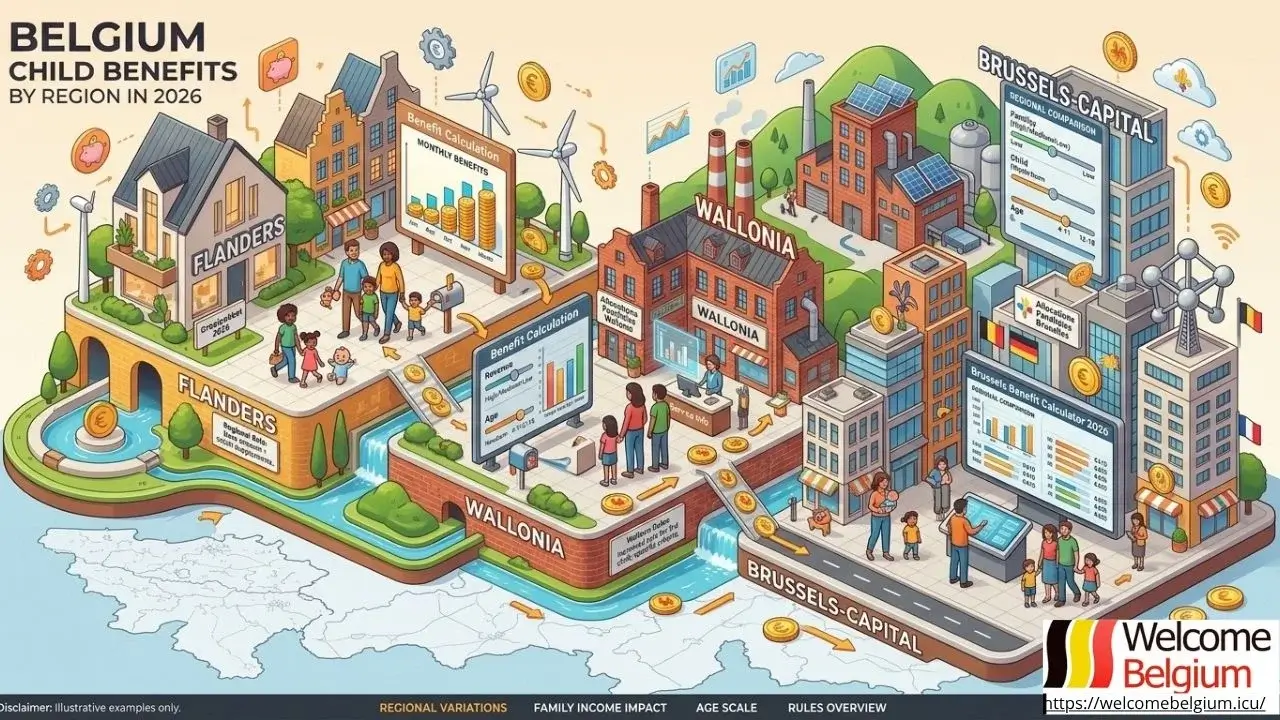
- Flanders: The [groeipakket system] in Flanders stipulates that the base rate for each child is a fixed €184.62 per month. Current tariffs, including all supplements and coefficients, are locked in the official [Groeipakket registry] and regulated by the state public fund [FONS]. An age supplement is added to the base sum upon reaching 6 and 12 years, alongside an annual school bonus (schoolbonus).
- Brussels: The public fund [Famiris] uses a differentiated scale. Here, monthly child payments directly depend on the child’s age and the parents’ total income level, as established in the official [Famiris guide]. Following the scheduled spring indexation of 2026, all changes and new tariff grids were published in the [Famiris fund bulletin].
- Wallonia: The local model is also built on stepped payments, where the final size of the support is determined by the social status of the parents and the aggregate family income. The exact amounts of the base rates before and after the reform are available on the [Famiwal fund portal], and a summary tariff table for the current year is presented on the official website of the [KidsLife association].
Real-World Case Study:
An expat family with two children (aged 7 and 13) rented a home in Ghent (Flanders), receiving the standard payment package. The older child received an age supplement (extra payments at ages 6 and 12) and a school bonus (schoolbonus) in August. Later, due to the father’s job, the parents relocated to Brussels. Because of differences in local legislation and changes to the accrual structure (as Brussels began taking their high family income into account), the total support amount was adjusted in accordance with the rules of the Famiris fund.
Please remember that when changing your place of residence, there is no automatic data transfer between regions. You are obligated to personally notify your current fund about the move; otherwise, payments will be temporarily frozen due to a registered address mismatch in the single registry.
Tip:
Any social supplements tied to parental income are recalculated by the funds post-factum based on the tax return from two years prior. If your income dropped sharply in the current year, it is highly recommended to file an application for a manual case review, providing current payslips (loonfiches / fiches de paie).
Taxes and Social Supplements: What Else the Belgian Family Allowance System Includes
Having children automatically increases your tax-free allowance (belastingvrije som). Calculations are handled by the [SPF Finances] service. Through the [Minfin personal portal], a fixed fiscal deduction is activated for each dependent child.
Understanding your general tax status as a foreign resident is a crucial step. To learn more about special deductions and rules for international workers, read our analysis of expat taxes in Belgium.
Additionally, the state provides a tax deduction for daycare and nursery (crèche) costs. You can recover up to 45% of official expenses based on a fiscal certificate via Form 281.86. The daily write-off limit is €17.30 per child. If a minor has chronic illnesses, the funds award supplements for a [child with a disability] (special needs payments) based on a scale ranging from 1 to 21 points.
Step-by-Step Instructions for Claiming Deductions
Step 1: Obtaining Certificate 281.86
Every year in March or April, you must request an annual fiscal Form 281.86 from the administration of your nursery, school, or after-school care organization. This document officially records the number of days the child spent at the facility and the total amount paid. Accredited organizations often transfer this data to the tax authorities automatically via the Belcotax system, but personal verification by parents remains mandatory.
- Timeline: March – April of the current year for the previous financial year.
- Where to go: The request should be directed to the secretary or accountant of your daycare/nursery.
Step 2: Verifying Data in Tax-on-Web
The tax return filing period opens in May and June. You need to log into the state portal [MyMinfin] using a digital key (eID or the itsme app) and open the Tax-on-Web form. Navigate to Section X (Code 1384). If childcare expenses were automatically pulled from the database, cross-check the numbers with your paper certificate. If the field is blank, you must manually enter the amount and number of days.
When navigating the online portal, it is highly recommended to follow a verified procedure. You can check our comprehensive guide on filing a tax return in Belgium to prevent common mistakes and ensure all forms are filled out correctly.
- Timeline: Until the end of June for self-filing; until mid-July if filing through a tax advisor.
- Where to go: Online portal [MyMinfin], under the electronic declarations section.
Step 3: Checking Dependent Status
On the same [MyMinfin] portal, while filling out the general questionnaire, you need to check the personal data block regarding family composition. Ensure that all children are officially listed as your dependents. An error or a missing checkbox in this column will block the automatic recalculation of the basic tax-free allowance, and the system will calculate your taxes using the standard single person’s rate.
- Timeline: Completed simultaneously with the declaration review in May–June.
- Where to go: The “Family Composition” section (Ménage / Gezin) inside the tax form.
Step 4: Awaiting Payment and Closing the Tax Period
After the official submission of the tax return, the [SPF Finances] tax authority takes the documents for verification. By law, the state has until June 30 of the following year to send you the final assessment notice (Aanslagbiljet / Extrait de rôle). In practice, the document arrives much sooner. The calculation will state the final amount: if an overpayment was generated due to child deductions, the state will refund the money to your specified bank account.
- Timeline: 3 to 6 months after submitting documents (usually between August and March).
- Where to go: The final document will arrive in your electronic mailbox (eBox) and is duplicated in your [MyMinfin] personal account.
Analysis of Errors and Rejections
Immigrants most frequently face tax deduction rejections due to carelessness when filling out forms or choosing unlicenced facilities. Tax inspectors cross-reference every single line automatically, meaning any mismatch leads to the deduction being blocked.
| Typical Problem / Error | Reason for Tax Authority Rejection | Method of Correction and Resolution |
| Submitting regular receipts or invoices | The tax authority does not accept bank statements or receipts from private nannies. Only Form 281.86 is valid. | Check the institution’s official accreditation in advance (Opgroeien in Flanders or ONE in Wallonia). Only they can issue this certificate. |
| Conflict during co-parenting | Both parents claim 100% of the deduction for the exact same child in their respective tax returns after a divorce. | The tax benefit must be split exactly in half (50/50). Each parent needs to state this status under the corresponding codes in their form. |
| Exceeding the daily expense limit | The applicant enters the full cost of an elite nursery (e.g., €35 per day) instead of the allowed maximum. | Recalculate the sum manually before submitting. The number of attendance days from the certificate must be multiplied strictly by the established limit of €17.30 per day. |
| Child is not registered at the applicant’s address | The tax authority cannot see the child as a dependent because their official registration in the commune differs from the parent’s address. | Submit an application to the commune to update the data in the National Registry (Rijksregister) and attach the birth certificate to the tax return. |
If you receive an official rejection or an assessment amendment notice from [SPF Finances] (Proposition de rectification / Voorstel van wijziging), you have exactly one month to submit a reasoned objection. You must attach scan copies of the original 281.86 certificate and a family composition statement obtained from your commune.
Important: If you paid for a nursery or after-school care but the official 281.86 certificate did not arrive by the end of May, do not send the declaration blindly. Contact the administration of the childcare facility or manually input the data into the system, but be absolutely sure to keep a copy of your written request to the nursery in case of an audit by the tax inspection.
Current Personal Income Tax Parameters
| Category | Parameter | Amount / Rate |
| Base Allowance | Tax-free sum (for everyone without exception) | €10,570 per year |
| Tax Brackets | Up to €15,820 | 25% |
| From €15,820 to €27,920 | 40% | |
| From €27,920 to €48,320 | 45% | |
| Over €48,320 | 50% | |
| Local Tax | Municipal tax (Gemeentebelasting) | From 0% to 9% (depends on the commune) |
| Child Deductions
(Increases the basic tax-free allowance) | 1 child | + €2,010 |
| 2 children | + €5,180 | |
| 3 children | + €11,650 | |
| Toddler/Baby Bonus | Child under 3 years old (if nursery deduction is not claimed) | + €750 per child |
Childcare expenses are just one of the many instruments available for tax optimization. Discover other legitimate deductions and learn how to legally reduce taxes in Belgium to keep more of your hard-earned money.
In parallel, [child tax benefits in Belgium] operate to partially cover expenses for nurseries (crèche), kindergartens, official after-school care, and licensed summer camps. Parents have the right to file for a nursery tax deduction of up to 45% of officially spent sums. Expenses are written off based on a fiscal certificate using Form 281.86, with the maximum daily limit capped at €17.30 per child.
If a minor is diagnosed with chronic illnesses or developmental needs, regional funds approve [supplements for a child with a disability] (special needs payments), the size of which is calculated individually on a severity scale ranging from 1 to 21 points. Direct monthly [family allowances] (Groeipakket / Allocations familiales) are also built into the system, with sizes regulated at the regional level. For low- and middle-income workers, a social bonus (Sociale werkbonus) is provided—a special discount on social security contributions that effectively increases net take-home pay.
Legislative Framework
All tax deductions in Belgium are strictly regulated and rely on the following official documents:
- Belgian Tax Code (CIR 92 / WIB 92):
- Article 132 regulates the increase of the tax-free allowance for dependent children.
- Article 113 establishes the rules for deducting childcare expenses. The official text of the code is hosted in the state database [Moniteur Belge].
- Official Circular of SPF Finances: The document [Circulaire 2022/C/104 relative à la réduction d’impôt pour les frais de garde d’enfants] defines the exact eligibility criteria for daycare facilities. All instructions and document forms are accessible via the state portal [SPF Finances – Attestation 281.86] and on the agency’s pages [SPF Finances – Enfants à charge].
Practical Case Study: Part-Time Work of a Student Child
One of the most frequent “pitfalls” in Belgium occurs when a working teenager accidentally strips their parents of tax benefits.
Case Study: A 16-year-old daughter works during her holidays as a student (studentenarbeid) and earned €8,400 gross over the year. It is a two-parent household, and the parents file a joint tax return. Will she remain a dependent of her parents?
According to the rules of [SPF Finances], for a child to remain a dependent in a two-parent household, their personal net income (nettobestaansmiddelen) must not exceed €4,180 per year. By law, the calculation of a student’s net income looks like this:
- Tax exemption for students: A fixed first quota is subtracted from the total gross income and is not counted as income:
8 400 € − 3 190 € = 5 210 €
- Deduction of professional expenses: A standard automatic tax deduction for professional expenses at a rate of 20% is applied to the remaining sum:
5 210 € × 20% = 1 042 €
- Final net income for the tax authorities:
5 210 € − 1 042 € = 4 168 €
Conclusion: The final net income amounted to €4,168, which fits perfectly within the state-established limit (€4,180). The daughter officially remains a dependent of her parents. The family fully retains its right to an increased tax-free allowance. If she had earned even €50 more, the parents would have lost the benefit, increasing their taxes by approximately €900.
What Changed in 2026: New Rules for Birth Grants and Regional Benefits
The Kingdom’s social support legislation continuously adapts to economic realities. A series of critical regulatory adjustments came into force in 2026, directly impacting the final income of families with children. If you are mapping out a family budget or just getting ready to submit documents, you should account for three key updates in advance.
1. Winter Indexation of All Payments by 2%
Due to the fact that the state-established pivot index (index pivot) was officially exceeded in Belgium at the end of last year, all state benefits automatically increased in Brussels and Wallonia starting February 1, 2026.
Regional funds (such as [Famiris] and [Parentia]) implemented a 2% indexation on base rates and targeted supplements. The first increased disbursements for February arrived in parents’ bank accounts at the beginning of March 2026. These [2026 child benefit adjustments] affected:
- The initial birth allowance (Maternity grant / Startbedrag).
- Monthly base child payments for all age categories.
- Survivor’s supplements (orphan allowances) and supplements for children with special needs.
2. Final Phase-Out of the Toddler Allowance in Flanders
On January 1, 2026, new family benefit laws took effect within the Flemish [Groeipakket] system. The previously popular kindergarten attendance bonus (Toddler Allowance / Kleutertoeslag) for children aged 3 and 4 has been completely abolished.
This program was phased out incrementally, and the final cancellation of the supplement has now occurred across all age groups. The Government of Flanders has fully redirected the freed-up budget toward direct infrastructure financing for primary schools and expanding targeted monthly social payments for low-income families.
3. New Income Thresholds for Social Supplements
Driven by the general rise in the cost of living, the family annual income brackets required to qualify for increased monthly supplements (Sociale toeslag) have also changed. In 2026, the state set new amounts and income boundaries to protect vulnerable populations:
- Minimum Threshold: If the total annual family income is under €38,234,42, low-income families and single parents receive the maximum social supplement rate.
- Medium Threshold (for families with 1–2 children): The limit is expanded to a range from €38,234.42 to €48,322.46. Families whose income falls within these boundaries receive a partial (proportional) supplement.
- Extended Threshold (large families — 3 or more children): The upper ceiling of annual income for receiving regional social supplements has been raised to €78,403.91.
Important for Planning: The assignment of these supplements happens automatically. The Belgian tax authority ([SPF Finances]) transmits data directly to the payment funds; however, the check is always based on tax returns from two years ago (meaning in 2026, your income from 2024 is evaluated). If your income dropped drastically during this time (for example, due to job loss), you have the right to file an application and submit recent payslips (fiche de paie / loonbrief) to your payment fund manually, without waiting for the automatic recalculation.
Frequently Asked Questions (FAQ)
How can an expat start receiving child benefits in Belgium?
You must legally reside in the country, hold an official registration (registered address in a commune), and possess a valid residence permit. The child must also physically reside in Belgium or in an EU country. You can apply online through the websites of the respective funds (Famiris, Parentia).
What should I do if my income dropped in 2026, but the fund calculates payments based on old declarations?
Since funds automatically verify tax declarations from two years prior, you must contact your fund manually. Provide your current payslips (fiche de paie / loonbrief) from recent months to have your thresholds recalculated.
How often are family allowances indexed in Belgium?
Indexation triggers automatically every time national inflation exceeds the state-determined pivot index (index pivot). When this happens, payments increase by 2% two months after the threshold breach is recorded.
Can I receive benefits if one parent works abroad?
Yes, you can. European regulations on social security coordination apply in Belgium. If one parent works in Belgium and the second works in another EU country, the Belgian fund will cover the difference if local rates are higher.
What happens if a child temporarily changes their region of residence within Belgium?
You are required to notify your current fund. Because Flanders (Groeipakket), Brussels (Famiris), and Wallonia (Famiwal/Parentia) operate under independent rules, the child's file will be transferred to the new region.
The family capital distribution system in Belgium remains one of the most stable and protected in Europe thanks to its automatic indexation mechanism. However, system decentralization—specifically the elimination of certain supplements in Flanders from 2026 and the routine adjustments of income thresholds in Brussels and Wallonia—requires parents to stay highly attentive to details.
Keeping regional funds ([Famiris], [Parentia]) updated on changes in family composition, relocations, or drops in income levels guarantees the receipt of all eligible supplements in full.
Official Sources of Information
To verify current tariff structures, income limits, and to submit online applications, exclusively use the official state and regional portals of Belgium:
- Official website of the family allowance system in Flanders (Groeipakket): https://www.groeipakket.be
- Regional family allowance distribution fund in Brussels (Famiris): https://www.famiris.brussels
- Federal portal of the Famiwal fund (Wallonia): https://www.famiwal.be
- Website of the Parentia association of funds (operates across all regions): https://www.parentia.be
- Federal Public Service Finance of Belgium (SPF Finances): https://finances.belgium.be
Disclaimer
The information provided in this article is for educational and informational purposes only. Rules for awarding social subsidies, exact income calculation formulas, and regional laws are subject to change. The presented data is current for the year 2026. To obtain legally binding calculations and submit official documents, always contact the specialists of your respective regional insurance funds or payment agencies directly ([Parentia], [Famiris], [Groeipakket]). Our resource bears no responsibility for decisions made based on the materials of this publication.
Last legal and factual review of the information: June 9, 2026.