

Last Updated on May 28, 2026 by Alex
Every expat knows that the Belgian tax system is a complex maze, with income tax rates reaching up to 50%. My name is Alex, I am the founder of Welcome Belgium, and I know from personal experience just how many questions your first Belgian tax return can trigger. Filing a tax return with the tax authority (SPF Finances / FPS Finance) is mandatory for both residents (on their worldwide income) and non-residents who earn income within the country.
As an expert, let me give you a heads-up: taxes in Belgium for the year 2026 have brought some key changes — the government has abolished several federal tax deductions. This means you cannot simply copy and paste your deductions from previous years. For this financial year, maximum accuracy is essential. Below, I will explain step-by-step how to file your tax return online using Tax-on-web, which deadlines are relevant right now, and how to legally avoid fines.
Deadlines for Filing a Tax Return in Belgium in 2026
Filing deadlines depend on how you submit your documents and what your income sources are. For 2026, the tax authority has set several specific deadlines.
The official schedules and forms were approved by the Royal Decree of March 17, 2026 (Arrêté royal du 17 mars 2026), which established the current reporting model for personal income tax (Impôt des personnes physiques).
The full text of the decree, along with all its annexes, was officially published in the Moniteur Belge (edition of 23.03.2026). A detailed analysis of how the new amendments have affected the structure of the document can be tracked on the specialized legal portal Forum for the Future.
Taxpayer Calendar for 2026:
| Type of Return and Filing Method | Deadline for Tax Submission in Belgium | Who is it for / Key Features |
| Paper Tax Return (Universal deadline) | Until June 30, 2026 | For anyone filling out physical forms from the “brown envelope”. The deadline is identical for both simple and complex cases. |
| Online Filing: Simple Form (Simple) | Until July 15, 2026 | Employees, students, and retirees with no foreign income and no business activities in Belgium. Filed via Tax-on-web. |
| Online Filing: Complex Form (Complex) | Until October 16, 2026 | Freelancers, entrepreneurs, company directors, as well as expats receiving any foreign income (including foreign bank accounts and real estate). |
| Non-Resident Tax Return (Non-residents) | Set individually by SPF Finances (typically Autumn 2026) | Individuals living outside of Belgium but earning taxable income within the country. |
Please note: According to the reform of the Tax Code (CIR 92 / WIB 92), the filing deadlines for complex cases (until October) now apply uniformly — whether you submit the documents online yourself or hire a certified tax advisor to do it for you.
Many expats receive a pre-filled automatic proposal from the tax authority — a Proposition de déclaration simplifiée (PDS) / Vereenvoudigde aangifte. At first glance, this looks like a gift: the tax office did all the math for you, and if you agree, you don’t have to send anything back.
Warning, there is a catch! As an expert, I strongly recommend logging into the Tax-on-web system and double-checking this document line by line. The authority automatically fills in only the official Belgian data from your primary employer. The system will never automatically include:
- Your foreign bank accounts (such as Revolut or Wise) and foreign assets.
- Legal tax deductions (childcare costs, donations) that could return a significant amount of money to your pocket.
If you spot an error or need to make changes/additions to the automatic proposal, you must do so strictly before July 15, 2026 (or before June 30 if you are submitting corrections on paper).
Missing this deadline means the proposal becomes legally binding in its original state. Furthermore, failing to declare foreign accounts can lead to severe penalties. Official instructions and guidelines for checking your PDS can be found on the specialized SPF Finances page for checking automatic tax proposals.
Alex’s Tip:
If you are unsure which category your case falls into, it is best to review and adjust the pre-filled form (PDS) online before July 15.
How to File Your Tax Return in Belgium Online: A Step-by-Step Guide
Thanks to digitalization, paper tax forms in Belgium are becoming a thing of the past. Today, using the government’s online platform is the fastest, most secure, and most transparent way to report your income to the tax authorities.
In this guide, I will walk you through a detailed, field-tested, step-by-step roadmap to navigate the digital interface smoothly and without any technical confusion.
Step 1: Log In to the MyMinfin Portal
To get started, you need to access the official digital portal of the Belgian Ministry of Finance — MyMinfin.
- Go directly to the be service platform.
- The system requires secure mandatory authentication. As an expat, you have two primary options:
- Via the itsme® mobile app (the most convenient method for expats). Simply enter your phone number and confirm the login via a 5-digit PIN or biometrics on your smartphone.
- Using an electronic ID card (eID). For this method, you will need your physical ID card (or a resident card type A, B, C, etc.), a USB card reader, and the PIN code sent to you by your local municipality (commune / gemeente) when your documents were issued.
Step 2: Accessing the Tax-on-web System
Once successfully authenticated, you will be redirected to your unified personal dashboard. This is your main digital hub for all tax interactions with the Belgian state.
- On the homepage, locate the section labeled “Ma déclaration / Ma proposition de déclaration simplifiée” (My return / My proposal for a simplified declaration).
- Click the link to launch the built-in Tax-on-web web application.
- The electronic form for the current tax year will open. If you are logging in for the first time or need a break to gather additional documents, you can save your progress as a draft at any time. Your data will be safely stored, and you can return to it later.
Step 3: Filling Out the Return — Part I vs. Part II
The electronic form is divided as follows: Part I covers basic income, while Part II is intended for complex cases. If you moved to the country as a posted worker or a recruited researcher, you might be eligible for a highly advantageous fiscal status.
Make sure to read our detailed guide on the special expat tax regime in Belgium to find out how to reduce your taxable income. Additionally, a key requirement for this regime is the distance from your previous residence; check out our breakdown on who qualifies for the 150 km rule in Belgium to see if your case fits.
Here is how they work:
- Part I (Partie I / Deel I): This is the core section of the form and is mandatory for absolutely all taxpayers. It displays personal data, marital status, dependent children, as well as employment income (based on your tax sheets — Fiche 281.10), unemployment benefits, or standard pensions.
- Part II (Partie II / Deel II): This section is hidden by default. You must activate it manually in the Tax-on-web settings if your tax case is classified as “complex.” Filling out Part II is mandatory for:
- Self-employed individuals (Indépendant / Zelfstandige) and freelancers.
- Directors and managers of Belgian companies.
- Anyone declaring foreign income, overseas real estate, or other specific “miscellaneous income” (revenus divers).
Step 4: Verification, Electronic Signature, and Submission
Once all relevant codes have been filled in and your foreign accounts have been logged, it is time for the most critical phase — finalizing the document.
- Run the calculation: In the top menu, click the preliminary calculation button. The system will simulate your final tax assessment. You will see whether you are entitled to a tax refund from the state or if you need to pay an additional tax balance.
- Confirm your documentation: Check the final box confirming the statement: “Je tiens à disposition les pièces justificatives nécessaires” (I hold the necessary supporting documents at the disposal of the authorities). The SPF Finances has the right to request these documents (receipts, invoices, bank statements) during a random audit.
- The final blue button: If everything is correct, click the prominent “Confirmer pour envoi” (Confirm for submission) button. Simply saving a draft is not enough — your tax return is only legally filed once you hit submit, which acts as your electronic signature.
- Download the receipt: Once submitted, the status in your MyMinfin dashboard will update. Make sure to download the official PDF receipt confirming that your document has been securely archived by the ministry.
If you are officially married or have registered a legal cohabitation (cohabitation légale / wettelijke samenwoningen), you file a joint tax return.
In this case, after the first partner completes and signs the form, the second partner must log in with their own itsme®/eID account, access the exact same shared document, and also click the submission button. Without both electronic signatures, the tax authority will not accept the return!
If you are officially married or have registered a legal cohabitation (cohabitation légale), you must file a joint tax return. In this case, both partners must sign the form. If your partner recently moved to the country to join you, it is vital to understand their legal status and administrative steps by reviewing the updated framework for family reunification in Belgium.
Pro-Tip from Alex:
Do not leave your submission until the last minute. As the deadlines approach (in July and October), the MyMinfin portal can experience severe slowdowns due to high user traffic. It is always best to submit your form early to secure your confirmation receipt without the stress of last-minute server crashes.
Declaring Foreign Income and Bank Accounts: What Immigrants Need to Know
This is arguably the most critical section for our platform’s audience. The majority of expats moving to Belgium maintain financial ties to their home countries or use international neobanks.

However, local tax legislation is strict: under Articles 5 and 307 of the Belgian Income Tax Code (CIR 92 / WIB 92), all residents of the Kingdom are legally required to declare their worldwide income (revenus mondiaux), as well as the existence of any foreign financial instruments.
If you conceal a foreign currency account in your home country, a European digital bank account, or overseas real estate, the tax authority will eventually find out via the Common Reporting Standard (CRS) automatic exchange of fiscal information.
The Two Golden Rules for Expats:
- Registration with the National Bank of Belgium: You cannot simply check a box on your tax return. You must first register every single foreign account with the Central Point of Contact of the National Bank of Belgium (NBB / BNB). This is a one-time process for each new account, completed via the official NBB Central Point of Contact (CPC/CAP) web application.
- Transitioning to a “Complex” Case: Holding foreign accounts requires you to use the extended Part II of the tax return. The tax authorities classify these cases as complex. However, you should double-check your individual filing deadlines within your personal MyMinfin portal, as an automatic deadline extension to October may not occur for ordinary salaried employees.
Real-World Practice Cases
To better understand how Belgian taxes apply to foreigners, let us look at two typical scenarios our community members encounter regularly.
Case 1: An Expat with Revolut / Wise Accounts and a Home-Country Bank Account
- The Situation: Dmitry moved to Brussels on an IT contract. For daily expenses, he opened a Revolut card (with a Lithuanian IBAN), uses Wise for transfers, and kept an active bank account in his home country for occasional personal needs. The money in these accounts consists entirely of personal savings and generated no commercial profit during 2025.
- What to do for the 2026 Tax Return: Dmitry does not owe any tax on this money, but he is legally required to take two steps:
- Log in to the National Bank of Belgium website and report all three accounts (including Revolut and Wise, as they use foreign country prefixes like LT or BE/CH).
- In his personal tax return under Part I (Box XIV), check the box confirming that he or his minor children hold accounts abroad, specifying the account holders’ names and the countries (Lithuania, UK, or others). Since no income was generated, the tax due is zero. However, fines for merely failing to report the existence of these accounts range from €50 to €1,250.
Case 2: Renting Out property Outside of Belgium
- The Situation: Elena lives and works legally in Antwerp, but she still owns an apartment in her home country, which she rents out legally for €500 per month. She pays income tax on this rental revenue to the local municipality where the property is located.
- What to do for the 2026 Tax Return: The authorities require Elena to declare this worldwide income. She will need to manually activate Part II of the tax return within Tax-on-web.
- She must enter the cadastral income or the net rental amount received into the corresponding tax code.
- Important: Thanks to international double-taxation treaties, Belgium will not tax this €500 directly a second time. However, this amount will increase Elena’s total annual tax base. Consequently, her Belgian salary could push into a higher progressive tax bracket (for instance, a portion of her income might be taxed at 45% instead of 40%). This is known as the “exemption with progression clause,” and you must factor it in beforehand.
Advice from Alex:
There is a common misconception that payment platforms like PayPal are completely exempt from oversight. According to tax authority clarifications, a personal PayPal account must only be declared if it is used for business purposes or if funds are regularly accumulated and held on it.
If the digital wallet is used purely as a pass-through tool for instant online purchases and its balance is always at zero, you do not need to register it with the National Bank of Belgium or include it in your tax return.
Fines and Consequences for Late Filing or Errors
Submitting documents to the tax authorities is a heavily monitored process. If you miss a deadline or choose to hide a portion of your income, the system flags it automatically. Belgian law outlines a comprehensive range of financial sanctions for compliance violations.
The tax authority’s leniency depends entirely on your compliance history. For a first-time minor mistake made in good faith with no fraudulent intent, you may be spared a tax surcharge. However, repeat errors or deliberate misrepresentation will trigger severe administrative penalties.
Penalties and Tax Surcharges:
| Type of Violation | Penalty / Surcharge Amount | Assessment Details |
| Late Filing (First-time offense) | €50 to €1,250 | A fixed administrative fine. The exact amount depends on the duration of the delay. |
| Errors in Good Faith (Good faith) | 0% to 10% surcharge | If the inspector deems the mistake accidental, the surcharge on the reassessed tax amount is minimal or waived. |
| Deliberate Concealment (Fraudulent intent) | 20% to 200% surcharge | Applied if an audit proves intentional code manipulation or concealment of foreign assets. The percentage scales up with each repeat offense. |
| Late Tax Payment | 8% annual interest | Capitalized on the outstanding debt for each month of delay past the payment due date specified in your assessment (base fiscal rate). |
The most dangerous consequence of completely ignoring your deadlines is the launch of an automatic tax assessment procedure, known in Belgian law as Taxation d’office (or Aanslag van ambtswege).
If the tax office does not receive your form through MyMinfin, the inspector has the legal right to unilaterally calculate your income tax based on the indirect data available to them (such as your official salary data), without factoring in any of your actual eligible tax deductions.
When Taxation d’office is initiated, the burden of proof shifts entirely to you. This means contesting the assessed amount becomes incredibly difficult: you will need to hire legal counsel, initiate an official audit, and dispute the tax office’s claims point by point within strict legal timeframes. Furthermore, failing to file a tax return automatically extends the standard statute of limitations for a state audit from 3 to 4 years.
Real-World Case: Missing a Deadline Due to a Forgotten Foreign Account
Mikhail works as an engineer in Leuven. He failed to submit his form via Tax-on-web by the standard deadline for simple returns (July 15), assuming that because he held an account with Wise, his deadline was automatically pushed to October 16. However, he had not activated Part II of the tax return on the portal in advance, did not check the foreign account box, and failed to submit his draft on time.
In September, Mikhail received a notice from the SPF Finances. The audit office recorded a failure to file by July 15. Because it was his first offense, the department issued a minimum administrative fine of €50.
The primary complication, however, was that the system locks standard access to regular filing after the deadline passes. Mikhail had to submit a correction through a specific internal protocol, proving a lack of fraudulent intent to avoid a 10% tax surcharge on his final tax liability.
Important Note:
Always submit your tax return on time, even if it is incomplete or contains placeholder information due to missing documents. You can modify a submitted draft or upload an official amendment via MyMinfin within the deadline completely free of charge and without penalties. Delaying submission past the official deadline, however, is guaranteed to generate unnecessary compliance issues.
How to Reduce Your Taxes in Belgium: Legal Tax Deductions in 2026
The section we are about to cover traditionally receives the highest reader engagement and delivers the most practical value. Due to Belgium’s high progressive tax rates, knowing how to correctly apply tax deductions (réductions d’impôt) allows you to reclaim substantial amounts of money from the state.
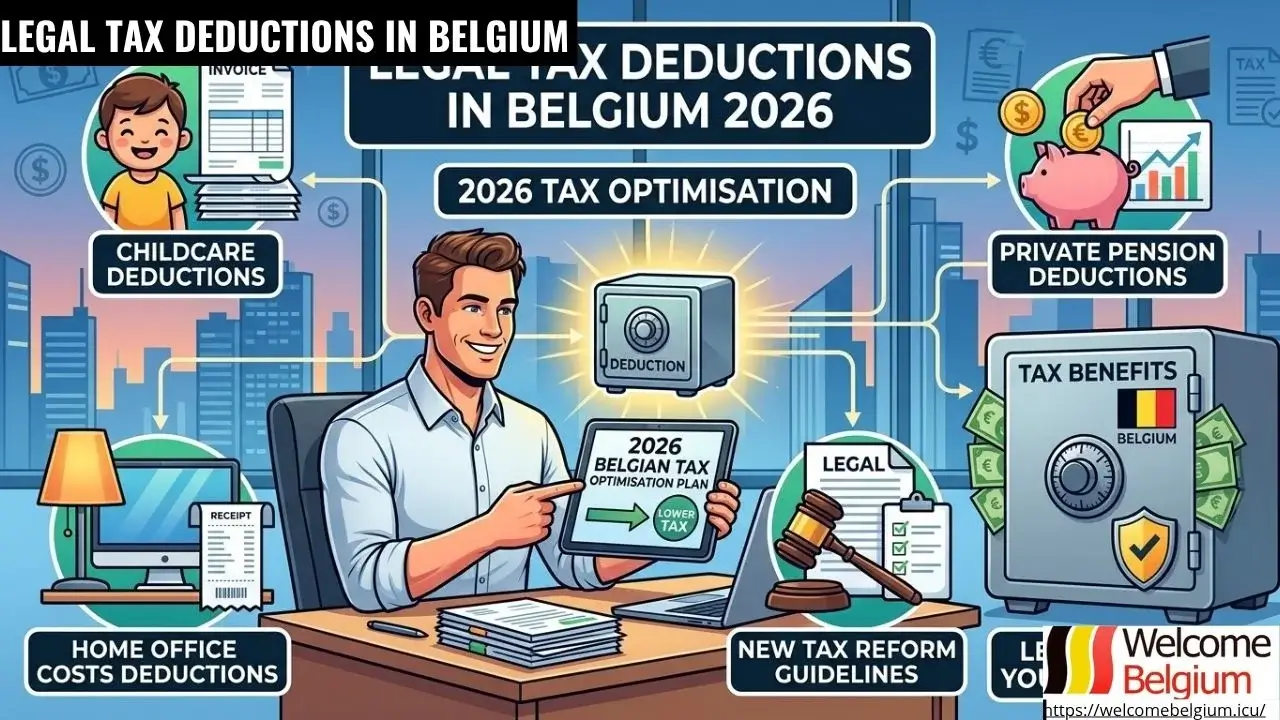
When filing your tax return in 2026 (for income earned in 2025), you can legally reduce your taxable base using both personal and professional expenses.
However, the fiscal landscape has changed drastically this year. As part of a major reform package, the country’s government enacted the “Miscellaneous Measures Act” (Loi contenant des mesures diverses), which was officially published in the Belgian Official Gazette (Moniteur Belge). Beginning with the 2026 tax season, this law completely abolished or scaled back several familiar federal tax benefits. Our goal is to determine what you can still write off against your taxes and which codes in your MyMinfin form are now obsolete.
Key Legal Deductions That Remain Active
Even with the strict reforms in place, several powerful and fully legal tools remain at your disposal to lower your tax burden:
- Childcare and Nanny Expenses (Garde d’enfants): If you have children under the age of 14 (or under 21 if they have a severe disability), you are entitled to write off the expenses of certified nurseries, kindergartens, after-school care, or official summer camps. For each day a child attended care in 2025, you can declare up to €17.20. This provides a direct tax reduction of 45% of the amount spent.
- Private Pension Savings (Pension-épargne): This is one of the most popular tax optimization strategies among expats in Belgium. You choose your own contribution limit into your pension fund for the previous year:
- For contributions up to €1,050, the state returns a 30% tax reduction on the amount (savings of up to €315).
- You can opt for an increased limit of up to €1,350, but the tax reduction then drops to 25% of the total amount (savings of up to €337.50).
- Charitable Donations (Dons): Donations made to recognized Belgian or pan-European non-profit organizations and foundations reduce your tax liability. The minimum single contribution must be at least €40.
- Crucial change in the 2026 reform: The state has lowered the tax reduction rate for charitable donations. While you previously received a 45% return on the donated amount, starting in the 2026 tax year (for 2025 income), this reduction is fixed at 30%.
- Alimony and Maintenance Payments (Pensions alimentaires): Payments made to a former spouse or for child support, mandated by a court order or an official agreement, reduce your taxable base.
- Please note: Under the new rules of the 2026 reform, the deduction coefficient for payments made during the reporting period has been reduced from 100% to 70% of the paid amount.
- Home Office Expenses: This applies to freelancers, self-employed individuals, and salaried employees whose contracts explicitly provide for remote work. You can declare expenses for internet, electricity, and a portion of your rent utilized as office space. For salaried employees, an automatic flat-rate deduction for professional expenses (frais professionnels forfaitaires) applies at a rate of 30% of gross income (with a strict upper limit of €6,070 in the 2026 tax season for the 2025 income year). If your actual costs are higher, you must prove them item by item in Part II of the declaration.
Which Tax Deductions Were COMPLETELY ABOLISHED in 2026?
As of the 2026 tax season, several federal tax incentives have been cut or terminated; it is recommended to double-check the current rules on the SPF Finances website before submitting your return.
Blacklist of Abolished Deductions (2026 Tax Season):
| Expense Category | Status in 2026 | Previous Policy |
| Installation of Home Charging Stations | Completely Abolished | Previously, the purchase and installation costs of a home electric vehicle charging station qualified for a substantial tax reduction. |
| Domestic Staff Expenses | Completely Abolished | Writing off expenses for the wages of official domestic helpers, cleaners, or certified caregivers is no longer applicable. |
| Adoption Procedure Expenses | Completely Abolished | The federal tax reduction for legal and administrative costs incurred during child adoption has been entirely eliminated. |
| Legal Protection Insurance | Completely Abolished | The tax deduction for insurance premiums paid toward legal support policies (assurance protection juridique) is no longer available. |
| Employer Subsidies for Private PCs | Completely Abolished | The well-known “PC private plan,” which allowed employers to compensate employees for purchasing computers tax-free, has been discontinued. |
Real-World Case: Tax Optimization for a Young Family in Brussels
Arthur, an engineer, and Kristina, a marketer, are raising a 4-year-old son who attends a certified kindergarten in the municipality of Ixelles. During 2025, their child spent 180 days at the kindergarten.
Additionally, Arthur contributed €85 per month to his private pension savings account (pension-épargne), accumulating €1,020 over the year. At the beginning of the year, the couple also donated €200 to the Red Cross.
When filling out their tax return in 2026, they were legally able to claim the following deductions:
- Kindergarten: 180 days × €17.20 (maximum permitted daily limit) = €3,096. A tax reduction of 45% returned €1,393.20 to the family budget.
- Pension Plan: The contribution amount (€1,020) fell within the standard limit. A 30% reduction brought them a refund of €306.
- Charitable Donations: For their €200 donation, under the new 2026 rules, they received a 30% reduction, which lowered their tax by an additional €60 (instead of the €90 they would have received a year prior).
The total legal tax return for their family amounted to €1,759,20. Meanwhile, Kristina originally wanted to include the costs of installing a charging station for their new electric vehicle on the form, but learned in time from our guide that this federal benefit had been completely annulled.
Important Note:
A tax reduction (réduction d’impôt) and a reduction of the taxable base (déduction) are different mechanisms. Pension plans and childcare expenses grant a direct tax reduction (the percentage is subtracted directly from your final tax due). Conversely, home office expenses reduce the total gross income amount upon which your tax is calculated.
If you want to maximize your returns and conduct a proper tax optimization, gather all physical certificates (such as the tax form Fiche 281.86 from your kindergarten or your insurance statements) before the end of June to avoid entering codes at random.
Frequently Asked Questions (FAQ) About the Belgian Tax System
The absence of a pre-filled form (Proposition de déclaration simplifiée) does not exempt you from your obligations. You are required to log in to the MyMinfin portal independently and submit a standard electronic return via the Tax-on-web system before the official deadline.
Yes. Before the official filing window closes, you have the right to modify and resubmit the form through your personal portal as many times as necessary. The system will record and process only the latest submitted version.
Yes. Any income earned within the territory of the Kingdom is subject to mandatory declaration, even if you were only in the country for a couple of months. For such cases, filing a tax return frequently results in a substantial refund.
Yes. Local legislation requires the disclosure of the mere existence of financial instruments. All your foreign accounts (including Revolut and Wise cards) must be registered with the National Bank of Belgium in advance and logged in the annual form.
Official spouses and individuals who have registered a legal cohabitation are required to file a single joint tax return. The document is considered accepted only after both partners have signed it in the Tax-on-web system using their eID/itsme® credentials.
The SPF Finances issues an assessment notice called the Avertissement-extrait de rôle (Aanslagbiljet). By law, the tax authority has until June 30 of the year following the submission year to send this document (i.e., until June 30, 2027, for the returns filed in 2026).What should I do if I did not receive a simplified tax proposal (Proposition)?
Can I correct a mistake after submitting my tax return online?
Do I need to file a tax return if I worked in Belgium for less than six months?
Is it mandatory to declare empty or inactive accounts abroad?
How does marital status affect the submission of documents?
How long does it take for the state to send the final tax calculation?
Navigating the fiscal system requires punctuality and accuracy. The key is to strictly observe deadlines, verify pre-filled data, and declare foreign assets. If your situation includes business income or complex investments, an individual consultation with a qualified specialist can help avoid penalties and legally optimize your payments. Submitting your tax return in Belgium on time is the foundation of your financial security and successful integration.
Sources
- Federal Public Service Finance (SPF Finances) — The official portal of the Belgian Ministry of Finance: https://finances.belgium.be/
- MyMinfin Portal — Taxpayer personal portal for digital fiscal services and the Tax-on-web platform: https://www.myminfin.be/
- Official Information Guide of Belgium — The direct tax return section on the Ministry’s subdomain: https://fin.belgium.be/en/private-individuals/tax-return
- Belgian Official Gazette (Moniteur Belge) — The official government domain for looking up Royal Decrees and legislation: https://www.mbbs.just.fgov.be/
Disclaimer
The information provided in this article is for educational purposes only and reflects the personal experience of the author as of 2026. Belgian tax legislation is updated regularly, and calculations depend heavily on your individual circumstances. This article does not constitute official legal or financial advice. In case of complex tax situations, we recommend seeking official clarifications directly from SPF Finances or consulting a certified Belgian accountant. The authors of this article assume no liability for decisions made based on these materials.