Last Updated on April 26, 2026 by Alex
An internship in Belgium in 2026 has evolved into a strategic migration tool. Thanks to the digitalization of the Working in Belgium portal, obtaining legal residency after completing your practice has become more streamlined—yet the process demands strict adherence to new procedural updates.
If you are currently in the country as a stagiaire, it is vital to begin your status transformation in a timely manner. This ensures your Belgian residence does not expire immediately following the conclusion of your contract. The primary routes to legalization involve switching your residency type to a Single Permit or utilizing the Search Year (Orientation Year) program. In this guide, we will break down how to effectively use the post-internship period to prepare your documents and navigate the updated salary thresholds required to secure your stay in Belgium. This plan will help you transition from a trainee to an official resident within the 2026 regulatory framework.
Legal Status of an Intern in Belgium
Before proceeding, it is crucial to distinguish between the two legal grounds for your stay:
- Exchange Programs (e.g., Erasmus+): Your internship is tied to your university’s curriculum. In this case, your status is governed by educational regulations, and your right to stay is strictly limited to the dates on your university certificate.
- Convention d’immersion professionnelle (CIP): This is a professional training agreement concluded directly with an employer and approved by regional authorities (e.g., the regional employment service in Flanders).
In 2026, the CIP is the primary instrument for graduates and young professionals looking to enter the Belgian labor market. Official requirements for these agreements can be verified on the Working in Belgium portal.
To prevent exploitation under the guise of “training,” intern rights in Belgium are strictly regulated:
- Working Hours: The CIP internship schedule is rigid. Performing tasks beyond the standard 38–40 hours is generally not permitted, as it violates the educational nature of the contract.
- Stipend (Indemnité): You receive an allowance rather than a salary. In 2026, the minimum amount is indexed based on age, but it remains lower than the national minimum wage.
- Tax Status: A minimal tax is withheld from this amount, but you do not pay full social security contributions (RSZ) like a regular employee.
The Critical Nuance: Why can’t you simply extend an internship indefinitely? Belgian law views the CIP as a temporary measure for skill acquisition. The total duration of all internships of the same type cannot exceed 12 months.
If the immigration office notices a company attempting to keep you as an intern for a second or third year, the permit extension will be denied. In 2026, monitoring has become automated via data exchange between regional labor departments. Your goal is to use this year as a launchpad for a full employment contract.
Advice from Alex:
Don’t treat the CIP as ‘just an internship.’ From day one, look at it as a long-term job interview. In Belgium, companies are often hesitant to sponsor visas for ‘outsiders,’ but they will fight for someone they’ve already trained for their specific processes.
Your goal is to become so indispensable within 6 months that HR approaches you with a Single Permit offer. And remember: start monitoring internal vacancies at least three months before your internship ends to ensure you can file your paperwork without having to leave the country.
Transitioning After an Internship in Belgium 2026: Paths to Residency
Moving from an internship to long-term residency in Belgium in 2026 requires a clear understanding of the legal tools available. Today, the primary methods for status transformation remain: applying for a Single Permit through employment, requesting a Search Year for graduates, or obtaining a Professional Card for business activities.
Each path has strict criteria regarding salary and qualifications. Your strategy will depend directly on your current contract type and specific regional regulations (Flanders, Wallonia, or Brussels).
Scenario #1: Transitioning to a Single Permit (Work Status)
This scenario is the most reliable path to long-term residency. If your internship was successful and the company is ready to hire you, the process of “transforming” your stay begins. The core mechanic here is filing an application for a Single Permit, which combines your right to work and your right to live in Belgium into one document.

The transition process involves the employer submitting a new application via the online portal. Crucial note: While your case is being processed (typically taking 8 to 12 weeks), you must maintain a legal stay. If your internship ends before the Single Permit decision arrives, you must either request a temporary extension or utilize a Search Year to avoid violating immigration laws.
The primary approval criterion in 2026 is meeting the salary thresholds. In Belgium, these limits are indexed annually. Below is the current table for Flanders, which migration services use as a benchmark for issuing permits.
Salary Thresholds for Flanders (2026)
| Worker Category | Annual Gross Salary 2026 | Notes |
| Highly Qualified (HQ) | €53,220 | Bachelor’s/Master’s degree required |
| Young Professionals (<30 years) | €42,576 | Reduced threshold for first contracts |
| Management Positions | €88,790 | For top-level executive roles |
| EU Blue Card | €64,500 | Requires recognized 3+ year degree |
If your specialty is on the list of priority occupations—known as Knelpuntberoepen (shortage occupations)—the procedure may be simplified. For roles such as engineers, IT developers, or energy specialists, regional authorities often streamline formalities because the market is in dire need of talent.
For interns who have already worked under a CIP (Convention d’immersion professionnelle), proving your “uniqueness” to the local labor market (Labour Market Test) is often easier. Authorities recognize that you are already integrated into the company’s workflow, which serves as a strong argument for granting a Single Permit. You can always find the latest list of shortage occupations on the VDAB website.
Important:
The figures in the table above are your “passing grade.” If the company offers you €3,500 gross per month and you are 25 years old, you meet the Young Professional limit. However, if you are 31, that amount will not suffice for HQ status.
Always verify your HR department’s calculations using the formula: Monthly Salary × 13.92 (this includes holiday pay and the 13th month). If you fall even €100 short of the threshold, it is a guaranteed rejection. Negotiate your base salary—your Card A depends on it!
Scenario #2: Search Year (Orientation Year) — A Year to Find Your Path
Not everyone is eligible for this status. In 2026, the rules strictly define the eligibility circle: it includes graduates of Belgian higher education institutions (Bachelor’s, Master’s, PhD) and students who completed a mandatory internship as part of their Belgian study program. If your internship was part of a curriculum at a university within the EU, you may also apply, though the procedure is slightly more complex.
The key highlight for 2026 is the proof of solvency. To get your Search Year approved, you must demonstrate to the Immigration Office that you have sufficient funds to live without relying on the social assistance system.
For the 2026-2027 academic year, the minimum monthly amount is fixed at €1,062. Consequently, you must show approximately €12,744 in a blocked account for the full year, or provide a formal obligation (sponsorship) from a Belgian citizen or resident with a sufficient, stable income (at least €3,235.88 net per month for a single sponsor and one student).
The primary advantage of the Search Year is unrestricted access to the labor market. During this period:
- Work for any employer: You are not tied to a single sponsor.
- No hourly limits: Unlike a student visa, you can work full-time.
- Trial period: You can explore different companies until you find the one that will ultimately sponsor your Single Permit.
Important: You must apply for this status before your current residence permit (Card A) expires. Official procedural details can be found on Migration.be.
Advice from Alex:
“The Search Year isn’t a vacation; it’s your legal safety net. Even if your current boss promises you the moon, apply for the Search Year if your card is expiring. This gives you the right to work legally while their HR department takes its time (and they will take their time) processing your Single Permit.
Remember: as soon as you find a job that meets the HQ salary thresholds, you can ‘jump’ from the Search Year to a work-based Card A at any moment without waiting for the year to end.”
Scenario #3: Professional Card (For Freelancers and Entrepreneurs)
If your internship proved you’re ready for the “deep end,” or if you’ve spotted a market gap, your path is the Professional Card (Beroepskaart). This isn’t just a work permit; it’s a full entrepreneurial status allowing you to be a freelancer or a company founder in Belgium.
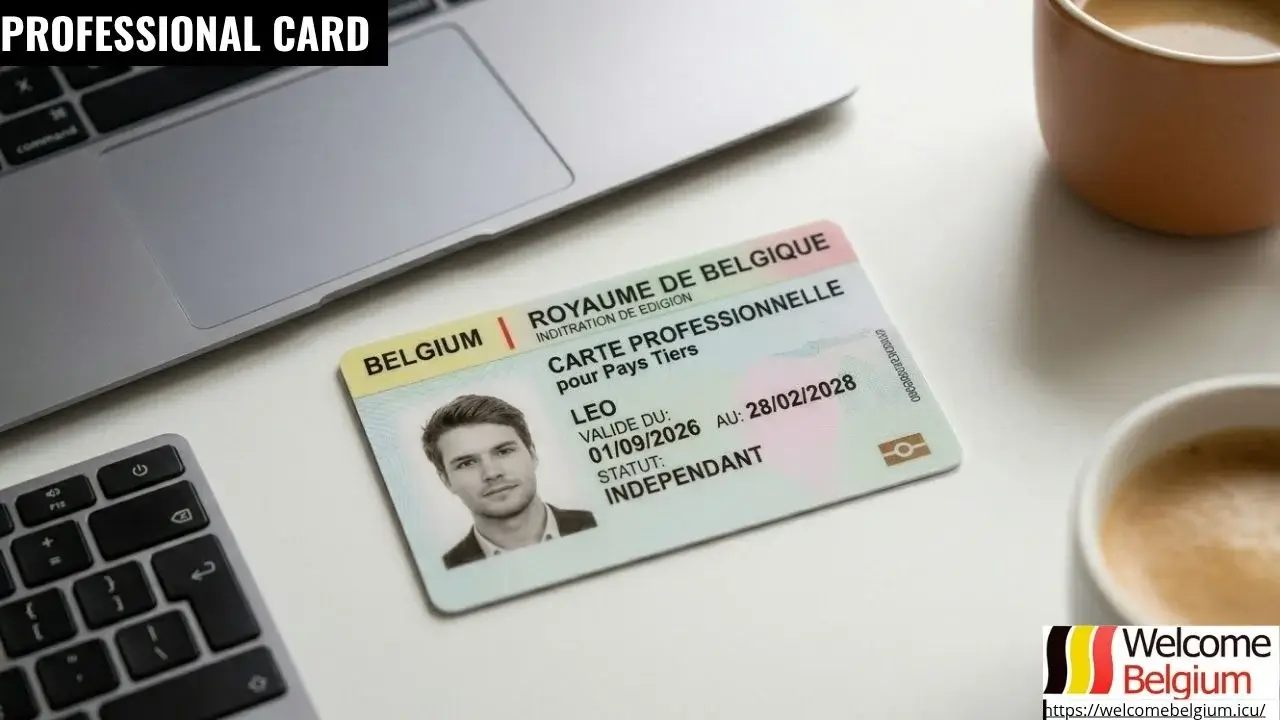
In 2026, obtaining a Professional Card is essentially a “business idea competition.” While the Single Permit only requires meeting a salary cap, here you must prove economic utility to the region. Your internship gives you a massive advantage: you already understand the local market, have contacts, and perhaps even your first potential clients among Belgian partners.
The backbone of your application is the business plan (usually up to 20 pages), which must include:
- Market Analysis: Competitor research within your specific region.
- Financial Forecast: Projections for the first 2–3 years.
- Economic Impact: Evidence of innovation or job creation (even if it’s just your own position).
2026 Regional Nuances
Rules for entrepreneurs vary significantly depending on your base:
- Flanders: Priorities include innovation, export potential, and technology. In 2026, Flanders requires proof of at least €22,838 in a financial account and evidence of a stable projected income above €26,086 per year after taxes.
- Wallonia: This region values job creation and projects that revitalize the local economy. Wallonia is often more receptive to social or cultural projects, though financial scrutiny remains strict.
The Professional Card is issued for a maximum of 5 years, but the first “trial” card is usually valid for only 2 years. During this time, you must prove your business is viable and generating enough income to support you.
Important:
Don’t try to wing your business plan. In 2026, immigration offices in Flanders and Wallonia look for Letters of Intent (LoI) from future clients rather than just pretty charts. If you built connections during your internship, ask those partners to write a letter stating they intend to use your services. This is a far stronger argument for officials than any theoretical forecast. Also, ensure your degree is recognized in Belgium—for many “regulated” professions, this is a mandatory step for starting a business.
Regional Differences: Flanders, Wallonia, and Brussels
Belgium is a federal state, and immigration rules depend directly on where your employer is registered. In 2026, the gap between regions has become even more pronounced: Flanders is accelerating processes through new fees, while Brussels maintains stable but significantly longer procedures.
Flanders: Speed and Shortage Occupations
Flanders prioritizes economic efficiency. The Flemish employment service (VDAB) has streamlined hiring for the Knelpuntberoepen (Shortage Occupations) list but has introduced additional administrative filters.
Key Facts for Flanders (2026):
- Regional Fee (Retribution): Costs €250 per Single Permit application. The case will not be processed without proof of payment.
- Processing Time: Average of 30–45 days (the fastest in the country).
- Priority Professions: IT developers, engineers, and cybersecurity specialists.
- Official Resource: be — Work & Social Economy.
In 2026, Flanders began strictly requiring proof of payment at the exact moment of filing. If your HR department forgets to attach the receipt, the case is closed automatically without a refund. This is the price for “Flemish acceleration,” which provides answers nearly twice as fast as other regions.
Brussels: Capital Status and Stability
The Brussels-Capital Region remains the most conservative. There are no additional regional fees, but the administrative workload is higher, resulting in longer wait times.
Key Facts for Brussels (2026):
- Salary Threshold: Approximately €3,703.44 per month for highly qualified specialists.
- Processing Time: Between 3 and 4 months. You must apply well in advance.
- Labor Market Access: Proof is required that the company office is physically located within the 19 communes of Brussels.
- Official Resource: Economy-Employment.brussels.
Due to long wait times, obtaining an Annex 15 (a temporary document proving your case is in progress) is critical. In 2026, without this document, you may face issues renewing your health insurance (Mutuelle) if your original Card A expires before the Single Permit decision is issued.
Wallonia: Focus on the Industrial Sector
In 2026, Wallonia significantly indexed salary requirements to match inflation and attract specialists to the industrial sector.
Key Facts for Wallonia (2026):
Minimum income levels for a Single Permit are indexed annually. As of 2026, the following gross annual forecast values apply (based on Flemish benchmarks often mirrored by Wallonia):
- Highly Qualified Specialists (HQ): From ~€53,220 per year.
- Young Professionals (<30 years): Reduced threshold from ~€42,576.
- EU Blue Card: From ~€64,500.
- Official Resource: Le Forem — Wallonie Emploi.
Note: Always check the Working in Belgium portal at the time of filing, as regional authorities can make adjustments mid-year. In 2026, Walloon authorities increased the frequency of the Labour Market Test, requiring proof of why a local resident cannot be hired. Former interns have an advantage here: their “justification” is the training already completed within the company.
Important:
Follow the “Legal Address Rule.” Your region is determined not by where you rent an apartment, but by where the company is registered. If you live in beautiful Ghent (Flanders) but your employer is based in Brussels, you play by Brussels’ rules. Double-check the registration address with HR before paying the €250 Flemish fee to avoid sending money into a void.
Step-by-Step Transition Guide: Internship to Residency 2026
In 2026, transitioning from an internship to a full work status is entirely digital via the Working in Belgium portal. The secret to success is managing your deadlines and budgeting for administrative fees, which are now indexed every January.
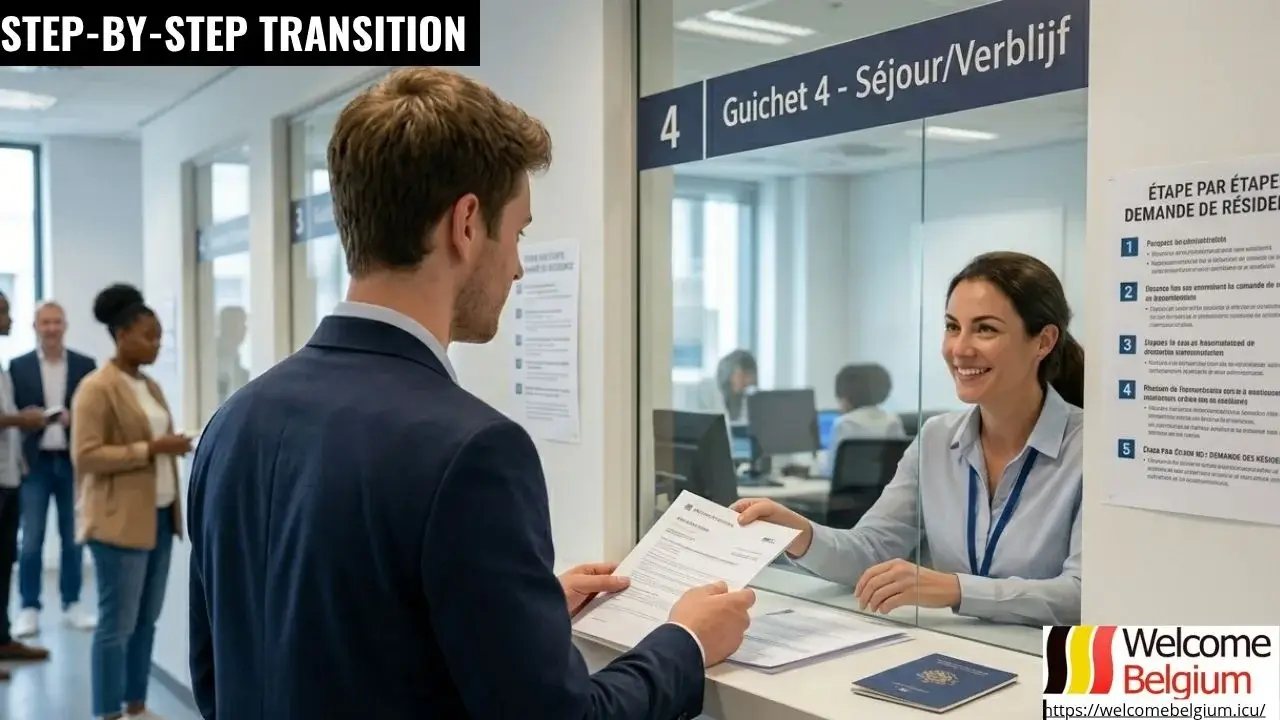
Step 1: Document Preparation (3–4 months before contract end)
Don’t rely solely on your HR department; start gathering your package early. In 2026, the Immigration Office (IBZ) has become extremely strict regarding scan quality and the validity periods of certificates.
- Criminal Record Certificate: Must be no older than 6 months.
- Medical Certificate: Must be from an accredited physician (applying from within Belgium simplifies this).
- Diploma Equivalence: For the Single Permit HQ track, this is mandatory.
- Passport: Must be valid for at least 12 months beyond the planned start date of your contract.
Step 2: Fee Payment and Application Filing
Belgium currently operates a two-tier fee system. Without proof of payment, your case will not even be opened on the portal.
- Federal Fee (IBZ): In 2026, this is €377 for highly qualified specialists. It must be paid via bank transfer with a mandatory structured communication. Check the official IBZ website for the latest bank details.
- Regional Fee (Flanders Retribution): If your company is in Flanders, prepare an additional €200 (introduced in January 2026). This “speed fee” allows the Flemish authorities to process cases via a fast-track system.
- Submission: Your employer uploads all documents to the Working in Belgium
Step 3: Processing and Receiving Annex 46
After submission, you enter a “quiet period.” Processing times in 2026 vary significantly by region:
- Flanders: Thanks to recent reforms, regional approval often arrives within 15–30 days.
- Brussels & Wallonia: Budget for 3–4 months.
- Outcome: If approved, you and your employer will receive Annex 46. This document confirms the positive decision from both regional and federal authorities and is the legal basis for your residency.
Step 4: Commune Visit and Receiving Your Card A
Once you have Annex 46, visit your local Commune (town hall) of residence.
- You will be issued a temporary Annex 15 or Annex 49 (valid for 45 days) while your plastic card is printed.
- In 2026, the administrative fee for ordering the card at the commune is between €25 and €50.
- After roughly 2 weeks, you collect your Card A—your official residence permit.
2026 Timeline and Cost Summary
| Stage | Duration (2026) | Estimated Cost |
| Document Gathering | 2–4 weeks | Cost of certificates & translations |
| Regional Approval | 15–90 days | €200 (Flanders only) |
| Federal Approval (IBZ) | 2–8 weeks | €377 |
| Card A Issuance | 14 days | €25–€50 |
Advice from Alex:
“A vital life hack for 2026: if you’ve filed your documents but your internship and current Card A have expired, you have the right to stay in Belgium because your case is ‘in progress.’ However! Go to the commune immediately and get an Annex 15. Without this paper, you can’t travel to Germany for a weekend or prove to a doctor that you’re still insured. Also, double-check that structured communication on your payment—miss one digit, and the IBZ will be hunting for your money for a month.”
Taxes and Social Security: What Changes in Your Pocket?
Switching from an intern to a full-time staff member in 2026 is a moment where your “take-home” pay might surprise you. Your fixed internship stipend will be replaced by the complex Belgian taxation system, where the gap between what the employer promises (Gross/Brutto) and what lands in your bank account (Net/Netto) can reach 40–45%.
When you sign a Single Permit contract, you transition from the “trainee” category to a “taxpayer.” The most significant difference is the mandatory social security contribution (RSZ/ONSS), which stands at 13.07% of your gross salary, followed by a progressive income tax.
Key Changes When Switching Status:
- From “Stipend” to “Salary”: An intern’s allowance (CIP) often avoids full social security coverage. Now, your salary serves as the legal base for your future pension and unemployment benefits.
- Health Insurance (Mutuelle): While basic insurance contributions are deducted from your paycheck, you must still pay your specific insurance fund’s membership fees (quarterly or annually) independently.
- Pension Contributions: From day one of your Single Permit employment, you begin accruing official Belgian pension seniority.
- Holiday Pay (Pécule de vacances): Unlike an internship, where leave is often unpaid or informal, you are now entitled to paid leave and a “13th month” (Double pécule de vacances). Note that in Belgium, the right to a full vacation quota is usually accumulated based on the previous working year.
Net vs. Gross Calculation (2026 Example):
If your Highly Qualified (HQ) contract meets the threshold of €4,435 per month (Gross), here is what to expect after deductions for a single person without children:
- Gross Salary: €4,435
- Estimated Net Pay: Approximately €2,850 – €3,000.
For a precise forecast, use calculators on portals like SD Worx or Jobat.
Common Reasons for Rejection and How to Avoid Them
A rejection in 2026 is not a final sentence, but it is a serious legal problem that can block your path to residency for several years. The Immigration Office (IBZ) now uses algorithms for initial document screening, so any formal error is flagged instantly. Pay attention to these three critical zones:
1. Education Level Mismatching the Job Title
For Highly Qualified (HQ) status, your degree must be recognized in Belgium and match the job description.
- The Error: Your internship was in Marketing, but the Single Permit contract is for a Business Analyst position while you hold a Philology degree.
- The Solution: Verify that your profession code matches your education level (Bachelor/Master). If your degree was obtained outside the EU, complete the Equivalence procedure through NARIC well in advance.
2. Filing Delays (The 15-Day Rule)
In 2026, timing rules have become ruthless. If your current residence permit expires before your new application is registered in the system, you fall into a “legal gray zone.”
- The Error: Submitting documents on the final day of your Card A
- The Solution: Remember the “15-Day Rule”—this is the critical deadline before your current status expires by which all documents must already be uploaded to the portal. Ideally, apply 2–3 months in advance. If time is running out, obtain an Annex 15 from the commune as insurance.
3. Health Insurance Issues
The Belgian state will not issue a Single Permit if you are not 100% insured.
- The Error: A gap in coverage when transitioning from student insurance to work-based insurance.
- The Solution: Ensure your Mutuelle/Ziekenfonds is notified of your status change. In 2026, you are required to provide a certificate of “no outstanding debt” from your insurance fund when submitting your application.
Advice from Alex:
“The most foolish reason for rejection is a ‘blurry’ passport scan or an expired criminal record check. In 2026, officials don’t call you to ask for a missing paper; they simply set the status to ‘Refused.’ Personally check every single page in the PDF file before hitting send. If you see that deadlines are tight and your degree isn’t recognized yet—apply for a Search Year as a backup plan. It’s far better than facing a deportation order over a formality.”
FAQ: Residency Status in Belgium After an Internship (2026)
Can I change employers immediately after my internship?
Yes, but conditions apply. If you transition to a Single Permit, the authorization is typically tied to a specific company for the first year. If you change jobs, your new employer must apply for a modification of your permit. However, under the Search Year (Orientation Year) status, you have unrestricted access to the labor market and can change employers without limitations.
Do I need to leave Belgium to obtain a work visa?
No. If you are legally residing in the country at the time of application (holding a valid Card A as a trainee or student), the change-of-status procedure is handled within Belgium. A trip to a consulate for a Visa D is only required if your current residence permit expires before your new application is officially registered.
Does my internship count toward the 5-year residency requirement for citizenship?
Belgian legislation considers the period of continuous legal residence under Card A. For a precise calculation of your specific case, we recommend consulting the legal service of your commune (local town hall), as the recognition of residency years can depend on the specific type of your initial residence permit.
How much money must be in my account for a Search Year in 2026?
To prove financial solvency for the 2026/2027 academic year, you must demonstrate funds of €1,062 per month. In total, for a 12-month search period, you must show at least €12,744 in your account or provide a formal obligation (sponsorship) from an eligible sponsor.
How much are the administrative fees in 2026?
When switching to a Single Permit (HQ/Blue Card) status, the following fees apply: Federal Fee (IBZ) — €377, Regional Fee (Flanders) — €200, Card Issuance (Commune) — between €25 and €50.
Advice from Alex:
“Google loves clear answers, and Belgian immigration loves exact payments. Double-check that your federal fee is exactly €377. The 2025 rates (€368) are no longer accepted, and paying the wrong amount will lead to an automatic rejection of your case.”
Disclaimer: This article is for informational purposes only and reflects the regulations as of early 2026. Belgian migration rules are subject to frequent changes. For legally binding decisions, always consult official resources (IBZ, VDAB) or a certified immigration lawyer.