Last Updated on April 15, 2026 by Alex
If you are planning a Family Reunification in Belgium in 2026, the latest updates to the migration law might require you to rethink your timeline. Belgian bureaucracy has never been a sprint, but following the reforms that took effect in February 2025, the rules and—more importantly—the processing times have shifted significantly.
Many expats are asking: “Why has my case been pending for six months without an update?” Let’s break down the realistic waiting times for Family Reunification and why the “standard” timelines you find on old forums no longer apply.
Family Reunification: Official Deadlines vs. 2026 Reality
First, let’s establish the legal framework. In Belgium, the decision period depends entirely on the status of the “sponsor” (the person already residing in Belgium).
Family Reunification Processing Times
| Sponsor Category | Official Legal Deadline | Realistic 2026 Timeline |
| Belgian Citizen | 6 Months | 5–7 Months |
| Non-EU Citizen (Third-country national) | 9 Months | 12–15 Months |
| High-Skilled Pro (EU Blue Card / Single Permit) | 4 Months | 4–7 Months |
- If the Sponsor is a Belgian Citizen
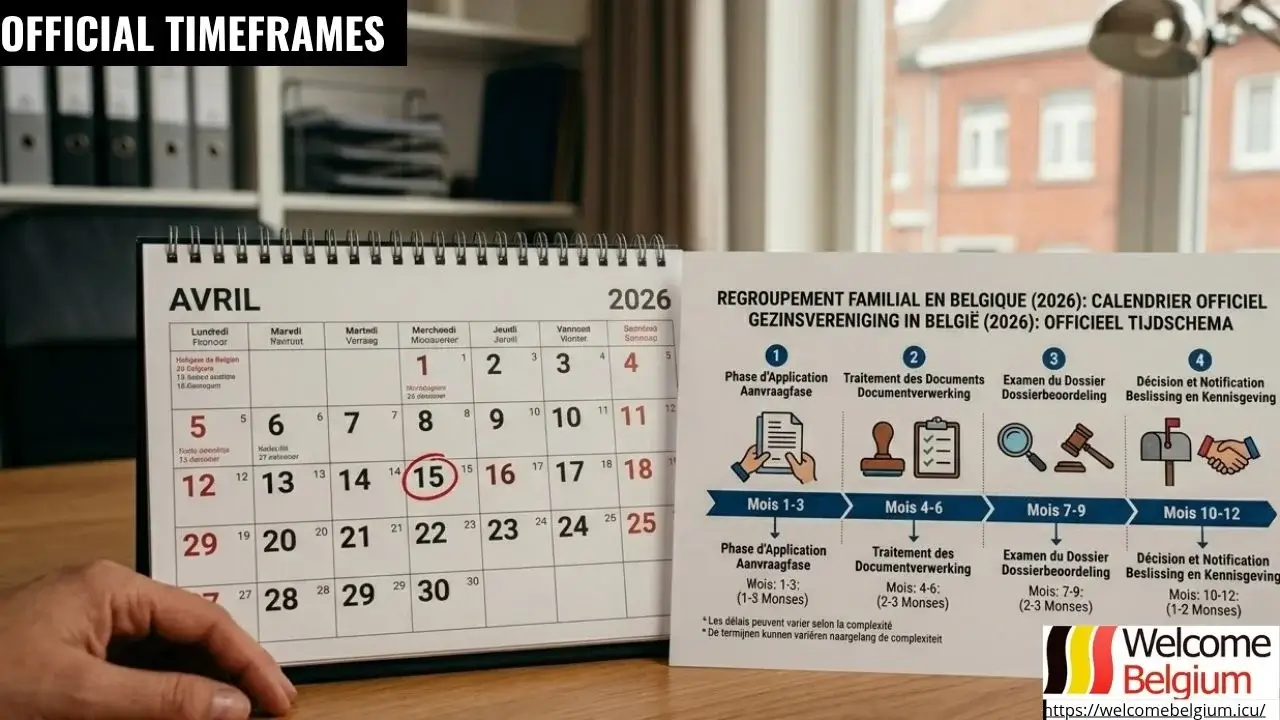
By law, the Immigration Office (Dienst Vreemdelingenzaken / Office des Étrangers) must issue a decision within 6 months from the date the complete dossier is submitted.
- In Practice: If your case is straightforward, you might see an approval in 5 months. However, if officials suspect a “marriage of convenience” (mariage blanc), the period can be extended for further investigation.
- If the Sponsor is a Non-EU Citizen (Third-country national)
This category faces the strictest wait times. The base waiting period is 9 months.
- Warning: The Immigration Office has the right to extend this period twice by 3 months each. Total: 9 + 3 + 3 = 15 months.
- 2026 Update: Due to the massive load on the Working in Belgium portal and archive restructuring, extensions are currently occurring in roughly 70% of cases.
- Fast-Track: High-Skilled Professionals (Blue Card / Single Permit)
If you are in Belgium as a specialist (H-card or Single Permit for highly qualified personnel), your family qualifies for an accelerated procedure.
- Initial Deadline: A decision should be made within 4 months.
- Extensions: Only one extension of 3 months is permitted. Maximum total: 7 months.
What Changed in Belgian Rules (April 2026)
In February 2026, a series of Royal Decrees came into force. These reforms didn’t just hike the cost of Belgian citizenship to €1,000—they significantly raised the bar for those applying for Family Reunification.
Updated Processing Times & Extensions
| Sponsor Type | Initial Deadline | Extension | Maximum Total |
| Belgian Citizen | 6 Months | None | 6 Months |
| Non-EU Citizen | 9 Months | +6 Months | 15 Months |
| EU Blue Card Holder | 4 Months | +3 Months | 7 Months |
New Financial Threshold (2026)
Sponsors must now prove a stable, regular, and sufficient net income equal to at least 110% of the Minimum Guaranteed Wage.
- As of March 1, 2026: This amount is €2,173.88 net per month.
- Dependents: You must add an additional 10% for each additional dependent family member.
Warning: If your income is even one euro short, the application faces an automatic refusal, and your waiting period “resets” to zero.
For a detailed breakdown of how to calculate your income and which bonuses are taken into account, see our guide: What income is now required for family reunification in Belgium.
Age Requirements
The minimum age for the reunification of spouses or partners has been raised from 18 to 21 years.
- Exception: This does not apply if the marriage or partnership was already established before the sponsor arrived in Belgium.
If you have been granted Subsidiary Protection, you are now required to reside in Belgium for 2 years before you are eligible to apply for family reunification (this period was previously shorter).
Step-by-Step Plan for Family Reunification in 2026
To ensure your file doesn’t end up in the “further clarification required” pile, follow this checklist:
- Verify the Administrative Fee: In 2026, the application fee is indexed. Ensure you have transferred the exact current amount. You can check the latest rates on the IBZ (Immigration Office)
- Annex 15quinquies: Once you submit your documents to the consulate, you will receive a certificate of receipt. The “9-month clock” officially starts from the date on this document.
- Monitor via Itsme: In 2026, you can track your case status through the Working in Belgium portal or the Intervisas If there has been no status change for 4 months, ask your lawyer or employer to file an official inquiry.
- Housing & Insurance: Do not wait for the visa to be issued to secure health insurance or suitable housing. The Immigration Office often verifies that your housing meets official standards (e.g., separate rooms for children) while the process is still ongoing.
Useful Links & Official Sources
For those who prefer to double-check the facts (which I highly recommend!):
- IBZ – Regroupement familial (FR) — Official rules and guidelines from the Belgian Immigration Office.
- belgium.be — Requirements for the Visa D application via Belgian consulates.
- be — The premier expert resource for Belgian migration law (in Dutch).
Alex’s Pro-Tip:
If you are currently an intern or on a temporary track and planning to bring your spouse over — don’t wait for a permanent contract to start the paperwork. Begin gathering police clearance certificates and getting your marriage certificates apostilled right now. In 2026, an “extra” month spent on prep can save you six months of waiting later. Also, keep in mind: your income must be stable for the last 12 months. The Immigration Office often “discounts” one-time bonuses and premiums when calculating your eligibility.
FAQ: Quick Answers on Family Reunification in Belgium (2026)
This section is designed for those who need the facts “short and sweet.” Here are the most frequent questions that the Immigration Office usually answers with dry legal jargon.
- How long does the Family Reunification process actually take in 2026?
In 2026, the standard legal timeframe for non-EU citizens is 9 months. However, the Immigration Office reserves the right to extend the review twice by 3 months each. In practice, given the current backlog, you should prepare for a 12–15 month wait from the date of submitting a complete dossier.
- Can I speed up the family reunification process?
An expedited procedure (up to 4 months) is only available for EU Blue Card holders and high-skilled specialists on a Single Permit. For all other categories, there is no “on-demand” acceleration. The only way to avoid delays is to submit a flawless dossier with the correct and up-to-date administrative fees.
- What is the minimum income requirement for 2026?
To receive a positive decision, the sponsor must prove a stable monthly net income of at least €2,173.88 (110% of the minimum threshold). This amount is subject to indexation; always check the IBZ.be portal for the latest figures. Your income must be consistent and backed by a contract valid for at least 12 months.
- Do family members need to leave Belgium to apply?
If your family members are already in Belgium legally (e.g., on a tourist visa or a different residence permit), in most cases, the change of status can be processed at the local commune without them leaving the country. If they are outside the EU, the application must be filed exclusively through the Belgian consulate for a Visa D.
- What if the Immigration Office does not respond within the deadline?
If the maximum period (9 or 15 months, depending on the case) passes without a decision, the law may interpret this as “tacit approval.” In this event, you should immediately consult a lawyer to file an official request with the commune to issue the residence permit.
Alex’s Final Advice:
This is where 40% of applicants fail. The biggest mistake is thinking “it will be fine” if your income is just €10 below the threshold. In 2026, the system is set for automatic rejection: if the numbers don’t match, you get a refusal. Don’t gamble with your family’s time — it’s better to wait for a salary raise or take extra shifts to ensure your bank statements show the required amount with a safety margin.
Still have questions about specific amounts or Annex documents? Drop a comment below, and let’s look into your case!