

Last Updated on April 25, 2026 by Alex
Key Benefits in Belgium in 2026 (At a Glance)
In 2026, the Belgian benefit system includes several key payments:
- Child Benefits (Groeipakket): from €188.31 per month per child, plus a one-time birth grant starting from €1,314.27.
- Unemployment Benefits: up to €3,520 in the first three months (65% of the salary cap), with a total payment limit of up to 24 months.
- Social Assistance (RIS from CPAS): from €893.65 for cohabitants to €1,811.57 for families with dependents.
Introduction
The Belgian social model of 2026 is a complex but well-oiled machine. High taxes are compensated by one of the most reliable financial protection systems in Europe. For an expat, these benefits serve as a “stabilizer,” allowing for confident budget planning.
In this guide, I’m Alex — author of a project about life and finance in the EU — and I will break down the monetary side of the issue: how much, for what, and on what legal grounds you will receive funds in your bank account.
Who is This Article For?
This guide is specifically written for those planning their budget in the realities of 2026:
- Expats and New Residents: To understand what state support you can count on immediately after moving.
- Families with Children: To compare payments across different regions (Flanders, Wallonia, Brussels) when choosing a place to live.
- Employees: To know your rights and benefit limits in case of resignation or redundancy under the new 2026 rules.
- Students and Youth: To clarify the conditions for receiving benefits during and after their studies.
Monetary Benefits and Allowances in Belgium 2026 (Table)
As of March 1, 2026, Belgium implemented a 2% indexation. Below is the up-to-date table of all main benefits in Belgium for 2026, including amounts and eligibility criteria.
| Benefit Name | Amount (2026) | Eligibility | Official Authority |
| Groeipakket (Start) | €1,314.27 (one-time) | Families at birth/adoption | Groeipakket (Vlaanderen) |
| Groeipakket (Base) | from €188.31 (monthly) | Parents of children up to 18/25 years | Famiwal (Wallonie) |
| 13th Month Salary | 100% of gross salary | Employees with >6 months of service | SPF Emploi |
| Holiday Pay | 92% of monthly salary | All officially employed workers | ONVA (Vacances annuelles) |
| Unemployment | up to €3,520 (max) | Terminated workers (24-month limit) | RVA / ONEM |
| Bicycle Bonus | €0.37 / km | Commuting to work by bike | CNT / NAR |
| Meal Vouchers | up to €10.00 / day | Salaried employees (new limit) | Social Security Belgium |
Important:
In 2026, Belgium has become stricter towards those who remain unemployed for long periods (RVA reform). However, the system has become more generous toward those building careers and using eco-friendly transport.
Child Benefits (Groeipakket / Allocation Familiale)
In Belgium, the Groeipakket system is more than just “money for the child.” It is a comprehensive support package, and each region calculates it differently.
Here is what your “Growth Package” consists of in 2026:
- Start Amount (Startbedrag / Geboortepremie): A one-time payment upon the birth or adoption of a child. In 2026, it amounts to €1,314.27 (in Flanders) and approximately €1,344 (in Brussels and Wallonia). You can request it through funds like Parentia or KidsLife as early as the sixth month of pregnancy.
- Basic Monthly Benefit: The main amount is paid until the age of 18 (or up to 25 if the child is a student). Following the March 2026 indexation, the base rates are:
- Flanders: €188.31 per child.
- Wallonia: €192.73 (base rate for the Famiwal fund).
- Brussels: €186.51 (for children under 11), increasing to €198.42 at age 12.
- School Bonus (Schoolbonus): Paid every August for each child attending school or daycare. In 2026, it ranges from €23.07 to €100, depending on age and region.
- Social Allowances (Sociale toeslag): If the total family income in 2026 is below the threshold of €40,701, an additional €73 to €100 is automatically added to each monthly payment.
An important nuance from Alex:
If you live in Brussels but work in Flanders (or vice versa), your payments will depend on the child’s place of residence, not your place of work. All regional funds are required to comply with federal child rights laws, so delays in 2026 are very rare.
Unemployment Benefits in Belgium 2026
The main innovation of 2026 is the 24-month limit on payments. It is no longer possible to remain on state support for years without a valid reason. While the system has become stricter, the benefits are higher in the initial months to provide a financial cushion during your job search.
Previously, benefits could last almost indefinitely. Since March 1, 2026, the rules have changed radically as the government introduced an historic limit to encourage people to return to the workforce faster.
How much is paid in the first months?
The unemployment period now has a clear expiration date. From March 1, 2026, when applying to RVA / ONEM, you immediately receive a calculated duration:
- Base Year: Anyone who has worked at least 12 months in the last 3 years is entitled to 1 year of payments.
- Bonus Year: For every additional 4 months of seniority, you receive 1 extra month of benefits (maximum 12 additional months).
- The Result: Your absolute limit is 24 months over your entire career (excluding individuals over 55).
Duration and Rates
Belgium uses a “degressive” system where support gradually decreases to maintain your motivation:
- Months 1–3: You receive 65% of your last salary. The cap was raised to €3,520 gross, which is beneficial for high-income specialists.
- Months 4–6: The rate drops to 60% of the salary.
- Months 7–12: You still receive 60%, but the salary “ceiling” used for calculation is lowered.
- Months 13–24: You move to a fixed amount (lump-sum), which depends on your family composition (single people receive more than cohabitants).
How to receive financial assistance:
- Unions (Syndicat): In Belgium, benefits are paid either through the state agency CAPAC or through unions (ACV, ABVV, ACLVB). I recommend joining a union—they handle all the bureaucracy with the RVA and protect your rights in case of unfair dismissal.
- Retraining: As of 2026, high-benefit retention during training is only permitted for “critical” professions (e.g., healthcare or specialized IT). Standard courses no longer “freeze” the benefit reduction.
- Seniority: In 2026, you must have at least 312 days of work within the last 21 months to qualify for benefits.
How not to lose your payments
If the 24 months expire and you haven’t found a job, RVA benefits cease entirely. In this case, you will have to apply to the CPAS (OCMW) for a Social Integration Income (Revenu d’intégration), but this involves significantly lower amounts and a higher level of state oversight into your life.
Social Assistance from CPAS (OCMW)
If your insurance-based benefits (like unemployment) have run out, or if you do not have sufficient work history, the social integration system takes over. The governing legislation here is the Law of 26 May 2002 regarding the right to social integration.
It is important to note that the right to social supplements in 2026 is linked to your annual income. Check if your current salary meets the new government standards in this article: Salary Thresholds in Belgium 2026.
As of March 1, 2026, these amounts have been indexed. However, the verification of income for cohabitants has become significantly stricter.
Current RIS (Revenu d’intégration sociale) Rates for 2026
The Basic Social Integration Income (RIS) is paid monthly. These sums represent the “minimum” guaranteed by the state to maintain a basic standard of living:
| Category | Monthly Amount (as of 01.03.2026) | Who falls into this category |
| Cohabitant (Cat. 1) | €893.65 | Those living with someone else (partner, parents, friends) |
| Isolé (Cat. 2) | €1,340.47 | Single individuals living and managing a household alone |
| Famille à charge (Cat. 3) | €1,811.57 | Parents with dependent children |
Source: Official RIS Rates 2026 (SPP Intégration Sociale)
Key Changes and Conditions in 2026
- Income Control Reform: Starting March 1, 2026, when calculating the benefit, the CPAS is obliged to consider the resources of all adult “debtors of maintenance” (parents, children, spouses) living with you. This is regulated by the updated Resource Verification Act.
- The PIIS Contract: Payments are now strictly linked to the PIIS contract (Individualized Project for Social Integration). You are legally obligated to actively look for work or engage in studies. If you fail to meet the contract terms, financial assistance can be suspended according to Article 20 of the aforementioned law.
- Additional Assistance: Beyond the RIS, you may be entitled to “equivalent assistance” (aide sociale équivalente) if you do not fall under the 2002 law (for example, depending on specific residence permit statuses). Details can be found on the Federal Integration Portal.
A note from Alex:
For expats with a temporary residence permit (Card A), applying for help from the CPAS carries a risk. According to the Law on the Access of Foreigners to the Territory (1980), receiving social assistance without a justified reason can lead to a refusal to renew your residence permit due to “insufficient personal means.”
Comparing Belgian Regions: Where is it Better to Live in 2026?
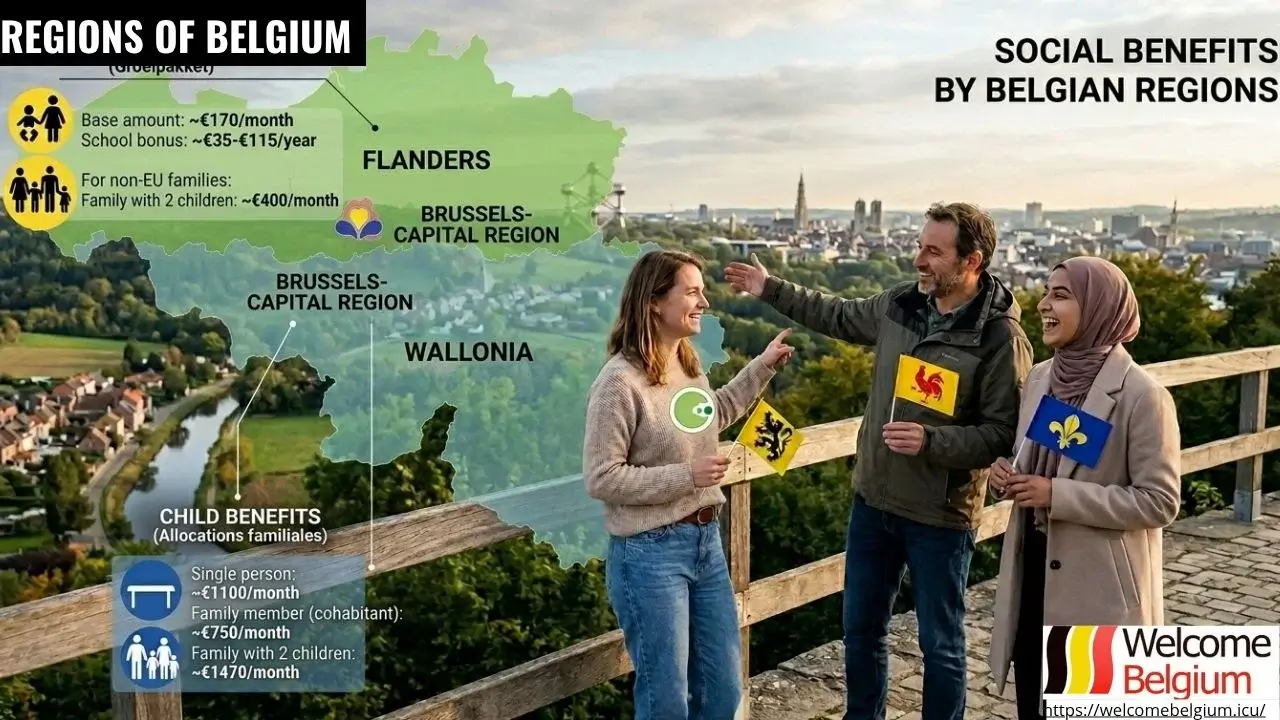
In short: Flanders focuses on stability and automation, Wallonia on supporting large families, and Brussels on assistance for youth and students.
Flanders
Flanders was the first to implement a radical reform, merging all child benefits, school bonuses, and social allowances into a single “Growth Package” (Groeipakket). It operates on the principle of “one child, one rate,” regardless of the child’s birth order in the family.
- The Main Advantage: The highest one-time birth grant for a first child in 2026—€1,314.27 (known as the Startbedrag). Flanders maintains the lead in 2026 for this “entry” sum for new families.
- Who is it for? Ideal for working families with 1–2 children. The system is highly automated via the be portal. If you are registered in the commune and have a legal income, human intervention is minimal—funds are simply deposited into your account on the 8th of every month.
- Social Filters: In 2026, Flanders uses a precise system of social supplements (Sociale toeslagen). If a family’s annual income is below €40,701, a social bonus is automatically added to the base amount of €188.31. This makes the region very comfortable for those just starting their careers in Belgium.
- The Law: The primary regulatory act is the Decreet van 13 juli 2018 betreffende het Groeipakket. This law established the right of every child to financial assistance regardless of the parents’ professional status.
Alex’s Tip: Although the system is automated, I recommend choosing one of the five public providers yourself (e.g., Parentia or Fons). The amounts are identical by law, but in 2026, the speed of support and the quality of mobile apps vary between them.
For those working in Flanders, the automation of the benefit system is closely linked to your legal status. Check out the latest changes in the employment procedure: Single Permit Rules in Flanders 2026.
Wallonia
If your family plan involves three or more children, or if your children are entering their teenage years, Wallonia offers a more substantial financial package. The main operator here is the state fund Famiwal, which manages distributions based on regional legislation.
- The Main Advantage: The base monthly payment here is higher than in Flanders, standing at €192.73 per child (following the March 2026 indexation). Furthermore, Wallonia has retained significant “age supplements” (Suppléments d’âge). For instance, when a child reaches 6 and 12 years old, the amount increases noticeably to help offset growing costs for hobbies and clothing.
- Who is it for? Perfect for large families. Wallonia applies progressive supplements; therefore, a family with three children receives €50–80 more than in Brussels or Flanders. The region also offers extended social supplements for families with below-average incomes.
- Birth Grant (Allocation de naissance): In 2026, it is €1,344.90 for the first child. This is a few dozen euros more than in Flanders, making the “start” in this region financially smoother.
- The Law: The legal basis is the Décret du 8 février 2018 relatif à la gestion et au paiement des prestations familiales. This document empowers Wallonia to set its own higher rates to support demographics.
If you are planning to bring your family to Belgium, remember that the right to child benefits arises immediately after registering the children at your address. For more details on how the rules have changed and what income is required for sponsorship, read our article: New Family Reunification in Belgium 2026.
Alex’s Tip:
If you live in Wallonia, I recommend applying through Famiwal as it is the direct state fund. They process documents based on the new 2026 “age” indexes the fastest. Also, check for the “Large Family” (Famille nombreuse) status, which provides additional discounts on SNCB trains and TEC public transport.
Brussels
The Brussels system is managed by the state fund Famiris. In 2026, it places a heavy emphasis on teenagers and young adults, compensating for the high cost of living in the capital.
- The Main Advantage: Progressive amounts that grow significantly as the child matures. In 2026, the base of €186.51 (for children under 11) grows to €198.42 starting at age 12. If the child continues into higher education, they can receive benefits up to age 25.
- Who is it for? Families with teenagers and students. Brussels offers the most flexible social supplements for families whose income does not exceed specific thresholds (in 2026, this is approximately €38,000 to receive the maximum supplement).
- Birth Grant: It stands at €1,344.90 for the first child, matching the Walloon rate and exceeding the Flemish one.
- The Law: Ordonnance du 25 avril 2019 réglant l’octroi des prestations familiales.
Alex’s Tip:
In Brussels, the payment system is strictly tied to educational status after age 18. To avoid losing financial aid from Famiris, ensure your educational institution submits data to the database on time, or provide an enrollment certificate (attestation de fréquentation scolaire) yourself before the end of September.
FAQ: 10 Quick Answers
Do I have to pay taxes on child benefits (Groeipakket)?
No. According to the Belgian tax code, child benefits are not subject to income tax and do not need to be included in your annual tax return.
When is the money deposited into my account?
Child benefits are paid on the 8th of each month for the previous month. If the 8th falls on a weekend or a holiday, the money arrives on the last working day before that date.
Can I get unemployment benefits if I resign voluntarily?
Usually, no. The RVA/ONEM imposes a penalty period ('quarantine') ranging from 4 to 52 weeks. An exception may be made if you resigned for a 'compelling reason' (e.g., medical reasons or moving for a partner's job).
Does the size of the child benefit depend on my salary?
The base amount does not. However, eligibility for social supplements (Sociale toeslag) depends directly on your annual household income (the 2026 threshold is approximately €40,701).
What should I do if I move from Brussels to Flanders?
You do not need to change your fund manually, but you are legally obligated to notify your current fund of your change of address. Your payments will be recalculated according to Flemish rates automatically.
Can I receive benefits if my child does not live in Belgium?
Yes, provided you are officially employed in Belgium and paying social security contributions, and the child lives in an EU country. However, the amounts may be adjusted (indexed) based on the cost of living in the child's country of residence.
How do I get a 13th-month salary if I haven't worked a full year?
You will receive it on a pro rata basis (proportional to the months worked), provided you have been with the company for more than 6 months (though this can vary by your sector’s Joint Committee / Commission Paritaire).
Does applying to the CPAS affect my citizenship application?
Yes. To obtain citizenship or permanent residency (PR), you must prove social and economic integration. Regularly receiving assistance from the CPAS in the 5 years preceding your application can be grounds for refusal.
Do I need to apply for the school bonus?
No. If you are already receiving the basic child benefit, the Schoolbonus will be paid automatically in August.
What happens if I was overpaid?
Funds (RVA, Famiwal, etc.) have the right to demand the return of overpayments for 3 to 5 years. It is better to report an error immediately; otherwise, the amount will be deducted from your future payments with interest.
In 2026, the benefit system in Belgium has become stricter, but it remains one of the most generous in Europe. If you understand the rules of the game and utilize the available payouts, you can significantly reduce your financial burden during your first years in the country.
Official Sources (Ministries and State Funds)
Below are direct links to the main government resources. In 2026, all current information on payment amounts and conditions can be found under the “Montants” / “Bedragen” sections of these websites.
1. Child Benefits (by Region)
- Flanders: be — Official Flemish government site for all family-related payments.
- Wallonia: be — Walloon state fund for family benefits.
- Brussels: brussels — Official benefit distribution fund for the Brussels-Capital Region.
2. Social Assistance and Integration (CPAS / RIS)
- Ministry of Integration: Mi-is.be — Federal Public Planning Service (SPP) for Social Integration (current RIS subsistence rates).
- General State Portal: be — Official information portal of the Belgian Federal Government.
3. Official Authorities and Funds
- RVA / ONEM — National Employment Office (unemployment benefits and 2026 reform rules).
- SPP Intégration Sociale — Federal service for social integration (oversight of CPAS/OCMW).
4. Unions and Payment Offices
- CAPAC / HVW — Public fund for the payment of unemployment benefits.
- SNCB and TEC — Transport companies to check for large-family discounts.
How to find the exact figure:
Once on any of these sites, simply type “Montants” (French) or “Bedragen” (Dutch) into the search bar (magnifying glass icon). This will display the tables with the latest data following the most recent 2026 indexation.
Disclaimer
This article is for informational purposes only and is based on Belgian legislation as of 2026. Social services review each case individually. For an official calculation of benefits, always contact the relevant state authorities (RVA, CPAS, or regional child benefit funds) directly.