

Last Updated on May 23, 2026 by Alex
Hello there!
Alex is here. Today, we are going to look into one of the most common fears my readers write to me about at Welcome Belgium: “I arrived on a Single Permit, but the working conditions are unbearable. If I quit, will I be deported?”
Let me answer right away: no, there is no serfdom in Belgium. Changing jobs with a Single Permit is completely realistic and legal. However, in 2026, the rules of the game have become tougher: minimum salary thresholds have increased, and Flanders has strictly cut its occupation lists. The main risk when transitioning to a new boss is losing your Card A (residence permit) due to an oversight.
To prevent this from happening, I have put together this step-by-step guide. We will look at how to legally change companies without leaving the country, how much time you have to search for a job if you get laid off, and how to protect your status.
Before diving into the nuances of transitioning to a new boss, we highly recommend checking out our comprehensive guide to the Single Permit in Belgium to understand the fundamental criteria and requirements for foreign experts in 2026.
Changing Jobs in Belgium with a Single Permit 2026: Key Takeaways
- Work experience under 12 months: You need a new Single Permit. The procedure is full, involving a strict labor market test in Belgium for expats.
- Work experience over 12 months: Changing companies follows a simplified scheme. You are free on the labor market within your professional profile.
- In case of dismissal: You have exactly 90 days to find a new job. Immediate registration with a regional employment agency (Actiris, VDAB, or Le Forem) is mandatory.
- The golden rule: Do not resign until your new application is officially approved on the Working in Belgium portal.
For step-by-step algorithms, current 2026 salary thresholds, and real-world case studies, read our full guide below.
The Golden Rule: How Long Have You Already Worked in Belgium? (The Difference Between the First Year and Subsequent Years)
Many expats make a critical mistake, thinking that the rules for transitioning to a new boss are the same for everyone. In reality, Belgian law establishes a strict baseline divide for immigrants—the first 12 months of official employment in the country. This exact length of service determines which transfer scenario your case will follow.
If you decide to change your employer binding in Belgium, you need to clearly understand which category you fall into today. To make it easier for you to navigate, I have compiled these two completely different scenarios into one clear table:
| Criterion | Scenario A: You have worked LESS than 12 months | Scenario B: You have worked MORE than 12 months |
| Labor Market Access | Labor market: limited (Marché du travail: limité). You are strictly tied to a specific company and position. | Free access to the labor market (Marché du travail: illimité) within your professional category. |
| Procedure Complexity | Maximum. The entire process is launched practically from scratch. | Simplified. The new employer is completely exempt from the labor market test. |
| Start of Work | Only AFTER the regional authority approves the new application. | Immediately after the official notification to the authority and registration of the new contract. |
| Regional Binding | Strict. Approval is issued by a specific region (Flanders, Brussels, or Wallonia). | The permit is valid throughout Belgium (within your professional category). |
The basic rules and rights of expats are anchored in the updated European Single Permit Directive Directive (EU) 2024/1233. At the national level in Belgium, the primary legal document is the Royal Decree of September 2, 2018 (Arrêté royal du 2 septembre 2018). You can double-check its official texts and publications via the Ministry of Justice database Moniteur Belge / SPF Justice.
These specific acts grant you the legal right to change companies, but they also divide the procedure into two scenarios based on whether you managed to contribute to the Belgian social security system during your first 12 months.
Scenario #1: Work Experience Under 12 Months (Strict Binding)
If your Belgian contract has lasted less than a year, your Single Permit in Belgium has a restricted status during this initial year. The transition process looks as follows:
- Employer binding: The state did not issue the permit to you personally, but to a specific tandem: “You + your current employer”.
- Restarting the procedure: Changing companies during this period means that the new organization must submit a completely new, full application from scratch through the federal digital platform Working in Belgium.
- Ban on early start: Until the new decision is officially approved by the ministry, you do not have the right to work a single day for the new company.
- Specialty binding: The professional category is thoroughly checked, and the employer must prove to the authorities that they could not find a Belgian or EU citizen for the position.
Scenario #2: Work Experience Over 12 Months (Free Access)
As soon as you cross the one-year milestone, the situation changes dramatically. Here is what is crucial to know about how to change jobs in Belgium with a Single Permit after one year:
- Simplified transfer: You gain legitimate free access to the Belgian labor market. The new company no longer needs to collect massive document packages to justify hiring you.
- Regional specifics: Submitting a notification of change of employer or renewing your status is now significantly easier through the profile authorities: for Brussels — Brussels Economy and Employment, for Flanders — be (as well as Departement Werk en Sociale Economie), and for Wallonia — Wallonie Emploi.
- Profile preservation: In most cases, a radical change of professional category will still require a new evaluation of your dossier by regional authorities.
- Mandatory notification: There is no such thing as an automatic “silent” transfer—the new contract must still be sent to the immigration authorities for registration.
Warning from Alex:
Friends, be extremely careful when calculating these 12 months! Many think that if a calendar year has passed since the plastic card was issued, they are safe. This is a mistake. The official Ministry of Labor counts exclusively the days of actual employment for which the employer paid social security contributions into the ONSS (Office National de Sécurité Sociale) system.
If you took long periods of unpaid leave or were on long-term sick leave without coverage, these periods will be deducted from your total length of service. Before signing your resignation letter, make sure you have 365 days of clean social security contributions. Due to this frustrating mistake, you might accidentally slide back into the first scenario, creating massive residency status issues out of nowhere.
Step-by-Step Guide: Job Change Algorithm (If You Have Worked LESS Than 12 Months)
If you have worked in the Kingdom for less than a year, you will face the most complex and legally sensitive process. The main recommendation we frequently share at welcomebelgium.icu: experts do not advise resigning from your old position before receiving official approvals.
Leaving prematurely without a safety net increases risks to your legal status. In such cases, the immigration service (Office des Étrangers) has legitimate legal grounds to initiate a review or revocation procedure for your Card A.
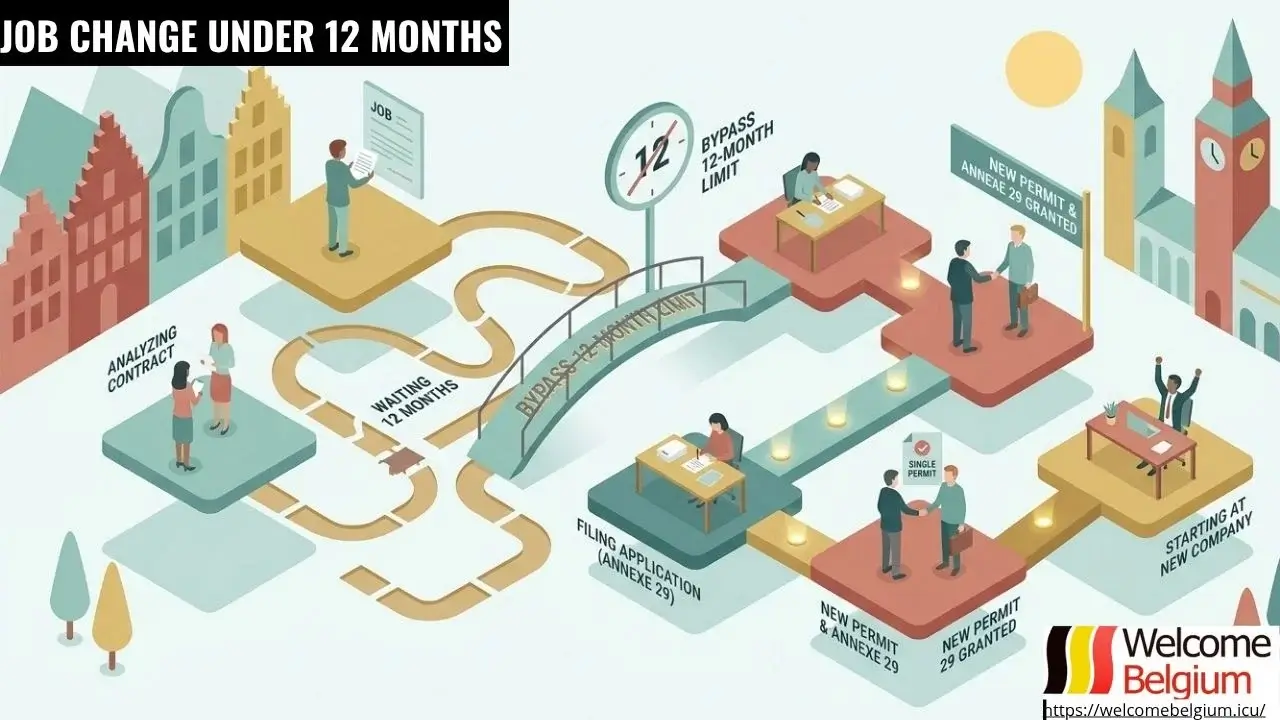
In 2026, the Single Permit employer change procedure for those with under 12 months of experience is fully digitalized. Let’s break down this legal transition route in detail.
Where to Apply, How Much It Costs, and How Long to Wait?
Before launching the process, you and your new employer should familiarize yourself with the costs and standard timelines of this procedure in 2026:
- Where to submit documents: The application is sent electronically via the single federal Belgian portal Working in Belgium. The system will automatically forward the case to the relevant regional authority based on the registered legal address of the new company:
- In Brussels — Brussels Economy and Employment.
- In Flanders — Departement Werk en Sociale Economie.
- In Wallonia — Wallonie Emploi.
- How much it costs (2026 Government Fees): Document processing costs are typically covered by the hiring party. In 2026, a dual-fee system applies:
- Federal Administrative Fee (Immigration Office Fee): Indexed on January 1, 2026, it stands at €377 per dossier. Applications are not accepted for review without the payment receipt.
- Flanders Regional Fee (Flemish Retribution): As part of the 2026 reform, Flanders introduced its own additional document processing fee of €250. Brussels and Wallonia do not apply such fees at the moment.
- Processing times: Official regulations grant authorities up to 4 months to reach a decision. In practice in 2026, responses for the IT sector and bottleneck occupations via the online platform arrive faster — averaging 4 to 8 weeks. However, if the occupation requires a detailed local labor market test, the process can take around 3 months.
Step-by-Step Guide: 4 Stages of a Safe Transition
| Stage | What Happens | Important Nuances / Documents |
| Step 1. Search & Contract | Receiving an offer and drafting the employment agreement. | A suspensive clause (clause suspensive) must be included in the new contract. |
| Step 2. Application Submission | The new boss submits the case to the Working in Belgium portal. | A basic document package is required (see list below) + payment of government fees. |
| Step 3. The Wait | Belgian authorities review the dossier and make a decision. | Keep working at your old job! Starting early at the new company is strictly prohibited. |
| Step 4. Resignation & Transfer | Issuance of the permit and official transition. | You receive Annex 46 (Annexe 46), work your notice period (préavis), and change companies. |
What to prepare for Step 2 (Documents for the new Single Permit):
- A color scan of all pages of your international passport and current Card A;
- A certified translation of your diploma;
- A recent medical certificate and a clean criminal record certificate (casier judiciaire).
Case Study (Under 12 Months of Experience):
Denis arrived in Brussels as a Java Developer. After 7 months, he found a new offer with a 25% higher salary. Overjoyed, Denis submitted his resignation (démission) on the very first day his new employer uploaded the documents to the Working in Belgium portal.
Result: The case review dragged on for 9 weeks due to internal ministry verifications. Denis’s old contract ended, leaving him without a job and a legal sponsor for 1.5 months. He miraculously avoided the cancellation of his Card A thanks to prompt assistance from lawyers and the leniency of his commune.
Conclusion: Under no circumstances should you write a resignation letter at your old job until you have the official Annex 46 in your hands!
Important: This algorithm is the most reliable way to change companies in Belgium, ensuring the continuity of your legal stay in the country and minimizing risks to your Card A. Haste in these matters often costs too much, so always wait for the official document on the portal.
How to Change Jobs in Belgium with a Single Permit Without an Employer Binding After 12 Months?
After the first year, the procedure indeed becomes noticeably simpler. If you have conscientiously worked in the Kingdom for your first year, I have an excellent insider tip for you: you can breathe a lot easier. The Belgian labor market opens up from a completely new angle for expats, and the transition procedure from one company to another is significantly streamlined.
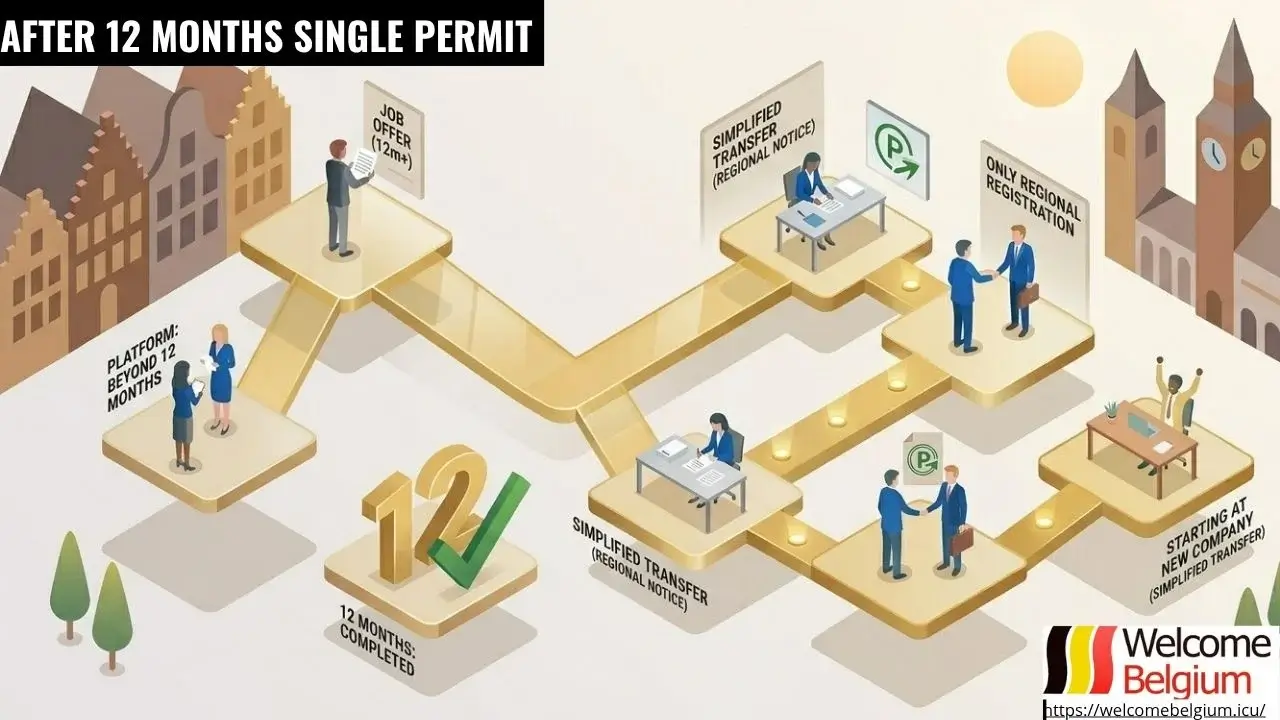
The main advantage of this stage is that the new boss is completely exempt from conducting the so-called Labor market test (checking the local labor market). They no longer need to prove to the ministry that no suitable Belgian or EU citizen was found for the position. After 12 months of continuous employment, the procedure for most highly qualified workers is simplified.
However, having more than a year of experience does not mean you have an automatic right to just pack your things, walk into a new firm, and sit at a desk. Bureaucratic control does not disappear; it simply changes form.
Here are the key rules to remember so that your Card A renewal goes smoothly during a job change:
- Preserving your professional profile: You gain freedom of action only within your working category. If you came to the country as a highly qualified specialist (e.g., an IT Architect), you can easily arrange a transfer to another company for a similar engineering role. But you cannot suddenly leave to work as a hotel receptionist or open a restaurant — for a radical change of activity, the procedure will have to be launched from scratch.
- Mandatory notification to Belgian Immigration: The state must know in real time who is paying taxes for you. As soon as you sign an agreement with a new company, this dossier (including the new contract) must be sent for registration via your electronic account on the Working in Belgium
- A visit to the local town hall: Your legal status in the country is still tied to the physical plastic card. The commune (Gemeente / Mairie) must receive updated data from the Ministry of Labor. Usually, the actual plastic of Card A is not replaced before its expiration date, but a note regarding the change of the sponsoring legal entity is accepted in the state register.
Important Summary: After 12 months of work, a standard work visa effectively transforms into a free pass across Belgian companies within your profile. The main thing is not to forget about timelines, ensure that the new company change is officially recorded by officials, and submit documents for Card A renewal 60 days before it expires.
Case Study (Over 12 Months of Experience):
Elena worked for 14 months as a Marketer in a large agency in Antwerp under a Single Permit. She was offered a Lead Brand Manager position at an international retail chain. The commune requested additional verification of her diploma, causing the process to stretch out for nearly a month. The new employer simply notified the immigration service and uploaded the contract, since no labor market test was required.
However, when Elena’s colleague, who arrived under the same program, attempted to transition from an IT Engineer to a startup co-founder as a Managing Director after 15 months of experience, the commune blocked the process.
Conclusion: After a year, changing employers within your field can be done quickly and painlessly. But with a radical profile change (or transitioning into business), the status of a “highly qualified specialist” will have to be proven all over again.
What to Do If You Get Laid Off? Expat Rights with a Single Permit and Action Plan
Losing a job is always a major stress, and when a person is in a foreign country and their life is tied to an immigration status, the situation feels critical. If you have faced a dismissal with a Single Permit in Belgium, the first thing to do is calmly assess your legal options. You are not required to leave the country the very next day. Belgian legislation protects the rights of foreign workers, and you have legitimate time to find your bearings.
The “90 Days” Rule: How Much Time Does an Expat Have?
The main legal shield you possess is a fixed buffer period. According to the regulations, if a contract is terminated at the employer’s initiative, you have exactly 90 days to legally remain in Belgium and find a new position.
Critically Important Clarification: This buffer lasts for 90 days or until the expiration date of your physical Card A, if your current card expires sooner than these 3 months end.
During this timeframe, your former employer notifies the Office des Étrangers (Immigration Office) about the contract termination. However, an automatic countdown is triggered, granting you official time to secure a new sponsor.
Checklist: First Steps After Dismissal
To understand how long an expat can legally look for a job in Belgium without losing the right to a residence permit, you need to take two key actions immediately:
- Collect your C4 Form from the employer. This is the primary document confirming the fact and reason for the contract termination (redundancy, position elimination, etc.). Without it, you cannot move forward with official institutions.
- Register with a regional employment agency. This must be done within the first few days following your dismissal. Registration is not just a tool for finding vacancies; it serves as official proof for the immigration service that you are actively seeking a new job and intend to remain within the Belgian economic sector.
Depending on your registered place of residence (town hall registration), you must contact a specific employment agency:
Many expats are unaware that if you have worked in Belgium for a certain period (usually at least 12 months) and paid taxes, you have a full right to claim unemployment benefits (allocation de chômage) upon redundancy. This is processed through trade unions (e.g., CSC, FGTB) or the state auxiliary fund CAPAC. Holding a Single Permit does not deprive you of this right, provided the dismissal was not your fault.
Being laid off does not mean you are left without support. You can check the eligibility criteria and learn how to apply for unemployment benefits in Belgium while navigating your 90-day job search window.
Case Study:
Mark was laid off from his position as a Systems Analyst in Antwerp due to company restructuring. He held a Card A that was still valid for another 8 months. Within a week, Mark registered with the VDAB and applied for unemployment benefits. On the 65th day of his search, he found a company ready to launch the employer change procedure. Because he managed everything within the allotted 90 days, his legal status remained continuous, and the immigration service approved his transition to the new employer.
Conclusion: Dealing with a layoff and knowing how to change jobs in Belgium with a Single Permit follows a clear algorithm. The main thing is to legalize your unemployed status with an employment agency during the first week and focus on finding companies experienced in working with foreign specialists. You have time.
Important: Key Legislative Changes in 2026 for the Single Permit in Belgium
If you plan to change jobs in Belgium with a Single Permit, it is critically important to take into account the massive immigration law reform unfolding in 2026. Content written based on the rules of previous years is guaranteed to result in a rejection today.

The new rules are regulated by federal law and regional legal acts. The main document that triggered the global overhaul of the rules is the Belgian Royal Decree coordinating inter-agency cooperation. You can monitor all legal act publications in real time through the official government database Moniteur Belge.
Three fundamental changes in 2026 that every expat must know about:
1. New Salary Thresholds for 2026 (Indexation)
To successfully change employers, a new employment contract must strictly comply with the updated salary benchmarks. The decision to issue permits is now tied to rigid regional criteria. If a new company offers you a rate based on last year’s old limits, it will trigger an automatic rejection from the immigration authorities. The gross amount is verified down to the cent.
Official documents regarding the limits are published on regional profile websites:
- For Brussels: Directives on the Brussels Economy and Employment
- For Flanders: Current instructions on the state portal be.
- For Wallonia: Regulations in the special section of Wallonie Emploi.
2. Strict Reform in Flanders
Effective January 1, 2026, Flanders radically changed its approach to economic immigration, based on the new Decree of the Flemish Government on labor market reform:
- Complete exclusion of low-skilled labor: Positions such as warehouse workers, cleaners, and kitchen assistants can no longer qualify for a Single Permit.
- Reduction of bottleneck occupations: The list of so-called “critical” specialties for mid-level professionals has been slashed to exactly 21 positions (long-haul truck drivers, for example, were removed, but roofers remain). The full official list of positions can be downloaded on the Departement Werk en Sociale Economie
- Status and role level control: Now, it is not just the applicant’s diploma that matters, but the alignment of the vacancy itself with a highly qualified profile. A top-tier specialist cannot be hired for an ordinary linear position just to bypass the rules.
- New fee: An additional regional processing fee of €200 per case is introduced in Flanders (in addition to the standard federal administrative fee).
If your potential employer is located in the Flemish region, make sure to read our detailed analysis of the new Single Permit rules in Flanders, as local authorities have significantly altered the compliance process.
3. Full Digital Transformation
As of May 2026, Belgium has completely eliminated any paper-based applications and email communication. Even for short-term contracts and cross-border workers, an uncompromising law applies: absolutely all cases must be submitted exclusively through the single state online portal Working in Belgium.
Reference Table: Current Salary Thresholds for 2026
Below are the official minimum salary thresholds (Gross / Bрутто) effective for submitting and renewing a Single Permit in 2026.
| Belgian Region | Highly Qualified Specialist | Executive Category (Executives) | EU Blue Card |
| Brussels (Calculated monthly) | €3,703.44 / month | €6,647.20 / month | €4,748.00 / month |
| Flanders (Calculated annually) | €48,912.00 / year (under 30 years old: €39,129.60) | €78,259.00 / year | €63,586.00 / year |
| Wallonia (Calculated annually) | €53,220.00 / year (under 30 years old: €42,576.00) | €88,790.00 / year | €68,815.00 / year |
Note on calculation: By law, for the annual thresholds in Flanders and Wallonia, the monthly equivalent is calculated by dividing the total sum by 13.92 (taking into account the specific Belgian system of paying a 13th-month salary and holiday bonuses). In Brussels, limits are traditionally fixed in a monthly gross format.
Job Change Checklist:
If you are navigating these 2026 legislative changes to change jobs in Belgium with a Single Permit, the transition algorithm to a another employer looks like this: your new company uploads the employment contract to the Working in Belgium portal, attaches the proof of fee payment, and proves that the position meets the qualification criteria and new salary limits. Applications are no longer accepted under the old rules.
FAQ: Frequently Asked Questions About Changing Jobs with a Single Permit in 2026
Yes, but only through a complete re-application procedure submitted by your new employer to the Ministry of Labor. The golden rule is: do not resign from your old position until official approval from the authorities is granted, otherwise, you will lose your legal status.
In most cases, regional authorities will reject applications if the salary does not meet the established benchmarks. Gross amounts are thoroughly checked down to the cent.
Official regulations grant authorities up to 4 months to reach a decision. However, in 2026, responses via the online platform Working in Belgium for the IT sector and bottleneck occupations arrive faster — averaging 4 to 6 weeks.
For most Single Permit holders in the highly qualified worker category, the employer change procedure does indeed become simpler after 12 months. However, specific conditions may still vary depending on the region and the type of permit you hold.
In practice, foreign workers are usually granted a buffer period of up to 90 days to secure a new employer. However, the exact timelines may depend on your specific dossier and the validity period of your current Card A. To protect your status, you must immediately register with a regional employment agency.
Yes, a former student can undergo this process from within the country. If you are legally residing in Belgium, your new employer can apply for the Single Permit via the electronic portal without requiring you to return to your home country.
If your experience is under one year, you will be reissued a new Card A after receiving Annex 46. If you have worked for more than a year, you do not need to physically change the plastic card; the commune will simply update the sponsor details in the state register.Can I change jobs in Belgium during my first year with a Single Permit?
What happens if the salary in the new contract is below the 2026 thresholds?
How long does the approval process actually take when changing companies?
I have worked for 14 months and want to leave. Do I need to wait for approval again?
I was laid off. How much time do I have to find a new company?
Is it possible to change status and switch to a Single Permit from a student visa without leaving Belgium?
Do I need to physically replace my plastic Card A at the commune during the transition?
This brief FAQ on how to change jobs in Belgium with a Single Permit in 2026 shows that a transition is possible at any stage. The key takeaways are to strictly comply with the gross salary thresholds, submit applications exclusively through the digital portal Working in Belgium, and never resign prematurely without official government approval.
Belgian bureaucracy has become faster in 2026, but it still demands strict compliance with the law. Plan your transition carefully, and your legal status in the Kingdom will remain entirely secure. Good luck with your new position!
Sources
When preparing this guide, official government portals, Belgian legislative acts, and current regional directives for 2026 were consulted:
- Federal Authorities and Databases:
- Single Belgian Immigration Portal: Working in Belgium
- Official Database of Legal Acts: Moniteur Belge
- Regional Ministries and Employment Authorities:
- Brussels: Brussels Economy and Employment
- Flanders: VLAIO Department instructions on be and permit guidelines on Vlaanderen.be (specifically the Departement Werk en Sociale Economie).
- Wallonia: Employment Department on Wallonie Emploi and the work permits section on Wallonie Emploi Permis.
- Regional Employment Agencies (Mandatory Registration After Layoff):
Legal Disclaimer
This material is provided for informational purposes only and does not constitute formal legal advice. Belgium’s immigration rules for 2026 feature numerous nuances that depend on your specific commune and professional specialty. The Welcome Belgium project assumes no liability for decisions made based on this article. Before resigning or signing a new employment contract, always double-check the latest requirements with an immigration lawyer or directly on the official Working in Belgium portal.