
Last Updated on May 3, 2026 by Alex
If you are planning to work in Belgium or have already received an offer, you have likely encountered the terms STR and SRR. At first glance, it sounds complicated, but in reality, it is much simpler. This is a special tax regime for expats in Belgium that allows for a significant reduction in the tax burden for foreign employees and researchers.
Who is this for? Primarily high-skilled professionals recruited from abroad, as well as researchers and scientific staff. However, in practice, many expats do not even know they are eligible for this benefit and overpay their contributions.
I, Alex, will break everything down as clearly as possible: what STR/SRR in Belgium is, how it works, and whether it’s worth your attention.
What STR and SRR Mean: An Explanation
They are often perceived as different benefits, but in practice, they represent the same regime with different scopes of application. STR is used for international employees in a business environment, while SRR is for researchers and specialists working on scientific and R&D projects.
Both mechanisms follow the same logic: Belgium reduces the tax burden to attract foreign talent. However, they are regulated under a single legislative reform — the Programme Law of December 27, 2021, which introduced a new regime for impatriates and researchers starting from 2022.
The legal basis is the Programme Law of December 27, 2021, which came into force on January 1, 2022, and replaced the old administrative system for expats (the official text of the law is available through the Belgian Official Gazette).
Official information and clarifications on the application of the regime are published by the Belgian tax authority — FPS Finance, which regulates practical implementation.
Comparison Table:
| Parameter | STR (Special Tax Regime) | SRR (Special Researcher Regime) |
| For Whom | Foreign employees | Researchers and scientific specialists |
| Objective | Attracting qualified workers | Support for science and R&D |
| Main Benefit | Reduction of taxable income | Similar tax benefits |
| Who Applies | Employer | Employer |
STR is the program for “regular” high-skilled expats, while SRR is the version for those working in science and research. Otherwise, the logic is the same: if you moved to Belgium for work, you may pay fewer contributions if you meet the conditions.
Advice from Alex:
Many confuse these programs with an “optional tax benefit,” but in practice, it is a strictly regulated government program. It is applied only through the employer and only if you meet the legal criteria, not at the employee’s initiative.
Who Qualifies for STR/SRR in 2026
This is not a universal benefit for all expats, but a strictly regulated tax regime applied only when specific conditions are met. Its goal is to attract qualified specialists and researchers from abroad within Belgium’s government programs.

Key Participation Conditions
To qualify, the following basic criteria must be met:
- You were hired or transferred to Belgium from abroad.
- Prior to employment, you were not a tax resident of Belgium.
- The move is directly related to work.
- The regime is processed by the employer (self-application is impossible).
- The position belongs to a qualified or research field.
In most cases, a minimum income level applies (around €70,000 per year, subject to indexation). This threshold is used as an additional filter but is not the sole deciding factor.
In practice, the program applies to:
- International specialists hired from abroad.
- Employees transferred to Belgian office locations.
- Researchers at universities and R&D centers.
- Specialists in high-skilled positions.
If you are planning to work in Belgium, you have likely come across the terms STR and SRR. This special tax regime is designed to attract international talent by reducing the tax burden. Before diving into the specifics of these programs, it is essential to understand the general framework of expat taxes in Belgium to see how much you can actually save.
Important Clarification:
Even if you meet the salary and position requirements, the regime is not applied automatically. The deciding factor is the combination: status before moving + nature of hiring + type of position.
Summary: Is STR/SRR Worth Your Attention?
It is not suitable for all expats, only for those who meet the formal criteria for international recruitment and qualified or research roles. In practice, this means the regime is truly worth considering only in the case of job relocation and compliance with FPS Finance requirements.
If you meet the basic conditions (international recruitment, no Belgian tax residency prior to the move, qualified position, and processing through the employer), STR/SRR can be a financially beneficial tool for reducing the tax burden.
However, it is important to note: the regime is not a guaranteed benefit and always depends on a combination of factors — employee status, contract structure, and the employer’s decision.
Advice from Alex:
If you already meet the conditions, it should be considered a working tool for optimizing budget contributions. If not, it most likely does not apply to your case.
How Tax Benefit is Formed (In Practice)
In Belgium, this does not automatically lower the tax and does not work as a fixed discount. The benefit arises from how the employee’s income is structured and which payments are recognized as expense compensation.
In practice, the mechanism looks like this:
- Part of the payments is structured as expat allowances rather than salary.
- Expense compensations (e.g., relocation or housing) are not included in the taxable base if conditions are met.
- As a result, taxable income is reduced.
Practical Application Examples
For example, if an employer compensates for a move to Belgium, this amount can be structured as a reimbursement and does not increase the tax base.
Similarly with housing: a housing allowance can be partially accounted for separately from the salary if regime conditions are met.
This does not provide a fixed percentage of savings. The final effect depends on:
- Compensation structure.
- Salary level.
- Which payments are recognized by the state service as permissible.
Therefore, two employees with the same salary can have different net incomes.
The 150 km Rule: Why It Matters
The 150 km rule is one of the criteria used to assess eligibility for STR/SRR in Belgium. It relates to how far from Belgium your place of residence was before moving.
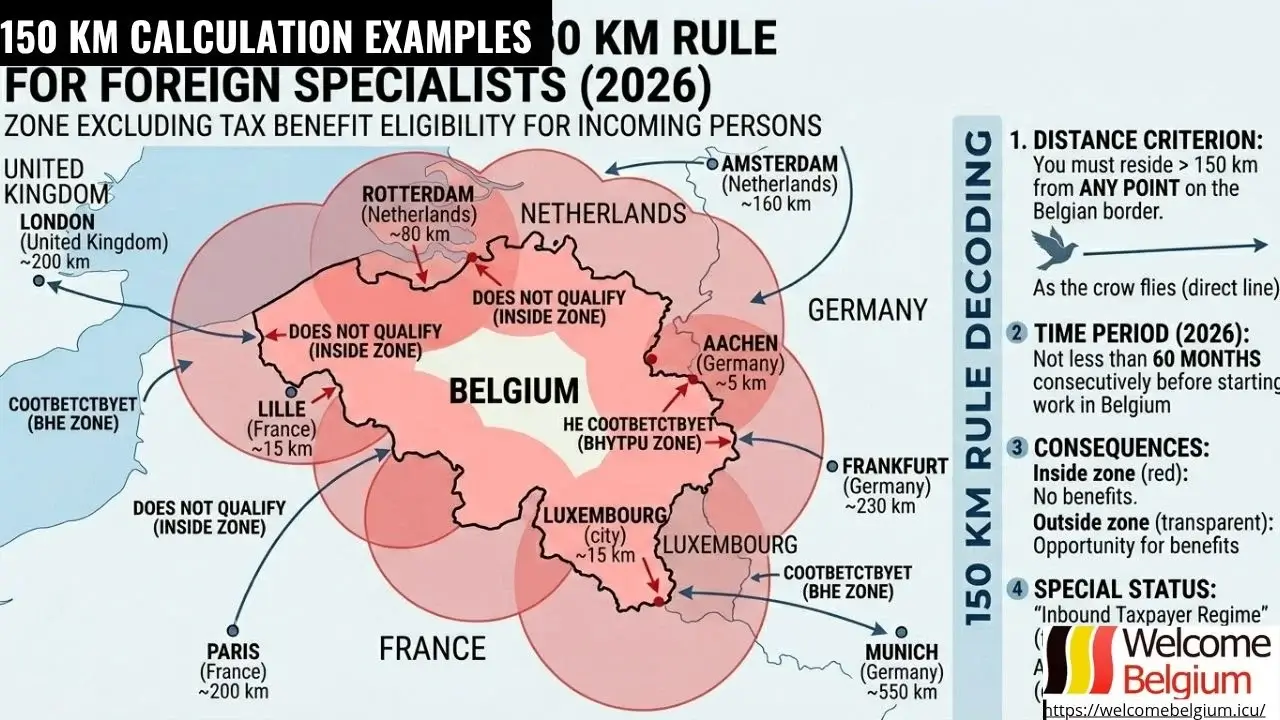
Essence of the rule: The tax authority checks whether you were truly recruited from abroad, rather than being within “local mobility” inside the region.
If your previous residence was closer than 150 km from the Belgian border, it may raise questions when assessing compliance with regime conditions. If the distance is greater, it usually confirms the international nature of the move.
The Belgian tax authorities use a “local mobility” filter to ensure the recruitment is truly international. You should check who qualifies for the 150 km rule in Belgium to see if your previous residence meets the requirements.
To be certain, you can follow this guide on how to calculate the 150 km distance from the Belgian border accurately.
Important:
The 150 km rule means that for the last 60 months before taking office, you must have resided more than 150 km from the Belgian border. This excludes residents of border areas of France, the Netherlands, Germany, and Luxembourg.
Why this is important for STR/SRR
In practice, the 150 km rule helps the state service determine if there was a real international recruitment. Even if you have:
- A high salary
- A qualified position
- A contract with an international company
…this rule can become an additional factor in checking eligibility.
Advice from Alex: The 150 km rule is often perceived as a formality, but in practice, it works as a “real expat” filter. The tax authority evaluates not only the contract but also the geographical context of the move.
How to Obtain STR/SRR: Brief Steps
The program is not processed independently but exclusively through the employer. The application is submitted to FPS Finance within the established procedure for expats and researchers.
In practice, the process looks formal but depends entirely on the company hiring you.
Step 1. Compliance Check
The employer first assesses if the employee fits STR/SRR:
- International recruitment or transfer from abroad.
- Qualified or research position.
- Lack of Belgian tax residency prior to employment.
- Compliance with the regime’s basic requirements.
Step 2. Preparation of Documents by the Employer
After preliminary selection, the company compiles a data package:
- Employment contract.
- Job description.
- Confirmation of relocation or hiring from abroad.
- Structure of the compensation package.
At this stage, it is crucial that the contract terms comply with tax practice requirements.
Step 3. Submission of Application via Employer
The employer submits a request for the application of STR/SRR to the tax administration. This is the application special tax regime Belgium procedure.
The employee is not directly involved in the submission process — they are the subject of the compliance check.
Step 4. Verification and Application of the Regime
FPS Finance reviews the application and evaluates:
- Compliance with criteria.
- Nature of international recruitment.
- Structure of income and compensations.
Upon approval, the regime is applied to the employee’s income according to the established rules.
Processing Times
On average, the procedure takes from a few weeks to several months. The exact timeframe depends on:
- The speed of the employer’s submission.
- Complexity of the case.
- The workload of the tax service.
Advice:
In practice, the key stage is not the submission itself, but the preparation before it. If the contract or compensation structure does not initially meet STR/SRR requirements, FPS Finance may refuse even at the verification stage, even for a formally suitable candidate.
Duration of STR/SRR and Renewal
STR/SRR in Belgium does not have a fixed duration in years and applies only as long as the conditions under which it was granted are maintained. The regime is regulated by the Programme Law of December 27, 2021 (Belgian Official Gazette), and its application is monitored by the Belgian tax service FPS Finance.
The regime remains in effect as long as compliance with established criteria is maintained. No separate formal renewal procedure is provided — application continues automatically upon fulfillment of conditions.
The regime is maintained or terminated based on the following factors:
- Existence of a valid employment contract with the employer.
- Maintenance of international employee or researcher status.
- Compliance with criteria set by the Programme Law 27 December 2021.
- Extension of the employment contract without significant changes to terms (regime is maintained).
- Change of employer (requires a new assessment of eligibility).
- Change in position or nature of work (review of eligibility possible).
- Loss of compliance with tax administration criteria (regime is terminated).
The duration of the expat tax regime in Belgium is determined not by a calendar period, but by continuous compliance with conditions established by law and administered by FPS Finance.
Common Errors and Misconceptions about STR/SRR
It is often perceived as a “universal tax benefit for expats,” but in practice, it is a strictly regulated regime whose application depends on specific hiring conditions and requirements of the Belgian tax service FPS Finance. Due to simplified interpretations, errors regularly occur among employees and employers, which can lead to refusal or termination of the regime.
Below are the most common errors, their source, and the correct understanding from a practical application perspective:
| Problem / Misconception | Source of Error | Correct Understanding / Solution |
| STR/SRR can be processed independently | Confusion with regular tax deductions | The regime is processed only through the employer; independent submission is impossible |
| A high salary is sufficient to obtain the regime | Simplified understanding of “expat tax benefits” | Salary is important, but key is international hiring and compliance with FPS Finance criteria |
| STR/SRR is guaranteed when moving to Belgium | Perception error as an automatic benefit | The regime applies only when all legal conditions are met and confirmed by the tax administration |
| The regime operates independently of the employer | Incorrect understanding of program structure | STR/SRR is tied to a specific employer and employment contract |
| Refusal is related only to income | Focus only on financial criteria | Refusal is also possible due to status before moving, hiring structure, or position mismatch |
Most problems arise not from the legislation itself, but from incorrect interpretation of conditions or attempts to apply it without observing formal criteria.
FAQ — Frequently Asked Questions about STR/SRR
Below are key questions about STR/SRR in Belgium that most often arise among expats and employers. These answers are based on practical application and rules set by the Belgian tax service FPS Finance.
Can I get STR without an employer?
No. It is processed exclusively through the employer. Independent application is impossible as it is applied within the employment contract and confirmed by the employer.
What is the minimum salary for STR in 2026?
There is no fixed single threshold in the law, but in practice, a guideline of around €70,000 per year is applied (subject to indexation). Crucial importance still lies in compliance with other criteria, not just income.
Can I lose STR status?
Yes, it can be terminated if conditions cease to be met: change of employer, change in position, or loss of international employee status.
Does STR equal Belgian tax residency?
No. STR/SRR is not tax residency. It is a special tax regime applied to income under certain conditions but does not change the tax resident status itself.
How much can I realistically save?
There is no single fixed amount. Savings depend on the income structure, compensations, and which payments are recognized by the tax authority as permissible under the program. Results can differ significantly for different employees.
Can I change employers while on STR?
Yes, but it does not transfer automatically. Changing employers requires a new assessment of compliance with STR/SRR conditions and a new confirmation of application.
Is this suitable for freelancers?
No. STR/SRR applies only to salaried employees working under an employment contract. Self-employed specialists and freelancers do not fall under this.
STR/SRR in Belgium is a strictly regulated tax regime applied only to international recruitment and fulfillment of established criteria. It is not a universal benefit for all expats and always depends on the specific structure of the employment contract, employee status, and employer decision. In most cases, the key factor becomes not only the income level but also compliance with formal requirements set by the Belgian tax system.
If you are considering a move or have already received an offer, it makes sense to evaluate STR/SRR in advance — before signing the contract, as the possibility of applying benefits directly depends on how the hiring terms are structured.
Sources
- Programme Law of 27 December 2021 (Moniteur belge — official text of Belgian law): https://www.ejustice.just.fgov.be/cgi/article_body.pl?language=en&pub_date=2021-12-31&caller=summary&numac=2021043380
- FPS Finance — official information on the tax regime for expats (STR/SRR): https://finance.belgium.be/en/individuals/international/expats
- Belgian Official Gazette (Moniteur belge) — official publication of Belgian legislation: https://www.ejustice.just.fgov.be/cgi/welcome.pl
Disclaimer
The information in this article is for reference only and does not constitute individual tax advice. The application of STR/SRR depends on the specific situation, employment contract structure, and assessment by the Belgian tax authority. Rules and administrative practices may change. For decision-making, it is recommended to consult official sources or qualified tax advisors in Belgium.