
Last Updated on April 22, 2026 by Alex
Quick Checklist
Before diving into the 2026 bureaucracy, define your relocation strategy. In Belgium, the choice between the EU Blue Card and the Single Permit depends on three factors: seniority, salary, and region.
- Option A: “The Experienced Player” (EU Blue Card)
- Experience: 3+ years of verifiable IT experience within the last 7 years.
- Salary: From €4,748 gross per month or higher.
- Profile: No degree required. In 2026, professional experience is officially equivalent to higher education.
- Main Advantage: Accelerated Permanent Residency (PR) and free access to the labor market after one year.
- Option B: “The High-Demand Pro” (Single Permit — Shortage Occupation)
- Experience: 2+ years, but salary is below the Blue Card threshold.
- Specialization: DevOps, Cloud, Cybersecurity, Data Science (occupations on the shortage list).
- Profile: Requires the VAV procedure (validation of competencies) in Flanders or Brussels.
- Main Advantage: Simplified Labour Market Test — it is easier for the employer to prove your value.
- Option C: “The Niche Expert” (Single Permit — Standard)
- Experience: Unique expertise in a rare tech stack.
- Profile: No degree, but the company is willing to prove you are one of a kind.
- Main Advantage: Ability to relocate even for positions not on official shortage lists, with strong support from company lawyers.
Pro Tip: If your offer exceeds €57,000 per year, insist that HR applies for the Blue Card. This is the most “seamless” and prestigious route in 2026.
Introduction
As of April 2026, the Belgian labor market shows a paradoxical dynamic: while there is an acute shortage of highly qualified IT talent, migration law requires impeccable documentary proof of qualifications.
For many experienced engineers, architects, and developers, the lack of a specialized degree becomes an “invisible barrier” when applying for a Single Permit. Modern European bureaucracy is not a dead end but a system of algorithms where professional seniority can be legally equivalent to an academic degree.
In 2026, the relocation procedure without a diploma requires more meticulous case preparation from both the candidate and the employer. Depending on the region — Flanders, Wallonia, or Brussels — rules vary significantly. However, two main legalization paths stand out globally.
We will break down the mechanisms for confirming professional experience through the VAV (Validation of Skills) procedure for a standard work permit and analyze the updated EU Blue Card requirements, which in 2026 became more flexible for IT specialists with five or more years of proven experience.
New Rules and Salary Thresholds 2026
For an IT specialist without a degree, the primary criterion for a Single Permit is falling into the Highly Skilled Staff category. In 2026, Belgian authorities further diversified these requirements: thresholds now depend on both age and specific region.
To receive approval, your annual salary must not fall below the established limit. Note that Flanders traditionally maintains the highest standards.
| Region | Profile Type (Highly Skilled) | Annual Gross Income 2026 |
| Flanders | IT Specialist (All ages) | €52,560 |
| Brussels | Specialists over 30 years old | €50,820 |
| Brussels | Specialists under 30 years old | €40,656 |
| Wallonia | High Qualification | €49,980 |
Data is based on official publications from regional employment services: Economic Migration Flanders and Brussels Economy and Employment.
The main difference between these categories in 2026 lies in the level of responsibility and the pay scale:
- Highly Skilled: The “major league,” including IT engineers, system architects, and lead developers. The key criterion here is not a diploma but meeting the salary threshold (€50,000+ gross) and proven experience. This group remains a priority for accelerated Single Permit processing in 2026.
- Middle Skilled: This includes technical specialists in shortage occupations (e.g., junior systems administrators or network technicians). Salary requirements are lower, but the list of professions is strictly limited by regional “shortage lists” (knelpuntberoepen), updated every two years.
For a specialist without a degree, the Highly Skilled route is more reliable, as a high salary serves as the primary indicator of indispensability to the Belgian economy in the eyes of migration services.
In Belgium, the concept of “annual income” is broader than just twelve monthly payments, which is critical for meeting immigration limits. The compensation system is built on the principle of indexation and additional payments.
In 2026, the Belgian Immigration Office (IBZ) audits cases without degrees by checking not only the current salary but also the employer’s commitment to automatic inflation adjustments and the 13th-month salary, which is officially included in the total gross annual income.
Critical Salary Indexation Points in 2026:
- Indexation: Belgium operates an automatic salary-to-inflation linking system. If a contract is signed in January at the minimum threshold and indexation occurs in June, the salary must increase proportionally. Otherwise, your Single Permit may be revoked upon renewal.
- Income Structure: The amounts in the table represent the total gross cost of labor. This includes: base salary, holiday pay, and the “13th-month salary.” Bonuses not guaranteed by the contract are not included in the threshold calculation.
Important:
Minimum salary levels for foreigners in Belgium are reviewed annually on January 1st. Ensure your employer includes a “buffer” of 2-3% above the threshold to avoid issues during sharp spikes in the Consumer Price Index (CPI).
VAV Procedure: Step-by-Step Competency Validation
For many IT specialists in 2026, the absence of a degree is no longer a dealbreaker, thanks to the VAV system (Validation des Acquis de l’Expérience / Erkenning van Verworven Competenties). This mechanism officially converts practical work experience into a legally valid document recognized by migration authorities for Single Permit applications.
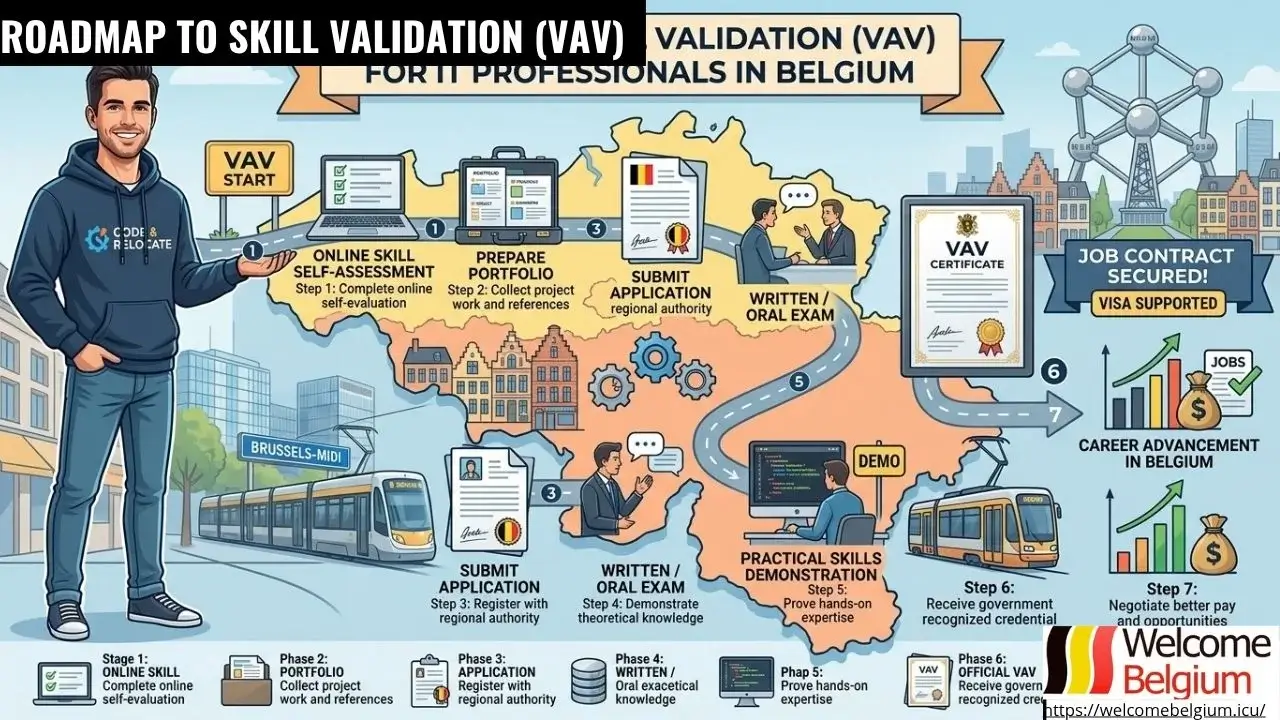
Validation of Acquired Competencies (VAV/EVC) is the process of officially recognizing skills gained outside academic environments (self-education, project work, bootcamps). Upon completion, you receive a Certificate of Experience (or Titre de compétence), which Belgian employers and the state treat as a professional qualification of a specific level.
The procedure takes place in regional Belgian centers. Your choice depends on where your future employer is registered:
- Flanders: Managed by VDAB (Erkenning van Verworven Competenties). They offer the most extensive list of IT competencies for validation.
- Brussels: Contact Actiris or specialized Cité des Métiers
- Wallonia: Handled by the Le Forem
Critical Note: Selecting the correct center is vital, as the certificate must meet the regional migration requirements where the company is registered. In Flanders, the process is often faster due to high automation and a focus on shortage IT talent.
The Competency Dossier (2026 Requirements)
To be admitted to the exam, you must prepare a “Competency Dossier” including:
- Seniority Proof: Detailed recommendations from past employers (in English or with a sworn translation) specifying tech stacks and project roles.
- Portfolio: Links to GitHub, architectural diagrams of implemented solutions (respecting NDAs), and technical articles.
- Certifications: Professional certificates (AWS, Azure, Google Cloud, Cisco) significantly accelerate the admission process.
The Assessment
After a dossier review, you will be invited to a session (in-person or online) consisting of:
- Technical Test: A real-time practical assignment (e.g., code refactoring or identifying architectural vulnerabilities).
- Expert Interview: A discussion with 2–3 Belgian industry experts focusing on theory and real-world crisis management.
Alex’s Advice:
Don’t try to “appear” better than you are. In 2026, the assessors are active Tech Leads from major Belgian companies. They value architectural understanding and concrete logic over memorized syntax.
The EU Blue Card Route: 2026 Update
While the Blue Card was once exclusive to Master’s degree holders, the rules changed in 2026. For the IT sector, practical experience is now officially recognized as equivalent to higher education across the EU.
Table: EU Blue Card Procedure 2026
| Stage | Where to Apply (Official Site) | Cost (Gov Fee) | Waiting Time |
| 1. Seniority Verification | EUR-Lex (Directive 2021/1883) | Free | 1–2 weeks |
| 2. Blue Card (H-Card) App | Working in Belgium Portal | €180 | 4–12 weeks |
| 3. Type D Entry Visa | VFS Global / Embassy | €180 | 5–15 days |
| 4. Commune Registration | Local Administration (Commune) | €25–€50 | 2–4 weeks |
Why This is a Game-Changer
To qualify for a Blue Card in Belgium in 2026, an IT specialist only needs to prove 3 years of relevant professional experience within the last 7 years. This is based on EU Directive 2021/1883 (Article 2, Clause 9), which equates ICT professional skills with higher education.
- How it Works: You no longer need the complex VAV procedure or diploma equivalency. Contracts and references proving “highly skilled” work are sufficient.
- Condition: The contract must be for at least 6 months, and the salary must meet the Blue Card threshold.
Mobility and Family Perks
- Intra-EU Mobility: If you’ve worked 12 months under a Blue Card in another EU country (e.g., Germany or Poland), you can move to Belgium via a simplified procedure.
- Employer Flexibility: After the first 12 months, you can change employers simply by notifying the regulator—no new card application required.
- Family “Superpowers”: Spouses receive automatic work rights. They do not need a separate sponsor and can work for any employer or start a freelance business immediately.
It is crucial to remember that obtaining an H-Card requires not only proof of experience but also meeting strict financial criteria. Be sure to check the new EU Blue Card minimum salary threshold in Belgium for 2026, as these figures are indexed annually.
Final Pro-Tip:
If your IT experience exceeds 3 years and your salary hits the threshold (approx. €57,000 – €64,000 in 2026), choose the Blue Card path. It is the fastest route to EU long-term residency.
Shortage Occupations and the Labour Market Test
In 2026, Belgium utilizes “Dynamic Shortage Lists”. If your role is featured on these lists, your employer is exempt from the Labour Market Test—the requirement to prove that no local Belgian or EU candidate was available for the position. Furthermore, for these roles, professional experience often takes precedence over formal education requirements.
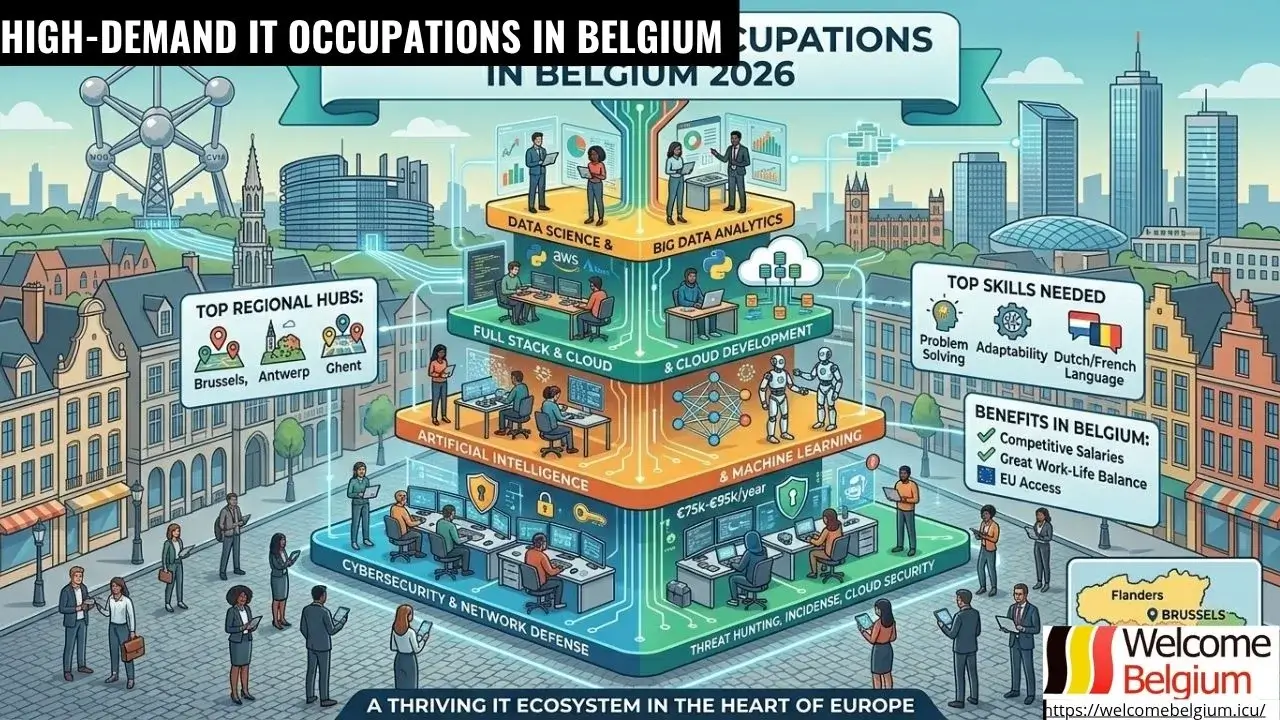
Each region maintains its own registry, which can be verified online. For the IT sector, the 2026 landscape is as follows:
- Flanders (VDAB): The most progressive registry. In 2026, the Top 10 consistently includes Cloud Architects, Data Engineers, and Cybersecurity Specialists.
🔗 Official VDAB Shortage List (Knelpuntberoepen)
- Wallonia (Le Forem): This list is valid until September 2026 and highlights a critical need for Systems Analysts and Network Administrators.
🔗 Official Le Forem Occupation List
- Brussels (Actiris): The capital region focuses heavily on Software Developers, DevOps Engineers, and IT Project Managers.
🔗 Official Actiris Portal (Pénurie de main-d’œuvre)
Why This Benefits You in 2026:
- Automatic Exemption: According to the Immigration Office (IBZ) regulations, professions on these lists receive automatic approval regarding “economic necessity.”
- Degree Flexibility: For shortage roles, the validation of experience via VAV or the Blue Card “Green Lane” is prioritized. The state prefers immediate taxpayers over lengthy academic equivalency processes.
- The 3-Week Rule: If your position is for a Software Developer or DevSecOps specialist, the employer simply needs a certificate from the regional employment service stating the vacancy remained unfilled locally for 3 weeks.
If your specialization is on the shortage list, the process is significantly streamlined. However, regional nuances exist: for instance, the new Single Permit rules in Flanders for 2026 have recently come into effect, directly impacting processing times for IT talent.
Alex’s Tip:
Always check the specific list for the region where your company’s headquarters is physically located. In 2026, the rules in Flanders and Wallonia can vary significantly, even for identical roles like a Systems Architect.
Technical Submission: The “Working in Belgium” Portal
The May 2026 Reform marked the complete phase-out of paper applications and postal mail. The entire process—from the initial contract upload to final approval—now takes place exclusively in a digital environment through a Single Digital Gateway.
The transition to a fully digital workflow is more than a recommendation; it is a legal requirement. Starting this year, the Working in Belgium portal becomes mandatory from May 1, 2026, meaning old email or paper-based methods are no longer accepted.
Portal Interface: Division of Roles
The Working in Belgium portal is the unified access point for both you and your employer. The process is divided into two distinct parts:
- Company Responsibility: The employer creates the application, uploads the labor contract, the job description, and proof of tax compliance.
- Specialist Responsibility: You gain access to your specific section (via invitation or a personal dashboard) to upload personal documents: passport scans, a criminal record certificate, and proof of qualification (such as your VAV certificate or proof of seniority for the Blue Card).
File Requirements: The 2026 Digital Standard
The Immigration Office (Office des Étrangers) has become extremely strict regarding data quality and formats:
- Translations and Apostilles: Any document not in English, French, Dutch, or German must include a sworn translation. As of 2026, Belgium fully accepts e-Apostilles, which significantly accelerates the verification process.
- Digital Identification: For those already in the EU, login is handled via eID or the Itsme First-time applicants from abroad will receive a temporary profile with mandatory two-factor authentication (2FA).
- Format: Documents must be in searchable PDF format, with a maximum file size of 10 MB per document.
In your personal dashboard, the application status is updated in real-time. A push-notification system was introduced in 2026; if an official requires additional information, you will receive an instant alert rather than a physical letter weeks later.
Critical Deadline:
According to the official federal immigration guidelines, the “freeze” period for applications requesting additional documents has been reduced to 15 days. Failure to upload the required file within this window results in the cancellation of the application without a refund of the administrative fee.
Errors, Refusals, and the Right to Appeal
For an IT specialist without a degree, a refusal is not the end of the road. More often, it is a signal that the documentation was compiled incorrectly. In 2026, statistics show that over 30% of refusals are successfully overturned when handled by a professional immigration attorney.
Why are Refusals Issued in 2026?
The primary reason for non-degree applicants is a mismatch between the job level and the proven experience.
- Role Mismatch: You apply for a Senior Architect position, but your VAV-validated experience or references only support a Middle-level role. To immigration authorities, this looks like an attempt to artificially inflate the salary to bypass thresholds.
- Employer Error: The company fails to clearly articulate why they need a “specialist without a degree” when local candidates with EU certifications may be available.
- Administrative Slips: Using outdated certificates or incorrect translations of technical terms in the job description.
Legal Pathways
If you receive a Decision of Refusal (décision de refus), you have two primary options:
- Re-application: If the error was technical (missing file, expired translation), it is faster to submit a new case via the Working in Belgium
- Attorney Intervention: A popular practice in 2026 is the “preliminary appeal.” Your lawyer sends a formal letter to the Office des Étrangers, citing specific points of the EU Directive (e.g., for the Blue Card) that the official may have overlooked. This often forces a review without going to court.
The Appeals Process (CCE/RVV)
If negotiations through the company fail, the case is referred to the Conseil du Contentieux des Étrangers (CCE) — an independent judicial body that reviews the legality of administrative decisions.
- Deadlines: You have exactly 30 days from the date of the refusal notification to file an appeal. In 2026, the processing time for IT-related cases at the CCE ranges from 3 to 9 months.
- Note: Filing an appeal for a Single Permit generally does not grant the right to remain in the country if your current visa or residence permit has expired.
- Costs: Adjusted for 2026 indexation, the state fee for filing a CCE appeal is €251 (up from the previous €200). Professional legal fees for an IT case typically range from €1,500 to €3,500, depending on complexity (e.g., establishing experience equivalence via judicial precedents).
- Chances of Success: For IT professionals with a VAV certificate or those meeting the Blue Card criteria (3 years of experience), 2026 courts side with the candidate in 75% of cases. Judges often find immigration office refusals to be “formalistic” or “insufficiently motivated” if the specialist’s skills benefit the Belgian economy.
Official Resources for Appeals
To ensure your case is handled correctly, use the following official resources:
- Council for Alien Law Litigation (CCE/RVV): The primary portal to check case status, search the precedent database, and verify current court fees.
- Immigration Office (Office des Étrangers): Section regarding applicant rights and refusal notification procedures.
- Find a Lawyer: The official Belgian Bar registries to filter for immigration specialists (Droit des étrangers).
Why These Resources Matter:
- The Filing Fee: The €251 fee (2026 rate) must be paid to a specific CCE account as outlined in their regulations; otherwise, the appeal will not be considered.
- Case Precedents: The CCE website contains a database of similar IT cases. If the court has previously ruled in favor of a “non-degree tech pro” in a similar situation, your lawyer can use this as a powerful precedent.
Final Advice:
Do not go to court for purely technical errors (e.g., wrong file format). It is cheaper and faster to re-apply via the Working in Belgium portal with corrected documents than to wait six months for a judicial ruling.
Practical Case Studies (2026)
An analysis of law enforcement and immigration practices in 2026 highlights three primary scenarios for legalizing IT specialists without a relevant university degree. These examples illustrate how the EU Blue Card and Single Permit mechanisms function in real-world market conditions.
Case Study 1: Senior Backend Developer – Qualification via Experience (Blue Card)
- Profile: Specialist (32 years old), Tech Stack: Python/Go, 10 years of experience. No formal higher education.
- Conditions: Contract with a financial institution (Brussels), Salary: €5,500 (gross).
- Procedure: Application under the updated EU Directive 2021/1883. The employer initiated an EU Blue Card (H-Card) request by providing documented proof of seniority (reference letters, tax/employment records) covering the last 7 years.
- Result: Approval granted within 5 weeks. Meeting the “3 years of relevant experience” criterion was officially recognized as sufficient grounds for a degree exemption.
Case Study 2: Systems Administrator – Competency Validation (VAV)
- Profile: Specialist (27 years old), Profile: Server Systems Administration. Higher education degree is in a non-related field (Agriculture).
- Conditions: Offer from a tech hub (Ghent, Flanders), Salary: €3,800 (gross). This amount falls below the Blue Card threshold.
- Procedure: Application for a Single Permit (A-Card) via the Shortage Occupations list. To confirm qualifications, the candidate underwent the VAV (Validering van competenties) procedure at a certified VDAB Following a successful technical assessment, an official certificate of competence (Vervolmakingsgetuigschrift) was issued.
- Result: Visa issued after 3 months. During the waiting period for the physical residence card, the local municipality (Commune) issued an Annex 15 document, allowing the specialist to begin work immediately.
Case Study 3: Overturning a Refusal – Administrative Correction
- Profile: Frontend Developer (React).
- The Issue: Initial refusal by the Immigration Office. Reason: Incorrect job description provided by the employer. The position was classified as “Junior,” which prevented the application of shortage occupation benefits.
- Solution: Rather than filing a formal appeal with the CCE (Judicial Council), the company engaged an immigration attorney to file an administrative appeal. Evidence of expertise in highly specialized tools (Web3/Security) was added to the dossier, allowing the role to be reclassified as a “Shortage Occupation.”
- Result: The second review took 6 weeks and resulted in the issuance of the permit.
Analytical Summary
These cases confirm that in 2026, the critical success factor is not the existence of a diploma itself, but the correct correlation between the job description, the salary level, and the specific type of permit selected.
FAQ: Top 5 Questions for 2026
Do I need to apostille my work book (employment record) to prove seniority?
For the Blue Card in 2026, the Immigration Office (IBZ) prioritizes detailed reference letters from employers written in English, specifically outlining your tech stack. An apostille on a work book is usually not required, but a sworn translation (traduction jurée) of all documents not in Belgium's official languages is mandatory.
Can I change jobs immediately after relocating?
Under a Single Permit, you are tied to a specific employer for the first year. The Blue Card offers more flexibility: during the first 12 months, you must notify the authorities of a change in employers, but after one year of work, the card becomes 'open,' allowing you to work for any employer in Belgium.
How much money must I have in my bank account to apply?
Belgium requires the payment of an administrative fee (€152 – €251 depending on the case type). There is no specific requirement for IT specialists to show 'frozen' savings; your high-salary employment contract serves as legal proof of financial means.
Can I bring my family with me at the same time?
Yes. In 2026, Family Reunification applications can be processed in parallel with your main application via the Working in Belgium portal. Spouses receive automatic work authorization, allowing them to work for any employer or start a business.
What if my profession is removed from the Shortage List?
Even if a role (e.g., Junior Web Developer) is removed from the list, an employer can still hire you via the general procedure by proving no local candidate was found. However, in 2026, core IT roles (DevOps, Data Science, Cloud) are protected by long-term government quotas.
Official Resources for Verification:
- Working in Belgium — The unified state portal for all work permit and Single Permit applications.
- Office des Étrangers (IBZ) — The official site of the Belgian Immigration Office regarding entry rules and Blue Card criteria.
- EUR-Lex: Directive (EU) 2021/1883 — Full text of the EU Directive establishing the right to a Blue Card based on 3 years of professional experience (Article 2, Paragraph 9).
- VDAB (Knelpuntberoepen 2026) — The official Flanders shortage occupation list, updated for 2026.
- Le Forem (Wallonia Shortage List) — Official registry of high-demand roles and competency validation procedures in Wallonia.
Disclaimer
The information provided is for educational purposes and is current as of April 2026. Belgian migration laws and administrative fees are subject to regular indexation. It is highly recommended to consult with certified immigration attorneys registered with the Avocats.be (French-speaking) or Advocaat.be (Flemish-speaking) bar associations before making final decisions.
Final Note: In 2026, Belgium is competing for talent as aggressively as major tech giants. If you are a professional, the lack of a university degree is not an obstacle—provided your case is technically well-prepared.