Last Updated on June 7, 2026 by Alex
Hi! Alex here. Based on my personal experience, I will put it bluntly: after relocating, it is critically important to declare your presence to the authorities on time. If you are entering on a long-term Visa D (for third-country nationals), the law requires you to initiate registration within 8 working days. If you are an EU citizen, you have up to 3 months to submit your application. Nonetheless, given the queues in administrative offices, you definitely should not delay this process. Registering at the commune in Belgium is the primary step from which an expat’s legalization begins.
These first steps in emigration can be intimidating with all the terminology, but everything boils down to a clear algorithm. To obtain a temporary residence permit, you need to properly submit your documents after arriving in the country. EU citizens request proof of residence via the Annex 19 form, while their family members request Annex 8. In 2026, migration rules have become more digital, but the commune still demands perfect order in your paperwork. Let’s break down how to do this quickly and without rejections.
What Are Annex 19 and Annex 8 and Who Needs Them for Registration in Belgium
The foundation for regulating the rights of expats to long-term stay in the country is the core Belgian legislation on the rights of foreigners:
| Legislative Act | Essence of the Document | Links to Full Text |
| Law of December 15, 1980 (Loi du 15 décembre 1980 sur l’accès au territoire, le séjour, l’établissement et l’éloignement des étrangers) | The main migration law defining the rules of entry, stay, establishment, and removal of foreign nationals. | Official text on Justel
|
| Royal Decree of October 8, 1981 (Arrêté royal du 8 octobre 1981 sur l’accès au territoire, le séjour, l’établissement et l’éloignement des étrangers) | Regulates the practical procedure for executing the law, including the issuance of administrative annexes (Annexes). | Official text on Justel |
The division between these documents is both legal and strictly practical. From the perspective of procedures at the Belgian Immigration Office, they represent different stages of a single process:
- Annex 19 is a temporary document (certificate) issued to an immigrant on the day of their initial application to the local administration (commune). It officially confirms that you have applied for registration and records your request for Belgian resident status. From the moment this certificate is issued, you are in the country legally under the protection of migration laws.
- Annex 8 is the final paper confirmation (attestation d’enregistrement) that your right to long-term residence has been officially recognized by the authorities. Based on the approved Annex 8, the commune orders a permanent plastic electronic resident card for you (a type E plastic card or EU card).
In 2026, requirements for applicants are distributed as follows:
- Employees: Obligated to attach an employment contract (contrat de travail) or official confirmation from the employer to the application.
- Self-employed persons: Must confirm their registration as an entrepreneur in Belgium and the payment of social security contributions.
- Students: Provide an official certificate of enrollment in an accredited educational institution and health insurance.
- Economically inactive persons: Obligated to prove they possess sufficient personal financial resources and a stable income so as not to become a burden on the Belgian social security system.
A common mistake made by newcomers is confusing the temporary paper certificate with the final plastic ID card. Remember: what is Annex 19 in reality? It is your first intermediate shield. With it, you can already begin setting up your life, but true registration is considered complete only when the case is approved by the Immigration Office (Office des Étrangers) and you receive your official Annex 8.
Important:
According to the Royal Decree of October 8, 1981, and the regulations of the Belgian Immigration Office (Office des Étrangers), the Annex 19 document serves as confirmation of the submission of your application (demande d’attestation d’enregistrement). By law, if your file is incomplete, the commune records the list of missing documents in the annex itself, after which you have a legal window of 3 months to gather and submit the missing certificates.
However, in practice in 2026, many overburdened communes (especially in Brussels) look for various pretexts to turn applicants away or refuse to issue an appointment slot if the document package is not fully uncompleted from the start. To avoid dragging out the process, it is highly recommended to assemble a 100% complete package right away.
Step-by-Step Algorithm: How to Book an Appointment and Complete Registration at the Commune
The legalization process in Belgium is strictly structured. Errors at the registration stages or ignoring the requirements of migration authorities lead to lost time. Furthermore, in the event of a gross violation of migration rules and deadlines for the declaration of residence, based on Art. 42 of the Law of December 15, 1980 on the Justel portal, the Immigration Office has the right to impose an administrative fine of up to €200.
For maximum clarity, the entire process is broken down into three key steps.
Step 1: Booking an Appointment (Rendez-vous)
- Where to go. The application is submitted to the administration (commune / gemeente) strictly corresponding to your place of residence. If you rented an apartment in Brussels (for example, in the commune of Evere), you cannot apply to the commune of Ixelles or central Brussels. The appointment is booked online through the official website of the commune (under the Population / Citoyenneté or Loket Migratie section).
- How long to wait. Catching a free slot (rendez-vous) in major cities (Brussels, Antwerp, Liège) must be done even before departure or within the first days after arrival. Queues can stretch 2 to 4 weeks in advance.
- How much to pay. The online booking itself is free. The standard state fee for opening a file and processing documents ranges from €15 to €30 (depending on the commune) and is paid during the personal visit. An urgent card issuance procedure (if necessary) will cost approximately €150.
Step 2: Personal Visit and the Language Barrier
- Where to go. On the designated day and time, you come to the building of the local commune with your full package of documents.
- Communication nuances. Belgian civil servants in Wallonia and Brussels communicate in French, while in Flanders they speak strictly Dutch. Based on the Belgian legislation on languages in administrative matters (Lois coordonnées sur l’emploi des langues en matière administrative), official state administrative affairs must be conducted strictly in regional languages, and the use of English in state institutions is not provided for. Consequently, administration staff are not obligated to provide service in English. To avoid misunderstandings when processing documents, the official has every right to demand the presence of a French- or Dutch-speaking interpreter.
- Result of the stage. If the document package is approved, you will be handed a paper certificate on the very same day—now you know from practical experience exactly how to get Annex 19.
Step 3: Address Verification (Police Control)
- Where to go. You do not need to go anywhere—this stage takes place at your home.
- How the procedure works. After Annex 19 is issued, the commune forwards a request to the local police station. Within 1 to 3 weeks, a neighborhood police officer (agent de quartier / wijkagent) will visit your home without prior notice.
- Purpose of the visit. The officer must ensure that you actually reside at the specified address. He may inspect the apartment, check for the presence of personal belongings, and ask you to sign a report.
Breakdown of a Typical Situation
In my expert practice, the same scenario repeats regularly, demonstrating how the registration procedure breaks down:
- The doorbell issue. An expat books an appointment at the commune, successfully passes the first visit, but forgets to put a sticker with their last name on the mailbox and doorbell (leaving the previous tenant’s data there).
- Daytime visit. The neighborhood police officer comes for the inspection during working hours (from 10:00 to 16:00) when the applicant is at the office.
- Administrative dead end. Not finding the required last name on the mailbox, the officer doesn’t even leave a notice, but simply turns around and logs a rejection in the database for the address (“does not reside”). As a result, the commune cancels the process, and the entire procedure has to be started from scratch.
If you do not speak French or Dutch, do not try to explain things using hand gestures. The best option is to bring along a French- or Dutch-speaking acquaintance or prepare a clear cover letter in the local language in advance, detailing the purpose of the visit point by point with references to the attached documents.
Tip:
In practice, the absence of a last name on the mailbox and doorbell is one of the most common reasons for problems during a police address check. Many communes officially recommend placing your last name on the facade elements immediately upon moving in.
Put an orderly sticker with your name on it on the very first day, and if you frequently work from an office, leave a note for the officer indicating your working hours and phone number.
Document Checklist for the Commune
To ensure your commune registration in Belgium goes successfully on the first try, you need to prepare a strictly regulated package of papers. Below is a summary table of the core documents required for any expat, regardless of their administrative status.
| Document | Formatting Requirement | Reason for Provision |
| Original Passport / ID Card | Valid international passport (validity period—minimum of 6 months at the time of submission). | Establishing identity and nationality. |
| Registered Lease Agreement | Certified copy with a stamp from the tax authority (FPS Finance) or a printout from the MyMinfin system. | Confirmation of the legality of residence at the address. |
| Proof of Purpose of Stay | Employment contract, university enrollment decree, or business documents. | Substantiation of the right to long-term resident status. |
| Health Insurance | Active policy from a Belgian mutuelle or international insurance with full coverage. | Proof that the expat will not become a burden on the healthcare system. |
| Civil Documents with Legalization | Birth certificate, marriage certificate (with an apostille and sworn translation). | Confirmation of civil status and family relationships (critical for Annex 8). |
Detailed Breakdown of Each Document from the Checklist
Gathering documents often raises questions due to the specific demands of Belgian bureaucracy. To avoid an automatic rejection on your first visit, each item from the list above must be prepared taking into account the following nuances:
- Original passport or identity card: The commune only accepts valid international passports. Ordinary internal ID cards from non-EU countries are not suitable. Make sure to check that there are empty pages left in the passport for stamps, should they be needed.
- Lease agreement: Simply having a signed agreement between you and the landlord is not enough. By law, the property owner is obligated to register the contract with the Ministry of Finance free of charge within two months of signing. The commune will demand a document bearing an official registration stamp (or a digital mark from the MyMinfin personal account). If housing is rented through sub-brands or platforms like Airbnb, request a special long-term confirmation (attestation d’hébergement) from the hosting party.
- Grounds for stay (employment contract or resources): If you moved for work, the primary document is a valid employment contract (contrat de travail). For those requesting status based on financial independence, the commune will require bank statements confirming regular passive income or the presence of substantial savings covering the statutory minimum wage.
- Health insurance policy: You must be insured from your first day of stay. At the submission stage for Annex 19/8, a private international insurance policy that covers all risks within the country’s territory will suffice. As soon as the registration advances, you will need to register with a local health insurance fund (mutuelle / ziekenfonds) as quickly as possible.
Navigating the local health insurance system can be complex for newcomers. To better understand how to register with a mutual fund and what expenses are covered, check out our comprehensive guide on health insurance in Belgium.
Requirements for Translation and Legalization of Documents
All official documents issued outside of Belgium (for example, a birth certificate or marriage certificate) must undergo an international legalization procedure.
- Apostille. The “Apostille” stamp must be affixed in the country that issued the document. It is more difficult to get an apostille on documents obtained at a consulate abroad, so this should be taken care of before your departure.
- Sworn translation. Documents must be translated into one of the state languages—French or Dutch (depending on your region of residence). Document translation in Brussels must be performed exclusively by a certified sworn translator registered in the official registry of the Ministry of Justice. Belgian communes accept translations done in other countries reluctantly and frequently demand their local verification.
Important:
Start a thick plastic folder and make physical paper copies of absolutely every document, including translations and passport pages with visas. Even though Belgium is actively introducing online services in 2026, local officials still love folders with files.
If you prepare a full set of photocopies for them in advance and neatly hand them over alongside the originals, it will save you a ton of time and immediately put the commune employee in a good mood.
Processing Deadlines and Registration Cost
Processing documents in an unfamiliar country always brings up many questions. To help you find your bearings, we have detailed how long the entire process takes, how much it will cost, and what rights you will hold during the intermediate stages.

Waiting Times: From Visit to Plastic Card
The processing timeline—from the first application at the local administration to the moment the ready plastic card is in your hands—usually takes anywhere from a few weeks to 3–5 months.
This entire period is made up of several stages:
- Submission of documents. Although the law leaves a window for providing missing certificates, in practice in 2026, communes require the most complete file possible during the very first visit to avoid extending deadlines or facing a registration rejection.
- Police verification. After the documents are accepted, a local neighborhood officer (agent de quartier) comes to your home without warning to confirm real residence at the specified address. This is a mandatory step for entry into the national registry.
- Data processing by the immigration office. Following a successful police visit, the documents are forwarded for approval to the Immigration Office (Office des Étrangers). There, compliance of the status with all current requirements is verified.
The Financial Side: Duties and Fees
The overall price of registration at the commune consists of state and local levels, and directly depends on how urgently the documents need to be produced.
| Type of Payment | Description of the Procedure | Approximate Cost |
| State Administrative Fee | Depends on the purpose of stay (students pay around €251, work visas and family reunification—from €152 to €218). Certain categories of applicants are exempt from it. | From €152 to €251 |
| Card Issuance (Commune Fee) | The cost of manufacturing the electronic plastic card itself (e.g., an EU card or other card types) via the standard procedure. | From €20 to €30 |
| Urgent Plastic Manufacturing | Express issuance of an electronic card within 1–2 working days in case of an emergency. | From €120 to €150 |
Temporary Status: Restrictions and Rights with Annex 19
While the Immigration Office reviews the case, you find yourself in an intermediate status. The Annex 19 (or Annex 19ter for family members) obtained on the day of submission confirms that you are legally in the country, but places tight limits on travel and work.
What you need to know about travel and trips around the Schengen area:
- Border crossing. The paper Annex 19 certificate is an internal Belgian document. By itself, it does not grant the right to travel outside of Belgium or move within the Schengen Zone.
- Departure rules. To legally leave Belgium and return back, you must have a valid passport from your country in hand (plus a Schengen visa if a visa regime applies to your citizenship). If there is no visa, you will have to wait for the case approval without leaving the country.
- Final document. You will be able to fly freely around Europe without visas only when the commune issues you an Annex 8, and you receive your plastic resident ID card based on it.
Employment and changing administrative status:
- Right to work. Labor rights completely depend on the grounds on which you submitted your documents. If you register as an employee with an active contract, you have the right to work while waiting.
- Ban on changes. It is not recommended to change employers, resign, or attempt to alter your status (for example, switching from work to study).
- Risk of cancellation. Any change in conditions during the review stage will lead to the commune canceling the current application, forcing you to gather the entire document package all over again.
Tip:
Annex 19 is merely a confirmation that the commune has accepted the application. Closely monitor the deadlines indicated on the certificate: usually, the authorities are given up to 6 months to hand down a final verdict on the case.
Do not plan any important trips outside of Belgium in the first three months after applying, as a police officer’s visit might fail due to your absence, which will instantly reset the entire process.
Common Mistakes and Problems When Obtaining Annex 19/8
The Belgian bureaucratic system does not forgive negligence. Even a minimal mismatch of documents with current regulations drags out the process for months or leads to a complete cancellation of the case. It is recommended to eliminate systemic traps in advance, which newly arrived expats fall into most frequently.
Core Mistakes When Relocating to Belgium and Submitting Documents
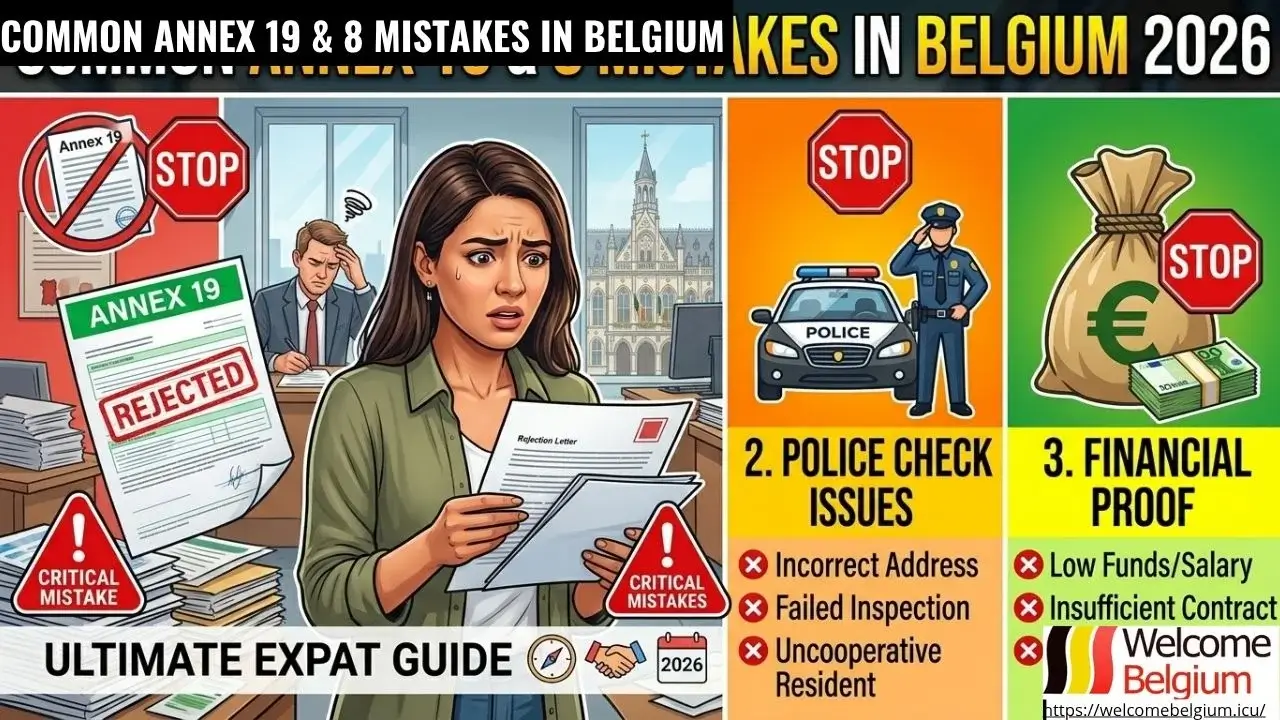
Based on multi-year statistics of inquiries and analysis of rejections on the Welcome Belgium platform, all typical applicant errors can be divided into three main categories:
- Submitting an unregistered lease agreement. Many sign a contract and immediately go to the administration. However, the commune strictly requires a contract registered with the tax authority (FPS Finance). If the property owner has not entered the document into the MyMinfin state database, commune officials will refuse to accept the document package on the very first visit.
- Absence of a last name on the mailbox and doorbell. This is the most massive reason for the cancellation of the procedure. If the neighborhood police officer comes for an inspection and does not find the applicant’s last name on the facade elements or mailbox, he will record that the immigrant does not reside at the address. The officer is not obligated to call your mobile phone or search for the applicant.
- Incorrect financial confirmations. Economically inactive citizens and students frequently provide simple printouts from online banking without official stamps, statements in foreign languages without a sworn translation, or amounts that do not cover the 2026 statutory minimum. In practice, failing to meet financial criteria is a frequent reason for an official rejection being issued on a case.
Analysis of a Model Precedent: How the Registration Procedure Breaks Down
In Belgium’s migration monitoring practice, the same administrative pattern is regularly recorded, giving rise to mass issues with the commune:
- Stage 1 (Submission). The applicant successfully books a slot online, provides the documents, and receives a temporary paper Annex 19 in hand. At this stage, it is mistakenly assumed that the process is finished.
- Stage 2 (Verification). Two weeks later, a neighborhood officer is dispatched to the address. The applicant at this moment is at their workplace in the office, and the mailbox still displays the data of the previous apartment tenant. The police officer leaves and files a report stating it was impossible to confirm the fact of residence.
- Stage 3 (Decision). Instead of a summons to pick up the permanent plastic card, the applicant is sent an official registration rejection. The Annex 19 certificate is canceled unilaterally, and a negative precedent is logged in the immigration office database. The entire procedure—from paying fees to gathering certificates—is launched from absolute zero.
Options for Solving Processing Issues
If you have already run into difficulties, the migration agency is delaying review (longer than the legal 6 months), or you have received an official notification about a shortage of data, act according to a strict algorithm:
- Request a written rejection. If you are rejected verbally during an appointment, politely ask for an official written rejection (refus) stating the specific article of the law or regulation. This will serve as the legal basis for future actions.
- Use the window to correct errors. In Belgian administrative law, there is always a legal timeframe allowed to eliminate shortcomings. If the problem lies in the contract or statement, redo them strictly according to the instructions and send them to the official email of the commune’s migration department, referencing your case number.
- File a pre-trial claim. If the commune violates deadlines or issues an unmotivated decision, a legal tool of protection is an official appeal to the Council of State (Conseil d’État). In practice, involving a specialized professional, such as a migration lawyer, and sending a correctly drafted pre-trial claim accelerates the work of officials several times over.
Tip:
Check your case status on your own without waiting for letters. If more than three weeks have passed since successful police visit and there is no news from the commune, do not wait for a paper notice in your mailbox.
Write a polite inquiry to the email address of the commune’s registration department (Service Population / Bureau des Étrangers). It frequently happens that the digital invitation to receive Annex 8 has already been generated, but the system encountered an error during transmission.
Core Changes in Commune Registration Rules in 2026
Belgian migration legislation has undergone a large-scale reform over the past year. The main vector of changes in 2026 is total digitalization combined with a sharp tightening of financial barriers and procedural requirements. While previously many administrative rough edges could be smoothed out during the process, in practice, the verification procedure has become significantly stricter regarding any inaccuracies in an applicant’s file.
The current administrative procedures are heavily influenced by recent structural updates in national law. The latest Belgium migration reform 2026 has completely reshaped the immigration landscape, introducing strict digital workflows and leaving zero room for incomplete paper applications.
Digitalization of Processes: 2026 Platforms
The transition to digital rails has become mandatory for all categories of immigrants. Instead of live queues and paper applications, Belgium has completely moved interaction with expats into the online space:
- “My Address in Belgium” service. A single state platform has been launched for primary registration and change of address. Now, notifying the commune of your arrival and uploading the core file for police address verification occurs electronically through this portal.
- Single platform “Working in Belgium”. The procedure for processing single work and residence permits (Single Permit) for employees from third countries is fully centralized on the state portal Working in Belgium. All stages—from submission by the employer to linkage with your commune—take place exclusively within the digital loop.
Tightened Checks and the Policy on Incomplete Applications
The key procedural change relates to the policy on reviewing cases by the Belgian Immigration Office (Office des Étrangers / Dienst Vreemdelingenzaken). In accordance with the updated regulation governing the procedure for accepting documents (within the framework of directives from the Federal Public Service Home Affairs—FPS Interior), the practice of “submitting missing certificates later” has been officially terminated.
The first visit rule:
Belgian legislation still provides a legal window to submit missing documents within the established three-month period after Annex 19 is issued. However, in practice in 2026, under directives from the Federal Public Service Home Affairs (FPS Interior), many communes aim to minimize paper bureaucracy and demand the most complete document package possible during the very first appointment.
If key substantiations of status (for instance, a registered lease agreement or an employment contract) are not provided within the window allocated by the agency, this will with a high degree of probability lead to an official refusal to recognize the right of residence and the cancellation of the case.
New Financial Requirements: 2026 Cost of Living
In accordance with annual indexing and new decrees from the minister for migration, Belgium has substantially raised the bar for the minimum income required for a legal stay.
- For foreign students. Starting from the 2026–2027 academic year, the minimum amount of net monetary funds (means of subsistence) for the approval of a student residence permit has risen to €1,062 per month. When using a blocked account for a year ahead, it is necessary to lock in no less than €12,744. Official requirements and current amounts are anchored on the visa portal of FPS Foreign Affairs and on the criteria page of the Office des Étrangers.
- For family reunification (Sponsorship). The threshold for regular net income for sponsors has increased to €2,323.10 net per month (with a step of +10% for each subsequent dependent). These norms and exact limits are regulated by Art. 40 of the Law on Foreigners on the Justel portal. Furthermore, an important differentiation has been introduced for Single Permit holders: a confirmed income of the main applicant at a level of no less than €5,000 gross per month allows family members to obtain visas for reunification in an accelerated automatic mode (ex officio) directly through the consulate. If the income is below this benchmark (but above the mandatory minimum of €2,323.10 net), the file is sent for standard review to Brussels, which can take more time.
For employment-based expats and their sponsors, income requirements extend beyond the basic cost of living. Make sure to review the official salary thresholds in Belgium 2026 required to secure and maintain a valid Single Permit or Blue Card status.
Pros and Cons of “Digital” Bureaucracy
The global transition of Belgium to digital platforms has brought immigrants an obvious plus—speed. Multi-hour queues in commune waiting rooms have vanished, and electronic notifications have cut the average time for primary document processing by 20–30%. Officials can no longer lose your physical file in the depths of the archives.
However, the flip side of this coin is an absolute loss of flexibility. The digital algorithm is stripped of the human factor. Previously, an individual commune employee could understand a situation, accept an incomplete package, and give you two weeks to obtain a certificate while issuing a temporary Annex.
Today, electronic algorithms do not allow you to complete the submission of a form if a correct PDF document of the established model is not attached to mandatory fields (such as “Registered Lease Agreement” or “Solvency Proof”). Relocating to Belgium in 2026 requires maximum attentiveness from the applicant when assembling a case even before sending an online application.
Frequently Asked Questions (FAQ) About Registration at the Commune in Belgium
Below are collected answers to the most vital questions foreigners face during the legalization process. This short directory from Welcome Belgium will help you protect your expat rights in Belgium and avoid critical blunders.
Is it possible to legally work in Belgium immediately after receiving Annex 19 / Annex 8?
Yes. The paper certificates Annex 19 and Annex 8 confirm that you have launched the registration process and are in the country legally. Working with an Annex 19 in Belgium is permitted in full from the very first day of issuance, provided that your core ground for immigration initially implies employment.
What should I do if the police came for an address check and I wasn't home?
Don't panic. If a police address check in Belgium falls through because of your absence, the officer will leave an official notice in your mailbox. You need to promptly contact him via the specified email/phone or personally appear at the local police station to coordinate a new time.
How long can you stay in Belgium without registering at the commune?
According to Art. 5 of the Law of December 15, 1980, third-country expats arriving on a long-term Visa D must declare their presence within 8 working days. For EU citizens planning long-term residence, the law provides a window of up to 3 months to submit an application (Annex 19).
Is it possible to travel around the EU while the commune reviews documents and I only have Annex 19 in hand?
No. By itself, Annex 19 does not replace a full residence permit and does not grant the right to free movement. For your trips to other countries within the Schengen Zone to be legal, you must have a valid international passport with a valid visa in your hands.
A successful relocation and legalization in Belgium in 2026 directly depend on your readiness to play by the strict rules of the digital era. Belgian bureaucracy has become noticeably faster thanks to online platforms, but it has completely shed its former flexibility. Every detail—from the correct amount in your account to the current nameplate on your mailbox—holds critical significance. Scrutinize your file before visiting the commune, make use of every practical tip, and then that coveted resident status will become merely a matter of time.
Sources Used
- Official state portal for processing single work permits: https://www.workinginbelgium.be/
- Legislative requirements of the Belgian Immigration Office (Office des Étrangers) regarding financial support for foreign citizens: https://dofi.ibz.be/en/themes/ressortissants-dun-pays-tiers/etudes/favoris/sufficient-means-subsistence
- Official visa instructions and regulations of the Federal Public Service Foreign Affairs of Belgium (FPS Foreign Affairs): https://diplomatie.belgium.be/
- Belgian Law of December 15, 1980, on the entry, stay, residence, and removal of foreigners (Loi sur l’accès au territoire, le séjour, l’établissement et l’éloignement des étrangers): https://www.ejustice.just.fgov.be/cgi_loi/change_lg.pl?language=fr&la=F&table_name=loi&cn=1980121530
Disclaimer
The information in this article is for informational purposes only and does not constitute official legal advice. Migration rules, financial limits, and administrative procedures in Belgium are subject to change. To obtain current data and verify an individual case, always refer to the primary sources—the official websites of the Belgian Immigration Office (Office des Étrangers) or certified specialized lawyers.