
Last Updated on June 5, 2026 by Alex
Last legal review of the material: June 2026. Article Expert: Alex, specialist in Belgian migration law (KU Leuven).
Hi! Alex here. I have personally gone through all the stages of legalization in Belgium, and my specialized education at the University of Leuven (KU Leuven) allows me to analyze local migration law at the source level. My goal is to translate the kingdom’s complex administrative regulations into clear and practically applicable algorithms.
Obtaining a residence permit in Belgium requires strict compliance with the current rules of the Immigration Office (Office des Étrangers). This guide compiles official requirements, the practical process of interacting with the commune (commune / gemeente), and a step-by-step plan to help you obtain legal resident status and avoid common mistakes.
How to Obtain a Residence Permit in Belgium: Main Grounds for Immigration
When it comes to obtaining a residence permit, it is first necessary to draw a clear line between applicants. The kingdom’s migration legislation divides all immigrants into two fundamental categories, each with its own grounds for relocation and its own legal pathway:
- EU Citizens (as well as EEA and Switzerland): A simplified immigration track applies to them. Having the right to free movement, they are exempt from the need to obtain entry visas. Their legalization is advisory in nature and occurs directly through registration with the municipal administration at their place of residence.
- Third-Country Nationals (countries outside the EU, including the CIS): For this category, the process is strictly regulated. To obtain a residence permit, you must first confirm a legal ground to the migration authorities, obtain a national Category D visa in your country of origin, and only then request a resident card.
Below is the official regulatory framework governing these processes. The analysis of migration processes in this guide relies exclusively on primary sources:
Official Legislative Framework:
| Number and Date of the Regulatory Act | Official Name of the Law | Link to the Primary Source |
Law of December 15, 1980 | Law on access to the territory, residence, establishment, and removal of foreigners (Loi sur l’accès au territoire, le séjour, l’établissement et l’éloignement des étrangers) | |
Royal Decree of October 8, 1981 | Royal Decree on access to the territory, residence, establishment, and removal of foreigners (Arrêté royal sur l’accès au territoire, le séjour, l’établissement et l’éloignement des étrangers) |
To qualify for a work-based residence permit, your employment contract must meet the strict financial criteria set by regional authorities. Make sure to review the updated salary thresholds in Belgium in 2026 to confirm your compensation complies with the latest regulations.
For third-country nationals, the basic Law of 15.12.1980 highlights three main legal directions:
- Professional Immigration: This includes work visas for employed staff (highly qualified specialists applying for a Blue Card), as well as tracks for independent entrepreneurs and startup founders.
- Education: Foreign students enrolled in recognized Belgian universities or higher schools are entitled to temporary resident status for the duration of their studies.
- Family Reunification: Close relatives (spouses, minor children) of individuals already legally residing in Belgium have the right to obtain status.
Legal Case Study: The Nuances of Changing Status from Study to Work
In the practice of legal support for third-country graduates of Belgian universities, conflicts often arise when changing residence status. A typical precedent: a Master’s graduate from KU Leuven finds an employer in the Brussels Region.
Common Mistake: Attempting to apply directly for a standard work card while remaining in a state of administrative limbo.
To solve the problem, the transitional “search year” status was activated in a timely manner, which allowed the graduate to legally wait for the Blue Card processing inside the country, without leaving Belgium to reapply for documents.
Practical Recommendation:
If you are graduating from a Belgian university, never delay transitioning to the “search year” status. The application for this transitional year must be submitted before your current student Card A expires.
This maintains continuous legality in the databases of the Office des Étrangers and allows the new employer to process your work card without additional delays and fines for the company.
Types of Residence Permits in Belgium and Varieties of ID Cards
Below is a summary table describing the key types of residence permits in Belgium most frequently issued to foreigners. It is compiled based on the current regulations of the country’s State Registration Portal and contains links to official departments.
Summary Table of Belgian ID Cards:
| Card Type | Issued To | Validity Period | Right to Work | Official Source |
Card A (Séjour temporaire) | Third-country nationals (work, study, reunification) | Usually 1 year (with the right to annual renewal) | Limited (according to visa/contract conditions) | |
Card EU (Former Card E) | European Union citizens (EU/EEA) | 5 years | Full (without additional permits) | |
Card EU+ (Former Card E+) | EU citizens after 5 years of continuous residence | Permanent (plastic card renewed every 10 years) | Full | |
Card H (Blue Card) | Highly qualified specialists from third countries | Up to 4 years (or for the duration of the contract + 3 months) | Full, but tied to a specific sector |
Belgium Type A Residence Permit: The Expat’s Main Document
For most citizens from non-EU countries, Type A is the first official status they receive. Legally, it is classified as a limited-term residence permit. This residence document is a high-tech plastic card with an embedded electronic chip.
When studying the structure of this card, it is important to pay attention to the following elements:
- Front side: Contains a photograph, personal data, personal identification number, and the exact validity period of the document.
- Back side: Indicates the type of migration track (e.g., “Student” or “Employee”) and a note on access to the labor market (Accès au marché du travail. Limité / Illimité).
The fundamental element of the card is the personal identification number from the National Register of Natural Persons (Rijksregisternummer / Numéro de registre national). It consists of 11 digits, where the first six represent the owner’s date of birth in reverse order. Without this number, it is impossible to open a bank account, arrange health insurance, rent accommodation, or file a tax return.
Since this type of residence permit has a limited validity period, it is necessary to initiate the renewal procedure at the local commune 30–45 days before the expiration date. When submitting documents for renewal, the commune issues a temporary document (Annex 15), which confirms your legal stay in the country while the new plastic card is being manufactured.
It is important to remember that Card A is strictly tied to the purpose of your stay. If it is work, in the event of early termination of the contract, the foreigner does not lose their status instantly. According to the current version of Art. 61/7 of the Law of 15.12.1980 (taking into account the latest reforms of the Single Permit and Blue Card directives), the period allowed to search for a new employer is strictly differentiated.
It ranges from 90 to 180 days, depending on the total length of service in Belgium and the specific type of ID card. During this adaptation period, a foreigner has the right to legally reside in the country and re-register documents through the regional ministry of employment.
Card EU: Residency for Citizens of the European Union
Citizens of EU member states who come to Belgium for work, study, or as financially independent individuals receive a Type EU card. This document confirms their right to free residence under European law.
The procedure for obtaining this card begins with filing an application at the commune (requesting an Annex 19 application). Following this, the applicant is granted a temporary Belgian resident ID card valid for 5 months (Annex 21), during which the commune conducts a residential address check and verifies the documents.
The main legal grounds for processing an EU card are:
- Employment: A valid employment contract with a Belgian or international employer (Contrat de travail).
- Independent Economic Activity: Registering as a freelancer or opening your own company in the country.
- Education: Official enrollment in a recognized educational institution of the kingdom, provided you have health insurance and sufficient financial resources.
- Financial Independence: Proof of a stable passive income or personal savings that allow you not to burden the local social assistance system.
Following a successful check, the commune issues a permanent plastic Card EU valid for 5 years. It grants the full right to employment and conducting business on equal terms with Belgian citizens, without the need to obtain additional work permits.
Card EU+: EU Permanent Resident Status
After 5 years of continuous residence on an EU card, citizens of the Union can apply for permanent resident status (droit de séjour permanent) and a Card EU+. The document is open-ended (the plastic card is changed once every 10 years) and provides important legal advantages:
- Economic Freedom: There is no longer a need to confirm employment, business, or income to the commune when updating documents.
- Prolonged Absence: Status is maintained even if the resident temporarily leaves Belgium for a continuous period of up to two years.
- Prerequisites for Naturalization: The EU+ card officially confirms the 5-year residency requirement for obtaining a Belgian passport. To process this at the commune, proofs of residence are provided (tax returns, registry extracts, utility bills).
Card H: European Blue Card
The Type H card (European Blue Card) is targeted at highly qualified specialists from third countries with strict criteria regarding higher education and annual salary levels. Unlike the standard working Card A, the Blue Card offers expanded rights and mobility:
- Free Labor Market: After 24 months of work, a specialist can change employers without processing a new permit through the regional ministry of employment.
- European Mobility: After 18 months of residence in Belgium, the holder of a Card H has the right to move to another EU country under a simplified procedure for qualified personnel.
Important:
Having a Type A card imposes an obligation on you to inform the commune of any changes in your life. In the event of a change in life circumstances (change of employer, relocation, divorce), a resident is obliged to notify the municipal authorities within 8 working days (according to Art. 42 of the Royal Decree of 08.10.1981 and regulations on the IBZ portal).
Violation of this requirement is recorded as an administrative offense against population registration rules. Failure to timely notify the authorities can lead to serious administrative consequences. This includes forced deregistration from the address (police reports), fines at the municipal level, as well as critical problems during subsequent residence permit renewals at the Office des Étrangers.
The Process of Obtaining a Residence Permit in Belgium: A Step-by-Step Algorithm
The entire process of obtaining a residence permit in Belgium for third-country nationals is a strictly structured timeline. For your residence paperwork to be successful, you must go through four consecutive stages of the administrative process—from working with a diplomatic mission to integration into the local municipality’s database.
Step 1: Obtaining a National Category D Visa
- Where to go: Document submission is carried out in your country of origin—through an accredited visa application center (e.g., VFS Global) or directly to the consular section of the Embassy of Belgium. You cannot arrive on a Schengen tourist visa and request residency on-site.
- Cost: The consular fee for a Visa D is €180. Additionally, the visa center service fee is paid (around €30–40). Also, for most third-country applicants, a mandatory administrative fee of the Belgian Migration Service (Redevance) is required, which, depending on the grounds (work, study), ranges from €140 to €425.
- Timeline: Processing times depend heavily on the grounds for application. Student visas and visas for highly qualified specialists (Single Permit) are usually issued in 2–6 weeks. In complex cases or for family reunification, the process can take from 3 to 9 months, as documents are sent to Brussels for approval.
The outcome of this stage is a national Visa D stamped into your passport. It gives you the right to enter the kingdom and reside legally while the local administration reviews your primary case.
Step 2: Primary Registration in the Commune
- Where to go: The first steps upon arrival in Belgium are strictly regulated by law. You have exactly 8 working days from the moment you cross the border to appear at the local municipality (Administration communale / Gemeentehuis) at your place of actual long-term residence.
- Timeline: A visit to the commune most frequently requires a preliminary online appointment on the municipality’s official website. Sometimes you have to wait 3 to 10 days for an open slot, so it is recommended to book a slot even before flying to Belgium.
You must provide a passport with a Visa D, a long-term lease agreement, and photographs. Commune staff will enter your data into a preliminary register of foreigners and initiate a chain of internal administrative checks.
Step 3: Visit from the District Police Officer (Wijkagent / Agent de quartier)
- Where to go: You do not need to go anywhere—this stage is entirely remote. Information from the commune is automatically transmitted to the local police station at your place of registration.
- Timeline: The official address verification takes from 1 to 3 weeks from the day of your visit to the commune. A local police officer conducts a personal inspection at the specified address without prior notice (based on Art. 7 of the Law of 19.07.1991 on the structures of public registers and instructions of the Ministry of Internal Affairs of Belgium).
The purpose of the visit is to physically verify that you actually live in this apartment, and that a plate with your surname is installed on the mailbox and doorbell. The officer verifies the fact of your real residence at the specified address and compiles a corresponding report for the commune.
Step 4: Issuance of Temporary Permit and Printing of the Plastic Card
- Where to go: After a successful police visit, you will receive a notification (by email or paper letter) inviting you to revisit the commune to apply for the residence permit (the final ordering of the plastic card).
- Cost: The cost of issuing a standard electronic ID card (Card A or H) is around €25–35 (the exact amount depends on the tariffs of the specific commune). If the document is needed urgently, you can order expedited manufacturing in 2–3 days, but the price will rise to approximately €120–150.
- Timeline: On the day of payment, you submit your biometric data. Approval from the Office des Étrangers and the physical printing of the plastic take 2 to 4 weeks. For this period, the commune issues a temporary paper certificate (Annex 15), which replaces the ID card inside the country.
After about 15–20 days, PIN/PUK codes will arrive at your postal address. With them and the paper Annex 15, you come to the town hall one last time to activate the chip and pick up your finished plastic Card A or H.
Possible Problems, Complications, and How to Solve Them
Even with perfect document preparation, the administrative process in Belgium can go off script. Below are the main risks that immigrants face, along with practical methods to tackle them.
Extended Review Times and Delayed Address Inspection
- Problem: You submitted documents to the commune, but the police officer hasn’t come for over a month. During this time, you cannot fully use banking services or order your plastic card.
- Reason: High workload at the specific police station (especially in large cities like Brussels or Antwerp at the start of the academic year in September), or the officer came when you weren’t home.
- Solution: Do not wait passively. Find the contact details of the local police station (commissariat) online by zip code. Write to or call your Wijkagent / Agent de quartier directly. Explain the situation and politely arrange an approximate time for a visit.
Risk of Registration Refusal Due to Non-Compliance of Housing
- Problem: The police officer came, inspected the apartment, but the commune sent an official refusal of registration.
- Reason: Strict housing sanitary standards operate in Belgium (Code du Logement). If a studio is too small for two people or lacks proper heating/ventilation, the police will record “overcrowding” or unsuitability of the housing. A refusal will also be received if there is a direct prohibition by the owner on registration (Domiciliation) in the lease agreement (Bail).
- Solution: When searching for housing, always clarify with the landlord in writing: “Est-ce possible de mettre la domiciliation ici?”. If a refusal has already been received, you will have to urgently search for new housing, sign a new contract, and resubmit a registration application to the commune.
Direct Refusal to Issue or Renew a Card by the Office des Étrangers
- Problem: The migration service issues a negative decision on your case and sends a refusal to renew your current status.
- Reason: Failure to meet residence conditions. For students, this could be academic failure (insufficient number of ECTS credits passed); for workers, income falling below the legally established minimum or dismissal; for family tracks, suspicion of a sham marriage or a lack of legal income from the sponsor.
- Solution: You have exactly 30 days to formally appeal the decision to the Council for Alien Law Litigation (CCE — Conseil du Contentieux des Étrangers). For this period, deportation is suspended, and you remain in the country legally. In such a situation, it is necessary to immediately involve a specialized Belgian migration lawyer.
Legal Case Study: The Multilingual Traps of Belgian Communes
Administrative practice in Flanders and Wallonia differs significantly at the level of sub-laws, which often creates language traps for expats.
In the practice of analyzing lease agreements (Bail / Huurcontract), cases of legal disputes at the border of regions have been recorded. For example, when renting housing on the border of the Brussels Capital Region and Flanders.
The local commune issued a refusal for primary registration due to an incorrectly formatted language annex to the lease agreement. We managed to contest this decision at the municipal level simply by providing the correct legal interpretation of the rule in Dutch.
Practical Recommendation:
Always check in advance which language official workflow is conducted in your specific commune; the rules of the game here are strict. In Flanders, they fundamentally will not speak French with you, and in Wallonia, they will not speak Dutch.
If you do not speak the regional language at a basic level, be sure to bring a translator or a local French-/Dutch-speaking acquaintance with you to submit documents. This will save you from ambiguous interpretations and speed up the administrative process.
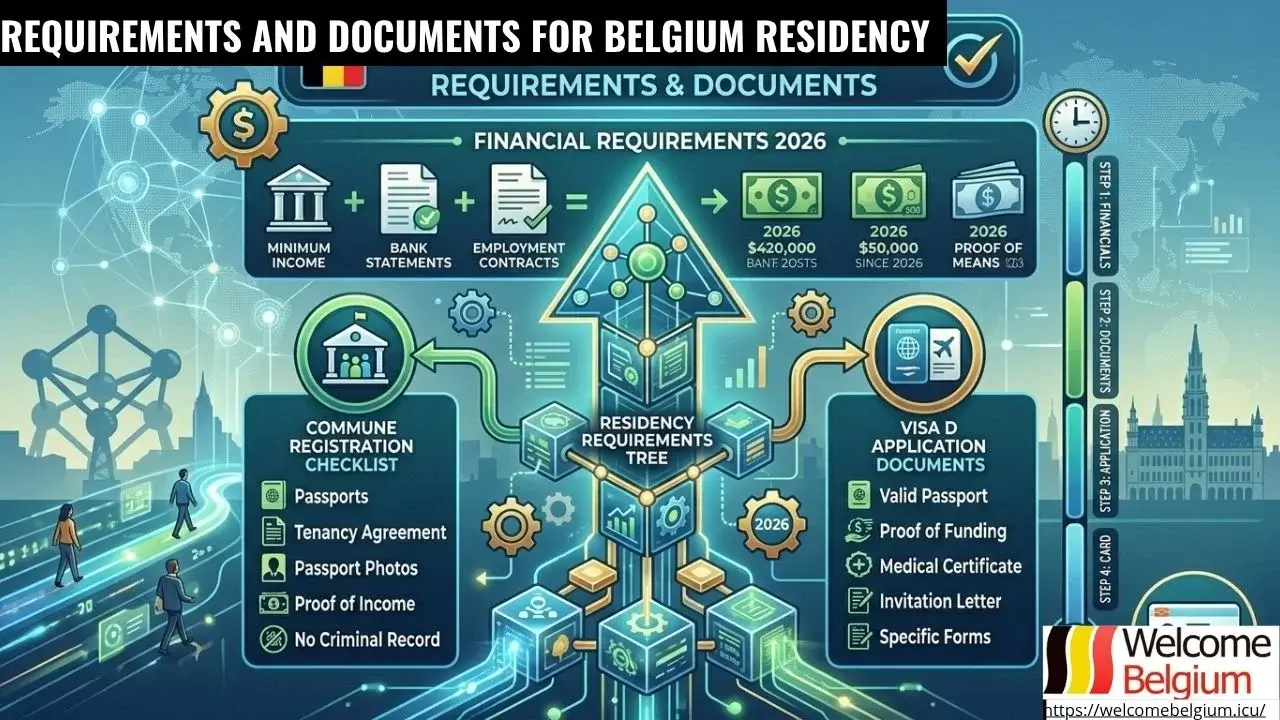
Requirements for Obtaining a Residence Permit in Belgium and the Required Package of Documents
The Immigration Office (Office des Étrangers) evaluates each applicant according to strict criteria. To understand how to process residency in Belgium, you need to collect a package of official certificates confirming your good standing, social integration, and complete financial capability.
Once your residency is approved and you register at the local commune, joining a health insurance fund (mutuelle) becomes your immediate priority. Standard health insurance in Belgium is compulsory for all foreign residents to access subsidized healthcare services.
Below, the basic blocks of documents and criteria are broken down in detail, without compliance to which it is impossible to get approval.
Personal Reliability and Legalization of Documents
Every adult third-country national is obliged to confirm the absence of problems with the law.
- Certificate of Good Conduct / No Criminal Record: The document must cover at least the last 6 months of residence.
- Apostille and Translation of Documents: The criminal record certificate, birth, or marriage certificates are subject to mandatory apostilling in the country of issuance. Following this, a certified translation of the documents into one of the official languages of Belgium (Dutch, French, or German) is performed. If the translation is done outside the country, it must also be certified.
Financial Independence Criterion and Cost of Living
The authorities of the kingdom strictly monitor that foreigners do not become a burden on the local social system. Requirements for your income depend on the chosen immigration track.
- Foreign Students
To process a student residence permit, it is necessary to prove the availability of sufficient means of subsistence. For the academic year 2026–2027, this cost of living is fixed at €1,062 net per month.
The most reliable confirmation method is the blocked account system (Blocked Account). The student transfers the entire amount for the year ahead (around €12,700) to a special account of the Belgian university, and the university pays them €1,062 monthly for current expenses.
- Professional Immigration (Employees)
For specialists from third countries, regional salary thresholds are established. For 2026, the following minimum gross income requirements apply:
- Brussels Capital Region: For highly qualified specialists, the minimum threshold is €3,703.44 gross per month; for European Blue Card holders (Card H), it is €4,748.00 gross per month.
- Flanders: The annual threshold for qualified personnel is €48,912.00 gross; for young specialists under 30, it is €39,129.60 gross; and for the Blue Card, it is €63,586.00 gross.
- Wallonia: A highly qualified employee must earn from €53,220.00 gross per year, and a specialist with a Blue Card from €68,815.00 gross per year.
Infrastructure Integration: Housing and Medicine
In addition to income, the final package of documents for a residence permit necessarily includes local service agreements.
- Lease Agreement: You are required to provide an officially registered long-term lease agreement (Bail / Huurcontract). The housing must comply with regional sanitary standards and be suitable for permanent registration at the address (Domiciliation).
- Health Insurance: Immediately after registering with the commune and receiving temporary documents, an expat is obliged to register with a local health insurance fund—Mutuelle / Ziekenfonds. This insurance covers a significant part of the costs for medical services in accordance with the current tariffs of INAMI/RIZIV, hospitalization, and the purchase of prescription drugs. At the document submission stage at the consulate, a standard international policy is accepted, but inside the country, the presence of local insurance is verified strictly.
Legal Case Study: Verifying the Financial Criterion for Family Members
When analyzing Belgian regulatory acts, it is important to pay attention to the dynamics of changes in minimum income thresholds. For example, in May 2026, as part of an audit of migration forms on the Office des Étrangers website, new requirements for sponsors were recorded.
Holding a temporary residence card tied to your employment means that career changes involve specific legal procedures. Read our detailed guide on how to safely change jobs in Belgium with a single permit without jeopardizing your legal status.
Right around this time, during a review of inquiries through a blog feedback form, a critical mistake was successfully prevented: one of the applicants was calculating the net profit amount for family reunification using old, no longer relevant limits.
In conducting administrative cases for family reunification, a common reason for refusals is the use of outdated regulatory limits. In particular, there have been cases where applicants calculated the net profit amount without taking into account current requirements.
We adjusted the document package in time, adding statements under the special SRR tax regime, which proved sufficient financial independence to the migration officials.
Important:
If you are confirming income through sponsorship or a family track, remember that for family reunification with a third-country national, the sponsor must show a stable income equal to at least 120% of the guaranteed minimum income in Belgium. In 2026, this threshold exceeds €2,400 net per month.
At the same time, unemployment benefits or social assistance are not counted in this calculation, but legal income from a business under special tax regimes is fully taken into account if properly declared.
Advantages of Belgian Residency and Prospects for Moving for Permanent Residence
Before proceeding to a detailed breakdown of rights and obligations, it is important to note that all these norms are strictly regulated by Belgian legislation. The main regulatory acts in this area are the Law of December 15, 1980, which regulates the rules of entry, residence, and removal of foreign citizens, and the Royal Decree of October 8, 1981, which supplements it. It is these documents that determine the legal status of each expat in the kingdom.
Below is a summary table describing the key rights and legal obligations of Belgian residence permit holders, based on the provisions of these laws.
Summary Table of Resident Rights and Obligations
| Rights of the Resident | Obligations of the Resident |
Freedom of movement: Visa-free entry to all countries belonging to the Schengen Area (up to 90 days out of every 180). | Legal residence: Mandatory registration at the place of actual residence (Domiciliation) within 8 days after entry. |
Access to the labor market: The right to legal employment or conducting business (according to the conditions of your migration card). | Timely renewal: Submitting documents to extend status strictly 30–45 days before the card’s expiration date. |
European medicine: Access to the healthcare system through mandatory insurance (Mutuelle) with compensation for a significant part of medical expenses. | Informing authorities: Notifying the commune of a change of address, employer, or marital status within 8 working days. |
Social guarantees: Protection of employee rights, right to benefits (subject to tax conditions), and family allowances. | Financial capability: Annual confirmation of income not lower than the cost of living established by legislation. |
Plan for the future: Opportunity to apply for long-term European status (PR) and citizenship after 5 years of continuous service. | Payment of taxes: Timely declaration of worldwide income and payment of income tax on the territory of Belgium. |
What Belgian Resident Status Offers
Belgian residence permit holders gain access to the key benefits of European infrastructure. European status allows minimizing bureaucracy during travel, and also grants the right to use the kingdom’s developed social system on equal terms with local citizens.
Processing local insurance (Mutuelle) guarantees you and your family members access to one of the best healthcare systems in the world with compensation for treatment costs, hospitalization, and prescription drug purchases. In addition, long-term residents gain the right to purchase real estate at standard European mortgage rates.
The Road to Permanent Residency
Any temporary validity period of a residence permit in Belgium (for example, an annually renewed Card A) is only the first stage of immigration. The ultimate goal for most expats is a full relocation to the country for permanent residence, meaning obtaining permanent resident status.
The kingdom’s legislation establishes the following rules for transitioning to open-ended status:
- Residency Requirement: You must live continuously and legally in Belgium for 5 years. Short-term trips for holidays or business trips are allowed, but a prolonged absence can reset this period.
- Economic Integration: The applicant is obliged to prove that they regularly paid taxes and did not depend on the social security system.
- Language and Social Integration: As a rule, official proof of language and social integration is required (for example, completing the civic integration course Inburgering), which in practice most often corresponds to a language proficiency level of not lower than A2. Requirements may differ in detail depending on the region of residence (Flanders, Wallonia, Brussels) and the specific type of status requested.
Fulfilling these conditions allows you to change a temporary residence permit to a long-term permanent resident card (for example, Card B, C, or D depending on the initial track), which virtually equates your rights to local citizens and opens a direct path to obtaining Belgian citizenship.
Legal Case Study: Confirming the Continuity of Service
Within the procedures for confirming the residency requirement, cases of excluding individual periods of residence from total service are recorded, since the counting of student years strictly depends on the requested status (national permanent residence, EU long-term resident status, or citizenship).
In this precedent, we successfully secured the residency requirement and changed status without leaving the country through the correct combination and audit of work periods under a Single Permit and a Blue Card.
Practical Recommendation:
If your goal is permanent residence and citizenship, start collecting language certificates and integration course diplomas from your very first year of life in Belgium. The five-year milestone will arrive quickly, and queues for language tests in communes and certified centers (such as Atlas or Integration Flandre) can be booked up for months in advance.
Having a ready language portfolio by the time your card expires will save you a massive amount of time and nerves.
Log of Data Update and Verification
Update History:
- June 2026 — Regional salary thresholds updated for the Blue Card and standard residence permits.
- June 2026 — Financial requirements for student blocked accounts updated for the academic year 2026–2027.
- June 2026 — Comprehensive check and replacement of primary source links performed in the Justel database.
Information Verification Methodology
In preparing and verifying this material, exclusively official sources were used:
- Original texts of laws and royal decrees in the Belgian legal search engine Justel / Moniteur Belge.
- Current directives and circulars of the State Immigration Office (Office des Étrangers).
- Official administrative regulations of Belgian municipal communes.
- Regulations and tariff grids of regional employment services (Brussels, Flanders, Wallonia).
Frequently Asked Questions About Residence Permits in Belgium (FAQ)
The process takes from 2 to 5 months. The timeframe depends on the grounds for immigration and how quickly the district police officer (Wijkagent) verifies your address after registration at the commune.
You can, provided your national Visa D is still valid. If the visa has expired and you only have a temporary certificate on hand (Annex 15), you cannot leave Belgium—other Schengen countries do not recognize it.
For the first Card A, language knowledge is not required. However, during renewal, the migration service will check your integration steps (Effort d'intégration), and for permanent residence, level A2 is required.
Yes. Status is revoked if the grounds for its issuance have disappeared (dismissal, expulsion from university), fraud has been revealed, or you were absent from the country longer than permitted.
The officer will leave a note in the mailbox with their contacts. You need to immediately contact them by phone or email and arrange a new visit time to avoid a refusal of registration.
Yes, Belgian legislation allows transitioning from a student Card A to a work card (Single Permit) or a Blue Card (Card H) inside the country, provided you sign a contract before your current permit expires.How long does it take to process a residence permit in Belgium?
Is it possible to travel around Europe while waiting for the residence permit card?
Is it mandatory to know the language to get the first residence permit card?
Can an already issued residence permit be revoked?
What should I do if the police came to check the address and I wasn't home?
Can I change status (e.g., from student to work) without leaving Belgium?
Obtaining Belgian residency is a strictly regulated process that requires an expat to have flawless precision in preparing documents and to strictly adhere to local administrative rules. A temporary residence permit (Card A) is merely a starting point. Successful completion of all stages, from the police visit to the annual confirmation of financial independence and language integration, guarantees legal status and opens a direct path to open-ended permanent residence and Belgian citizenship in five years.
List of Sources
- Official Portal of the Belgian Immigration Office (Office des Étrangers): https://dofi.ibz.be/
- State Information Portal of Belgium (Federal Public Service): https://www.belgium.be/
- Official Text of the Law of December 15, 1980 on the state legal portal Justel: https://www.ejustice.just.fgov.be/eli/loi/1980/12/15/1980121550/justel
- Official Text of the Royal Decree of October 8, 1981 on the Justel portal: https://www.ejustice.just.fgov.be/eli/arrete/1981/10/08/1981001949/justel
- Portal of the Employment and Integration Service of Flanders (Vlaanderen): https://www.vlaanderen.be/
Disclaimer
The information in this article is provided solely for informational purposes and does not constitute professional legal advice. Belgian migration legislation, financial thresholds, and administrative requirements are subject to change. To obtain current data for your specific case, always refer to the official resources of the Office des Étrangers or certified Belgian migration lawyers.