
Last Updated on May 19, 2026 by Alex
Welcome! This is Alex, your resident expert at welcomebelgium.icu. Relocating to the Kingdom involves navigating complex bureaucracy and a distinct adaptation period. To successfully settle down, living in Belgium requires a clear understanding of its unique regional structure. The country is divided by a strict linguistic border and local regional autonomy, which directly shapes the daily lives of foreign professionals in Belgium.
When deciding where to live in Belgium, it is crucial to evaluate the economic landscape of each territory. The prosperous region of Flanders offers higher average salaries but mandates cultural and linguistic integration (Inburgering) in Dutch. On the other hand, French-speaking Wallonia attracts newcomers with more affordable rental housing, though it generally offers fewer job vacancies.
If you are evaluating Belgian regions for living without knowing the local languages, the Brussels-Capital Region is your best option. This international hub is ideal for career opportunities, although the cost of living in Brussels for expats is significantly higher.
Registering at the Municipality in Belgium: A Step-by-Step Guide to Obtaining Your National Number and Residence Card
Your first few days after immigrating are the most critical. Legally living in Belgium doesn’t start with unpacking your bags—it begins with a visit to the local town hall. The foundational framework governing this process is the Belgian Aliens Act of December 15, 1980 (Loi du 15 décembre 1980 sur l’accès au territoire, le séjour, l’établissement et l’éloignement des étrangers).
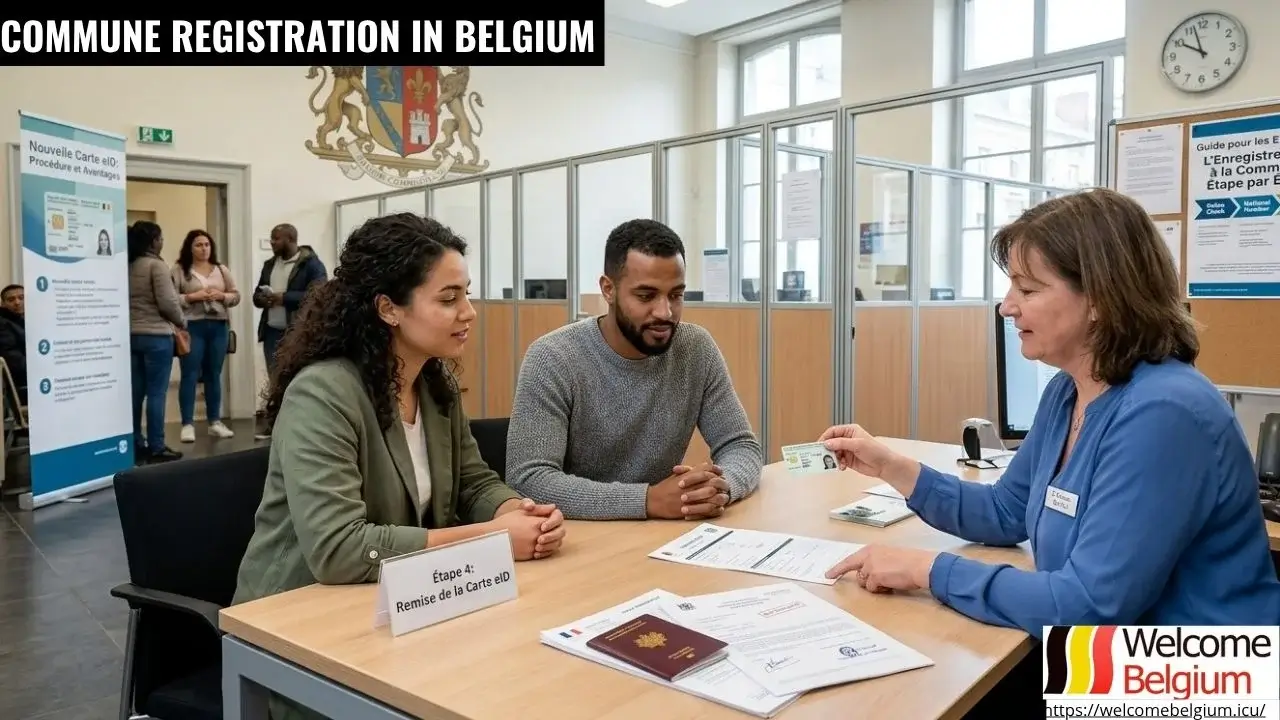
According to this law, every newly arrived expat must formally notify the local authorities of their place of residence. Without completing this mandatory procedure, you will not be able to access public services, open a Belgian bank account, or sign up for health insurance.
The registration and documentation process is broken down into four consecutive steps, each requiring absolute precision:
- Step 1: Booking an Appointment (Town Hall). Immediately upon arrival, you must submit an application to your local municipality (Maison Communale / Gemeentehuis). This must be done strictly within 8 working days of entering the country. I highly recommend booking an appointment slot online via the official portal of your specific city or commune. You can double-check the general up-to-date rules and official authority contacts on the government portal be.
- Step 2: Submitting Documents. For your meeting with the municipal officer, you are required to bring your passport with a valid Visa D, the original copy of your long-term lease agreement, and proof of your legal status (such as an employment contract). If your documents are in order, you will be issued a temporary document covering your legal stay.
- Step 3: Police Address Check in Belgium. This is a highly specific feature of Belgian bureaucracy. Within three weeks of submitting your documents, a local neighborhood police officer (Agent de quartier / Wijkinspecteur) will visit your home unannounced. Their role is to verify that you actually reside there: they will check for personal belongings and ensure your name is listed on the mailbox.
- Step 4: Issuance of the eID. Once the police submit a positive report to the municipality, you will receive an official letter in the mail containing your PIN/PUK codes. After receiving this, you can pick up your finalized electronic identity card.
Successfully completing this process means you have been assigned a personal National Number (Numéro National) and issued a physical Belgian residence card (electronic eID card). You are now fully integrated into the state system.
Alex’s Expert Tip:
Do not attempt to “outsmart” the system during the police address check. If you provide a fake address or if the officer misses you three times at home, the municipality will cancel your entire application process. If you work full-time at an office, leave a polite note on your door with your phone number for the neighborhood cop—in most cases, they appreciate the communication and will contact you to schedule a specific visit time.
Long-Term Housing Rentals in Belgium: How to Rent an Apartment in Brussels and Secure Your Deposit
Finding property is one of the most challenging stages of relocation. The market is highly competitive, which means that securing a rental property in Belgium requires not only financial investment but also solid legal awareness.
Below is a detailed breakdown of how the entire process works, from property hunting to regional legal differences.
Property Hunting (Websites, Organizations, and Government Agencies)
The vast majority of long-term housing in the country is listed through specialized online platforms and real estate agencies (Agences immobilières).
- Top Real Estate Portals in Belgium (Aggregators):
- Social Networks and Community Groups: For finding rooms, studios, or flatshares (Colocation), Facebook is widely used (search for groups using terms like “Bouche à oreille” or «Bruxelles à louer»). Be careful: the risk of encountering rental scams here is remarkably high.
- Official Legal Consultations: If you face legal difficulties while renting, free assistance is available from dedicated public services. In Wallonia, you can contact the Info-Conseils Logement department, while general legal aid across the country is provided by regional branches of Droits Quotidiens.
Alex’s Tip: Independent house hunting through aggregators requires lightning-fast reactions. To maximize your chances of success, prepare a structured digital “rental dossier” (dossier de location) containing your employment contract and recent bank statements so you can send it to the landlord immediately after the viewing.
Financial Guarantees and Property Inspections
Belgian law strictly protects the rights of both parties, meaning that “under-the-table” cash handovers are legally out of the question.
- Rental Deposits in Belgium (Garantie locative): The deposit amount typically equals 2 or 3 months’ rent, depending on the region. Remember: never hand over cash directly to a landlord. The funds must be transferred to a dedicated, locked bank account (Compte bloqué) opened in your name.
- Release Conditions: The deposit is frozen by the bank; neither you nor the landlord can withdraw it unilaterally. The funds are released only after both parties sign a lease termination agreement or via a ruling by a local Justice of the Peace (Juge de paix / Vrederechter).
- Inbound and Outbound Inspections (État des lieux / Plaatsbeschrijving): This is a mandatory legal document describing the condition of every single square centimeter of the property before you move in.
- Conducting the Inspection: Usually, a certified independent expert is hired, and the cost is split 50/50 between the tenant and the landlord. The document details all existing defects, cracks, and meter readings. A second inspection is carried out when you move out.
Real-Life Error: The “Verbal Agreement” Case
Nikita moved to Brussels and rented a studio. Upon moving in, the landlord promised: “The stains on the parquet and the crack in the bathroom tiles are old defects, I know about them, it’s totally fine.” To save €150, they skipped the formal inspection. Two years later, Nikita decided to move out. The landlord hired an expert for the outbound inspection, who flagged those specific damages as new. As a result, €1,200 was deducted from Nikita’s deposit for parquet sanding and tile replacement.
Alex’s Verdict:
If you are planning a long-term rental property in Belgium, never take a landlord’s word for it. If a defect isn’t written down in the move-in inspection report, you are legally responsible for it.
Regional Differences Across Belgium
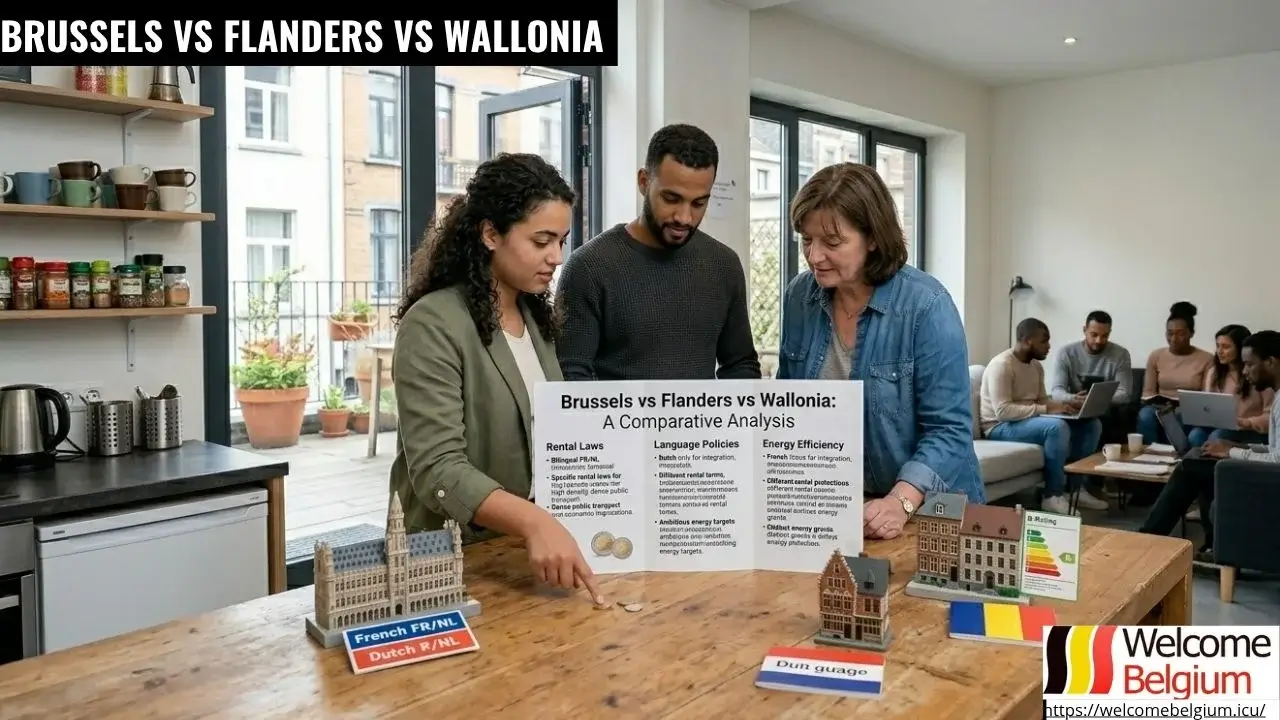
Following the sweeping regionalization of housing laws, rental regulations are now governed by local regional decrees, meaning that rules vary across the country.
- Brussels-Capital Region: Demand is astronomical, and the market is cutthroat. To secure an apartment in Brussels, you must pass a competitive screening process by providing a comprehensive rental dossier (passport, work contract, bank statements). It operates under the updated Code bruxellois du Logement, which legally obliges landlords to return the deposit within 2 months of move-out—failing to do so triggers a mandatory fine of 10% of the monthly rent for each month of delay.
- Flanders: Here, rentals are regulated by the Vlaams Woninghuurdecreet Flanders permits landlords to request a deposit of up to exactly 3 months’ rent on a locked account. Furthermore, energy efficiency standards (EPC/PEB certificate) are strictly enforced. If a property has a poor energy rating, the landlord’s legal right to apply annual rent indexation (increases) is heavily restricted.
- Wallonia: Landlord-tenant relationships are governed by the Walloon Decree of March 15, 2018, on Residential Leases. Deposits on a locked bank account are capped at a maximum of 2 months’ rent (or 3 months if secured via a bank guarantee). While Wallonia offers more affordable property prices, administrative circulars dictate that small apartments (under 28 m²) and studios require a landlord to hold a specific state-issued letting permit (Permis de location).
Critical Takeaways
Because of regional variations, always verify which specific housing decree is stated in the lease header. Selecting the wrong contract type or miscalculating the maximum deposit size can serve as major grounds for contesting the agreement in court.
The standard Belgian lease—known as a 3-6-9 contract—is signed for a duration of 9 years. You are free to move out earlier, but if you break the lease during the first year, you must pay a penalty equal to 3 months’ rent; breaking it in the second-year costs 2 months’ rent, and in the third year, 1 month’s rent.
Always make sure the landlord registers the lease in the federal tax system (MyRent) within 2 months of signing. If they fail to do so, the law grants you the right to leave without giving the standard 3-month notice and without paying any early termination penalties.
Cost of Living in Belgium in 2026: Grocery Prices, Utility Bills, and Estimated Monthly Budget
When planning your monthly budget, it is crucial to understand the actual structure of expenses in the country. Living in Belgium is consistently ranked among the most expensive experiences in Europe, with the primary financial burden distributed between housing rentals, taxes, and utility tariffs.
Below is an objective comparison of monthly expenses across major categories for two different household profiles.
| Expense Category | Single Specialist (1 person) | Family with a Child (3 people) |
| Housing Rental (1 BR / 3 BR apartment) | €800 – €1,100 | €1,300 – €1,800 |
| Utilities (electricity, gas, water) | €150 – €200 | €250 – €350 |
| Grocery Basket | €300 – €400 | €700 – €950 |
| Home Internet and Mobile Communication | €70 – €90 | €120 – €160 |
| Public Transport (monthly passes) | €49 | €98 (for two adults) |
| Estimated Total Budget | €1,369 – €1,839 | €2,517 – €3,458 |
Utility Bills and Hidden Expenses
The local utility system operates on a specific financial model that frequently catches newly arrived expats off guard.
- How Utilities Work in Belgium: Payment for energy resources (electricity and gas) is structured around a system of fixed advance payments. Every month, you pay a fixed amount calculated on the historical average consumption of the property.
- Annual Reconciliation: Once a year, the provider takes exact meter readings and issues an annual reconciliation statement (Régularisation / Jaarafrekening). If your actual consumption exceeds the advance payments, you will be billed for a balance due that can amount to several hundred or even thousands of euros. If you managed to save energy, the difference will be refunded to your bank account.
- Telecommunications: The local telecom market is strictly divided among major players, which naturally drives up prices. The main national internet service providers are Proximus and Telenet. Unlimited home broadband with speeds starting from 60 Mbps costs around €50 per month, while a standard mobile data plan ranges between €20 and €25.
- Hidden Costs (Paid Trash Bags): Belgium enforces strict waste sorting regulations. Garbage collection is funded directly through the purchase of official municipal bags of specific colors (for plastics, organics, paper, or general waste). These must be purchased exclusively at supermarkets within your specific administrative commune. Incorrect waste sorting is heavily penalized by local commune inspectors.
Real-Life Error: The Annual Reconciliation Shock
Maxim’s family rented a spacious apartment in an older building in Wallonia with a G-class energy certificate. Their monthly advance payment for gas and electricity was set at a modest €120. Happy with the apparent savings, Maxim kept the radiators turned up to the maximum (23°C) all winter. A year later, the annual reconciliation statement (Jaarafrekening) arrived. The energy provider recalculated the consumption at actual market tariffs and demanded a single lump-sum payment of €2,400, temporarily freezing their account until the matter was settled.
Alex’s Verdict: Expats must realize that renting a poorly insulated property in Belgium comes with hidden risks. Always check the property’s PEB/EPC certificate before signing a lease agreement and request the provider to increase your monthly advance payments to realistic figures if the building is old.
Utility bills are directly tied to the energy efficiency of the building. Due to local climate patterns and high heating tariffs, apartments with poor insulation certificates (class F or G) require two to three times more energy to heat. Opting for such inefficient housing can instantly inflate your monthly budget due to these hidden bills.
Grocery Prices and Supermarket Chain Analysis
Belgian grocery retail is clearly segmented by price categories and service quality. Choosing the right supermarket chain allows you to significantly lower your overall food expenses.
- Discount Supermarkets (Maximum Savings): The Colruyt and Aldi chains offer the lowest grocery prices in Belgium. Colruyt features a distinct wholesale-warehouse layout without fancy displays, but through aggressive process optimization and private label brands, it keeps the cost of a basic food basket to a minimum. It is highly cost-effective to drive there for large, weekly family shopping trips.
- Mid-Range and Premium Supermarkets: The Carrefour chains (especially in Market and Express formats) and Delhaize focus on a higher level of customer service, offering a wider selection of organic (Bio) products and delicacies. The cost of a similar basket of basic food items here will be 15% to 30% higher than at discount stores.
Price differences between chains are shaped not only by brands but also by packaging sizes and volumes. Purchasing vegetables and meat at local open-air markets—such as the Gare du Midi market in Brussels on Sundays—allows you to buy fresh produce at prices significantly lower than those found in any supermarket chain.
Alex’s Tip:
If you want to protect yourself from massive surprise bills during the annual gas and electricity reconciliation, visit independent state tariff comparison services immediately after moving in. Use Energyprice.be for Brussels and Wallonia, or VREG for Flanders. Manually adjust your monthly advance payment upwards in your energy provider’s portal if you prefer a warm home. It is much safer to pay an extra €20 per month than to face an unexpected, mandatory €500 debt at the end of the year.
Relocation to Belgium for Expats: How Health Insurance (Mutuelle) and Public Transport Work
Successful relocation to Belgium for expats is impossible without a clear understanding of how the Kingdom’s core social institutions operate. The local healthcare and transport infrastructures are highly efficient, but their regulations require upfront study to avoid bureaucratic errors and unnecessary financial expenses.
Healthcare System and Medical Insurance
Belgian healthcare relies on a mandatory public-private insurance system, where every resident must independently select a fund for registration.
- Mandatory Insurance: Registering with a health insurance fund (Mutuelle / Ziekenfonds) is a legal obligation for every expat.
- Choosing a Fund: You are free to choose any major organization, such as Partenamut or CM (Christelijke Mutualiteit).
- Membership Fees: The cost of participation is standard for everyone and averages around €12–€15 per month.
- Partial Reimbursements: The system guarantees a refund of up to 75–80% of the cost of doctor visits and medical procedures.
- Choosing a GP: Immediately after moving, you need to find a local general practitioner (Médecin généraliste / Huisarts).
- DMG Registration: An electronic medical record—known as the Dossier Médical Global (DMG)—is set up with your chosen doctor.
- Deductible Reduction: Having a DMG consolidates your medical history in one place and lowers your personal out-of-pocket share for each doctor’s visit.
Choosing the right fund depends on your personal needs for additional services, such as extended dental coverage or mental health support. For a comprehensive breakdown of tariffs and registration steps, read our dedicated guide on how health insurance in Belgium is structured.
The healthcare system is fully digitized. When a family doctor issues a prescription, it is electronically linked to your eID (identity card). At the pharmacy, you simply present your card: the pharmacist scans it, views the prescription, and immediately sells you the medication with the discount provided by your insurance.
Public Transport and Language Integration
The country’s transport network is considered one of the densest in Europe, and language policy is strictly tied to the geographical boundaries of the regions. This system provides great convenience for international professionals and students.
- SNCB Railways: Intercity rail travel is completely controlled by the national company SNCB (trains run every 15–30 minutes).
- Brussels Transport (STIB): Within the Brussels-Capital Region, buses, trams, and the metro are operated by STIB/MIVB.
- Flemish Transport (De Lijn): In the Flemish region, buses and trams are run by De Lijn, where Dutch is the primary language.
- Walloon Transport (TEC): In the southern part of the country, passenger transport is managed by the TEC operator, using French exclusively.
- MOBIB Cards: For regular travel, single tickets are cost-inefficient—you should obtain a unified plastic MOBIB card to load your transit passes.
- Inburgering Course: In Flanders, a virtually free integration program called Inburgering is available for foreigners.
- Parcours d’intégration: In Wallonia and Brussels, similar integration centers offer the Parcours d’intégration
- Program Content: These state courses include intensive language study, lectures on Belgian civic law, and job-seeking assistance.
Real-Life Error: The Case of Missing Out on Legal Money
Alina spent her first six months working in Brussels purchasing a monthly STIB pass for €49 and SNCB train tickets to Antwerp out of her own pocket, spending around €150 per month. She simply did not know that Belgium has a law mandating employer compensation for commuter transport expenses. When she casually mentioned this in a conversation with HR, she discovered the company was legally obligated to cover 80% of those costs. She couldn’t claim the money back retroactively because the receipts were not submitted on time.
Alex’s Verdict:
Comfortable long-term living in Belgium requires immigrants to know their labor rights. The moment you issue a MOBIB card or buy a train ticket for work, take the invoice straight to your company’s accounting department.
State Social Assistance in Belgium: How Vulnerable Categories Can Access Support via CPAS (OCMW)
The Belgian social protection system is considered one of the most advanced in Europe. The state guarantees basic support to anyone legally residing in the country who finds themselves in a difficult financial or personal situation. This support is accessible to permanent residents, temporary residents, and individuals under temporary protection status.
The Role of the Public Social Welfare Centre (CPAS / OCMW)
The main state institution responsible for distributing social assistance and financial support to vulnerable groups is the Public Social Welfare Centre. Depending on the region, it is called CPAS (in French) or OCMW (in Dutch). Offices of this structure are located in every single commune across the country.
At the end of the bulleted list, right before the “Real-Life Error” box about Ahmed.
Text with link: Keep in mind that the financial audit process is rigorous and requires full disclosure of your financial assets. To understand how the evaluation system works, check out our in-depth article about the OCMW / CPAS in Belgium.
- Purpose of the Centre: The primary mission of CPAS is to ensure that every resident of the commune enjoys a standard of living consistent with human dignity.
- Social Worker: Upon application, a personal social worker is assigned to your case to conduct a detailed audit of your income and living conditions.
- Living Allowance: The center distributes a crucial social benefit—the integration income (Revenu d’intégration / Leefloon).
- Housing Subsidies: CPAS can partially cover long-term rental costs, fund a rental deposit advance, or provide subsidies for utility bills.
- Medical Assistance: If you lack the funds for Mutuelle membership fees, the organization covers your medical expenses and prescription drugs.
- Emergency Aid: In urgent cases, the center issues one-off food vouchers or helps cover winter heating bills.
- Official Website: You can review the list of legal regulations and find your local branch’s contact details on the federal portal of the POD Maatschappelijke Integratie (Public Planning Service for Social Integration).
Real-Life Error: The Major Mistake Made by Work Visa Holders
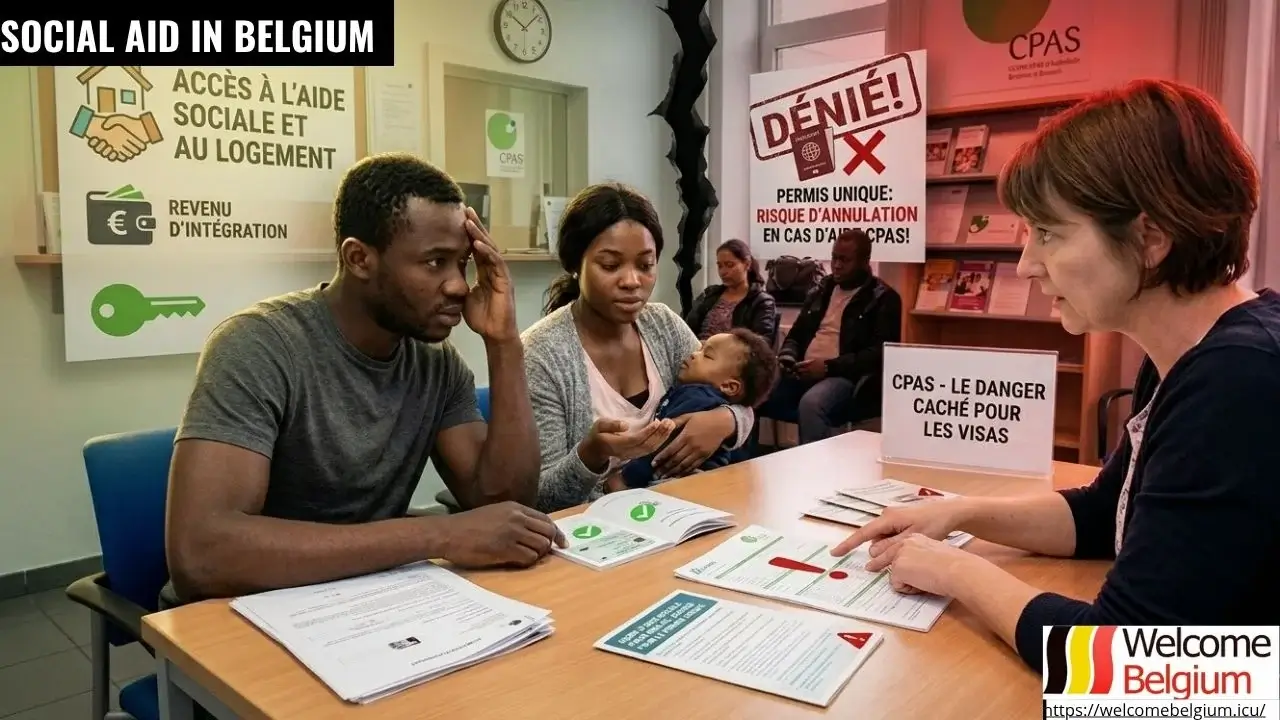
Ahmed, an IT engineer, lost his project, and his income plummeted. Friends advised him to visit his commune’s CPAS to claim the integration income (Leefloon) while searching for a new position. Ahmed submitted the paperwork and received payments for two months. However, when he went to renew his Single Permit (a work-linked residence permit), the immigration authorities (Office des Étrangers) issued an order for him to leave the country.
You automatically acknowledge an inability to support yourself, which invalidates the core conditions of your residence permit. To avoid critical mistakes, make sure to review the specific legal maintenance requirements that come with a work visa to Belgium for highly skilled professionals.
Alex’s Verdict:
If your legal status depends on a work or business visa, applying for financial assistance from state welfare funds acts as an immediate red flag for immigration authorities. You automatically acknowledge an inability to support yourself, which invalidates the core conditions of your residence permit.
Social Housing and Charitable Organizations in Belgium
If state allowances cover only basic necessities, long-term challenges (such as prolonged unemployment or supporting a large family) are alleviated through affordable housing schemes and major humanitarian funds.
- Social Housing in Belgium (Logement social): A program providing state-subsidized apartments at rental rates significantly below the market average (the cost is directly pegged to your actual household income).
- Allocation Conditions: Due to extensive waiting lists, priority is strictly granted to the most vulnerable categories—individuals with disabilities, large families, and victims of domestic violence.
- The Belgian Red Cross: The Croix-Rouge (French-speaking) and Rode Kruis (Dutch-speaking) organizations distribute free clothing, hygiene products, and basic household items.
- Food Banks: The national network of Banques Alimentaires / Voedselbanken distributes quality food items through local associations to families living on critically low incomes.
- Caritas Catholic Foundation: The extensive international network Caritas International provides targeted humanitarian and legal aid to refugees and individuals under temporary protection.
- Regional Associations: Major cities host dozens of localized volunteer services (such as Restos du Cœur) that offer hot meals and psychological support.
To access free food banks or subsidized social housing, in 90% of cases you will still require an official referral or an income certificate issued by your dedicated social worker at the CPAS.
Alex’s Tip:
If you find yourself in a crisis, the very first step is to learn how to access help legally and visit your local CPAS branch without hesitation. Remember that seeking basic social assistance while holding temporary protection status has zero negative impact on your legal standing. However, if you are in the country on a work visa or as a highly skilled expat (H-card), receiving regular welfare payouts from CPAS can be interpreted by the Office des Étrangers as a failure to maintain financial self-sufficiency, creating severe risks for your permit renewal.
Living in Belgium: FAQ and Answers to Popular Immigrant Questions
This section compiles concise, expert answers to the most critical questions faced by expats. These short-form summaries will help you quickly navigate the core regulations of the Kingdom.
Initially, within Brussels and the IT sector, yes. However, for communicating with your local commune, processing official paperwork, and fully integrating into society, French or Dutch is absolutely essential.
If your deposit is frozen on a dedicated bank account (as required by law) and the landlord refuses to release it, the Justice of the Peace (Juge de paix / Vrederechter) is the only authority legally empowered to resolve pre-trial claims and rental disputes.
If your doctor uses the eHealth system and scans your electronic identity card (eID), your medical reimbursement will be automatically deposited into your bank account within 2 to 3 days. Paper forms can take up to two weeks.
Yes, provided you hold a legal residence permit and your income falls below the minimum level. However, for work visa holders (Single Permit), requesting financial aid from the CPAS carries a severe risk of your residence permit being revoked.
Strictly for up to 6 months. After registering at your commune and receiving your eID card, you are legally obligated to customs-clear the vehicle, obtain Belgian license plates, and pay the national road tax.
Yes. If you reside in Belgium for more than 183 days a year, you automatically become a tax resident and are legally required to declare your worldwide income.
Yes, an on-duty family doctor can visit your home, but this service costs more than a standard consultation at a practice (Cabinet médical / Praktijk). Your Mutuelle will still cover the standard base portion of the expense.
Yes. Successfully completing the state-sponsored integration program (Inburgering / Parcours d'intégration) exempts you from taking a language exam when applying for citizenship after 5 years of legal residency.Can I get by in Belgium using only English?
What should I do if my landlord refuses to return my rental deposit (Garantie locative)?
How can I get a rapid medical refund through my Mutuelle?
Can a foreign worker claim assistance from the CPAS (OCMW)?
How long can I drive a car with foreign license plates in Belgium?
Do I need to pay taxes if I work remotely for a foreign company?
Can I request a doctor's home visit in Belgium?
Is the integration course mandatory for acquiring citizenship?
Relocation and long-term integration into a new country is a major project that requires patience, discipline, and strict adherence to local regulations. While Belgian bureaucracy may seem complex due to regional laws, specific verification systems, and communal nuances, it remains completely transparent and logical for those who stay well-informed.
A successful and comfortable life in Belgium for expats relies on taking these essential steps on time:
- Timely registration at your local town hall (Commune / Gemeente) and obtaining a national registration number.
- Formally executing a long-term lease agreement in complete accordance with the law, without ever handing over cash.
- Meticulously planning your household budget around the advance payment system for utility bills.
- Compulsorily registering with a health insurance fund (Mutuelle) to safeguard both your health and finances.
Learn the local languages, maximize the opportunities provided by free state integration courses, do not hesitate to seek legal support when needed, and always verify information through official Belgian channels. The Kingdom offers massive prospects to those who respect its laws and are ready to become a part of this multicultural European society. The step-by-step guides on our portal are always here to help you navigate this journey confidently and without errors!
List of Sources and Official Resources
To verify data accuracy, track amendments to Belgian legislation, and interact with government bodies, rely exclusively on official primary sources:
- Official Portal of the Belgian Government: be Official Portal – General registration rules, resident rights, and ministry contact directories.
- Immigration Legislation: Belgian Aliens Act of 15 December 1980 – The primary legal document on the Refworld legal documentation platform.
- Immigration Office (Office des Étrangers / Dienst Vreemdelingenzaken): IBZ Immigration Office – Official instructions on visa types, entry regulations, and long-term stay requirements.
- State Social Assistance: POD Maatschappelijke Integratie (CPAS / OCMW) – The federal website of the Public Planning Service for Social Integration. Features details on minimum income (Leefloon) calculations and local welfare office locators by commune.
- Regional Housing Law in Wallonia: Wallonie Logement – Real estate rental decrees, inspection report rules (État des lieux), and housing subsidies for the southern region.
- Energy Efficiency and Tariffs in Flanders: VREG (Vlaamse Regulator van de Elektriciteits- und Gasmarkt) – The official regulatory authority in Flanders for verifying energy contracts and monitoring rental indexation limits.
Disclaimer
Please Note: The information provided in this article is strictly for informational purposes and does not constitute legal, financial, or tax advice. Legislation and tariffs in Belgium change regularly. Before signing contracts, transferring funds, or applying for social benefits, always cross-reference data on official government portals or consult with qualified attorneys and official social workers. The platform administration bears no liability for any consequences resulting from the use of the materials provided in this article.