Hi! I’m Alex, an immigration consultant at WelcomeBelgium.icu. If you’re planning to move to the “Heart of Europe” as a professional, the Single Permit (or Combined Permit) is your most important asset.
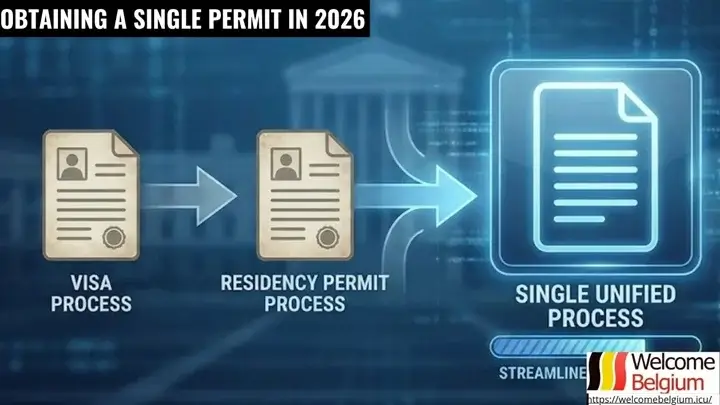
In 2026, Belgium has fully streamlined its immigration policy. There is no longer a separate “work visa” in the traditional sense; instead, you apply for a single document that grants both work authorization and a residence permit. Whether you are a high-skilled developer or an engineer, navigating the Foreigners Office and regional labor laws can be tricky. In this guide, I’ll show you how to secure your Residence Permit Type A, meet the latest salary thresholds, and avoid the common traps of the Belgian bureaucracy. Let’s get your career in Belgium started!
Official Source: Working in Belgium Official Portal
Legislative Framework and Regional Differences: Why Geography is Everything
Belgium is a federal state, and labor migration issues are decentralized. This means that the Regional Ministry of Employment (each region has its own) independently decides which specialists the economy needs and what income level is considered sufficient. Although the Single Permit card looks the same nationwide, the conditions for obtaining it are dictated by three regions: Flanders, Wallonia, and the Brussels-Capital Region.
Flanders (Vlaanderen): Tech Hub and Strict Selection
Flanders is the most economically active region, home to Antwerp with its massive port and chemical cluster, as well as Ghent and Leuven with their IT startups.
- 2026 Update: As of January 1, Flanders introduced a regional fee (retribution) for applications, amounting to approximately €250 (in addition to the federal fee).
- Single Permit Flanders Rules: Authorities now strictly verify not just the diploma, but the actual correspondence of the role. If you are applying as a “highly skilled professional,” your work must truly be qualified, not just meet the salary threshold.
- Labor Market: The region has closed loopholes for low-skilled labor. They are now looking for top talent or people from a very narrow list of shortage occupations.
- Official Resource: be — Work Permits.
Wallonia (Wallonie): Industrial Renaissance
The southern region with its capital in Namur and a major industrial center in Liège.
- Features: In 2026, Wallonia made the largest leap in salary indexing. If your employer is located here, be prepared for the income floor to be higher than the national average.
- Shortage Occupations Wallonia: The list is valid until September 30, 2026, and includes 56 key positions, ranging from construction managers to CNC technicians.
- Official Resource: Emploi Wallonie.
Brussels (Bruxelles-Capitale): Center of Diplomacy and Services
Brussels is a world of its own, hosting NATO, EU headquarters, and thousands of consulting firms.
- Features: Work in Brussels for expats is mostly related to management and IT. Brussels is the only region that calculates salary thresholds monthly, not just annually.
- Rules: They are more lenient towards international staff but require strict adherence to “full-time employment” rules (at least 80% of working time).
- Official Resource: Economy-Employment Brussels.
Shortage Occupations Lists
If your profession is on the shortage list, the employer does not need to conduct a “labor market test” (proving they couldn’t find a Belgian for the position).
| Region | Top Shortage Areas | Key Features |
| Flanders | IT Developers, Engineers, Nurses, Roofers. | List shortened; truck drivers and bakers removed. |
| Wallonia | Electricians, Maintenance Techs, Logisticians. | Focus on construction and energy sectors. |
| Brussels | Cybersecurity, Analysts, Social Workers. | Huge demand for bilingual specialists. |
Alex’s Pro-Tip:
Since 2026, Flanders has enforced the “80% rule”: if more than 80% of a company’s staff are foreigners on fixed-term contracts, new Single Permit applications may be rejected to prevent “cheap labor” imports disguised as specialists.
Who is the Single Permit for? Categories and Occupations
In Belgium, there is no “general queue.” The system is divided into clear streams. If you don’t fit into one of the categories below, obtaining approval from the Regional Ministry of Employment will be nearly impossible.
Highly Skilled Professionals: Blue Card vs. Single Permit
This is the most popular route for expats. The main requirement is a higher education degree (minimum 3-year Bachelor’s) and a specific salary threshold.
- EU Blue Card 2026: Harder to get due to higher salary floors (€63,586 in Flanders, €68,815 in Wallonia). However, it offers more freedom: after 12 months, you can change employers more easily, and it accelerates your path to EU permanent residency.
- Highly Skilled Single Permit: More accessible initially but strictly tied to a specific employer for the first few years.
Shortage Occupations (Medical, Engineering, IT, Construction)
If your profession is on the regional shortage occupations list, your employer doesn’t need to prove they couldn’t find a local candidate.
- Engineering Jobs in Belgium: The “gold standard.” Civil engineers, renewable energy experts, and automation specialists are in high demand.
- IT Vacancies in Brussels: Demand for cybersecurity and AI developers is skyrocketing in 2026.
- Single Permit for Doctors and Nurses: Medicine is a special case. Beyond the permit, you need qualification recognition (equivalence) and registration with the Belgian medical board. In Flanders, nurses benefit from a reduced salary threshold (similar to those under 30).

Executives and Management Personnel
For top managers, the degree requirement is more flexible, but the salary threshold is the highest in the country (e.g., €88,790 in Wallonia for 2026). The authorities verify your actual power: you must manage a department or the whole company.
Interns and Researchers
- Interns: For recent graduates (within 2 years). Requires a formal training plan and a salary not lower than the sectoral minimum.
- Researchers: If you have a contract with an accredited scientific institution (like KU Leuven), the process is fast-tracked and often exempt from standard income requirements.
Official Source: EU Immigration Portal – Highly Qualified Workers Belgium
Salary Requirements 2026: The Financial Thresholds
The most critical part of your Single Permit application is the salary. In 2026, Belgium has updated its thresholds, and for the first time, Wallonia has surpassed Flanders in the required minimum for highly skilled workers.
Minimum Gross Salary Thresholds for 2026
All figures are in Euro Gross (Brutto). Note that Brussels uses a monthly calculation, while other regions focus on the annual total (including the 13th month and holiday pay).
| Category | Flanders (Annual) | Wallonia (Annual) | Brussels (Monthly) |
| Highly Skilled (30+ years) | €48,912.00 | €53,220.00 | €3,703.44 |
| Young Professionals (< 30 years) | €39,129.60 | €42,576.00 | Same as Highly Skilled |
| Executives / Management | €78,259.00 | €88,790.00 | €6,647.20 |
| EU Blue Card | €63,586.00 | €68,815.00 | €4,748.00 |
Taxes and Social Security: From Gross to Net
Understanding taxes in Belgium for foreigners is vital.
- Social Security (RSZ/ONSS): A standard 07% is deducted directly from your gross salary.
- Progressive Income Tax: Belgium has one of the highest tax rates in the world (up to 50%). For a gross salary of €4,500, your Net Income will typically range between €2,700 and €2,900, depending on your family status.
- Automatic Indexation: Your employment contract in Belgium is legally bound to the “index.” If the cost of living rises in 2026, your employer is mandated to increase your salary accordingly.
Official Source: Coming to Belgium – Formalities
Salary Requirements 2026: How Much Do You Need to Earn to Move?
In Belgium, there is no single “minimum wage” for all migrants. Salary limits in Belgium depend on your category (age, qualification) and the region where your employer’s office is registered.
Important:
All amounts below are in Euro Gross. In Belgium, there is a significant difference between “gross” and “net” salary, as the tax burden is one of the highest in Europe.
Actual Salary Thresholds for 2026 (Annual Income)
For most categories, the calculation is based on annual income, including the 13th month and double holiday pay.
| Category | Flanders | Wallonia | Brussels |
| Highly Skilled Professionals | €48,912 | €53,220 | ~€44,441 (€3,703/mo) |
| Young Professionals (< 30 years) | €39,129 | €42,576 | — (General threshold) |
| Executives / Management | €78,259 | €88,790 | ~€79,766 (€6,647/mo) |
| EU Blue Card | €63,586 | €68,815 | ~€56,976 (€4,748/mo) |
Breakdown by Category:
- Young Professionals under 30: Flanders and Wallonia traditionally offer a “discount” for early-career talent. This is a great chance for graduates to enter the labor market. The minimum salary for Single Permit 2026 in this case is 80% of the standard threshold.
- Highly Skilled Professionals: The most popular type. If you are 30+ years old, expect a figure around €4,100 – €4,400 gross per month.
- Medical Personnel: In 2026, nurses in Flanders have a salary threshold equal to young professionals (€39,129), which significantly eases their hiring process.
Salary Indexation and Employment Contract
Belgium uses a system of automatic indexation. If inflation rises, your salary in the employment contract must be revised.
Attention:
As of June 1, 2026, a new rule applies — full indexation only applies to the first €4,000 of your monthly salary. For amounts above this, the increase on the “surplus” will be limited.
Taxes in Belgium for Foreigners: What’s Left “Take-Home”?
When you see €4,500 in your contract, don’t celebrate too early.
- Social Security: Approximately 13.07% is deducted from the employee.
- Income Tax: Progressive scale. On high salaries, the rate can reach 50%.
- The Result: From a €4,500 gross salary, you will receive approximately €2,700 – €2,900 Net, depending on your family composition and children.
Alex, WelcomeBelgium:
“Always ask your employer for a ‘Gross-to-Net’ calculation. In Belgium, the gross amount can look impressive, but after deductions, life in Brussels or Antwerp might leave you with less than expected. Use expat tax benefits if your income is above €75,000 per year.”
Single Permit Procedure 2026: From Job Offer to Plastic Card
Many mistakenly believe that the Single Permit procedure is solely the employer’s responsibility. In reality, it is a team game where your speed in gathering documents determines the success of the entire migration. In 2026, the process has become fully digital, but also stricter regarding bureaucratic details.
Step 1. Contract Signing and Employer Verification
It all starts with the offer. Your employment contract must clearly state the salary level (not lower than the thresholds in Section 4) and job description.
- Important: As of January 1, 2026, Flanders introduced a mandatory employer check for tax arrears. If the company has outstanding social security contributions, the system will simply block the file.
Step 2. Submission via the “Working in Belgium” Portal
The employer uploads your dossier to the unified digital portal.
- Administrative Fee: As of January 1, 2026, the federal contribution fee is indexed at €377 for highly skilled specialists.
- Additional: In Flanders, a regional fee of €250 has been introduced this year, payable separately.
Step 3. Approval of the “Two Keys” and Annex 46
Your file is reviewed by two authorities in parallel:
- Regional Ministry of Employment (checks the economy and salary).
- Federal Foreigners Office (IBZ) (checks security and background).
- Work visa processing times: In 2026, Brussels and Wallonia aim for a 90-day window, while Flanders has launched a “fast-lane” for shortage occupations, where decisions can be reached in 15–30 days.
- Result: The Annex 46 This is your official authorization.
Step 4. Visa D and Commune Registration
With Annex 46, you apply for a national Visa Type D at the Belgian consulate (fee in 2026: €180). After entering the country, you have 8 working days to report to the Commune (town hall) of your residence. There, you provide biometric data, after which a police officer will visit your home to verify your residency. Only then will you receive the coveted Residence Card Type A.
Required Documents and Apostille: The 2026 Checklist
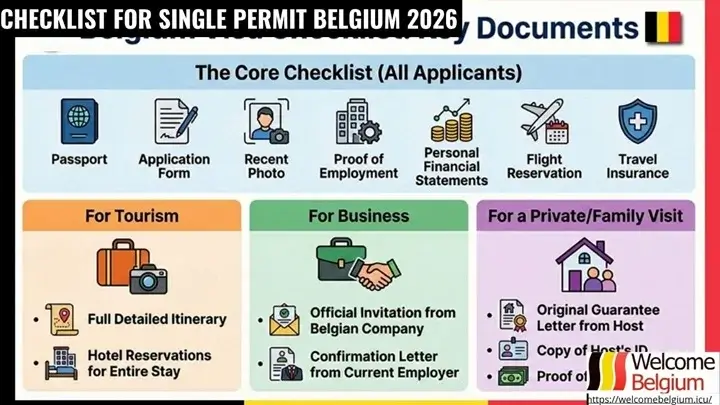
To avoid delays, prepare this document package in advance. Remember: any error in translation or a missing Apostille can set the process back by a month.
Full Document Checklist:
- International Passport: Validity must exceed 12 months.
- Diploma and Transcripts: Requires an Apostille on the diploma (original) and subsequent translation.
- Criminal Record Certificate: Must be issued no more than 6 months before submission and cover the last year of residence. An Apostille is also required.
- Medical Certificate for Belgium Visa: A specific form filled out by a doctor accredited by the Belgian Embassy. This confirms you do not pose a threat to public health.
- Proof of Fee Payment: Receipts for the payment of €377 (federal) and €250 (regional, if applicable).
Legalization and Translation Requirements
Document translation for Belgium must be done into one of the national languages (Dutch, French, German) or English (depending on the region; Flanders and Brussels readily accept English).
- Sworn Translator: At WelcomeBelgium, we always recommend using a sworn translator (beëdigd vertaler) based in Belgium. This eliminates any questions regarding the legality of the translation at the local commune.
- Legalization of Documents: Check if you need a full legalization chain or if a simplified Apostille is sufficient, depending on your citizenship.
Alex, WelcomeBelgium:
“In 2026, the most common reason for rejection was expired criminal record certificates. By the time the dossier reaches the federal level, the certificate ‘expires.’ Get a fresh one right before your employer submits the application on the portal!”
Document preparation is only half the battle. As a WelcomeBelgium expert, I often see migrants making mistakes after moving, not knowing their rights or fearing status loss during a conflict with a boss. In 2026, rules are more flexible, but the ‘link’ to the employer remains a key factor.
Rights and Responsibilities of a Single Permit Holder: Life in Belgium
Your Type A card is more than just plastic; it is your social contract with the state. It grants you almost the same rights as Belgian citizens, excluding the right to vote.
Can I Change Jobs?
This is the most common question. During the first few years, your Single Permit is tied to a specific employer.
- Changing Employers in Belgium: If you find a new role, the new employer must submit a new Single Permit application. You cannot simply quit and start the new job the next day — you must wait for regional approval (Annex 46).
- Unlimited Market Access: After a certain period (usually 4 years for most categories or 2 years for Blue Card holders), you gain unlimited access to the labor market and can change companies without a new work authorization.
Termination of Employment: What Happens?
If you face dismissal with a Single Permit in Belgium (either by your choice or the company’s), you have 90 days to find a new employer.
- During this period, your right of residence remains valid.
- You are entitled to social security and, in some cases, unemployment benefits if you have worked the required minimum period (usually at least 12 months in the Belgian system by 2026).
- Crucial: Notify your commune of the status change immediately to avoid your card being revoked.
Right to Family Reunification
Belgium is very family-friendly. Your Single Permit status entitles you to family reunification in Europe for your spouse and children under 18.
- Financial Requirement: As of 2026, your net income must be at least €2,323.10 per month (indexed) to support your family.
- Spouses receive the right to work in Belgium automatically without needing their own Single Permit.
Extension and Permanent Residency (PR)
Extension is initiated by the employer 2-3 months before the card expires. After 5 years of continuous legal residence, you can apply for Long-term Resident status (L-card) or Belgian citizenship, provided you prove language proficiency and social integration.
Alex, WelcomeBelgium:
“Never quit ‘into the void’ without a financial cushion or a new offer in hand. 90 days fly by fast, and Belgian bureaucracy does not forgive last-minute rushes.”
Common Reasons for Rejection and How to Avoid Them
A Single Permit rejection in 2026 is not always a final verdict, but it always means losing 3–4 months and non-refundable fees. Most negative decisions are caused by technical errors, not a “bad” candidate profile.
Safety Checklist from WelcomeBelgium:
- Salary Discrepancy: The main reason for rejection. Many employers use last year’s figures, forgetting that the minimum salary for Single Permit 2026 has been indexed. Ensure the contract states a fixed base salary; bonuses often don’t count toward the threshold.
- Employer Reliability Check: The Foreigners Office now filters out “shell companies.” The risk of rejection increases if the firm has existed for less than a year, has tax arrears, or if over 80% of its staff are foreigners on temporary contracts.
- Diploma-Job Mismatch: In 2026, Belgium introduced a strict audit of qualifications. If you apply as “High Skilled” with a linguistics degree but plan to work as a systems analyst, the authorities may claim a labor market mismatch.
- Administrative & Timing Errors: Rejections often occur due to expired documents.
- Criminal record certificates must be issued within 6 months of submission.
- Apostille on the diploma and its translation must be flawless.
- Medical certificates for Belgium visas are only accepted from embassy-accredited doctors.
If rejected, you have a 60-day appeal period. However, a work visa appeal in Belgium is long and expensive. Usually, it is faster to fix the error and resubmit. In complex cases, you will need an immigration lawyer in Belgium.
FAQ: Top Questions about Single Permit from Alex
- Can I apply while on a “visa-free” stay in Belgium? In 2026, the general rule remains: applications must be submitted while you are outside the EU. Exceptions are rare (e.g., changing status from student to work).
- How long to wait for the A-card? After receiving Annex 46 and entering, the plastic card takes 2–4 weeks to issue following the local police residency check.
- Do translations need legalization? Yes, document translation for Belgium must be done by a sworn translator. We recommend doing it within Belgium.
- What is the total cost in 2026? Expect a €377 federal fee and, in Flanders, an additional €250 regional fee.
- Does the status allow family reunification? Family reunification in Europe is available for spouses and children, and your partner gains full labor market access.
Conclusion: Your Path to a Single Permit in 2026
Moving to Belgium is a complex project, but with the right preparation, it is entirely manageable. In 2026, the Single Permit procedure is your primary tool for legalizing high-skilled work, offering not just a job, but a path to European residency and social security.
Alex, WelcomeBelgium: “The article is ready! We’ve built a comprehensive guide covering everything from salary thresholds to Apostille nuances. This material won’t just help your readers legalize their status; it will confidently push your site to the top of the rankings for Belgian relocation queries. Remember: the key to success in 2026 is starting early and double-checking every document!”