
Last Updated on April 21, 2026 by Alex
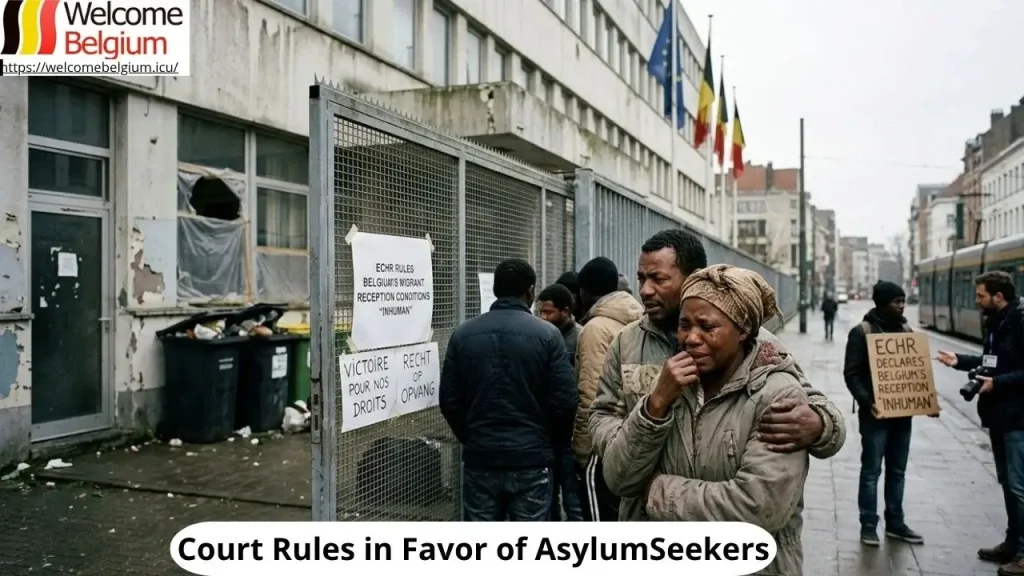
Brussels, April 9, 2026 — The European Court of Human Rights (ECHR) has delivered a landmark judgment in the case of M.V. and Others v. Belgium (Applications no. 28820/13 et al.). This isn’t just another fine; it’s a legal “slap in the face” to the Fedasil reception system, which has used “capacity crises” as an excuse for years.
The Core of the Case: 338 Days on the Pavement
On April 9, 2026, the ECHR ruled that the Belgian state violated the fundamental rights of asylum seekers, labeling their living conditions during the waiting period as inhuman and degrading.
The case dates back to 2022–2023. Four men—from Guinea, Cameroon, Angola, and China—arrived in Brussels seeking protection. Instead of shelter in official centers, they were left on the streets.
- The Court Order: Legal counsel acted swiftly. The plaintiffs held official injunctions from the French-speaking Brussels Labour Court (Tribunal du travail de Bruxelles), which explicitly ordered the state to provide immediate housing, food, and medical assistance.
- Ignoring the Law: The most shocking aspect was the government’s stance. The Belgian state simply refused to comply with its own domestic court rulings.
- The Price of Survival: One plaintiff spent 338 days on the street. Imagine nearly a year in a tent or on cardboard—through harsh winter months—without access to showers, toilets, or hot meals.
This verdict sends a powerful signal to anyone currently navigating the legalization process in the Kingdom: In Belgium, the rule of law sits above political convenience and resource shortages.
Belgium Asylum Statistics (January – March 2026)
| Metric | January 2026 | February 2026 | March 2026 | Total Q1 |
| New Applications | ~1,810 | 1,964 | 1,972 | ~5,746 |
| Decisions Rendered | ~2,400 | 2,666 | 3,139 | ~8,205 |
| Protection Rate (Approval) | ~23% | 22.7% | 25.5% | ~23.7% (avg) |
| Refusals / Inadmissible | ~77% | 77.3% | 74.5% | ~76.3% (avg) |
Deadline Alert: Flanders and Brussels will shut down email-based application intake exactly at midnight on April 30. To avoid technical rejections, ensure you review the new Single Permit rules in Flanders, which outline updated document requirements and filing procedures for 2026.
Official Sources:
- ECHR Case Database: HUDOC
- Official Gazette of Belgium: Moniteur Belge
- Federal Agency for the Reception of Asylum Seekers: Fedasil
Court Verdict: Violation of Three Convention Articles
This ruling is more than just an isolated case; it is a surgical dissection of systemic failures within the Belgian state apparatus. The ECHR was unanimous in its findings, concluding that the state undermined the very foundations of the rule of law.

Key Focus Areas of the Strasbourg Judges:
- Article 3 (Prohibition of Torture and Inhuman Treatment):
The Court ruled that living conditions on the streets reached a “level of severity” that degraded human dignity. Depriving asylum seekers of basic hygiene, warm shelter, and medical care for such an extended period was officially classified as inhuman treatment.
- Article 6 (Right to a Fair Trial):
Perhaps the most damning charge. The Court emphasized that justice becomes meaningless if a state allows itself to ignore its own national court rulings for months on end. Disregarding the orders of the Belgian judiciary was deemed unacceptable in a democratic society.
- Article 34 (Right of Individual Application):
Belgium did not only ignore local judges; it also delayed the implementation of “interim measures” specifically ordered by the ECHR as emergency relief. This was recognized as an attempt to block the migrants’ access to international protection.
This case is part of a broader pattern. Belgium has been under fire for years due to the ongoing “reception crisis.” Similar proceedings in national courts have already resulted in thousands of penalty payments (known as astreintes), totaling millions of euros.
However, the April 2026 decision is a watershed moment: it definitively establishes that “logistical difficulties” within Fedasil or a lack of shelter capacity can never serve as a legal excuse for violating human rights guaranteed by the European Convention.
The Aftermath: Who Pays for the Failure?
Belgium is now legally mandated to pay the victims compensation for non-pecuniary damage:
- The Figures: Awards range from €5,070 to €12,350 per person.
- Government Reaction: The current Minister for Asylum and Migration, Anneleen Van Bossuyt (N-VA), was quick to state that these events occurred under the previous administration. Nevertheless, she conceded that the verdict necessitates “systemic adjustments” within the Fedasil agency.
The Bottom Line: “Lack of space” is no longer a valid legal defense for human rights violations. This precedent reaffirms the state’s absolute duty to provide basic reception conditions.
Official Resources for Further Reading:
- Full Judgment Text: ECHR HUDOC Portal
- National Insight: European Migration Network (EMN) Belgium
Stay informed and know your rights.
— Your Guide, Alex.