
Last Updated on April 8, 2026 by Alex
Hi! Alex from WelcomeBelgium here. If you are aiming for Regulated professions or planning on recognizing a Ukrainian diploma for work, get ready for the quest known as Équivalence.
In 2026, requirements for Master/Bachelor level and ECTS credits have become stricter, and the process is now firmly split into two camps. You’ll have to choose between NARIC-Vlaanderen (if your path leads to the Flemish Community) and the Service des équivalences for Brussels and Wallonia (French Community). Remember, the difference between NARIC and Wallonia-Brussels isn’t just about the language, but also the submission portals—digitalization is everywhere, but the bureaucracy remains loyal to its traditions.
The first thing to understand is that the diploma equivalence procedure in Brussels, which starts at €150 in 2026, is impossible without an Apostille and a high-quality Diploma Supplement. If you are searching for how to recognize a medical degree in Belgium 2026, prepare for double scrutiny from SPF Santé to obtain the final Approbation. To avoid wondering how long to wait for diploma confirmation in Belgium—which typically takes 2 to 4 months—start preparing your Apostille and looking for a Traducteur juré before you even cross the border.
In this guide, we’ll break down step-by-step how to avoid drowning in paperwork and prove to the Belgian Office des Étrangers that your education meets their high standards.
What is Diploma Equivalence and When is it (Not) Needed?
Let’s get one thing straight: Équivalence is an official document certifying that your foreign education meets Belgian standards. Many newcomers make the mistake of thinking a sworn translation is enough. No, Bro—a translation is just reading the letters, while equivalence is the formal recognition of your Master/Bachelor level.
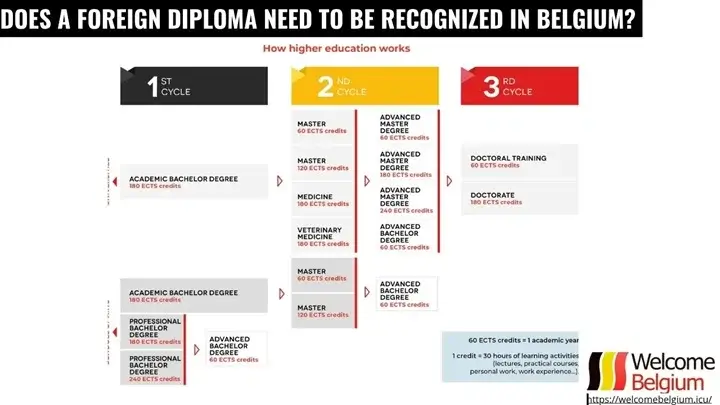
In 2026, Belgium has become even stricter in filtering diplomas. If you plan to work in the private sector (e.g., in IT), your experience is often enough for the employer. However, if your goal is public service, tax benefits, or obtaining high-qualified specialist status for the Office des Étrangers, confirmation is non-negotiable.
Professional vs. Academic Recognition
This is a subtle point where many stumble. It’s crucial to understand the difference between the right to study and the right to work:
Academic Recognition: Required if you want to continue your studies in Belgium (e.g., enrolling in a Master’s program). Here, the university evaluates your ECTS credits.
Professional Recognition: This is your “pass” to the labor market. It confirms your right to hold specific job titles and is managed by NARIC or FWB.
If you are requesting a confirmation of a Ukrainian diploma in Belgium for work, you need professional recognition. Keep in mind that how long to wait for diploma confirmation in Belgium depends on the type you choose: academic recognition is usually faster, while professional applications can get stuck in queues for months.
Regulated Professions in Belgium
There is a list of Regulated Professions where, without equivalence, you are literally outside the law. Doctors, architects, lawyers, engineers, and even school teachers—here is who can’t do without it:
Doctors and Medical Staff: If you’re looking for how to recognize a medical degree in Belgium 2026, prepare for the toughest path. Besides the diploma recognition, you’ll need an Approbation from SPF Santé to legally practice.
Architects and Engineers: Your degree must be recognized by the corresponding professional order (e.g., the Ordre des Architectes or the relevant engineering chamber).
Lawyers: It’s complicated due to legal system differences, but the procedure always starts with recognizing your basic law degree.
For these categories, the diploma equivalence procedure in Brussels, which may include additional fees for professional chambers, is strictly mandatory.
Official Legal Basis:
The detailed list of regulated professions and qualification recognition norms is established by Belgian law. You can consult the full legal text and the list of specialties on the official portal: Be-Expert / Guichet des professions réglementées.
Expert Opinion from Alex:
“Bro, don’t make the classic mistake: ‘I’ll get there and figure it out.’ If your profession is regulated, without equivalence, you are effectively uneducated to the system. Even if you’re a genius surgeon, you can’t officially treat a patient in Belgium without an Approbation. My advice: go for academic recognition if you just want ‘credentials’ for your CV, but if you’re aiming for major corporations or medicine—start the professional equivalence procedure six months before moving. It will save you a ton of stress and thousands of euros in lost wages.”
Where to Validate Your Diploma? Region Rivalry: Flanders vs. Wallonia
Belgium is a federal state, and when it comes to Équivalence, this manifests in a decentralized system. There is no single national office for diploma recognition. Choosing the wrong authority will lead to significant delays in your application process (remember, knowing how long to wait for diploma confirmation in Belgium is crucial, as the process usually spans several months). Your choice of institution depends entirely on where you intend to live, work, or which university you plan to attend.
NARIC-Vlaanderen: For Antwerp, Ghent, or Leuven
If you are heading to the North of the country—the Flemish Community—your primary ally is NARIC-Vlaanderen. This is a highly digitized organization that demands precision. They require a meticulous Diploma supplement, clearly defined credit hours, and a valid Apostille. In 2026, NARIC has further streamlined its online portal, but the scrutiny of Master/Bachelor level alignment against Flemish standards remains exceptionally rigorous.
H3: Fédération Wallonie-Bruxelles: For Brussels or Liège
For those choosing the French-speaking part of the country—the French Community (Wallonia and Brussels)—the procedure is handled by the Service des équivalences. While the diploma equivalence procedure in Brussels price is strictly regulated, the process here remains slightly more traditional. Although the transition to digital is underway, French-speaking authorities may still request physical documentation or more descriptive syllabi for specific courses.
Regional Comparison: Where to Submit Your Documents?
To help you navigate Belgian bureaucracy, I have compiled a reference table with direct contacts and official details for 2026:
| Feature / Authority | Flanders (NARIC-Vlaanderen) | Wallonia/Brussels (Service des équivalences) |
| Regions | Antwerp, Ghent, Bruges, Leuven | Brussels, Liège, Namur, Charleroi |
| Official Website | naricvlaanderen.be | equivalences.cfwb.be |
| Submission Method | 100% Online via Portal | Online Portal + Registered Mail |
| Average Price (2026) | €90 – €180 | €150 – €200 |
| Waiting Time | 2–4 months | 3–5 months |
| Office Address | Koning Albert II-laan 15, 1210 Brussels | Rue Adolphe Lavallée 1, 1080 Bruxelles |
| Phone | +32 2 553 17 00 | +32 2 690 89 00 |
Crucial Information: The prices and timelines listed above are estimates for standard cases, such as recognizing a Ukrainian diploma in Belgium for work. If your profession is in a shortage list or, conversely, requires complex vetting (like medicine), costs may increase due to extra expertise requirements, and the waiting period may be extended. Always check your application status through the portal of the chosen community.
Many participants see the Au Pair program as a stepping stone to life in Europe. If you plan to stay in Belgium for work or further studies, it is crucial to arrange the legal recognition of your degree in advance. A recognized diploma is not just a formality; it is a requirement for the EU Blue Card, which offers tax benefits and a faster track to permanent residency. For a detailed step-by-step guide on how to start this process, including 2026 costs and timelines, check out our complete guide to diploma recognition in Belgium.
💡 Alex’s Expert Tip:
“A vital nuance regarding these contacts: do not expect to simply ‘drop by’ these offices. In 2026, almost all administrative buildings accept visitors strictly by appointment (RDV), which must be booked online weeks in advance.
Furthermore, the difference between NARIC-Vlaanderen and Wallonie-Bruxelles is evident even in communication style. At NARIC, staff will easily switch to English. However, at the Service des équivalences, it is best to initiate the conversation in French—even if your level is basic—as it tends to facilitate a much smoother interaction. If you are unsure about your language skills, use the contact forms on their websites to ensure you have a written record of their guidance.” 🦾🇧🇪
Step-by-Step Recognition Algorithm in 2026
The process of credential recognition can seem like a bureaucratic maze, but by following these stages strictly, you minimize the risk of rejection or a “request for information,” which could delay your case by months. Here is how the path looks in 2026.
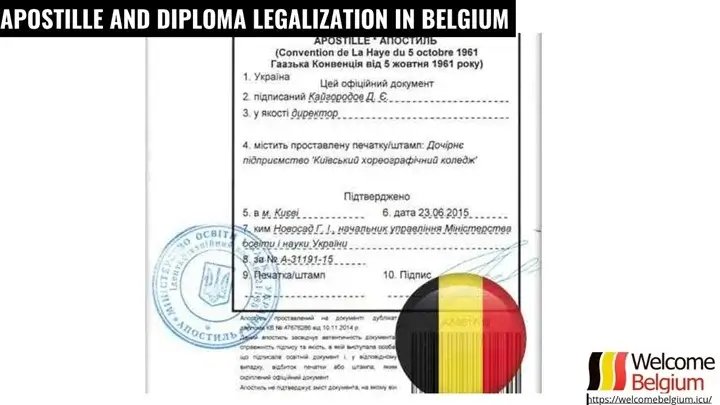
Step 1: Apostille and Legalization
Before your documents leave the country of issuance, they must be made “visible” to international law.
- Apostille: This is a specialized stamp issued in the country where the diploma was granted (usually by the Ministry of Education or Ministry of Justice).
- Legalization Nuances: If your country is not a member of the Hague Convention or does not have a simplified document exchange treaty with Belgium, you may require “double legalization” through the Consulate.
- Important: The stamp must be placed on the original diploma and its supplement, not just on a notarized copy.
Key Information: Without an Apostille, Belgian authorities (NARIC or the Service des équivalences) will not accept your documents for review. This is a baseline security requirement that confirms the authenticity of the official signature on your diploma.
Step 2: Sworn Translation (Traducteur juré)
Translations made by regular translation agencies outside of Belgium are generally not accepted.
- Why a standard translation fails: Belgian authorities only trust specialists registered in the National Register of Sworn Translators and Interpreters.
- Traducteur juré: These are linguists with legal standing. Their seal and unique digital code confirm the accuracy of the translation into one of Belgium’s official languages (French, Dutch, or German).
Official Registry: You can verify a translator’s status or find a certified specialist through the Belgian Ministry of Justice database: JustOnWeb – Translator Register.
Step 3: Gathering the “Document Case”
For a successful submission, you need a complete package. Missing a single document will result in an automatic “Stop” on your file.
- Valid Passport.
- Original Diploma and Supplement: This must include all grades and, crucially, the total number of hours or ECTS credits per subject.
- High School Certificate: Often required to confirm the 12-year education cycle, which is the standard in Europe.
- Proof of Change of Name: If the name on your passport does not match your diploma (e.g., due to marriage).
Take Note: If your diploma supplement does not list specific hours, the commission may demand an additional certificate from your university’s archives. Without detailed workload data, determining the Master/Bachelor level is nearly impossible.
Step 4: Online Application Submission
In 2026, in-person submissions have been entirely replaced by digital portals. All communication with the authorities happens through your personal account.
- For work in Flanders: Use the NARIC-Vlaanderen Online Portal. The system requires high-quality color PDF scans and an online administrative fee payment.
- For work in Brussels and Wallonia: Applications are submitted via the Fédération Wallonie-Bruxelles Portal. In 2026, this portal allows you to “top up” missing documents without canceling your original application.
💡 Alex’s Expert Tip:
“The biggest risk in 2026 is low-quality scans. These portals use Automated Character Recognition (OCR). If your file is a blurry ‘phone photo,’ the system will reject it at the upload stage. Get professional scans of all pages, including the Apostille stamps. Also, remember: if you plan to work as a healthcare professional, you will also need to register with SPF Santé, but only AFTER you receive your diploma equivalence from one of the portals mentioned above.” 🦾🇧🇪
Costs and Timelines: What Should Your Wallet Expect?
Diploma recognition in Belgium in 2026 is a financial investment in your career that requires clear planning. The main expense is the state administrative fee, which varies depending on the region you choose. It is important to understand that these funds are administrative charges for the commission’s work and are non-refundable, even if your application is rejected. In addition to the state fee, you must budget for a sworn translator within Belgium and the cost of the Apostille in the country where the diploma was issued.
Primary Expenses in 2026:
- State fee for higher education in Flanders (NARIC): €180.
- State fee for higher education in Wallonia/Brussels (FWB): between €150 and €200.
- Secondary school certificate recognition: between €75 and €90 depending on the region.
- Sworn translation (Traducteur juré): an average of €60–€120 for a full package (diploma + supplement).
- Exemptions: the procedure is often free for refugees, individuals under temporary protection, or recipients of social integration income (OCMW/CPAS), provided a recent certificate from social services is submitted.
Regarding timelines, in 2026, the average waiting period for a verdict is between 2 and 6 months. It is not possible to officially speed up the process—there is no paid “express review” service in Belgium. However, processing times are often reduced if certain conditions are met, allowing officials to handle your case more efficiently.
Factors Affecting Processing Speed:
- Shortage occupations: Engineers, doctors, and IT specialists with a preliminary employment contract can often receive a decision within 4–6 weeks.
- Authorization method: Submitting through the Itsme system or using an eID speeds up the initial identity moderation.
- Document quality: High-quality color scans and the inclusion of a supplement with credit hours (ECTS) eliminate additional requests that would otherwise push your file to the back of the queue.
- Type of equivalence: Recognition of the “level” of education usually proceeds faster than full recognition of a specific professional qualification.
The most reliable way to avoid a year-long process is to provide a comprehensive document package the first time. Any technical error or unclear digit on a scan will force the commission to send a request for clarification, which automatically adds at least 30 days to your waiting period.
💡 Alex’s Expert Tip:
“In 2026, a vital detail has emerged: if you plan to enroll in a university, apply for equivalence through the university itself. Many educational institutions have a priority communication channel with NARIC or FWB and can reduce the waiting time to about a month. However, keep in mind that ‘academic recognition’ for study purposes sometimes does not grant the right to work in the public sector—for that, a full procedure might be required. Always clarify this nuance in advance to avoid paying twice.” 🦾🇧🇪
Nuances for High-Skilled Professionals (EU Blue Card)
For professionals aiming for the EU Blue Card in 2026, diploma recognition is a critical prerequisite. While the IT sector has recently introduced pathways to prove qualification via professional experience, for almost all other industries, an officially recognized degree remains the mandatory “entry ticket.” Without formal equivalence, the Immigration Office cannot verify your status, which blocks access to fast-track permanent residency and intra-EU mobility rights.
How Diploma Recognition Impacts the Blue Card and Taxes:
- Salary Thresholds: The Blue Card requires meeting strict annual income limits (in 2026, approximately €63,586 in Flanders and €56,976 in Brussels). An officially recognized “Master’s” level degree automatically places you in the high-skilled category, making these thresholds the baseline for your permit.
- Tax Benefits (Expat Tax Regime): Belgium updated its expat tax regime in 2026. You can now receive up to 30% of your salary as tax-free allowances (Costs Proper to the Employer). For the tax authorities (FPS Finance) to approve this status, a recognized diploma serves as primary evidence of your specialized expertise.
- The €75,000 Threshold: As of 2026, the minimum gross salary to qualify for the special tax regime is generally set around €75,000 per year. Having a recognized Master’s degree helps justify such salary levels during tax audits.
- Professional Titles: For engineers, architects, and medical staff, recognition is the only way to legally use protected titles (like “Ir.” or “Arch.”) in a contract. This directly dictates your pay scale according to Belgian union salary grids (baremas).
Junior Professionals: If you graduated within the last three years, the salary threshold for the Blue Card may be lower (approx. €45,934), provided your degree is recognized as equivalent to a Belgian one.
IT Exceptions: High-level tech specialists can sometimes substitute a degree with documented work experience (3 years out of the last 7). However, for maximum tax deductions, having a formal “paper” recognition remains the most bulletproof argument.
💡 Alex’s Expert Tip:
“If your goal is the Blue Card, ask NARIC or FWB for Specific Recognition, not just a general level statement. In 2026, the Belgian tax authorities have become extremely detail-oriented. They don’t just want to know you have a degree; they want to see that your Master’s in Engineering or Economics is identical to a Belgian one. This doesn’t just secure your Blue Card—it can save you between €10,000 and €15,000 a year in income tax. Don’t cut corners on the translation of your credits/hours; that document is what truly ‘sells’ your expertise to the state.” 🦾🇧🇪
Frequently Asked Questions (FAQ)
In the diploma recognition process in 2026, the devil is always in the details. Here are concise answers to the questions that most often cause confusion for applicants.
- What if my university is not accredited?
If your university did not have state accreditation at the time your diploma was issued, obtaining full equivalence in Belgium is virtually impossible. In such cases, NARIC or FWB may issue a refusal or a “certificate of courses attended,” which does not constitute degree recognition. The only viable path is to apply to a Belgian university based on your existing studies; the university can then independently evaluate your credits and potentially enroll you in a shortened program (e.g., directly into the final year of a Bachelor’s).
- Do I need to recognize my high school diploma separately?
If your goal is to recognize higher education for employment, your high school diploma is submitted as a supporting document to confirm the total duration of your education (the 12-year rule). However, if you plan to start a Bachelor’s degree from scratch or if your profession specifically requires secondary vocational education, you must recognize the high school diploma through a separate procedure (Equivalence of secondary education). In 2026, these remain two different portals with two separate sets of fees.
- Can I start the recognition process while still in my home country?
Yes, and in 2026, this is the smartest move. Thanks to the full digitalization of the NARIC and FWB portals, you can submit your application online from anywhere in the world. The key is to have your original documents with an Apostille and to coordinate with a sworn translator in Belgium who can provide you with a digital scan of the translation. Obtaining recognition before you move significantly accelerates the processing of your work visa or EU Blue Card.
Conclusion
Validating your diploma in Belgium in 2026 is more than just a bureaucratic ritual; it is your actual gateway to European living standards and high-level earnings. The process demands time, meticulous attention to scan quality, and an initial financial commitment. However, every euro spent and every month of waiting pays for itself within the first year of working in a qualified position. Do not be deterred by the complexity: the portals are becoming more user-friendly, and Belgium’s demand for talented specialists continues to grow. Start building your “case” today, double-check the hours in your transcript, and take the first step toward your professional future in the heart of Europe. Good luck—you’ve got this! 🦾🇧🇪