
The year 2026 is the best time to sell: property prices in Belgium increased by 9% in 2024, and in Brussels and Antwerp by 11%+. Demand is high, and mortgage rates remain low (3.2–3.8%). The average time to sell a house is 3–6 months (Brussels and Flanders are faster, Wallonia is slower). Selling on your own saves €15,000–40,000 in agency commissions (3–5% + 21% VAT of the average price of €450k–550k).
In this article, you will get:
- a complete list of mandatory documents and certificates for 2026,
- how to accurately estimate your house and not lose money,
- three working methods of selling (on your own, through an agent, via Biddit),
- a step-by-step breakdown from listing to notary,
- tax calculations and how to reduce them to zero,
- a ready-made checklist: “House ready for sale in 30 days.”
Read on — we sell fast and for top dollar.
Features of Selling Real Estate in Belgium in 2026
In Belgium, there is no single federal law on real estate sales — the rules depend on the region:
- Flanders (Vlaanderen)
- Wallonia (Wallonie)
- Brussels-Capital Region (Bruxelles-Capital)
Each region has its own requirements for certificates (for example, Bodemattest is mandatory only in Flanders), its own timelines, and even slightly different registration duties (droit d’enregistrement), although the base rate for the seller is usually 0% when selling a primary residence.

A key feature is the mandatory role of the notary in 2026. Without a notarial deed (acte authentique), the transaction is simply invalid. The notary checks the legal purity, calculates taxes, and registers the transfer of ownership.
There are no restrictions for foreign owners: a citizen of any country can freely sell a house or apartment in Belgium without special permits.
The process is always two-staged:
- Compromis de vente — a preliminary agreement signed by the seller and the buyer (already has legal force).
- Acte authentique — the final notarial deed, signed 3–4 months after the compromis, after which payment is made and keys are handed over.
It is precisely between these two documents that the buyer secures a mortgage, and the seller receives the full amount minus the 10% deposit. Knowing this difference is critical to not losing time and money.
Tip:
Always verify regional requirements (Flanders, Wallonia, or Brussels) before starting the sale — the difference in mandatory certificates and timelines can cost you several thousand euros and extra months.
Preparing the House for Sale
Preparation is a key stage that takes 2–4 weeks and can raise the price by 5–10%. Without documents, the buyer will not sign the compromis de vente, and the notary will block the deal. In 2026, the list of mandatory certificates and documents has been updated: all of them must be no older than 10 years (or 6–12 months for inspections), and their absence risks fines of up to €5,000. Here is the complete list for 2026:
- PEB/EPC certificate (energy performance certificate, Performance énergétique des bâtiments). Mandatory for all properties >18 m². Shows a class from A (economical) to G (requires renovation). Cost is €150–250, issued by an accredited expert (Bruxelles Environnement or equivalent). Validity is 10 years, but update it after renovations. Include it in your listing on Immoweb — it boosts interest by 20%.
- Electrical inspection (contrôle électrique). For houses older than 25 years. Checks wiring safety. Price is ~€225, valid for 25 years. Only by a licensed specialist.
- Soil certificate. Bodemattest (from OVAM) in Flanders — €64–257, proves the absence of contamination. Certificat de sol (from SPW) in Wallonia — same concept. In Brussels — from BDES. Mandatory for all land/houses.
- DIU (Dossier d’Intervention Ultérieure). A new mandatory document since 2023 for properties with renovations after May 1, 2001. Contains plans, utility diagrams (electricity, gas, water), and risks for future work. Compiled by the contractor; if there was no work — a simplified version. Cost is €200–500, transferred to the buyer via the notary.
- Asbestos certificate. Only in Flanders for buildings prior to 2001 (including common areas from 2026). Checks for the presence of asbestos in materials. Price is €200–400 for a standard inspection. In other regions — optional, but recommended.
Additionally: title deed (notarial deed), urban planning extract, co-ownership rules (for apartments). Collect them in advance — the notary will check them.
What you can do yourself: Gather old documents (deeds, plans), home staging (cleaning, decor — raises the price by 3–5%, free or €500–1,000). Check meters and keys.
Accredited specialists only: All certificates (PEB, electrical, soil, DIU, asbestos) — via experts from the registry (e.g., CertiBru). Without them, the sale is impossible.
Start with PEB and electrical — they are the most expensive but pay off with a fast transaction.
Important:
Gather all mandatory certificates (PEB, electrical inspection, Bodemattest/Certificat de sol, and DIU) before posting the ad — without them, no buyer will sign the compromis de vente, and the notary will simply refuse to conduct the transaction.
Proper House Valuation in Belgium in 2026
Valuation is the foundation of a successful sale: overprice it by 10–15%, and the house will sit on the market for 6+ months; underprice it, and you lose €20k–50k. To avoid mistakes, consider the cadastral income (revenu cadastral) — the official tax base that influences the price (available on myminfin.be). Compare with 5–10 similar properties in your area: size, condition, year of construction. Growth factors: proximity to Brussels (+20–30%), PEB class A/B (+10–15%), having a garden (+5–8%).
Start with free online real estate estimates — they give ±10% accuracy in 5 minutes:
- Immoweb evaluation (be/valuation). Enter address, square footage, type — get a market price based on 100k transactions.
- Zimmo (be/waardebepaling). Focuses on Flanders, takes into account local trends.
- Realo (be/en/price-estimate). Ideal for Wallonia, with a VR tour for adjustments.
When to order an independent expert (expert-immobilier)? If the house is unique (historic, renovated) or online evaluations differ by >15% — average price is €450–750 (via biveca.be). The expert will issue a report that increases buyer trust and speeds up the transaction by 20–30 days.
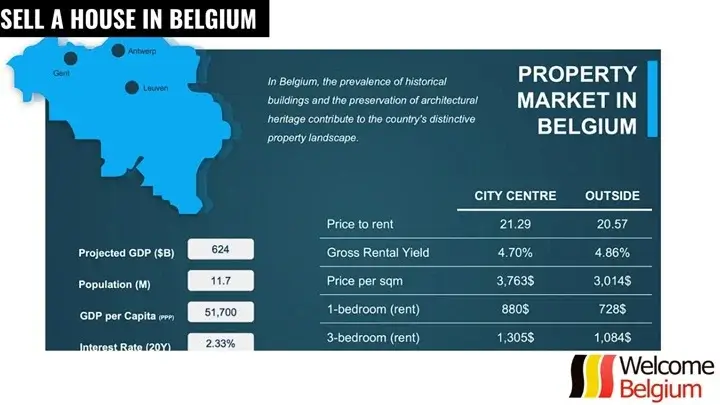
Here is a table of average prices by region and house types (Statbel and Immoweb data, August–September 2026, €/m² for houses; for apartments +20–30%):
| Region | Houses (detached / terraced) | Apartments | Average price m² Flanders / Wallonia 2026 |
| Flanders | 2,257–2,539 / 2,000–2,500 | 2,890–3,760 | 2,400 (growth +3%) |
| Wallonia | 1,411–1,708 / 1,300–1,600 | 1,847–2,292 | 1,600 (growth +6.8%) |
| Brussels | 3,308 / 3,000–4,000 | 3,800–5,000 | 3,800 (growth +3.1%) |
National average: €2,049–2,400/m² for houses. Use this as a guideline — the final price depends on your property.
Interesting:
In Belgium, cadastral income (revenu cadastral) is still calculated based on the year 1975 and artificially indexed — therefore, the real market price of a house is on average 40–50 times higher than the official cadastre.
Choosing the Method of Sale
The choice between selling a house on your own or through an intermediary determines the speed, price, and costs. In 2026, 40% of transactions in Belgium take place without an agent (data from Fednot), especially in Brussels where the market is active. Let’s consider three options.
1. Selling Independently (Without an Agent)
- Pros: savings of €15,000–25,000 (agent commission of 3–5% + 21% VAT), full control over the process, fast response to buyers.
- Cons: you spend time on ads and viewings (average selling time is 2–4 months in Brussels, up to 6 in Wallonia), risks of legal errors, fewer views without professional marketing.
Where to post ads:
- be — market leader, 80% of searches, free for basic listings (premium €300–500/month).
- be — focus on Flanders, 1–2 million visitors.
- be — modern design, video tours, free.
- be — local listings, cheap (€50–100).
- Facebook Marketplace — free, target audience of expats, 20–30% of leads.
How to write selling text: 300–500 words, focus on advantages (PEB/EPC class, transport, nearby schools), use keywords like “ideal house in Antwerp.”
Take photos: 20+ professional photos (HDR, 360° tour via Matterport, free via smartphone) + video (1–2 min). This increases response rates by 50%.
2. Through a Real Estate Agency in Belgium
The agent takes care of marketing, negotiations, and documents. The agent’s commission is 3–5% + 21% VAT (average 3.63% of the price, according to the IPI; for a €400,000 house, this means €14,000–20,000).
- When it pays off: if the house is complex (needs renovation, rare area) or you are busy — an agent speeds up the sale by 1–2 months and attracts 2–3 times more buyers. Choose an agent through the IPI (be), and sign an exclusive mandate to get a discount.
3. Online Auction via Biddit.be
A real estate auction is a transparent method: the notary prepares all documents in advance, and the auction lasts 1–2 weeks online.
- How it works: you set a starting price (70–80% of the market value), buyers bid (auto-bidding), and the highest bid + the next 4 are binding for up to 10 days. The seller accepts the final price; if yes — the deed is signed in 2–3 weeks (faster than the standard process).
- Pro: visibility to 100,000 users, prices rise by 20–40% (examples: +40% in Brussels).
- Who it is for: for an urgent independent sale of a house without defects, in Flanders/Brussels (notary fee 1–2% + platform fee of €500–1,000).
- Con: risk of overvaluation if there are few bids.
Choose based on your situation: independently for savings, a real estate agent in Belgium for comfort, or an auction for speed.
Viewings and Negotiations
To receive a buyer’s offer (offre d’achat), you need 25–40 real house viewings (Brussels/Flanders — 25–30, Wallonia — 35–45). The first serious offer usually arrives after 12–18 viewings.

Real tips for preparing your home (home staging Belgium, which really raise the price):
- Remove 50% of personal items and furniture — empty closets and rooms look 15–20% larger.
- Paint the walls in light tones (Magnolia, Pure White 01 by Levis, or Boss Paints) — this adds +5–7% to the price.
- Replace all burnt-out light bulbs and use warm light (2700–3000 K) — the house immediately looks cozier.
- In the bathroom and kitchen — new silicone joints, white towels, remove toothbrushes and old rugs.
- In the garden — mow the lawn, put away children’s toys, set up one table with chairs — buyers will already imagine themselves there.
- Scent: before the viewing, light a candle with a neutral scent (not vanilla!) or brew coffee — it works better than any perfume.
- In winter, turn on the heating 2 hours before the viewing; in summer — the air conditioning. A temperature of 21–22 °C is ideal.
- Add a virtual tour (Klapty or Nodalview — €99 one-time fee) — it yields +40% more responses and filters out 70% of useless visits.
Bargaining in real estate: Belgians bargain hard: the average negotiation is 4–8%. Never state your final price verbally. Correct phrases: “We already have an offer for €485,000, but if yours is higher and without mortgage conditions, we will consider it.” “For a quick compromis within 10 days and payment within 2 months — minus €10,000.” Always demand a written offer (offre d’achat) — it legally binds the buyer.
Signing the Compromis de Vente
The Compromis de vente is a full-fledged preliminary agreement in Belgium that already has legal force. From the moment it is signed, you are obliged to sell, and the buyer is obliged to buy the house at the fixed price. In 2026, 98% of transactions go through a compromis de vente.
Key points:
- 10% Deposit (acompte): the buyer transfers this to the account of the notary or the agency within 10–15 days after signing. The money is locked until the acte authentique. If the buyer backs out, the deposit remains entirely with you. If you back out, you are obliged to return a double deposit (20%).
- Validity of the compromis — usually 4 months (the most frequent term in Brussels and Flanders). During this time, the buyer must secure a mortgage and fulfill all conditions.
- Clause suspensive (suspensive conditions) — the most important lines in the contract:
- Securing a mortgage (the most common): if the bank refuses, the buyer gets 100% of the deposit back without penalty.
- Obtaining a residence permit (for non-EU residents).
- Absence of municipal demolition/reconstruction orders.
If at least one condition is not met, the deal is automatically terminated and the deposit is returned.
- Penalty for backing out without legal grounds: If the seller backs out → they pay the buyer 10–20% of the house price. If the buyer backs out → they lose the 10% deposit forever.
Advice for 2026: always add a clause stating that “the compromis is signed under the condition that the buyer provides bank approval for the mortgage within 30–45 days.” This protects you from “stalled” transactions.
The compromis de vente is usually signed at a notary’s office or at the agency. After this, you can no longer accept other offers — violations carry fines of up to 30% of the price.
The Final Act at the Notary
The final notarial deed (acte authentique) is the official completion of the transaction: the transfer of ownership, full payment, and the handover of the keys. It is signed at a notary chosen by the buyer (but you can propose your own). Without it, the sale is invalid.
How much time from the compromis to the acte? Délai entre compromis et acte — 2–4 months. In 2026, the standard is 3 months in Brussels/Flanders (for the mortgage) and up to 4 in Wallonia. It depends on the buyer’s bank and the notary’s checks (legal purity, absence of debts). If there is a delay, penalties apply according to the compromis (up to 10% of the price).
Who pays the notary and how much? The notary during a house sale is paid by the buyer (the one who passer l’acte). This includes:
- Honoraires (fees):57–4% of the price (degressive; for a €400,000 house, about 1.5–2%, or €6,000–8,000).
- Débours (administrative costs): €1,000–2,000 (registration, translations).
- Mortgage (if applicable): +1.3% of the loan.
Calculation example for a €450,000 house (Flanders): honoraires €7,000 + débours €1,500 = €8,500 (approx. 2% of the price in total). Use the simulator on notaire.be for accuracy.
Registration duties (registration duty) 2026? Paid by the buyer to the notary. Registration duty is 12% (Flanders), 12.5% (Wallonia/Brussels), but with reforms: for a primary residence, it is 2–3%. It is calculated based on the price and paid by the buyer (the notary transfers it to the state budget). The seller does not pay, except in cases of “under the table” payments (fines of 100%).
Handover of keys and utility meters: On the day of the deed, after payment (bank transfer), the keys and intercom codes are handed over. The notary records this in the protocol. Meters (electricity, gas, water) are transferred to the buyer (ORES/Fluvius, free of charge). You move out afterward, but specify the date in the compromis.
After the act, you are free: the money is in your account, and ownership is transferred. Check everything in advance — the notary will give you the final décompte 2 weeks prior.
Most importantly:
On the day of signing the acte authentique, the buyer transfers the entire remaining amount (minus the 10% deposit) directly to your account. Only after confirmation of the transfer will the notary give you the keys and documents — therefore, never hand over the keys before the act.
Taxes on Selling a House in Belgium in 2026
In Belgium, taxes on real estate sales (plus-value immobilière) refer to capital gains tax in Belgium, which is levied only in specific cases. Unlike many countries, there is no automatic tax on profits from a sale: 80–90% of transactions are completely exempt. The notary calculates everything automatically and transfers it to the state budget if necessary. In 2026, the rules remain stable, but with increased control over speculation (data from SPF Finances). You can calculate your amount on myminfin.be or through a notary for free.
 .
.
Plus-value (Capital Gains): When to Pay 16.5% and When 0%?
The capital gains tax is 16.5% (plus provincial surcharges of 0–9%, totaling 16.5–18%) on the net profit (selling price minus purchase price + renovation costs/documents). You only have to pay if:
- The sale happens within 5 years of purchase (based on notarial deed dates).
- It is not your primary residence (meaning the house was not your permanent place of residence for at least 12 months prior to the sale).
If you have owned it for >5 years — 0%, even if the profit is €100k–200k. Speculation (quick resale with risk) is taxed at 33%. Tax relief: deduct all proven expenses (renovations, agent, certificates).
Primary Residence (5 years of ownership) — Full Exemption:
If the house was your primary residence (exempté de précompte immobilier under art. 12 CIR/92 for at least 12 months before the sale) and you owned it for >5 years — the tax is 0%.
Example: bought for €300k in 2019, sold for €450k in 2026 — profit is €150k, but the tax is 0%. Prove it with your notarial deed + tax returns.
Secondary Residences and Investments:
For second homes, apartments for rent, or investments: if <5 years of ownership — 16.5% on profit. If >5 years — 0%. Investors: if the sale is through a company — corporate tax of 20–25% on the plus-value. Advice: hold for >5 years for full exonération.
Special Cases (Inheritance, Divorce):
- Inheritance: The 5-year period is counted from the date of the deceased’s death. If inherited in 2022, selling in 2026 is still <5 years, so the tax is 16.5%. However, you deduct the market value at the time of inheritance (notary’s appraisal).
- Divorce: If the house is divided by agreement — tax is 0% (it is not considered a sale). In the case of a judicial sale — it is treated like a normal sale, but with reliefs for the spouse (deduction of divorce expenses).
In both cases, the notary submits the declaration; for non-residents, there is withholding at the source.
Bottom line: in 2026, the 16.5% tax is a rarity for long-term owners. Check your property status in advance and save thousands of euros.
Useful Resources
Below are verified official and highly effective services used by 95% of sellers and notaries. Bookmark them — they will save you weeks of time.
| What you need | Service | What it provides | Link |
| Official information on selling | Notaire.be | Complete guides, cost calculator, list of notaries | https://www.notaire.be/immobilier |
| Online house valuation | Immoweb Valuation | Most accurate valuation ±8% | https://www.immoweb.be/fr/valuation |
| Online house valuation | Realo Estimate | Works well in Wallonia | https://www.realo.be/fr/estimation |
| Online auction | Biddit.be | Sale via auction in 2–3 weeks | https://www.biddit.be |
| Ordering a PEB certificate | Bruxelles Environnement (Brussels) | Search for accredited experts | https://environnement.brussels/certibeau |
| Ordering a PEB certificate | Leefmilieu Brussel / SPW Énergie | Flanders and Wallonia | https://www.energiesparen.be/epb |
| Soil certificate | OVAM Bodemattest (Flanders) | Free online | https://www.ovam.be/bodemattest |
| Notary cost calculator | Calculatrice Notaire | Accurate calculation in 30 seconds | https://www.notaire.be/calculatrice |
| Checking Cadastral Income | MyMinfin | Login via Itsme or eID | https://myminfin.fgov.be |
| Searching for real estate agents | IPI – Professional Institute of Real Estate Agents | Only licensed agents | https://www.ipi.be |
Save this table — it will replace dozens of hours of searching. Most documents can be ordered online in 1–2 days. If you encounter difficulties, write in the comments, and I will help you sort out your region and situation.
Conclusion and Checklist
Selling a house in Belgium in 2026 is completely realistic within 3–6 months and with maximum profit if you follow a proven scheme. The main thing is to collect documents in advance, correctly value the property, and not rush the compromis.
Checklist: “House Ready for Sale in 30 Days”:
- Ordered PEB, electrical inspection, Bodemattest / Certificat de sol
- Have the DIU and asbestos certificate (if needed)
- House is cleaned, light home staging is done
- Photos + virtual tour are ready
- Price checked on Immoweb + Realo + independent expert
- Ad placed on Immoweb, Zimmo, Facebook
- Selected a notary and agreed on a possible deed date
- Prepared copies of all documents for buyers
If there is a checkmark next to each point, your house will sell in the first 60–90 days at the best price.
Selling a house in Belgium in 2026 is realistic in 3–6 months and with maximum profit if you start today with the full package of documents (PEB, electrical, Bodemattest, DIU), check the price on Immoweb and Realo, take high-quality photos with a virtual tour, and place the ad on major platforms — then your property will go in the first 60–90 days at the best price. Write in the comments if you have any questions about your house.
Happy and fast selling!